It was 1986 and YHB was going to see New Order play at what was then called the Irvine Meadows (now the Verizon Wireless) Amphitheater, an outdoor venue in southern Orange County. New Order was at its synth-driven pop peak, but the two opening acts were virtually unknown in these parts. These were The Fall and The Durutti Column and, curious to know what they might sound like on stage, YHB purchased recent releases from the groups, including an album from the former and an EP from the latter. The second had an immediate impact, including the gorgeous song, "Tomorrow," which became a mainstay of The Durutti Column's discography.
When the concert started, an exceptionally thin and frail looking guitarist, Vini Reilly, ambled on stage and sat down on the floor, which was a strange sight in a place that seated thousands, and there he remained for the entirety of the set. A viola player, a trumpeter and a drummer, the exceptional Bruce Mitchell playing on a small kit, followed. In the large open-air environment, the band played songs characterized by exquisite guitar playing with viola and trumpet accompaniment and occasional solos and Mitchell's polyrhythmic touch, often using brushes. The performance was excellent, though entirely out of place, and this blogger was hooked. Then, The Fall appeared with its steady backbeat, driving guitar, and sarcastic poetic and political utterances from the irascible and irrepressible Mark E. Smith. During these unusual opening acts, the mainly young audience generally ignored the proceedings, but roared when New Order took the stage to perform their staggeringly popular danceable anthems like "Blue Monday" and "Bizarre Love Triangle."
There are many great albums by The Durutti Column, the sole mainstay of which is Reilly, though Mitchell has been a part of most recordings. Classically trained on piano, Reilly turned to guitar in his teens (he was briefly in a punk band with Stephen Morrissey, later known simply and famously as Morrissey from The Smiths and his long solo career) and is an phenomenal player, though hardly given to pyrotechnics, with a few exceptions. Instead, he plays with extraordinary facility, grace and precision, using gorgeous melodies and phrases rather than power chords or extremely rapid runs to make his mark.
It all started in Manchester, England, when impresario Anthony Wilson created the legendary Factory Records label and made The Durutti Column his first signing, just ahead of famed groups like Joy Division and Cabaret Voltaire. There was actually a band involved, but, before too much studio work could be attempted, two songs appeared on the label's initial release, A Factory Sampler from 1978, the unit disintegrated. Wilson reconfigured things so that the debut record, recorded in late 1979 and cheekily titled The Return of the Durutti Column (which, internally within Factory, it was, though publicly it was not) was Reilly accompanied on some pieces by a drummer and bass player, but on others by drum machines and synths manipulated by producer Martin Hannett. Both were notoriously idiosyncratic and uncompromising in their vision, but the combination worked.
The Return of the Durutti Column, which came out in January 1980, is entirely instrumental, with Reilly's lyrical and understated guitar playing taking center stage, but Hannett's production and atmospherics a perfect complement. The entire album is great and songs move pretty seamlessly from one to the next. The opening "Sketch for Summer" and its kindred "Sketch for Winter" are excellent embodiments of the Durutti sound, the latter featuring Reilly's gorgeous work alone. The shorter "Jazz," probably named for the drum machine cymbals utilized in it, and one of the longer pieces, "Conduct," are also very noteworthy.
Wilson and Factory were notable for unusual promotional and marketing ideas and one of them was the printing of the 2,000 copy run of the album on sandpaper, these being assembled by the members of Joy Division, soon to become legendary "post-punk" figures. These initial vinyl copies included a flexidisk with two electronic pieces by Hannett. In the 1990s, after Wilson resurrected Factory with a distribution deal through major label London Records, he reissued the back catalog of The Durutti Column in his "Factory once" series. The Return of the Durutti Column like other band albums features those Hannett pieces and four other songs recorded in 1980, two produced by Hannett. The cover shown here is from that 1996 reissue. YHB's initial copy of the album was actually a cassette housed in a burgundy clamshell box with a piece of sandpaper as a liner, one of several such clamshell editions of TDC albums obtained from a Tower Records store in Brea.
The 2002 film 24 Hour Party People a loosely-based biopic about Wilson, Factory and the Manchester music scene has a scene of Reilly playing to an empty house at the famed Hacienda Club owned by Wilson and Factory. While Wilson worked hard to champion the group and Reilly, The Durutti Column did have a small following in Manchester and a larger one overseas, being particularly popular in Portugal and Japan. Despite the failure of Factory, versions one and two, Reilly has continued a regular recording schedule of uniformly excellent records, which will be covered here subsequently. It is amazing that, nearly 35 years along, this criminally underrecognized musician is still steadily working to a small, but loyal, following.
The Durutti Column: The Return of the Durutti Column (Factory Records, 1980)
1. Sketch for Summer
2. Requiem for a Father
3. Katharine
4. Conduct
5. Beginning
6. Jazz
7. Sketch for Winter
8. Collette
9. In D
1996 CD bonus tracks on Factory once:
10. Lips That Would Kiss
11. Madeleine
12. First Aspect of the Same Thing
13. Second Aspect of the Same Thing
14. Sleep Will Come
15. Experiment in Fifth
No criticism, no reviews, no file sharing, just appreciation, on the basic premise that music is organized sound and from there comes a journey through one listener's library. Thanks for stopping in and hope you enjoy!
Tuesday, March 27, 2012
Sunday, March 25, 2012
John Cage/David Tudor: Indeterminacy
In the world of modern, so-called "avant garde" or "minimalist", classical music, there is no composer as well-known and, perhaps, infamous as John Cage. The Los Angeles-born Cage was a student, for a time, of Arnold Schoenberg, famed for his twelve-tone row method of composition, but developed increasingly idiosyncratic and challenging ways to make music.
Much of Cage's work was done for ballet works choreographed by his long-time partner, Merce Cunningham, but he also composed many other pieces that ran the gamut from the haunting "Four Walls" for piano and voice, his toy piano works, and the notorious "4'33"," a performance that required a pianist to walk out to the instrument and then sit at it without playing a note for the prescribed length in the title.
For Cage, this was an opportunity to have the audience "play" the piece by its reactions (uncomfortableness, awkwardness?) to the jarring silence. While the work may have seemed a publicity-seeking novelty not worthy of being called a "composition," it highlighted Cage's increasing concern with environment, in which the audience, the concert hall (or wherever the piece was being performed) and the performer were cohorts.
Increasingly, Cage became fascinated with chance and randomness as crucial elements to his work and he often used the numerology implicit in the classic Chinese philosophical work, the Tao Te Ching (pronounced Dow Duh Jing), as part of his compositional process. Like many post-World War II composers, he also embraced electronics as a means to further develop his work and found an important partner in David Tudor, whose methods of using electronic sound dovetailed nicely with Cage's concepts.
Perhaps the highlight of the two's collaborative spirit is the remarkable 2-CD set, Indeterminacy, recorded in 1959 and released by the Smithsonian Institution's Folkways imprint. Here, Cage recites 99 short narratives that seem, by turns, to be random/chance utterances, tales of encounters with fellow composers like Karlheinz Stockhausen, aphorisms related to Zen Buddhism (a field of study avidly pursued by the composer), and others, often spiced with humor and ironical observations. Cage adjusted the speed of his readings, as well as the pitch and cadence of his voice, to lend variety to his contributions. Meantime, Tudor, sitting in a separate room or space in the studio, manipulated a menagerie of electronic devices using snippets of material used in earlier Cage works, which themselves added a randomness and sense of chance proceedings to Cage's recorded narrations.
Is this music? This is a question that will often be raised in this blog (though, perhaps, what has been posted so far has been more about the quality of what a given reader or listener might discern rather than a philosophical question about the definition of music.) In the case of Indeterminacy, the music might be thought of as melodic and rhythmic through Cage's style of reading, while Tudor's contributions are, perhaps, more about coloration.
This blog defines music at its root as "organized sound." Certainly, this album was organized and it does contain sound. The fact that it does not have standard melodies, harmonies, rhythms, and coloration migth mean, to many, that it is not music. As with the related question, "is it art?" it could be posited that the answer is in (rather than with "the eye of the beholder") the "ear of the beholder." For this beholder, Indeterminacy is, indeed, music, just an expression and a form that is highly experimental and, yet, entertaining and intriguing.
Monday, March 19, 2012
Fela Anikulapo Kuti: The Best Best of Fela Kuti
Born in 1938 in Nigeria to a minister father and a teacher/political activist mother, Fela Kuti turned to music whereas his three siblings studies medicine. He lived for periods in London and Los Angeles before returning to his home country and creating a blend of funk,soul, jazz, and traditional Nigerian music, which he called "Afro-Beat." By the early 1970s, Fela hit on a formula in which albums generally consisted of two side-long tracks that had long instrumental introductions with a tight rhythm over which Fela, on saxophone or keyboards, and other musicians in his "Nigeria 70", later "Africa 70" and "Egypt 80" ensemble played extended solos and vamps. Vocalising usually involved Fela's chanting and singing of highly politicized lyrics while backup singers followed in a call-and-response mode.
The content of Fela's songs were direct satires on the follies of decades of African colonialism and, while they frequently targeted the colonizers, especially religions like Christianity and Islam, they also attacked Nigeria's military and civilan despots and Westernized Africans, including women who asserted rights that were not traditional in Nigeria or Africa generally. The relentless funky grooves of the music and the incendiary lyrics became Fela's famed calling card.
Unfortunately, political and military authorities were enraged by songs like "Zombie," "Sorrow, Tears and Blood," "Coffin for Head of State," and "Army Arrangement," and threw Fela in jail several times and destroyed his self-proclaimed "Kalakuta Republic" commune. In one instance, his aged mother was tossed through a window and later died from her injuries. Unbowed, Fela continued to issue his pointed musical jeremiads well into the 1990s. Developing complications from AIDS, however, the musician died in 1997. As is so often the case, Fela remained relatively unknown in this country until a musical celebrating his life and music, simple called "Fela" was produced in 2008 and just recently ended a run at the Ahmanson Theater in Los Angeles.
This blogger first heard Fela's music in 1990 with the recently-released recording "ODOO" on Shanachie Records. Like most of his recordings, there were the two side-long tracks. The title track, spelled out as "Overtake Don Overtake Overtake" and the other piece "CBB (Confusion Break Bones)" follow the time-honored formula referred to above and the album quickly became a favorite, though Fela's last few years featured very little recording or live performance. While the running times are 31 and 29 minutes, respectively, the hypnotic rhythms and beats, as well as the exciting extensive soloing are highly effective in mitigating the length. If a listener has spent time with Indian ragas, classical symphonies, or longer jazz performances, then there should be little problem with Fela's awesome extended Afro-beat pieces.
While devotees would champion the individual albums with their unedited tracks, the two-disc "Best Best of Fela Kuti," issues by Universal in 2000 provides a valuable overview of his career from 1972 to 1989, albeit with edited versions in most cases. The set is crammed full at 158 minutes and has the virtue of a tracklisting picked by Fela's son Femi, who has had his own notable career. From "Lady" to "ODOO", the album covers some of the greatest songs in Fela's career.
Highlights for this listener are "Roforofo Fight," "Zombie," "ITT," "No Agreement," and "Shuffering and Shmiling," though, truthfully, all of the thirteen selections are great and, with two essays and annotations to the pieces in the booklet, "Best Best" provides a solid overview of the career of one of the world's greatest performers.
Fela Kuti: The Best Best of Fela Kuti
CD1
1. Lady
2. Shakara
3. Gentleman (Edit)
4. Water No Get Zombie (Edit)
5. Zombie
6. Sorrow, Tears and Blood
7. No Agreement (Part 2)
CD2
1. Roforofo Fight
2. Shuffering and Shmiling (Part 2)
3. Coffin for Head of State (Part 2)
4. ITT (Part 2)
5. Army Arrangement (Part 2)
6. ODOO (Edit)
Thursday, March 15, 2012
Hüsker Dü: Zen Arcade
That was a great record-buying day way back when, going to the record store (remember those?) and picking up two double-LPs from the standouts of the local independent "punk" (well, mostly) label SST. One, to be covered here soon, was Minutemen's awesome Double Nickels on the Dime and the other was Hüsker Dü's staggering Zen Arcade.
The record is a concept album about a young man from a troubled home life trying to make sense of a confusing world as he ventures out on his own and some of its most intense songs directly reference the struggles at home, with titles like "Broken Home, Broken Heart," "Indecision Time," "Beyond the Threshold," "Pride," "I'll Never Forget You,"The Biggest Lie," and "What's Going On." Side Two of the LP is the most powerful with some of the above songs blasting through in roughly two-minute bursts of rage punctuated by guitarist Bob Mould's anguished, tortured vocals and blistering solos. Drummer Grant Hart provided a milder touch with such songs as "Never Talking to You Again," which has acoustic guitar from Mould rather than his trademark electric work, "Standing by the Sea" which juxtaposes ocean sounds with lyrics of alienation and isolation, and "The Tooth Fairy and the Princess," which has to be the most unlikeliest title of a song from a "punk" band.
That's part of the great success of Hüsker Dü, though, in that the songwriting differences between Mould and Hart provided a balance and widened the band's appeal. While eventually those differences led to acrimony and a bitter breakup, the yin and yang aspect of their relationship proved to be really effective on Zen Arcade and the few albums that followed.
But, to this listener, the key to the band was just as often the very solid, effective and grounding bass of Greg Norton. He didn't write many songs, do many vocals, or solo, but Norton's steady anchoring was essential to Hüsker Dü's impressive run through some of the best music of the Eighties. Now, a restaurant owner and part-time musician, Norton's presence only grew as subsequent albums were produced, engineered, and mixed in a way that presented his work better. Mould and Hart were justifiably lionized for their songwriting, but Norton was just as essential in making it all come together.
Zen Arcade garnered so much attention and interest that SST struggled to produce enough records to keep up with the demand, an issue that eventually led the band to sign with major Warner Brothers. Complaints were uttered about the production quality and sound, but it is worth noting that the band proudly proclaimed on the liners that "everything on the record is first take," excepting two songs. Moreover, "the whole thing took 85 hours, the last 40 hours straight for mixing."
The "punk" ethos is there in the lightning fast production of this low-budget album on a small label operating on a shoestring, but that explains a lot of what makes this record so great. The Hüskers were coming into their own, churning out powerful songs (with a little piano and acoustic guitar along with the heavier, faster pieces) that showed the growth of Mould and Hart's songwriting, as well as Norton's important contributions, and they were on a roll that lasted a few more great years.
They had been an underground hardcore band from Minneapolis, but this album made by the shore at Redondo Beach turned them into nationally and internationally-known figures in short order. More than a quarter century later, it doesn't sound dated and its power and passion remain undimmed. Zen Arcade is an essential document from the mid-1980s.
Labels:
Bob Mould,
Grant Hart,
Greg Norton,
Hüsker Dü,
SST Records,
Zen Arcade
Tuesday, March 13, 2012
Albert Ayler: Spiritual Unity
In the so-called world of "avant-garde" or "free" jazz, there was probably no one freer than tenor saxophonist Albert Ayler. Born in Cleveland in 1936, Ayler first developed professionally in Europe, where he had served, as so many jazz musicians did, in the military. His earliest recordings came out of Denmark and, in 1964, he returned to New York and formed a trio with bassist Gary Peacock (best known for his work in the Keith Jarrett trio, specializing in standards, with the renowned pianist and the remarkable drummer Jack DeJohnette) and drummer Sunny Murray, who may have been the freest drummer in jazz, coming first to attention with Cecil Taylor. Ayler was hailed for his innovations by John Coltrane, who was clearly influenced by the former in his work, especially from the 1965 album Meditations onward, and by the sadly underappreciated Eric Dolphy, who said Ayler was the best sax player he knew.
Their 1964 album, Spiritual Unity, the first release of the iconoclastic ESP-Disk label, is a fantastic document of Ayler's self-described "energy music." Freed of dependence on chord changes and standard timekeeping, the trio was an example of how absolute freedom (well, outside of the basic head or melody statement offered in a given piece) can work when the players are sympathetic to each other as well as independently playing whatever moves them on their instrument.
Peacock manages to provide a foundation without a steady rhythm or pulse, but his playing does keep the sound anchored, even as explores a wide tonal range on the bass. Murray, eerily humming or moaning throughout, which adds an air of mystery, foreboding, or a strange feeling of joy (depending on the listener's take) also employs a great variety of percussive elements, none of it involving rolls, hard cracks of the snare, or aggressive ride cymbal playing. Instead, he plays impressionistically and uses seemingly all parts of his kit, especially a spreading cymbal sound, to create with Peacock lots of space for the leader's playing. For something this "free" the rhythm section is amazingly grounded without being restricted to a defined sense of time.
Ayler, as he nearly always did, dominates the proceedings, largely because of his massive, powerful sound on the saxophone, assisted by the hardest plastic reed he could get. This not only allowed him tremendous volume, but an expansive vibrato that made his playing instantly recognizable (not that this was considered a good thing by many.) Known as an intensely charismatic, spiritual and eccentric person, Ayler was convinced that he was on a God-given mission to change the world through music. This might not have seemed that "far out" in the "far out" Sixties, but the sheer conviction he possessed is palpably heard in his music, especially on Spiritual Unity, where he finds the right compatriots to craft his message.
Ayler's most well-known composition, "Ghosts," is given two variations here, the second twice as long as the first (and Ayler soloing for much longer than on the first version), and it is the best example of his approach of using simple melodies, seemingly drawing from spirituals, pre-1930 New Orleans-style jazz, marches, and rural folk, to open a piece before launching into the totally free soloing that ran the gamut of expressive honking, screaming, wailing, squealing and, occasionally, a beautiful clear-toned phrase that could remind listeners that Ayler was perfectly capable of playing "in the tradition" if he chose to.
Actually, Albert Ayler was more "in the tradition" than people gave him credit for, if we allow for the fact that "in the tradition" can mean taking earlier aspects of the music, applying new ideas, and then creating a hybrid that celebrates the best of what jazz can be. Far more than merely high-volume screaming, Ayler crafted a totally unique sound that took "free" jazz to the limits.
At under 30 minutes and because of the empathy among the musicians that was fully realized in the title, Spiritual Unity is probably the best place for the uninitiated to start with Ayler. While his music is invariably described as "difficult," the best piece of advice on how to listen to it was offered by him and his trumpeter brother, Donald: try to listen to the sound and not the notes. In other words, don't get caught up in intellectualizing the music from a structural point of view. Instead, focus on the emotion embodied in the playing and let it carry you as far as you are willing to go.
For those willing to go along for the ride, the music of Albert Ayler, especially up through 1967 and the album Love Cry, can be a powerful and affecting experience. Disappointed that his message of music as the harbinger of a new, peaceful age was not reaching larger audiences, Ayler redirected his efforts towards a more commercial sound driven by funk, electric guitar, and "hippie" lyrics and vocals by his girlfriend Mary Parks (known as Mary Maria.) That proved to be unsuccessful also and, just as Ayler was starting to move back toward the free jazz sound that made his name (if not his fame), he disappeared in November 1970 and was found floating in the East River, a death usually attributed to suicide, though some believe he was murdered or perhaps fell in the river accidentally.
An early death often drives a mystique that can overshadow the work the person did, but in Ayler's case, the work speaks for itself. A better introduction to that work cannot be found than Spiritual Unity.
Albert Ayler Trio: Spiritual Unity (ESP-Disk)
1. Ghosts: First Variation 5:14
2. The Wizard 7:23
3. Spirits 6:48
4. Ghosts: Second Variation 10:02
Labels:
Albert Ayler,
ESP-Disk,
Gary Peacock,
Spiritual Unity,
Sunny Murray
Thursday, March 8, 2012
Franz Schubert: Die Grossen Symphonien
In 1990, when explorations into various types and forms of music were made by YHB, the world of "classical" was one of those investigated. Immediately, one of the favored composers emerged: Franz Schubert (1797-1828), a native of Vienna, who, in a remarkably short period, put forth an enormous amount of great music that was underappreciated in his lifetime, though now he is recognized as truly one of the great composers in history.
Schubert worked in a dizzying array of musical forms in short order: in about a decade between roughly 1820 and 1830 he wrote nine symphonies, over 600 lieder or songs with vocals, operas, religious works, solo piano, and chamber music. In fact, Schubert's work with lieder and the fact that his melodic gifts were so pronounced led many critics and others to conclude that he lacked the weight and gravity of such masters as Beethoven or Bach. Notably, though, Schubert's work might actually be favorably viewed as heir to the work of Mozart, who also had a preternatural gift for melodic invention.
While he is probably best known for his chamber music, including such renowned works as the "Trout Quintet" and "Death and the Maiden," as well as for the lieder, Schubert also created masterpieces in the realm of symphonies, including his "The Great" Symphony in C-Major, or his Ninth, and the Unfinished Symphony, or the Eighth (these and the Seventh were not numbered until decades after the composer's death.)
Today's entry focuses on a somewhat obscure recording of Schubert's Fifth, Eighth and Ninth symphonies along with a few shorter pieces, including the famous devotional chamber work, "Ave Maria." The 2-CD package was recorded by the Slovak Philharmonic Orchestra and the Slovak Chamber Orchestra, produced by a company in the Slovakian capital of Bratislava, and reissued by a German firm.
As is with the case with so much of classical recordings, the fact that the orchestras are not considered "top tier" does not at all mean that the playing or recording quality are inferior (at least not to amateur ears such as those belonging to YHB.) This is great music by a master composer rendered in a beautiful way by high quality orchestras.
Notably, this package was purchased, along with several others in the series, at, of all places, the Tuesday Morning store several years ago and many hours have been spent thoroughly enjoyed listening to the CDs. There are certainly dozens, maybe hundreds, of recordings of these major works of Schubert available on a variety of major and so-called "discount" labels. Most of us, though, would hardly know the difference relative to the performance quality.
In any case, Franz Schubert is among the greatest of composers and certainly at the highest level of what is often referred to as the "early Romantic" period, on par with such luminaries as Mendelssohn, Rossini and Paganini, among others. While to some, Schubert might not seem as powerful, deep or profound as Beethoven, but for remarkable quality in a sheer variety of a prolific nature, he is one of the most remarkable composers the "classical" world has ever known.
Tuesday, February 28, 2012
Ravi Shankar/Ali Akbar Khan: Ragas
For a time in the "flower power" years of the 1960s, the music of India achieved a stunning degree of success in America and England, largely propelled by the earnest efforts of George Harrison, guitarist of The Beatles, to study and apply that music in his own work (in such songs as "Norwegian Wood" and "Within You, Without You.") The Rolling Stones' Brian Jones played the sitar on the hit single, "Paint It, Black" in 1966. A little later, Miles Davis employed embellishments from Indian instruments like the tabla and tamboura in his early 1970s jazz "fusion" experiments. And, there was a time in the electronica/techno heyday of the 1990s that Indian music was given some exposure--hip hop label Tommy Boy, for example, put out a compilation album that fused electronica with Indian sounds in interesting ways. At about the same time, producer/bassist Bill Laswell formed Tabla Beat Science, in which a wide variety of Western sounds were melded with the virtuoso playing of tabla master Zakir Hussain and other Indian musicians.
Still, there is nothing like going directly to the source to discovery the wonder and power of Indian music, although a vast country like India has a great variety of regional sounds and styles. In southern India, to take one example, songs of the Carnatic tradition are very different than music played elsewhere in the country. In any case, today's selection is a fantastic introduction to two of the acknowledged masters of Indian ragas: Ravi Shankar (born 1920 and who just recently performed in Los Angeles at age 91!) and Ali Akbar Khan (1922-2009). Sitarist Shankar is by far better known in the West, because of his association with classical musician and conductor Yehudi Menuhin and with Harrison and because he found a way to tap into the Western market, espeically his performance at the Monterey Pop Festival . Khan, on the other hand, is hardly known, but his sarod playing is just as formidable and breathtaking.
The 1973 compilation album, simply titled Ragas, by Shankar and Khan is a fantastic introduction to Indian music and the work of these two masters. The two appear together on the first two tracks "Raga Palas Kafi" and "Raga Bilashkani Todi" along with tabla player Kanall Dutta and Nodu Mullick and Ashish Kuman on tamboura. These pieces were released in 1964 as The Master Musicians of India, while the third and fourth pieces, "Raga Ramdas Malhar" and "Raga Malika", feature Khan alone as soloist and supported by musicians on table and tamboura who were not credited on the album The Soul of Indian Music, which came out in 1965. Both albums were issued by the jazz label, Prestige, which was bought later by Fantasy Records, issuer of this compilation.
Ragas represents exceptional performances that bring out the emotion and feeling that the word "raga" represents. Indeed, there are important philosophical underpinnings to the raga tying into Hindu scriptural teachings, specifically the relation of the notes and tones of raga playing to the development of spiritual consciousness and a "non-manifest sound" that is a universal one, reaching to and from far beyond the confines of this planet alone. The musicians, in fact, are trained to not only learn the technical aspects of playing their instruments, but the philosophical act of meditating upon the rupa or form of the piece as they play it, so that they can fully develop their playing and spiritual connection to the themes, which evoke particular emotions.
For most listeners, though, enjoying the raga does not necessarily entail the application of any spiritual connection to Hindu philosophical thought. Instead, the listener can simply enjoy the music, from the slow introduction and statement of the melody to the gradual buildup of the music over the course of, in this case, roughly twenty minutes per piece, to a peak of brilliant improvisations that show the great range of Shankar and Khan in both the technical and emotional realms, while the rhythms of the tabla and the foundational support of the drone created by the tamboura underpin the flights of fancy achieved by the soloists. Listen to what we might call the embellishments that Shankar and Khan employ, through such techniques as slides, trills and echoes, and the two utilize a wellspring of variations of notes in scales that lead to a hypnotic apex, which then leads to a conclusion through the tamboura's drone.
There are many examples of world musics tied to direct spiritual experiences, such as that of the Sufi and the whirling dervish or the gnawa of Morocco and the gamelan of Bali, to name a few. The Indian raga is a kindred example and, whether one appreciates and accepts the philosophical premises and underpinnings or not, it is worth the effort to at least reflect upon the range of emotions that the music brings from a religious and philosophical standpoint. It enriches the experience far beyond the playing of notes, tones, semi-tones and octaves and allows the listener to get some idea of the millenia of tradition embodied in the music. A person can truly grow through the exposure to and appreciation of music from all over the world, including the sublime raga. This album is as good an example as any that testifies to the power of this art form.
There have been comments online about the subpar sound on this recording, but the performances ought to outweight any concerns about the 1990 remastering job done by Fantasy. This is spellbinding music by masters at peak form!
Ravi Shankar/Ali Akbar Khan: Ragas (Fantasy, 1973)
Raga Palas Kafi 20:11
Raga Bilashkani Todi 19:56
Raga Ramdas Malhar 18:43
Raga Malika 18:59
Labels:
Ali Akbar Khan,
Kanall Dutta,
Nodu C. Mullick,
raga,
Ravi Shankar
Sunday, February 26, 2012
The Mars Volta: De-Loused in the Comatorium
Rising from the ruins of the "underground" "cult" band At The Drive-In, which will be reuniting for this year's Coachella Festival, the appearance of The Mars Volta brought a sound that was a conglomeration of many obvious influences, from the music of Latin America and Mexico to punk to metal to King Crimson and Led Zeppelin and a whole lot more, but configured in a distinctive and unique way.
Guitarist Omar Rodriguez-Lopez creates the complex, multi-layered sounds that run through varied time signatures and move quickly from slow tempo introspection to piledriving, bonecrushing intensity from measure to measure while vocalist Cedric Bixler-Zavala crafts dense, impressionistic lyrics that can generally appear to be imcomprehensible, while delivered in a high-pitched soaring vocal style. While these two are the leaders of The Mars Volta, they have been supported by excellent musicians, including regular members and guests.
Their first full-length record is 2003's De-loused in the Comatorium, which is a concept album, though it would hardly be deciphered by the listener if the concept was not explained in a review or interview. It has to do with the institutionalization of a late friend of Rodriguez-Lopez and Bixler Zavala and the horrors associated with it. Whether or not the prospect of trying to understand the lyrics, song titles, and the album's concept are worth the effort or not, the instrumental aspects, including Bixler Zavala's vocalising, are well worth a listen on their own.
In addition to the guitarist and vocalist, regular members of the group at the time were drummer Jon Theodore, whose stamina, power and inventiveness are impressive, keyboardist Ikey Isaiah Owens, and percussionist Jeremy Michael Ward (whose brother, Jim, was a member of At The Drive-In with Rodriguez-Lopez and Bixler Zavala.) The two guests are the Red Hot Chili Peppers' Flea, a great bassist who plays throughout the album, and the scintillating guitarist John Frusciante, whose solos on "Cicatriz ESP" are trememdous.
The track that most stands out for YHB is "Drunkship of Lanterns," thogh "Inertiatic ESP," "Cicatriz ESP," "Televators," and "Take the Veil Cerpin Taxt" are also great songs (good luck deciphering the song titles, though.) As said before, the playing is excellent throughout and the complex rhythms laid down by Flea and Theodore establish a solid base from which everything is built. Rodriguez-Lopez produced the record with the legendary Rick Rubin and special note should be given to Rich Costey's mix, which really makes the most of the variety of textures and sounds laid down on the album.
There'll be further mention of The Mars Volta on this blog, but De-loused in the Comatorium retains that feeling of great surprise in discovery of something truly new that is rarely duplicated. It's an ambitious, fascinating, complex, challenging, confounding and powerful album, and, even if the concept, lyrics and song titles might be problematic for some, the music alone is worth the attention of the adventurous listener.
The Mars Volta: De-loused in the Comatorium
Son Et Lumiere 1:35
Inertiatic ESP 4:24
Roulette Dares (The Haunt Of) 9:31
Tira Me a las Arañas 1:29
Drunkship of Lanterns 6:20
Eriatarka 9:06
Cicatriz ESP 12:29
This Apparatus Must Be Unearthed 4:58
Televators 6:19
Take the Veil Cerpin Taxt 8:42
Friday, February 17, 2012
Cecil Taylor: Conquistador!
How can Cecil Taylor be described? He is a pianist, but also a percussionist (the piano, including his 96-key [yes, 96!] Bosendorfer, is after all, an inherently percussive instrument), and a poet, as well as a pioneer.
From his 1956 album Jazz Advance to his famed performances in Europe six years later that were as free an expression in jazz (or any music, for that matter) as there was at the time to his mid-60s records with Blue Note to the string of solo and "unit" albums in the 70s and 80s that cemented his fame/infamy and to recent endeavors, Taylor has been a true original, totally committed to his music.
He is not an "easy listen" like so many "easy listening" pianists are and his playing is "out there" or "avant garde" or "free." But, for those who are willing to follow the overall sound, the integrated playing in groups and the staggering range of patterns and scales he uses in solo performance, the effects can be spine-tingling.
The fact is, Taylor's technical expression is virutally unparalleled. His speed, power, dexterity, stamina, dynamics, and complex lyricism are awesome and staggering. Yet, even when he accompanies a soloist in a band setting, he draws attention for the inventive ways in which he uses scales and clusters of notes to help clue the soloist to any number of directions. Taylor can be appreciated in very different ways by listening to his solo work and that with his bands or "units." While much of the time is playing is so spectacular in its power, there are also those instances where a softer, more contemplative, but always creative, side shows. There are even moments of sweet melodicism and a yearning lyricism. Taylor often has stated that he thinks of dancers when he composes and plays, which is an interesting insight into his performance style.
Maybe listening to Taylor can be too much work. But, a modicum of effort has, in this case, proven to be highly rewarding. Certainly, the easiest of Taylor's music to listen to are the records before 1962, especially his Jazz Advance album, records like Love for Sale, or the Candid recordings like Air. But, his commitment to a freer sound afterwards can be breathtaking.
The first album YHB heard of Taylor's some twenty years ago was the Blue Note album, Conquistador!, recorded in Fall 1966. Here, the pianist brought in two bass players, Alan Silva and Henry Grimes, one to pluck and strum his instrument, while the other primarily used a bow to add a different sense of color and time. Two horns were included, with longtime associate Jimmy Lyons, an alto sax player who was criminally underrecognized for his ability to work in sync with Taylor and construct solos of invention and power, and trumpeter Bill Dixon, who transcended the upper-register blowing that most players strive for and played with a calm and clarity that is a nice foil for both Taylor and Lyons (Dixon reunited with Taylor in a live trio setting about a decade ago.) The great Andrew Cyrille on drums provides an elastic sense of rhythm and time for the soloists and he integrates very readily with the bassists.
The title track may have one Taylor's best theme statements, or heads, one that shows that his sense of melody is strong, despite all the attention he gets for his soloing, and which is played so well in harmony by Lyons and Dixon. And, the way the pianist accompanies the horn players and works with the rhythm section shows the care with which he crafts his compositions and works with his "unit." The other piece, "With (Exit)", features particularly strong solos from Lyons and Taylor, while the bassists perform beautifully in interplay. The CD has an alternate take of the latter tune, as well.
There will be many Cecil Taylor albums highlighted on this blog because in the opinion of YHB, Taylor is up there with Coltrane, Coleman and Davis as one of the great masters of jazz from the mid-1950s onward. Fortunately, I had the opportunity to see him play at the Jazz Bakery in Culver City in 1999, when he was 70, but playing with the energy and focus of someone decades younger. He has been frequently known to literally collapse from exhaustion, physical and mental, after a performance.
Indeed, a few years ago, when Taylor was 80, he flew from Norway to Germany to perform a concert, arrived early in the morning, rested briefly, went for a very advanced soundcheck and played for four hours, rested briefly again, came back and played for three more hours, even as some of the crowd filed in early for the show, and then played his set of maybe 75-80 minutes. This in his eighth decade of life!
He is now about 82 or 83 and still performing, while hardly recognized outside of his fans. He deserves more attention for what he has done and still does, but it does take concentration and focus. The results, however, are well worth the investment.
Cecil Taylor: Conquistador!
1. Conquistador 17:51
2. With (Exit) 19:17
3. With (Exit) (alternate take) 17:10
Bill Dixon: Trumpet
Jimmy Lyons: Alto Sax
Cecil Taylor: Piano
Henry Grimes: Bass
Alan Silva: Bass
Andrew Cyrille: Drums
Saturday, February 11, 2012
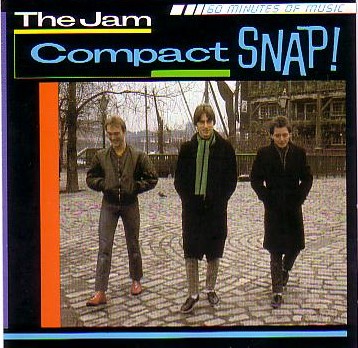
The Jam: Snap!
In 1983, maybe a year or so after the band broke up, I bought a double LP called Snap! by The Jam. Other than my first hearing of Led Zeppelin as a 13-year old and that of Prince's 1999, I hadn't, to that date, been so blown away by a band or an album as I was on first listening to the retrospective of the British trio of Paul Weller (guitar, vocals), Bruce Foxton (bass, backing vocals), and Rick Buckler (drums.)
The twenty-eight song album is a remarkable overview of a band that, in just five years, became a profoundly popular group in its native England, while barely making any impact at all in the United States. Indeed, the only song I'd heard by The Jam (and I listened to radio a lot then and hardly at all since the mid-1980s) was "Town Called Malice," which can occasionally be heard today.
Otherwise, the trio was "too British", it was supposed, to be accepted in America, which only goes to show how pathetic provincialism can be. Snap! is a fantastic album by a great band and led to the purchase and exploration of the group's proper albums, singles, and live recordings.
Many years later, the 5-CD box set, Direction, Reaction, Creation, was purchased and is a great compilation for devoted fans. For those who are interested in The Jam, but don't have the need or desire for such a massive collection, Snap! is a recommended entre to the band.
The first two albums, In the City and This is the Modern World, came out in 1977 while the punk movement was still strong in England, but the band's music was really based more on the mod influences of The Who, The Small Faces, and other British bands, such as The Kinks and, of course, The Beatles, of the mid and late 60s, as well as of Motown-influenced soul and R & B. Then, in 1978, the band hit its stride with the remarkable All The Mod Cons, and an incredible string of singles, some hitting #1 on the U.K. charts, and albums like Setting Sons and Sound Affects showed the band at its apex.
Great songs (all penned by Weller) like "Start;" "That's Entertainment;" "Funeral Pyre;" "A-Bomb in Wardour Street;" "Down in the Tube Station at Midnight;" "The Eton Rifles;" and "Going Underground" were instant classics in England and completely ignored Stateside. As excellent as these were, there were others that, while not as renowned, were also classic songs, including Foxton's "Smithers-Jones" and Weller's "Dreams of Children;" "When You're Young;" "Tales from the Riverbank;" "Thick as Thieves;" "The Butterfly Collector;" "Strange Town;" and a personal favorite, the sublime "Man in the Corner Shop."
While the band's final studio effort, The Gift, was an attempt to change the sound and introduce more R & B, soul, and pop elements, it was not as successful as earlier efforts and Weller was starting to be overwhelmed by success and its attendant pressures. Consequently, in a daring move, he decided to leave the group at its pinnacle and a last tour and the release of the singles "The Bitterest Pill (I Ever Had to Swallow)" and "Beat Surrender" marked the end of The Jam.
Weller went on to form The Style Council, which had a sound that moved firmly into pop territory, albeit with a diverse array of sounds and a continuing interest in politically-informed lyrics and, after a spectacular demise there, went into a solo career in the 90s that brought him greater renown than ever. How many musicians can lay claim to having three successful phases of a career? It's a testament to his abilities as a songwriter.
As to the other members, Buckler and Foxton wrote a bitter book about The Jam, which further widened the existing divide with Weller. Foxton released a solo album not long after The Jam's breakup and then played for 16 years with Stiff Little Fingers. Buckler, who was out of music for years, formed The Gift in 2006 with two other musicians to play The Jam songs. When Foxton joined a year or so later, the group was renamed From The Jam, though Buckler departed in 2009. Though Weller, true to his nature, adamantly refused to consider any reunion with his old bandmates, he did return to speaking terms with Foxton, who, in recent years, has appeared on stage and in the studio with Weller. Buckler and Weller, however, have not spoken all these years. Lately, a project called Foxton has been announced, in which the bassist is working with drummer Mark Brzezicki (from the popular Eighties band Big Country) and vocalist/guitarist Russell Hastings. The record is being made at Weller's studio and he plays on many tracks along with Ray Davies of The Kinks and Steve Cropper of Sixties band Booker T and the MGs.
In any case, you probably cannot find a better career retrospective anywhere than Snap!, which was first released in a 21-song single CD edition and then, later, in a double CD package and a 3-CD special edition. Thirty years will have passed at the end of this year since The Jam dissolved, but so much of their music is still fresh and timeless and Snap! captures the best of it.
Monday, February 6, 2012
Kronos Quartet: Howl, U.S.A.
In 1990, while beginning an immersion with "traditional" classical music, such as that of J. S. Bach, the subject of an earlier post, a dabbling also commenced with the "avant garde" strain, such as that of John Cage and Steve Reich (both of whom will figure subsequently.) The first exposure, though, to "modern" classical was through the remarkable work of Kronos Quartet and their fantastic 1990 album Black Angels. In fact, given the very limited exposure of newer compositions in the concert hall as well as the recording studio compared to that of "traditional" classical, the success of Kronos in building a highly-successful career playing "modern" classical, including many original commissioned works is stunning. Two opportunities to see the quartet live, one at an Orange County junior college and the other at U.C.L.A., are concert-going highlights.
My favorite album from Kronos is Howl, U.S.A., released in 1996. Here the quartet of David Harrington and John Sherba (violins), Joan Jeanrenaud (cello) and Hank Dutt (viola) work with four brilliant works. The first is Michael Dougherty's "Sing Sing: J. Edgar Hoover," which might be good to listen to after watching the recent biopic of the notorious F. B. I. chief. Dougherty used snippets of Hoover speeches over three decades that highlight his obssession with Communism, as directed through such techniques as wiretapping. The title comes from the composer's use of the string quartet as a "singing" complement to the digitally sampled speeches, while the sounds of sirens, machine guns, and patriotic singing add palpably to the piece.
Following is a section of the great Harry Partch's work "Barstow: Eight Hitchhikers' Inscriptions from a Highway Railing at Barstow, California." Partch, also to be covered in this blog later, developed a new system of notation and built his own instruments to create a music that often drew heavily from sounds and themes of the ancient Greek world. Yet, he spent some of his earlier years roaming the country as, essentially, a hobo, riding trains and then using those experiences in pieces like "Barstow." There, he literally used inscriptions from the roadside railing to demonstrate the loneliness, pathos, ironic and dark humor and, even pathetic attempts at finding soulmates that could be found among life's weary travelers, both figuratively and metaphorically. The voice of Ben Johnston is strangely perfect in voicing these all-too-human messages.
Scott Johnson's "Cold War Suite" from How It Happens (The Voice of I. F. Stone) is an apt counterpoint to Daugherty's Hoover piece. Johnson uses a Stone speech, from a 1983 radio address, and a wiretapped voice section, to show the journalist and political philosopher's keen sense of observation, outrage, perspective on history and other qualities in a voice that is ideally suited for Johnson's manipulations with echo and rhythmic repetition. Two of Stone's quotations stand out: the first, that American movies have had more influence on the world than any Marxist/Communist propaganda and, second, that America's military prowess, capped by the acme of the atomic bomb, was unable to prevent the debacle in Vietnam (or Russia's misadventures in Afghanistan (naturally, our recent wars in Iraq and Afghanistan are interesting to examine in this light now.)
Finally, there is "Howl," with music by Lee Hyla and the reading of the famed and notorious "beat" poem rendered by none other than its creator, Allen Ginsberg. As explained by the poet, the work was essentially built upon his feelings concerning America's Cold War-era military buildup and what he saw as a "repressive police bureaucracy." He also, however, added that he hoped "Howl" would bring "a clean Saxon four-letter word" to high school audiences in spite of authoritarian attempts to block such language! Notably, Hyla remarked that the work initially has Kronos performing in a complementary manner to the cadences of Ginsberg's recitation, but then moving independently towards the latter part of the nearly 26-minute piece, as if the two were "telling similar stories in separate ways."
The rendering of "Howl" alone is spectacular, but to have three other impressive pieces that tie-in thematically, while presenting varied musical approaches, makes this album a real masterpiece in "modern" music. Kronos has made many great albums of widely ranging styles, but Howl, U.S.A. stands out as a particularly brilliant concept and presentation.
1. Sing Sing: J. Edgar Hoover 10:40
2. Barstow" Eight Hitchhikers Inscriptions . . . 9:49
3. Cold War Suite from How It Happens . . . 10:35
4. Howl 25:41
Thursday, January 26, 2012
Bill Laswell/Material: Hallucination Engine
Like his frequent collaborator, John Zorn (subject of the last post,) bassist and producer Bill Laswell utterly defies categorization. Unlike anyone else in modern music (though at least one online commentator calls him, without much specificity, "the worst producer" in music), Laswell engages in consistently inventive "mash-ups" with musicians from all over the world, to the point where the performers generally never know on what album the end product will wind up.
Consequently, Laswell's projects are fascinating excursions in the ultimate fusions of sounds and styles from hip-hop, rock, jazz, world and electronic influences. Some of his groups, including Last Exit, Pain Killer, Divination, Method of Defiance and Praxis, are incredible conglomerations that bring together fantastic talent in invariably inspired situations. In other cases, projects might be collaborations with single musicians, such as with ambient mastermind Pete Namlook of FAX Records in the Outland and Psychonavigation series. Then, there are the one-offs or nearly so, like the amazing Tabla Beat Science, bringing together Indian tabla playing with electronic sounds, or the stunning SXL, which brought Korean-style drumming with Western instrumentation on the remarkable Into the Outlands recording. Finally, under the Island-distributed imprint Axiom, started in the late 80s and continuing for several highly-productive years, Laswell spearheaded the release of phenomenal world music recordings that ranged from the traditional to the highly fused (that is, with Western styles and instruments.) Needless to say, with hundreds of albums over the years, he has applied his playing, production, arranging and recombining in mind-blowingly varied ways.
While Laswell proably garnered his earliest attention to most people through his production work on Herbie Hancock's Future Shock album nearly thirty years ago, which garnered the hit record "Rockit," his first notable project was with the New York collective Material. Working in the postpunk environment of the late 70s, starting with the album Temporary Music, the band folded rather quickly, but Laswell, working with Nicky Skopelitis on guitars and synthesizer, reconfigured the ensemble into one that moved easily through genres on subsequent recordings.
In 1994, YHB got the first substantive exposure to Laswell's musical mash-up philosophy with Hallucination Engine, one of the last Axiom recordings. A quick reading of the featured musicians is a marvel: jazz saxophonist Wayne Shorter, reggae drum master Sly Dunbar (a.k.a. Drumbar), oud player and violinist Simon Shaheen, Parliament-Funkadelic stalwarts Bootsy Collins and Bernie Worrell, tabla players Zakir Hussain and Trilok Gurtu, percussionist Aiyb Dieng, and ney player Ali Jihad Racy are just some of the notables. Plus, there is a spoken-word appearance by poet and cut-up theorist William S. Burroughs on the track "Words of Advice," that is worth a listen just for the gravelly world-weary expostulating by Burroughs.
Dub, Indian music, Middle Eastern sounds, funk, jazz, ambient electronica and more make for a truly remarkable musical excursion on Hallucination Engine. It's hard to imagine a recording more eclectic than this one, but with Bill Laswell this smorgasbord of sound is standard operating procedure and his work will be covered extensively in this blog because of the excitement and interest it brings.
Material: Hallucination Engine (Axiom 314-518 351-2, 1994)
1. Black Light, 7:33
2. Mantra, 8:44
3. Ruins (Submutation Dub), 8:54
4. Eternal Drift, 7:35
5. Words of Advice, 3:58
6. Cucumber Slumber (Fluxus Mix), 7:30
7. The Hidden Garden/Naima, 13:00
8. Shadows of Paradise, 9:45
Sunday, January 22, 2012
John Zorn: Kristallnacht
Labeling and classifying music and musicians may or may not be useful or fair, but there are certainly instances where it can be pointless. This is definitely the case with John Zorn, whose long career has been filled with examples of music that defy easy categorization.
In 1990, when exploring various forms of music became a fascination for YHB, Zorn was notorious for the Torture Garden album released under his Naked City project. That recording will be covered here eventually and it was an interesting and remarkable introduction to this fascinating artist.
Later, came Kristallnacht (Night of Broken Glass), recorded in 1992, and comprising the first release in Zorn's Radical Jewish Culture series. Though Jewish, he had not explicitly identified personally with his heritage until about the time of this mind-blowing recording. Kristallnacht is a searing examination into the Nazi-led attack against the Jewish population of several occupied states in 1938 (and in which my future wife's maternal grandparents and other family were entangled in Vienna and from which some escaped and others perished in concentration camps. I also have Jewish ancestry--my grandmother, though mostly Hawaiian, had the maiden name Levy, as her paternal grandfather, the only of his family born outside of what is now Poland, left San Francisco for Honolulu in 1880.)
Sounds of broken glass, white noise, heavy percussion and grinding guitar evoke the horrors of Nazi brutality, while clarinet, trumpet and violin reflect the sadness, grief and contemplation of these actions, and there is plenty else on this amazing recording to show the range of emotions that one cannot get from films, books or other artistic expressions.
The opening track, "Shtetl (Ghetto Life)" intersperses Nazi rally speeches to a gorgeous klezmer or Jewish folk melody in a forceful juxtaposition that lays the groundwork for the evocative work to come. The next piece, "Never Again," uses extreme white noise to capture one emotional and psychological state of mind concerning the topic and Zorn warned that the piece "contains high frequency extremes at the limits of human hearing & beyond, which may cause nausea, headaches & ringing in the ears. Prolonged or repeated listenings is not advisable as it may result in temporary or permanent ear damage." This track lasts nearly 12 minutes and is one manifestation of Zorn's approach to music (and sound) that has made him a controversial figure over his career, but its carefully layered montage of broken glass sounds represents the rioting.
Then, comes to eerie windswept ambience of "Gahelet (Embers)" reflecting the quiet, but not the calm, that followed the violence and destruction with barely audible violin, guitar and radio sounds. Other tracks use some of Zorn's interesting approaches to composition with abrupt changes in styles, tempos and instrumentation, while "Barzel (Iron Fist)" is what it's title implies, a bludgeoning, pummeling piece of guitar, percussion and blaring sirens and noise representing Nazi militarism and terrorism. The last piece, "Gariin (Nucleus—The New Settlement) is most notable for William Winant's inventive percussion and guitarist Marc Ribot's stunning soloing. In fact, Zorn's careful composition and production is enhanced by the masterful playing on this record, including the work of Mark Feldman on violing, Anthony Coleman on keyboards, Mark Dresser on base, David Krakauer on clarinet and bass clarinet, and Frank London on trumpet--all Jewish musicians. The CD booklet has images of a burning synagogue, a glorified statue symbolizing a "Nazi Ideal", a Nazi soldier, and corpses of Jews at Bergen Belsen and excerpts of writings about the rioting and Jewish identity.
Zorn has been quoted as saying that Kristallnacht represented a passionate response to years of denying his Jewish heritage in dealing with the Holocaust. It is truly a visceral, emotional and thought-provoking recording that leaves a real impact on the listener and it defies any attempts at "File Under . . ."
John Zorn: Kristallnacht (Tzadik 7301, 1995)
1. Shtetl (Ghetto Life): 5:51
2. Never Again: 11:41
3. Gahelet (Embers): 3:25
4. Tikkun (Rectification): 3:02
5. Tzfia (Looking Ahead): 8:46
6. Barzel (Iron Fist): 2:01
7. Gariin (Nucleus—The New Settlement): 7:58
Sunday, January 15, 2012
Miles Davis: Bitches Brew
It's difficult enough for a musician or band can move from one era or style or genre of music to another and still maintain relevance and an audience and extremely rare to have it happen twice or three times. But, Miles Dewey Davis III (1926-1991) did something of this order of revolutionary change at least four times. From his 1940s debut in New York playing with Charlie Parker and Dizzy Gillespie during the heady days of the bop movement, to Davis' spearheading of the so-called "Birth of the Cool" nonet recordings of the late 40s, to the "hard bop" of his classic first quintet with John Coltrane, Paul Chambers, Red Garland and Philly Joe Jones to the several big band projects with Gil Evans to the second classic quintet with Herbie Hancock, Wayne Shorter, Tony Williams and Ron Carter and to the electric period, with all of its permutations--this kind of reinvention several times over is simply unique.
There will be a lot to say in future posts about Davis, whose "mercurial" persona on and off stage was nearly as commented upon as his music, but it is hard to think of anything he did that was as controversial and groundbreaking musically as the 1970 album, Bitches Brew. The title was somewhat shocking and the beautiful and eye-catching cover art work also drew much attention, but the music . . . well, there would be much arguing among musicians, fans and, naturally, critics about whether Davis was a revolutionary taking jazz to the only logical place it could go after the "New Thing" or free jazz dominance of the music through the 60s or a sell-out, pandering out to a rock audience to maintain popularity and prosperity. Or, worse, a destroyer of jazz, whose move into the fusion of jazz with rock via an emphasis on amplified electronic instrumentation encouraged the excesses that followed in the 70s (and, maybe even paved the way for the dreaded smooth jazz of later years.)
YHB first heard Bitches Brew about 1984, after dipping a toe into the waters with Davis's current album, Decoy. That latter album and most of the output after the trumpeter's 1981 comeback won't be covered in this blog, excepting the very interesting album Aura, recorded in 1985 and released a few years after that (and the three Davis concerts attended in the late 80s were good, entertaining gigs.) But, the riches of Bitches Brew along with the hearing of In a Silent Way, The Birth of the Cool and Kind of Blue in short order laid the groundwork for future explorations of Davis' work, especially in the last few years, a journey that has yielded a great deal of pleasure in following the many permutations of this master's incredible career.
There is so much to get into when it comes to this album, which was recorded in August 1969 and released eight months later. The solid rhythms laid down by bassists Dave Holland and Harvey Brooks, drummers Lenny White, Don Alias and Jack DeJohnette, and percussionists Alias and Jumma Santos are really essential, as are the grooves by keyboardists Chick Corea, Larry Young and Joe Zawinul, which swirl through and around the music in hypnotic ways. Wayne Shorter, a stalwart of the tenor, plays exclusively on the soprano sax in this recording and does a marvelous job.
But, perhaps the most notable sounds, outside of the leader's work, on this recording, because of their rare appearances in jazz generally at the time and the outstanding playing, are the bass clarinet of Bennie Maupin and guitarist John McLaughlin. Maupin's snaking and curling work are essential to establishing and maintaining the mood of the record and he probably has not received enough credit or attention for that. McLaughlin simply plays remarkably creative and interesting solos, free of grandstanding and attention seeking, but always displaying the restraint and sensitivity that so many technically adept guitarists lack.
As for Davis, "Miles Runs the Voodoo Down" showcases his playing best and, while he was always stereotyped as a middle-register player whose use of emotion and space were more important than his supposed lack of speed and proficiency, he gets plenty of opportunity to show speed, agility, and upper-register playing that belies what many of his critics suggested otherwise. He is also exceptional on the title track and on Shorter's "Sanctuary."
It is also important to mention Zawinul's contribution as the writer of "Pharoah's Dance", even if, as was usually the case with Davis recordings, the leader could and did dramatically change the composition, and the major contributions of producer Teo Macero. Macero assumed greater importance in the electric period because of his assiduous and time-consuming work in editing, more than he had done in previous efforts with Davis in the 60s. The artistry involved was with Macero's ability to take continuously recorded tape from the studio and craft a series of edits in a way to make them appear seemless, or nearly so. The approach of intensive editing may not have always worked so well in other efforts, according to critics, but on Bitches Brew the editing as well as the use of echo, reverb and looping are remarkable. In his autobiography, Davis had tellingly little to say about Macero's involvement in production and elsewhere sometimes diminished his longtime associate's work, but the leader's comments on the liner notes to the Tribute to Jack Johnson album, which was released next after Bitches Brew reveals Davis' debt to the devotion Macero had to creating innovative and important work from the hours and hours of tape from the sessions.
Kind of Blue had been Davis' biggest seller previously, but Bitches Brew actually achieved gold record status (500,000 or more copies), which was the first time a jazz album achieved that pinnacle (though, again, to some it was a decline--in qualitative instead of quantitative terms.) Davis began performing at rock venues, like the Fillmore auditoriums in New York and San Francisco, as well as Carnegie Hall, drew younger white and black crowds and made mindblowing music through his "retirement" in 1975.
This blogger likes music from all eras of Davis' long career--from the Birth of the Cool to Aura and plenty in between and can just as easily listen to Sketches of Spain as Agharta and Milestones as On the Corner and Kind of Blue as Get Up With It. The personnel, instrumentation, and song structures may change, but the unceasing desire for change and the quality of the performances are almost always rewarding in navigating the journey through several decades of Miles Davis' musical explorations, even if Davis' overt need to maintain an audience and keep the cash coming in were obvious. If Bitches Brew was a sellout, it was the most experimental, creative and unlikeliest of hit records imaginable. Kudos to Davis if he could maintain musical integrity and sell albums at the same time--this does not happen all that often.
It's hard to say that Bitches Brew constitutes a favorite album from such a widely varied and extensive career, but it certainly was an important . . . (OK, what is a synonym for milestone?) . . . landmark. It still sounds fresh and inventive over forty years later.
The image above is from the longbox edition of The Complete Bitches Brew Sessions, which is a 4-CD box that has stirred controversy for the inclusion of pieces recorded later in 1969 and early in 1970 from sessions not part of the album recordings, though it may be argued that the spirit of the record continued on to the later work. In any event, these boxes are usually for devoted fans or completists
Saturday, January 14, 2012
King Crimson: Red
In 1984, YHB was fully immersed in the "alternative rock" of the day, from the more popular R.E.M. and U2 to the independent DYI sounds of Hüsker Dü and Minutemen and lots in between. So, when a friend and fellow frequent concertgoer asked about going to see King Crimson do a show at the Greek Theatre in L.A., the answer was an immediate, resounding "NO!"
After all, wasn't King Crimson prog? How uncool and outdated could that be? Disturbing visions ensued of massive stage sets, florid light shows, bizarre costumes, murky concept albums with sidelong suites about fairies and dragons, endless noodling on overwrought keyboard and guitar solos, and on and on, ad inifinitum.
Undaunted, said friend unloaded a set of LPs (remember those massive black things) and begged for a considered listen. And, yes, persistence paid off. The journey through several albums from 1969 to 1984 was a remarkable one.
Actually, with each successive lineup of the ever-changing Crimson, the sounds actually were stripped down and refined further away from the stereotypical "progessive" sound to a leaner, tighter one (ones?) From the legendary debut, In the Court of the Crimson King, and its still-astonishing "21st Century Schizoid Man," to the much-maligned Lizard (1970) and Islands (1971), the riveting power of the 1972-74 lineup and its trio of albums and the surprisingly-successful reconstituted Crimson of the early 1980s, it was obvious that, in its relentless changeability, experimentation, and precision, KC became less of a prog band and operated within its own sphere, separate from anything else in the "rock world."
Guitarist Robert Fripp, who denies being the band's leader, but who has been its sole continuing member and has the patents and copyrights under his own name, has had a clever saying: King Crimson albums are "love letters" and the concerts are "hot dates." Another way of saying that, great as the albums can be, the band is best experienced live. That statement was fully validated by YHB at the June '84 gig at the Greek.
An impressed new fan drove home from LA that night and some albums were quickly acquired and absorbed. Lo and behold, however, KC, again, ceased to exist a month or so later and, so, was left aside in favor of other musical interests. One EP, 1994's Vroom was purchased and enjoyed, but, otherwise, a quarter century went by without any exposure to Crimson, though some aspects of the band's music, especially the 1974 album, Starless and Bible Black, resonated.
So, after 25 years, in Fall 1999, it was decided to give Crimson another go and the focus was the 1972-74 period, a popular one for Crimson fans. What hooked me was the track "The Talking Drum" from 1973's Larks' Tongues in Aspic. The African-style percussion by Jamie Muir, David Cross's keening violin playing, the alternating repetitive triads of bassist John Wetton (he of Asia fame in the early 80s), Bill Bruford's building and hypnotic drumming, and Fripp's Middle Eastern-style guitar playing, in particular, drew me in. It seemed that, while in 1984, my references to Crimson were limited to what I knew of "rock" to that point, the many years since brought exposure to classical, jazz and world music and this helped coalesce my interest in what KC had done over the years. The Starless and Bible Black album featured the amazing closer, Fracture, with Fripp's control, precision and clean tone leading to a thunderous finish. But, it was the final album of that period, Red, released in October 1974, that proved to be the most impressive.
The quartet finished extensive touring with a powerful performance at New York's Central Park on 1 July 1974, after which Cross was fired over Fripp's objections. Already disillusioned with the band's direction and enmeshed in a personal crisis requiring soul searching, the guitarist joined Wetton and Bruford in the studio just a week later to make Red and then informed his colleagues that he was offering no opinions as to the direction of the music.
While these were hardly ideal conditions, if such exist, to make a studio album, the trio, aided by several musicians who had been in Crimson as members or guests (including original member, reed player Ian McDonald, later of Foreigner), created Red, released in October 1974 and which is one of the three essential albums in the Crimson catalog (along with In the Court of the Crimson King and 1981's Discipline.)
The title track is one of the several pieces in the "canon" that are generally held out to be paramount and it is a great piece. Another key song is Providence, a live improvisation with a powerful closing that was edited to a rather abrupt end, and which was recorded in the Rhode Island city of that name, and one of several pieces (a few on Starless and Bible Black) that were included on studio albums, but with audience applause and other concert noise edited out, so that the distinction between studio and live performance was blurred--an interesting effect not often used. Two other songs, Fallen Angel and One Red Nightmare, tend to be downplayed because of the attention give to the others, but Wetton sings well and the band plays tightly. Bruford's use of cymbals on the latter piece is also noteworthy.
The centerpiece, however, and perhaps the greatest song in long history of King Crimson is Starless, a piece Wetton introduced in the Starless and Bible Black session earlier in the year and which was promptly rejected, though it became a live staple later. Persistence paid off, because, when taken up for Red, the song became a stunning display of Wetton's smoky vocals evoking the contemplative and dark lyrics, a long middle section of Fripp's repetitive but hypnotic triad of notes, and a complex and frequently frenetic ending section that, in total, had the band, including McDonald and others, virtually capsulizing the five-year history of Crimson in an exhilirating twelve minute tour de force.
Fripp didn't notify Wetton and Bruford, who both seemed to think that stardom was just around the corner for the band, which was to include McDonald as a permanent member, that he was leaving until later in the year. But, Starless, intended or not, was the ultimate swan song and Red the consummate send-off for a band that was unfairly defined by stereotypical appraisals of progressive rock.
There'll be much more to say here about King Crimson and its long, varied and notable recordings, but Red is about as apt a place to start as any. A 40th Anniversary edition, issued in 2009, has the original album and three bonus tracks (including the full version of Providence) on a CD and a variety of formats and rare 1974 video of the band performing, though in mono, four tracks, including Starless, from a French TV broadcast on a DVD. The mix by Steven Wilson of the band Porcupine Tree is truly outstanding (as all of the series are) and the edition is well worth seeking out for both the superior sound and the video content.
Labels:
Bill Bruford,
John Wetton,
King Crimson,
Red,
Robert Fripp
Tuesday, January 10, 2012
Johann Sebastian Bach: The Well-Tempered Clavier
Where can anyone possibly start when it comes to so-called "classical music," or "serious music," or, even just "music" (as if everything else somehow isn't)? Not only is the chronology extensive, but the arbitrary periods and genres (Early, Baroque, Romantic, Atonal,, Musique Concrete, Minimalist, etc.) are many and vast.
For this fundamentally untutored listener, though, perhaps the earliest experience that had a major impact on my enjoyment of "classical" was Johann Sebastian Bach, first through his violin works, then violcello (cello) pieces, next the organ, and then finally the cembalo or harpsichord. Bach (1685-1750) was actually best known as an organist in his lifetime and his compositions were not given their due until his musical descendants, principally Mozart and Haydn in the later 1700s and then Beethoven, Mendelssohn, Schumann and others, began to use his contrapuntal (counterpoint being the use of two or more harmonically independent voices--the last point, for example, touched upon the polyphony of the Bulgarian female choir music) methods and Bach's reputation as a composer was forever established.
One of Bach's most important works (and there are many, many of them) from the standpoint of the history of music, as well as study and listening enjoyment is The Well-Tempered Clavier, a series two-dozen preludes and fugues ranging from 2 1/2 to over 8 minutes in length. The composer issued his first edition of these pioneering works in 1722, stating that they were "for the advantage and use of all studious ad musical youth as well as for those already attending a university, set up for their special diversion . . ." Though the intent was clearly academic, at least for the publishing of the series, the "special diversion" also falls to untold numbers of listeners, including laypersons like YHB, who simply enjoy the pieces for their beauty, harmonic complexity, and range of styles.
The "well tempered" aspect concerns the tuning of the instrument (harpsichord in Bach's time, the piano in ours) so that the twelve notes contained in an octave are tuned to allow for the playing of all 24 major and minor keys. This greatly expanded the palette of the keyboard for composers and, though Bach was not the first to investigate "pantonal" ideas, his system became paramount for anyone following him, at least until modern (early 20th century) music brought such developments as atonal composition, where keys were jettisoned completely, from such compsoers as Bela Bartok and Igor Stravinsky, and twelve-tone serial work by Arnold Schoenberg and others, and the highly esoteric, but fascinating work of Harry Partch, who had his own notation system based on 43 notes played on his own custom instruments--truly amazing stuff!
Those with limited understandings (such as YHB) can, at least, listen to "early music" first and then that of Bach to hear the greater richness, variety and depth that his contrapuntal ideas generated relative to harmony, usually with three or four voicings in the pieces in The Well-Tempered Clavier, without having to be extensively schooled in the finer technical points.
At any rate, Bach's music is always an excellent place to start, as was the case here, with exploring the world of "classical music." Listening to Bach and other Baroque composers like Antonio Vivaldi, Georg Telemann and Georg Handel and then continuing to later composers like Haydn, Mozart, Beethoven, Mendelssohn, Chopin, Liszt, Brahms and others is an opportunity to see how the early ideas of counterpoint are developed and extended through the 19th century. Then, the explosive contrasts with "modern" 20th-century music becomes, at least for this listener, more understandable, as earlier notions of tuning, modulation, counterpoint, harmony and other aspects are challenged. Even with the limited range of listening of YHB, the journey through the varied aspects of "classical music" has been and continues to be exciting and educational and you don't have to be a music snob to enjoy the trip.
The image shows the cover of a two-CD issue of The Well-Tempered Clavier (or, in this case, The Well-Tempered Piano, even though a harpsichord or cembalo is played) by the German budget label Pilz (love those Pilz and Naxos releases!) in 1989. It's not Glenn Gould or Andras Schiff, but Christiane Jaccottet (1937-1999), a Swiss harpsichordist and professor at the Geneva Conservatory of Music, whose playing is outstanding.
Saturday, January 7, 2012
Village Music of Bulgaria
In 1990, a decision to explore an expanded variety of music led YHB to such avenues as jazz, classical and world music. Each had its many virtues, not the least of which was the opportunity to experience music that broadened the definition of what music was, be it through improvisation, the diversity of instrumentation, a varying approach to scales, rhythms, and time. Each had its many pleasures in discovery, but there was something fundamentally new and exciting for this listener in discovering music from other parts of the world outside the so-called "western tradition." Although certainly elements of jazz and classical, typically denoted the "avant-garde", could push, often forcefully, at that tradition, they were still of it.
With the music of other countries and societies, there awaited the journey to different sounds and concepts. These will be explored often here. It started, actually, with music released on the incomparable imprint "Nonesuch Explorer," a series devoted to world music that was introduced in the 1960s by Elektra Records's off-shoot, Nonesuch Records. In 1990, there was a true cultish phenomenon surrounding one of the Explorer series titles: the exotically named Les Mystére des Voix Bulgares (The Mystery of Bulgarian Voices.) Somehow, the planets aligned or whatever, but there was a groundswell of support from enough of the mainstream for this recording of polyphonal female choral music from Bulgaria, which featured unusual time signatures or meters, backing drones as well as instrumental support, and a clear influence of both Western and Eastern (the Ottoman Turks ruled Bulgaria, for example, for some five centuries) music.
The project was a decade and a half labor of love from French ethnomusicologist Marcel Cellier, who released his recording of the music on his small self-produced label in the mid-1970s. About a decade later, however, British producer Ivo Watts-Russell, impresario of the famed independent label 4AD (of whom more later with the Cocteau Twins), heard the album courtesy of Peter Murphy, the theatrical lead vocalist of the so-called Goth group, Bauhaus, and obtained licensing rights for it. While the 4AD label released the album in the U.K., it was Nonesuch that brought out the record in the U.S.
The choir has been known as the Bulgarian State [Radio and] Television Female Vocal Choir, though now officially changed to Les Mystére des Voix Bulgares to capitalize on their late 1980s/early 1990s fame, formed in 1952 when Bulgaria was fully controlled by a Soviet-allied Communist government. After the release of the first Les Mystére album, others followed, including a second volume that won a Grammy in 1990 for "Best Traditional Folk Recording." Strong sales, critical acclaim, and the right marketing and promotional approach led to world tours. This listener saw the choir perform at Royce Hall at UCLA in the early Nineties and it was a definite concert highlight.
The polyphony or diaphonic singing refers to harmonies by two, or sometimes three, parts of the choir simultaneously, though the harmonies appear dissonant and include jubilant cries, shouts and yelps, stunning glissandos, and, sometimes energetic support from several acoustic string, woodwind and percussion instruments, though the singing is often a capella.
Actually, the term "folk music" is misleading when it comes specifically to the Les Mystére organization, which came in the early 1950s with a decided orchestrated and arranged element imposed on the folk origins from rural Bulgaria. Still, the effects were breathtaking on record (for the most part--much debate issued with the From Bulgaria with Love recording and its pop-disco renderings, much less its cover with a long-barreled revolver pointed at one of the costumed choir members, in what appeared to be a reference to James Bond [?!]) and in concert.
So, this listing highlights a CD pairing of two 1960s LP releases by Nonesuch that gives, perhaps, a more "natural" rendering of Bulgarian folk music. These albums are A Harvest, a Shepherd, a Bride: Village Music of Bulgaria and In the Shadow of the Mountain: Bulgarian Folk Music, with these denoted on the CD case spine as Village Music of Bulgaria. This 1988 release is a gem--not as modern and splashy as Les Mystére and less overly choral and more focused on solos, duos and trios as well as instrumental pieces, but still having all of the entrancing elements of Bulgarian folk music and singing.
There are twenty-five titles (12 on the former and 13 the latter) in Bulgarian, so a track listing will be omitted here. Needless to say, anyone looking for a little adventure in either choral music or folk instrumental playing can hardly go wrong with this magnificent music.
Subscribe to:
Posts (Atom)