This is another great Lyrichord world music release, featuring the masterful Lily Yuan on the yangqin, a hammered dulcimer or zither. The liner notes explain that what distinguishes the instrument from similar ones in other parts of the world is the use of bamboo hammers or beaters that provide a much different range of timbre and dynamics.
The word yangqin means "foreign stringed instrument," and it is likely, the notes continue, that it migrated from Persia, where it is known as the santur (other posts on this blog have highlighted Persian recordings including that instrument.) Interestingly, the yangqin has only in recent decades been utilized as a solo instrument, as on this album, because it has traditionally been used to accompany other instruments in ensemble or vocalists.
Yuan was raised in Shanghai and was a child prodigy performing frequently on television and radio and, at 11, entered a major music conservatory in Beijing and performed for such dignataries as President Carter, among many others. She studied in Shanghai and joined the faculty of the music conservatory there. She later received a master's degree in music from the University of Toronto and began performing widely in North America. For years, she worked and taught on the East Coast of the U.S., but is now based in Irvine, California, teaching the yangqin and piano.
The nine pieces on this amazing recording feature Yuan's remarkable abilities, not just technically (although her abilities here are stunning), but also in evoking emotional range. The performances reflect the very long historical traditions of classical Chinese music and the resonant tones on the yangqin provide a depth and shimmering quality that brings the pieces beautifully to life.
No criticism, no reviews, no file sharing, just appreciation, on the basic premise that music is organized sound and from there comes a journey through one listener's library. Thanks for stopping in and hope you enjoy!
Thursday, March 29, 2018
Tuesday, March 27, 2018
Unknown Instructors: The Way Things Work
It was really great to find that Mike Watt and George Hurley, the propulsive and creative rhythm section of the great 80s band Minutemen and then the underrated and excellent Firehose, reteamed for a new project in 2003 called Unknown Instructors.
The duo wer teamed with guitarist Joe Baiza, another veteran of the South Bay punk scene, and poet Dan McGuire, who spearheaded the project on his own dime after a long friendship with Watt, along with guest Jack Brewer, Baiza's bandmate in Saccharine Trust. The band recorded The Way Things Work in a single marathon session at a San Pedro studio in August 2003 with Baiza and McGwire producing the album for Chicago-based Smog Veil Records, which released the album a little over two years later.
McGuire's poetry is very evocative, providing fascinating vignettes of gritty street life (he's from Toledo, an old industrial city), unusual and puzzling situations, and a delivery that is filled with irony and a world-weary tone. Behind him, Baiza plays trebly meandering lines and riffs and McGuire has said he put together the band and recruited Watt and Hurley so the guitarist could burst out with high energy playing, which didn't really happen on the record, but it was, after all, a one-day improvisational experiment.
Watt, a master at accompaniment, lays down solid grooves and interpolations in his distinctive fashion, and Hurley keeps things moving briskly by ranging through his kit with strength and a tasty range of color and texture on the traps, cymbals and bass drums. On his tracks, Brewer's voice projects a trembly fragility and, interestingly, a sense of lightness even with the dark matter of the poetry.
Even as a first-take experiment melding poetry and improvised music that was channeled in a different and more effective way on the band's second album, The Master's Voice (look for it in a future post), The Way Things Work does work pretty well, embodying what Baiza has referred to as the "sentiment and the spirit" of the exploration of punk rock, even as it sounds very different from common expectations of what that should be.
The duo wer teamed with guitarist Joe Baiza, another veteran of the South Bay punk scene, and poet Dan McGuire, who spearheaded the project on his own dime after a long friendship with Watt, along with guest Jack Brewer, Baiza's bandmate in Saccharine Trust. The band recorded The Way Things Work in a single marathon session at a San Pedro studio in August 2003 with Baiza and McGwire producing the album for Chicago-based Smog Veil Records, which released the album a little over two years later.
McGuire's poetry is very evocative, providing fascinating vignettes of gritty street life (he's from Toledo, an old industrial city), unusual and puzzling situations, and a delivery that is filled with irony and a world-weary tone. Behind him, Baiza plays trebly meandering lines and riffs and McGuire has said he put together the band and recruited Watt and Hurley so the guitarist could burst out with high energy playing, which didn't really happen on the record, but it was, after all, a one-day improvisational experiment.
Watt, a master at accompaniment, lays down solid grooves and interpolations in his distinctive fashion, and Hurley keeps things moving briskly by ranging through his kit with strength and a tasty range of color and texture on the traps, cymbals and bass drums. On his tracks, Brewer's voice projects a trembly fragility and, interestingly, a sense of lightness even with the dark matter of the poetry.
Even as a first-take experiment melding poetry and improvised music that was channeled in a different and more effective way on the band's second album, The Master's Voice (look for it in a future post), The Way Things Work does work pretty well, embodying what Baiza has referred to as the "sentiment and the spirit" of the exploration of punk rock, even as it sounds very different from common expectations of what that should be.
Saturday, March 24, 2018
Miles at the Fillmore: Miles Davis 1970: The Bootleg Series Vol. 3
The "Bootleg Series" of live recordings by Miles Davis and various ensembles, now comprising six volumes, released by Sony Music ranging from the mid-1950s to the mid-1970s, can be viewed, on one hand, as an attempt to mine the vaults for further product and trade off the legacy of the legendary trumpeter, bandleader, and mercurial figure.
Conversely, fans see these, variably, as valuable additions to his discography in which concert performances, much of which was previously unreleased (or, if so, were heavily edited) demonstrate the remarkable interplay and sonic power of the Dark Magus' groups over a radically changing period. After all, no figure in jazz morphed musically (and sartorially) so memorably without compromising his integrity as Davis.
This third volume of performances at the Fillmore East in New York, with some additions of parts of gigs at the companion venue, the Fillmore West, in San Francisco, is amazing, not just for the often-blistering, pounding, and soaring work done by a stunning band, but, because of the context.
Davis agreed to play shows at the historic rock venues, owned by impresario Bill Graham, as a vehicle to get his music out to younger people. This was a very shrewd move, given the massive decline of interest by those folks in jazz from the mid-Sixties onward, but it also exposed him to often cockeyed criticism that he was selling out (yes, that 26-minute version of "Bitches Brew" on the album of the same name was the easiest way to crack the Top Ten.)
It is strange to note that Davis opened (yes, OPENED) for Laura Nyro, Steve Miller, and Neil Young and Crazy Horse, at some of these shows. From a purely commercial perspective, it was obviously necessary (at least to Graham), but artistically, it was clear that, good as all of those performers were, Miles and his band were masters (including technically and in innovation in sound) way above the levels of the headliners.
In any case, here are staggering performances of classics of the Bitches Brew era, with the title track, "It's About That Time," and "Spanish Key" complemented by "Directions," standout from the mid-Sixties quintet, and other tunes from earlier incarnations (including strange truncated verions of "I Fall in Love Too Easily," added, perhaps, as brief quiet interludes to the bubbling cauldron of intense electric sound otherwise served piping hot to the mostly white, young audiences.)
There was a two-LP (or CD) album released by Columbia at the time, but it was heavily and interestingly edited by producer Teo Macero. The full pieces are restored in this edition, handled by noted producer Michael Cuscuna and Richard Seidel (whose detailed liners with great photos are also great to have.) The San Francisco performances, from April, included young sax player Steve Grossman, Chick Corea on electric piano, Airto Moreira on a variety of percussion instruments (cool additions of texture and color), Dave Holland on bass, and Jack DeJohnette on drums.
This was a great band, though Grossman, who was 19, was criticized for overabundance in his playing. But, then, for the June shows in New York, Keith Jarrett was brought in on electric organ (heard through the right channel, where Corea was in the left) and his prodigious talents added to those of the remarkable Corea (the great ensemble Circle morphed from this pairing) to really enhance the sound of this unbeatable ensemble.
Miles' electric period is the favorite of this blogger, though all periods are valued for various reasons, and this 4-CD deep digging into live performance of an astounding group is really a revelation.
Conversely, fans see these, variably, as valuable additions to his discography in which concert performances, much of which was previously unreleased (or, if so, were heavily edited) demonstrate the remarkable interplay and sonic power of the Dark Magus' groups over a radically changing period. After all, no figure in jazz morphed musically (and sartorially) so memorably without compromising his integrity as Davis.
This third volume of performances at the Fillmore East in New York, with some additions of parts of gigs at the companion venue, the Fillmore West, in San Francisco, is amazing, not just for the often-blistering, pounding, and soaring work done by a stunning band, but, because of the context.
Davis agreed to play shows at the historic rock venues, owned by impresario Bill Graham, as a vehicle to get his music out to younger people. This was a very shrewd move, given the massive decline of interest by those folks in jazz from the mid-Sixties onward, but it also exposed him to often cockeyed criticism that he was selling out (yes, that 26-minute version of "Bitches Brew" on the album of the same name was the easiest way to crack the Top Ten.)
It is strange to note that Davis opened (yes, OPENED) for Laura Nyro, Steve Miller, and Neil Young and Crazy Horse, at some of these shows. From a purely commercial perspective, it was obviously necessary (at least to Graham), but artistically, it was clear that, good as all of those performers were, Miles and his band were masters (including technically and in innovation in sound) way above the levels of the headliners.
In any case, here are staggering performances of classics of the Bitches Brew era, with the title track, "It's About That Time," and "Spanish Key" complemented by "Directions," standout from the mid-Sixties quintet, and other tunes from earlier incarnations (including strange truncated verions of "I Fall in Love Too Easily," added, perhaps, as brief quiet interludes to the bubbling cauldron of intense electric sound otherwise served piping hot to the mostly white, young audiences.)
There was a two-LP (or CD) album released by Columbia at the time, but it was heavily and interestingly edited by producer Teo Macero. The full pieces are restored in this edition, handled by noted producer Michael Cuscuna and Richard Seidel (whose detailed liners with great photos are also great to have.) The San Francisco performances, from April, included young sax player Steve Grossman, Chick Corea on electric piano, Airto Moreira on a variety of percussion instruments (cool additions of texture and color), Dave Holland on bass, and Jack DeJohnette on drums.
This was a great band, though Grossman, who was 19, was criticized for overabundance in his playing. But, then, for the June shows in New York, Keith Jarrett was brought in on electric organ (heard through the right channel, where Corea was in the left) and his prodigious talents added to those of the remarkable Corea (the great ensemble Circle morphed from this pairing) to really enhance the sound of this unbeatable ensemble.
Miles' electric period is the favorite of this blogger, though all periods are valued for various reasons, and this 4-CD deep digging into live performance of an astounding group is really a revelation.
Tuesday, March 20, 2018
Mustafa al Sunni: Songs of the Sudan
This fantastic Nimbus Records release features the music of Sudanese oud master and singer Mustafa al Sunni. Accompanied by percussionist Abd al Haziz Karar, whose work is sensitive and subtle, but highly effective, al Sunni plays his instrument with great skill and variety, while his keening vocals are beautifully done.
The liner notes do a great job of providing historical context for the music of this nation that has been rent apart by factional fighting for so many years, an irony given the many references in the essay to the wide-ranging influences in the music from many parts of northern and central Africa and beyond. The narrowed focus of political factions has so little to do with the long tradition of musical elements that are imported and absorbed into existing local ones.
Also noteworthy are the lyrics and the emphasis on poetry, whether the songs are traditional turath, or those passed down through generations, praise songs called savra that talk about the bravery of warriors, or hagiba, classical pieces with the most intent poetic lyrics. The intensity of these can be read in the translations provided in the notes.
Hearing the nimble playing of the oud, the excellent percussive accompaniment and the yearning singing and then thinking of the horrors that have emerged from the Sudan over recent decades, this recording is a reminder of how the music of Mustafa al Sunni represents a part of his nation's heritage and traditions that hopefully will survive the terror and turmoil.
The liner notes do a great job of providing historical context for the music of this nation that has been rent apart by factional fighting for so many years, an irony given the many references in the essay to the wide-ranging influences in the music from many parts of northern and central Africa and beyond. The narrowed focus of political factions has so little to do with the long tradition of musical elements that are imported and absorbed into existing local ones.
Also noteworthy are the lyrics and the emphasis on poetry, whether the songs are traditional turath, or those passed down through generations, praise songs called savra that talk about the bravery of warriors, or hagiba, classical pieces with the most intent poetic lyrics. The intensity of these can be read in the translations provided in the notes.
Hearing the nimble playing of the oud, the excellent percussive accompaniment and the yearning singing and then thinking of the horrors that have emerged from the Sudan over recent decades, this recording is a reminder of how the music of Mustafa al Sunni represents a part of his nation's heritage and traditions that hopefully will survive the terror and turmoil.
Sunday, March 18, 2018
Wolfgang Amadeus Mozart: The Magic Flute
It never gets old listening to the remarkable music of Mozart, especially because of the great variety of his output, the brilliance of his compositions, and the range of emotional, humorous and series content that can be found in his work. Whether it involves string quartets, symphonies, operas or whatever other form, Mozart's music is uniformly mindboggling.
The Magic Flute was the master's last opera and was still running in performance at Vienna when Mozart died in 1791 at age 35. The popularity of German magic operas was at a peak at the time and the composer worked with a theater manager and director to mount the story.
It involved a Queen of the Night enlisting a prince to rescue her daughter from a high priest, though it turned out that the priest was actually leading a respectable and honorable order and the queen was evil and trying to regain control of her daughter. A simple man accompanying the prince fails in a series of trials during the quest but is compensated with the love of a woman.
Mozart's masterful melding of instrumentation, massing and use of harmony and melody, with the voices is, even for this amateur, something to behold. Yet, the opera is well-known for its extraordinary difficulty for vocalists because of the challenging ranges required. From the outset, The Magic Flute was a resounding success and the composer attending many performances, registering his pride in the reception, though his death soon followed.
This recording, made in June 1993 in Budapest by the Failoni Orcehstra, conducted by Michael Halász, and the Hungarian Festival Chorus, is beautifully recorded and performed and the Naxos Records release is a pleasure to listen to.
The Magic Flute was the master's last opera and was still running in performance at Vienna when Mozart died in 1791 at age 35. The popularity of German magic operas was at a peak at the time and the composer worked with a theater manager and director to mount the story.
It involved a Queen of the Night enlisting a prince to rescue her daughter from a high priest, though it turned out that the priest was actually leading a respectable and honorable order and the queen was evil and trying to regain control of her daughter. A simple man accompanying the prince fails in a series of trials during the quest but is compensated with the love of a woman.
Mozart's masterful melding of instrumentation, massing and use of harmony and melody, with the voices is, even for this amateur, something to behold. Yet, the opera is well-known for its extraordinary difficulty for vocalists because of the challenging ranges required. From the outset, The Magic Flute was a resounding success and the composer attending many performances, registering his pride in the reception, though his death soon followed.
This recording, made in June 1993 in Budapest by the Failoni Orcehstra, conducted by Michael Halász, and the Hungarian Festival Chorus, is beautifully recorded and performed and the Naxos Records release is a pleasure to listen to.
Saturday, March 17, 2018
Sandoz: Dark Continent
After the dissolution of Cabaret Voltaire in 1994, after twenty years of some of the most adventurous and compelling electronic music around, Richard H. Kirk threw himself into a prodigious period of work, releasing many recordings under a panoply of nom de plumes.
One that he'd started in CV's last phase of work and then expanded on afterward was Sandoz, launched in 1992 and named for the Swiss pharmaceutical laboratory where LSD was developed in the late 1930s. There have been several Sandoz releases over the years and Dark Continent, which came out in 1996 on tJon Wonzencroft's great Touch label, is a particular favorite. The album is culled from two sessions, starting with a six-song extended play that appeared in 1993 and then another quartet of pieces recorded three years later for the CD release.
Sandoz has strong elements of African rhythm and percussion, as well as reggae and dub touches (a Sandoz album, the excellent Chant to Jah, was devoted to the latter) layered in with often lush electronic sounds. Dark Continent is a very consistent recording in terms of the quality of the pieces which always manage to provide distinctive aural touches among the steady repetition of rhythms and beats.
In late 2016, Mute Records issued a box set of Sandoz recordings from 1992-1994 including a remastered version of Dark Continent, the original of which has long been out of print and can be hard to find. That set and a larger collection of Kirk solo work issued at the same time provide a great overview of the work of a prolific and diverse artist using electronic musical resources to always compelling effect.
One that he'd started in CV's last phase of work and then expanded on afterward was Sandoz, launched in 1992 and named for the Swiss pharmaceutical laboratory where LSD was developed in the late 1930s. There have been several Sandoz releases over the years and Dark Continent, which came out in 1996 on tJon Wonzencroft's great Touch label, is a particular favorite. The album is culled from two sessions, starting with a six-song extended play that appeared in 1993 and then another quartet of pieces recorded three years later for the CD release.
Sandoz has strong elements of African rhythm and percussion, as well as reggae and dub touches (a Sandoz album, the excellent Chant to Jah, was devoted to the latter) layered in with often lush electronic sounds. Dark Continent is a very consistent recording in terms of the quality of the pieces which always manage to provide distinctive aural touches among the steady repetition of rhythms and beats.
In late 2016, Mute Records issued a box set of Sandoz recordings from 1992-1994 including a remastered version of Dark Continent, the original of which has long been out of print and can be hard to find. That set and a larger collection of Kirk solo work issued at the same time provide a great overview of the work of a prolific and diverse artist using electronic musical resources to always compelling effect.
Tuesday, March 13, 2018
Marilyn Crispell: Live in San Francisco
With John Coltrane's A Love Supreme as the spiritual inspiration and Cecil Taylor as a aesthetic catalyst, among other influences, Marilyn Crispell took her supremely gifted playing from the formalism of her training at the New England Conservatory to the improvisatory heart and soul of the pinnacle of jazz piano.
This Music and Arts Programs of America release is largely from a concert in San Francisco in October 1989 and demonstrated Crispell's talent for creative explorations of the instrument through her originals, as well as a highly personal interpretation of classic standards. As a great bonus, excerpts from Crispell's duet performance with the great Anthony Braxton, with whom she played for several years, at a live performance at Vancouver, and a Knitting Factory in New York concert with Reggie Workman (featuring a young Don Byron on clarinet) are also included.
The first two numbers, "Penumbra" and "Zipporah" are excellent examples of how Crispell plays with spiritual and rhythmic emphasis in her original pieces. She is not just a clone of Taylor, though the influence is very clear. Crispell speed, intensity and precision are also tied in to a heightened sense of off-kilter melodic feeling with a nod to Thelonious Monk, whose "Ruby, My Dear" is covered beautifully and distinctively, as is a great rendition of Coltrane's "Dear Lord." In the notes, Crispell pays homage to Braxton and his ideas of "using space and silence as much as sound, and using different textures." Her take of the old chestnut, "When I Fall in Love" is breathtaking as she adds so much to the standard with her sense of rhythm and juxtaposition of complex chordal voicings.
And, the additional 15 or so minutes of her work with Braxton and Workman show just how sensitive and distinctiveness an accompanist she can be, whether in the duet form with the former or the sextet, including the remarkable vocalist Jeanne Lee (check her on Archie Shepp's Blase album from 1969 on BYG Actuel). Live in San Francisco is a tremendous showcase of Crispell's artistry in all of its multidimensional aspects.
This Music and Arts Programs of America release is largely from a concert in San Francisco in October 1989 and demonstrated Crispell's talent for creative explorations of the instrument through her originals, as well as a highly personal interpretation of classic standards. As a great bonus, excerpts from Crispell's duet performance with the great Anthony Braxton, with whom she played for several years, at a live performance at Vancouver, and a Knitting Factory in New York concert with Reggie Workman (featuring a young Don Byron on clarinet) are also included.
The first two numbers, "Penumbra" and "Zipporah" are excellent examples of how Crispell plays with spiritual and rhythmic emphasis in her original pieces. She is not just a clone of Taylor, though the influence is very clear. Crispell speed, intensity and precision are also tied in to a heightened sense of off-kilter melodic feeling with a nod to Thelonious Monk, whose "Ruby, My Dear" is covered beautifully and distinctively, as is a great rendition of Coltrane's "Dear Lord." In the notes, Crispell pays homage to Braxton and his ideas of "using space and silence as much as sound, and using different textures." Her take of the old chestnut, "When I Fall in Love" is breathtaking as she adds so much to the standard with her sense of rhythm and juxtaposition of complex chordal voicings.
And, the additional 15 or so minutes of her work with Braxton and Workman show just how sensitive and distinctiveness an accompanist she can be, whether in the duet form with the former or the sextet, including the remarkable vocalist Jeanne Lee (check her on Archie Shepp's Blase album from 1969 on BYG Actuel). Live in San Francisco is a tremendous showcase of Crispell's artistry in all of its multidimensional aspects.
Monday, March 12, 2018
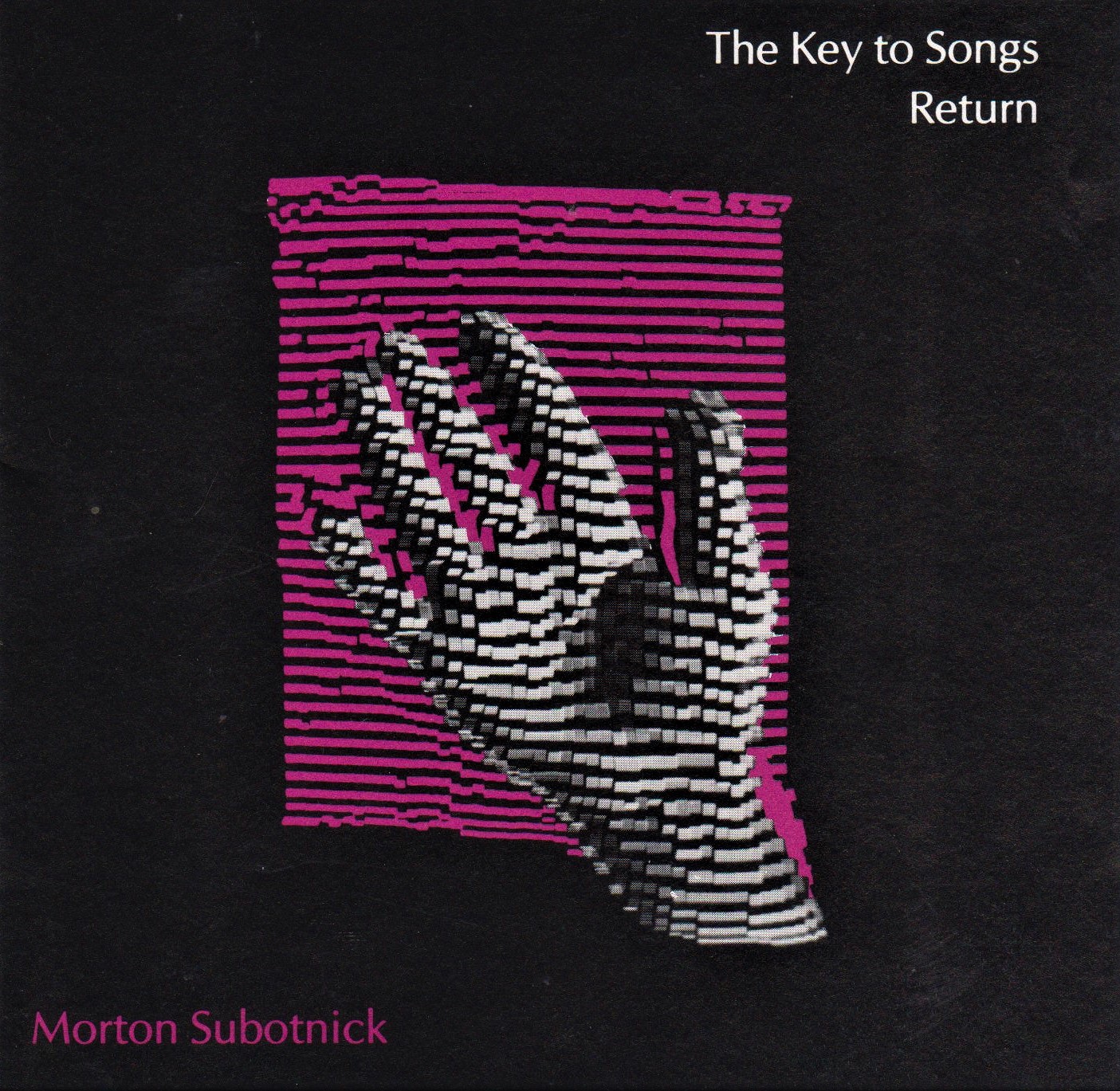
Morton Subotnick: The Key to Songs/Return
A native of Los Angeles, Morton Subotnick is a remarkable composer who works with electronics in highly compelling and very interesting ways. Subotnick is best known for his 1968 work, Silver Apples of the Moon, which was celebrated in Los Angeles recently on the 50th anniversary of the landmark piece. While attention is rightly being given to Silver Apples as a seminal piece of electronic music, this post looks at Subotnick's mid-1980s works, The Key to Songs and Return —A Triumph of Reason, which are amazing works, released on New Albion Records, which has released so much great modern music, utilizing YCAMS, the Yamaha Computer Assisted Music System, with the latter completely generated through that means, while the former utilizes that with acoustic instrumentation.
The Key to Songs comprises, the liners recount, "music for an imaginary ballet" based on a pictorial collage novel by surrealist painter Max Ernst, with one of the chapters labeled "The Key to Songs."
Subotnick uses two pianos, marimba, xylophone, vibraphone, viola and cello along with YCAMS to generate a dramatic and often frenetic score that mimics Ernst's collages, which are said to be dramatic, often erotic and playing with the line between reality and fantasy. Based solely on listening to the music, the latter point is notable in that telling acoustic from electronic instrumentation can be somewhat challenging. The composer even wrote instructions for the musicians to exaggerate their movements so audiences could tell the difference. The piece is dynamic and hypnotic.
Return was a commission to mark the appearance of Halley's Comet in February 1986 (it had last been seen in April 1910 and is predicted to return in July 2061). Comets were believed in ancient days to the harbinger of ruin and destruction on one hand and the auspicious indicator of great benefit on the other. Edmund Halley, in 1705, determined that a comet seen twenty-three years before would return about every 75 years. Subotnick's score "depicts the comet's passage through time" and the first part reflecting the era to 1758 when the comet's return was given Halley's name and the second for the period after that and to the future. The computer-generated music reflects music heard in the mid-1700s, specifically the work of Baroque composer Domenico Scarlatti and then quiet, contemplative passages alternate with the dymanic, intense bursts of sound marking the onset of the comet and "the triumph of reason" in Halley's work. In the second part, he evokes 18th and 19th century music (Mozart and Liszt), then ragtime for 1910, and electronic sounds for the current and future periods.
Computer and electronic music is often denounced for being cold and emotionless, but here are two fascinating recordings that show how these types can be skillfully blended with acoustic instruments to provide richness or depth or, on its own, created to bring a richness and diversity that belies that criticism. This recording is an ear-opening exploration into the possibillites of electronic music as evocative in ways it is accused of not being.
The Key to Songs comprises, the liners recount, "music for an imaginary ballet" based on a pictorial collage novel by surrealist painter Max Ernst, with one of the chapters labeled "The Key to Songs."
Subotnick uses two pianos, marimba, xylophone, vibraphone, viola and cello along with YCAMS to generate a dramatic and often frenetic score that mimics Ernst's collages, which are said to be dramatic, often erotic and playing with the line between reality and fantasy. Based solely on listening to the music, the latter point is notable in that telling acoustic from electronic instrumentation can be somewhat challenging. The composer even wrote instructions for the musicians to exaggerate their movements so audiences could tell the difference. The piece is dynamic and hypnotic.
Return was a commission to mark the appearance of Halley's Comet in February 1986 (it had last been seen in April 1910 and is predicted to return in July 2061). Comets were believed in ancient days to the harbinger of ruin and destruction on one hand and the auspicious indicator of great benefit on the other. Edmund Halley, in 1705, determined that a comet seen twenty-three years before would return about every 75 years. Subotnick's score "depicts the comet's passage through time" and the first part reflecting the era to 1758 when the comet's return was given Halley's name and the second for the period after that and to the future. The computer-generated music reflects music heard in the mid-1700s, specifically the work of Baroque composer Domenico Scarlatti and then quiet, contemplative passages alternate with the dymanic, intense bursts of sound marking the onset of the comet and "the triumph of reason" in Halley's work. In the second part, he evokes 18th and 19th century music (Mozart and Liszt), then ragtime for 1910, and electronic sounds for the current and future periods.
Computer and electronic music is often denounced for being cold and emotionless, but here are two fascinating recordings that show how these types can be skillfully blended with acoustic instruments to provide richness or depth or, on its own, created to bring a richness and diversity that belies that criticism. This recording is an ear-opening exploration into the possibillites of electronic music as evocative in ways it is accused of not being.
Sunday, March 11, 2018
Paco Peña & Eduardo Falú: Encuentro
This 1989 Nimbus Records release features the stellar talents of Argentinian guitarist and singer Eduardo Falú and Spanish flamenco guitarist Paco Peña, whose work has been highlighted here before.
Encuentro is a fine encounter between two maestros from different countries and generations, but whose artistry with the Spanish guitar is brought together beautifully. The fourteen tracks on the album feature four with FalĂş as sole or part composer and three that feature his rich, evocative vocalizations. These latter seemed clearly sequenced to provide breaks amid the instrumental pieces and they do that job quite well.
There are times when liner notes provide great background information on the performers, pieces, instruments and musical traditions and there are others in which they are well-intended, but not particularly informative and can be paeans to the performers that lay it on a bit a too thick.
That is the case with Félix Grande's tribute to Falú and Peña--the words "mankind" and "arts" are capitalized; musical instruments "affirm human and divine truths"; and we are entreated to listen to the music "as if it were the mysterious turns of the wheels of our destiny." There's much more, but the examples give plenty of an indication of Grande's expansive (get it?) essay's thrust.
Falú who had a distinguished career spanning some sixty years died in Buenos Aires five years ago at age 90, while Peña, now in his mid-seventies, released his last album four years ago but is still active with upcoming shows in London, Hong Kong and Pudong, China. Encuentro is a gorgeous album, melding approaches from a common background with signature personal touches.
Encuentro is a fine encounter between two maestros from different countries and generations, but whose artistry with the Spanish guitar is brought together beautifully. The fourteen tracks on the album feature four with FalĂş as sole or part composer and three that feature his rich, evocative vocalizations. These latter seemed clearly sequenced to provide breaks amid the instrumental pieces and they do that job quite well.
There are times when liner notes provide great background information on the performers, pieces, instruments and musical traditions and there are others in which they are well-intended, but not particularly informative and can be paeans to the performers that lay it on a bit a too thick.
That is the case with Félix Grande's tribute to Falú and Peña--the words "mankind" and "arts" are capitalized; musical instruments "affirm human and divine truths"; and we are entreated to listen to the music "as if it were the mysterious turns of the wheels of our destiny." There's much more, but the examples give plenty of an indication of Grande's expansive (get it?) essay's thrust.
Falú who had a distinguished career spanning some sixty years died in Buenos Aires five years ago at age 90, while Peña, now in his mid-seventies, released his last album four years ago but is still active with upcoming shows in London, Hong Kong and Pudong, China. Encuentro is a gorgeous album, melding approaches from a common background with signature personal touches.
Saturday, March 10, 2018
Dave Van Ronk: The Folkways Years, 1959-1961
This amazing album documents a short period of time, 1959 to 1961, when Dave Van Ronk recorded for Moses Asch's Folkways label, and there's a great deal of remarkable guitar playing and singing by a man who insisted he was not a folk singer, but a jazz singer.
Undoubtedly, Van Ronk was heavily indebted to black musicians, including blues, jazz and gospel artists including Jelly Roll Morton, Blind Lemon Jefferson, Bessie Smith, and the Reverend Gary Davis, and it is great to have his recollections about those years generally and the songs on the record specifically. He writes with great humor and irony, as well as affection for his influences and confederates.
He also was quite honest, noting that, with "River, She Come Down," the tune was "the only song I ever wrote that made me any money, and I hate it." He considered the piece "as a guitar exercise" with lyrics consisting of "nonsensical doggerel." But when Peter, Paul and Mary covered the tune, renamed "Bamboo," for their debut album, it "sold seven trillion copies." Still, Van Ronk concluded, "I shared the royalties (and the chagrin)" with Dick Weissman, who came up with the chorus.
While Van Ronk also offered that he should have waited a year or two before recording the pieces and thought of the work "as a journeyman's progress report" who "starting to get the hang of it," the album is filled with some excellent fret work, distinctive singing, and potent mixtures of humor and activism. It wasn't more than a few years before folk was passed by in favor of rock (note Van Ronk's friend Bob Dylan's decision to go electric in 1965) and Van Ronk became something of a forgotten figure, though he remained active until his death in 2002 at age 65.
This album, though, is a potent reminder of what an immensely talented musician Dave Van Ronk was and it's great that the Smithsonian put this together after its absorption of the Folkways inventory.
Undoubtedly, Van Ronk was heavily indebted to black musicians, including blues, jazz and gospel artists including Jelly Roll Morton, Blind Lemon Jefferson, Bessie Smith, and the Reverend Gary Davis, and it is great to have his recollections about those years generally and the songs on the record specifically. He writes with great humor and irony, as well as affection for his influences and confederates.
He also was quite honest, noting that, with "River, She Come Down," the tune was "the only song I ever wrote that made me any money, and I hate it." He considered the piece "as a guitar exercise" with lyrics consisting of "nonsensical doggerel." But when Peter, Paul and Mary covered the tune, renamed "Bamboo," for their debut album, it "sold seven trillion copies." Still, Van Ronk concluded, "I shared the royalties (and the chagrin)" with Dick Weissman, who came up with the chorus.
While Van Ronk also offered that he should have waited a year or two before recording the pieces and thought of the work "as a journeyman's progress report" who "starting to get the hang of it," the album is filled with some excellent fret work, distinctive singing, and potent mixtures of humor and activism. It wasn't more than a few years before folk was passed by in favor of rock (note Van Ronk's friend Bob Dylan's decision to go electric in 1965) and Van Ronk became something of a forgotten figure, though he remained active until his death in 2002 at age 65.
This album, though, is a potent reminder of what an immensely talented musician Dave Van Ronk was and it's great that the Smithsonian put this together after its absorption of the Folkways inventory.
Friday, March 9, 2018
The Original James P. Johnson, 1942-1945: Piano Solos
Here's a stellar Smithsonian Folkways release of solo piano recordings from the mid-1940s of the breathtaking James P. Johnson (well, except, according to an AllMusic review by Scott Yanow, for two tunes by Cliff Jackson, who went uncredited.) That still leaves plenty of classic stride piano playing by a man whose life bridged ragtime and jazz.
Recorded for Moses Asch and his Folkways Records label during the war years of 1942-1945, the album is filled with great melodicism, the left hand "striding" between the bass region and chordal playing, gorgeous fills and other elements. Stride piano playing is known to be technically challenging, but Johnson make it sound so easy with his smooth precision.
There are so many stunning moments on this album that it's hard to highlight particular songs and the range of pieces, from Joplin to Gershwin to W. C. Handy and Johnson's own compositions, is pertty impressive and spans a range of decades.
Probably the most interesting is the marathon 12-minute "Yamekraw: A Negro Rhapsody," which finds Johnson using the most of his considerable resources to play an extended meditation drawing from the blues, ragtime, classical and other elements to create a masterpiece of variety unlike anything else on the album.
Kudos to Smithsonian Folkways for transferring the material from the original sources and remastering it for excellent sound, given that the recordings are seventy-five years or so old. The liner notes also have great information on Johnson and the recordings. As a historical document and for fantastic entertainment, it's hard to beat "The Original James P. Johnson."
Recorded for Moses Asch and his Folkways Records label during the war years of 1942-1945, the album is filled with great melodicism, the left hand "striding" between the bass region and chordal playing, gorgeous fills and other elements. Stride piano playing is known to be technically challenging, but Johnson make it sound so easy with his smooth precision.
There are so many stunning moments on this album that it's hard to highlight particular songs and the range of pieces, from Joplin to Gershwin to W. C. Handy and Johnson's own compositions, is pertty impressive and spans a range of decades.
Probably the most interesting is the marathon 12-minute "Yamekraw: A Negro Rhapsody," which finds Johnson using the most of his considerable resources to play an extended meditation drawing from the blues, ragtime, classical and other elements to create a masterpiece of variety unlike anything else on the album.
Kudos to Smithsonian Folkways for transferring the material from the original sources and remastering it for excellent sound, given that the recordings are seventy-five years or so old. The liner notes also have great information on Johnson and the recordings. As a historical document and for fantastic entertainment, it's hard to beat "The Original James P. Johnson."
Thursday, March 8, 2018
New York's Ensemble for Early Music: Istanpitta
This blogger's first hint at early music was listening to a Dead Can Dance album in the early 90s, but it wasn't until some years later that a recording of medieval music played on original instruments was purchased, one of several in the collection.
Of these, one of the finest is this 1995 release on Lyrichord's Early Music Series, highlighting the excellent work of New York's Ensemble for Early Music, led by Frederick Renz and featuring guest artist, percussionist Glen Velez. Playing period instruments, including familiar ones like lutes, bagpipes, and dulcimers, but also some obscure examples such as the ciaramella, vielle, rebec, gemshorn, and organistrum, the ensemble described itself as "A Medieval Dance Band." That being the case, they play on this album as if they're partying like it's 1299!
Styles of performance include the estampie (or, in Italian, "istanpitta") for five of the tracks, four saltarellos and two sets of dance pairs. As the liner notes from a University of Toronto music professor, Timothy McGee, indicate, even with the information for about 50 total works and fragments and descriptions of instruments from the era, "poetic/artistic license is always present to varying degrees" even in period literature describing the music.
Renz, in his notes, wrote that, based on what is known, he "has invented accompanying parts in two and three voices for the estampies" outside of the established melodic line. He added that "the arrangements heard on this recording are this writer's realizations with improvisations by the members of the Ensemble for Early Music." This, he observed, is "in the spirit of extemporization practiced by dance musicians from the middle ages to the present" and "will be interpreted anew in performances to come."
With the added support of the masterful Velez, the group's work on Istanpitta is very impressive, espcially with the clarity of the recording and the acoustics provided at the St. James Chapel at St. John the Divine Cathedral in New York, where the taping was done in November 1994. Anyone curious about or interested in early music should enjoy this wonderful work.
Of these, one of the finest is this 1995 release on Lyrichord's Early Music Series, highlighting the excellent work of New York's Ensemble for Early Music, led by Frederick Renz and featuring guest artist, percussionist Glen Velez. Playing period instruments, including familiar ones like lutes, bagpipes, and dulcimers, but also some obscure examples such as the ciaramella, vielle, rebec, gemshorn, and organistrum, the ensemble described itself as "A Medieval Dance Band." That being the case, they play on this album as if they're partying like it's 1299!
Styles of performance include the estampie (or, in Italian, "istanpitta") for five of the tracks, four saltarellos and two sets of dance pairs. As the liner notes from a University of Toronto music professor, Timothy McGee, indicate, even with the information for about 50 total works and fragments and descriptions of instruments from the era, "poetic/artistic license is always present to varying degrees" even in period literature describing the music.
Renz, in his notes, wrote that, based on what is known, he "has invented accompanying parts in two and three voices for the estampies" outside of the established melodic line. He added that "the arrangements heard on this recording are this writer's realizations with improvisations by the members of the Ensemble for Early Music." This, he observed, is "in the spirit of extemporization practiced by dance musicians from the middle ages to the present" and "will be interpreted anew in performances to come."
With the added support of the masterful Velez, the group's work on Istanpitta is very impressive, espcially with the clarity of the recording and the acoustics provided at the St. James Chapel at St. John the Divine Cathedral in New York, where the taping was done in November 1994. Anyone curious about or interested in early music should enjoy this wonderful work.
Wednesday, March 7, 2018
Pamir: Songs and Music from the Roof of the World
This sensational recording from the French label Musique du Monde features the captivating music of the Pamir mountain area of the Badakhshan region of the Central Asia country of Tajikistan, which borders Afghanistan, China and other republics of the former Soviet Union.
The Pamir range is not as well known as the Himalayas, but has peaks that go as high as 24,000 feet and it is a rugged but beautiful area where the famed Silk Road between China and Europe passes and Marco Polo passed through Badakhshan in 1270 to get to China.
While the music of the region dates back many centuries, study of it is relatively recent and recordings were few. These performances were captured at community events and structures, including at weddings, funerals and dance performances. Lutes of five and six strings, a fiddle, and a variety of percussion instruments for the basis of the music. Eight musicians are the performers, including singers as well as instrumentalists with the eldest being in his mid-80s.
In addition to the very information and detailed liner notes, there are some great photographs of musicians and dancers in portrait and performance forms. The sounds have a lot of influence from Persia and the Shia Ismaili Muslims who live there take a lot of their vocal stylings and lyrical content from spiritual and devotional traditions dating back centuries to poets like Rumi, Hafiz and others.
The isolation of the peoples of the region are reflected in these remarkable recordings which were made in 1991 and 1992 just after the collapse of the Soviet Union and the also show the fascinating meeting point of societies from Central Asia in a part of the world too few of us (this blogger included) in America know enough (if anything) about.
The Pamir range is not as well known as the Himalayas, but has peaks that go as high as 24,000 feet and it is a rugged but beautiful area where the famed Silk Road between China and Europe passes and Marco Polo passed through Badakhshan in 1270 to get to China.
While the music of the region dates back many centuries, study of it is relatively recent and recordings were few. These performances were captured at community events and structures, including at weddings, funerals and dance performances. Lutes of five and six strings, a fiddle, and a variety of percussion instruments for the basis of the music. Eight musicians are the performers, including singers as well as instrumentalists with the eldest being in his mid-80s.
In addition to the very information and detailed liner notes, there are some great photographs of musicians and dancers in portrait and performance forms. The sounds have a lot of influence from Persia and the Shia Ismaili Muslims who live there take a lot of their vocal stylings and lyrical content from spiritual and devotional traditions dating back centuries to poets like Rumi, Hafiz and others.
The isolation of the peoples of the region are reflected in these remarkable recordings which were made in 1991 and 1992 just after the collapse of the Soviet Union and the also show the fascinating meeting point of societies from Central Asia in a part of the world too few of us (this blogger included) in America know enough (if anything) about.
Tuesday, March 6, 2018
FAX Compilation 1
My introduction to the remarkable electronic sound world of Pete Namlook (real name Peter Kuhlmann—check the surname backwards) came through his many collaborations with one of my favorite musicians, Bill Laswell, in the multi-volume Psychonavigation and Outland series of recordings for Namlook's FAX label. I have most of the entries in both series and have enjoyed them immensely.
It is always admirable when a musician working in a very uncommercial environment can create their own sustainable label and the FAX label is a good example of this. Until his untimely death in 2012, just before his 52nd birthday, the prolific German artist released a major catalog of his own recordings and of many others through the label.
This compilation is one of several released by FAX over the years and appeared in 1994. In addition to Namlook's work under the nom de plumes of The Putney, Air and 4Voice, there are collaborations with Richie Hawtin and Tetsu Inoue and contributions from Inoue, Atom Heart, longtime Laswell collaborator Robert Musso, and others.
This two-disc set is filled with excellent ambient pieces and works particularly well with headphones and concentrated attention. This is also the easiest to find of the several FAX compilations, because it had outside distribution, so, for those who like ambient electronics (and this was the heyday of it), the album is well worth seeking out.
It is always admirable when a musician working in a very uncommercial environment can create their own sustainable label and the FAX label is a good example of this. Until his untimely death in 2012, just before his 52nd birthday, the prolific German artist released a major catalog of his own recordings and of many others through the label.
This compilation is one of several released by FAX over the years and appeared in 1994. In addition to Namlook's work under the nom de plumes of The Putney, Air and 4Voice, there are collaborations with Richie Hawtin and Tetsu Inoue and contributions from Inoue, Atom Heart, longtime Laswell collaborator Robert Musso, and others.
This two-disc set is filled with excellent ambient pieces and works particularly well with headphones and concentrated attention. This is also the easiest to find of the several FAX compilations, because it had outside distribution, so, for those who like ambient electronics (and this was the heyday of it), the album is well worth seeking out.
Sunday, March 4, 2018
Anthony Braxton Live
With only fourteen posts last year and none so far this year, due mainly to less available time, the format here is switching to fewer words, but still promoting and highlighting inspiring music that others may enjoy. So, we'll see how this goes.
This live recording from a 1970s stint on Bluebird Records, an imprint of the major Arista label, and produced by Michael Cuscuna with Steve Backer as executive producer, is a phenomenal effort.
It hightlights some of Braxton's finest early compositions, including combinations (Braxton often does this--mingles elements of compositions) of numbers 6, 23 and 40, performed by his quartet at the Montreux Jazz Festival in July 1975 and at the Berlin Jazz Days festival in September 1976. The tour de force rhythm section at both concerts are the formidable Dave Holland on bass and Barry Altschul on drums. Trumpeter Kenny Wheeler is the other horn player at Montreux with trombonist George Lewis at Berlin. Braxton wields his alto, as well as soprano, clarinet and contrabass clarinet at both shows and the flute at the latter.
As Cuscuna observed in his brief liners, Braxton, Holland and Altschul were part of the brilliant, though short-lived group Circle, led by Chick Corea, and then Wheeler joined with the other three for some recordings in 1971 and future dates over the following years. Montreux was a highlight of the band before it disbanded because, Cuscuna says, Braxton was looking for a change.
For his amazing Creative Orchestra Music from 1976, Braxton brought in Lewis and resulting performances constituted, for Cuscuna, pure magic including the last piece on this disc, which the producer reckoned as "one of the pinnacles of collective jazz playing."
This disc is full of fantastic ensemble and solo work, as well as some of Braxton's most interesting compositions. He's had a long career filled with many highlights, but these live performances are among the greatest this admirer has heard.
This live recording from a 1970s stint on Bluebird Records, an imprint of the major Arista label, and produced by Michael Cuscuna with Steve Backer as executive producer, is a phenomenal effort.
It hightlights some of Braxton's finest early compositions, including combinations (Braxton often does this--mingles elements of compositions) of numbers 6, 23 and 40, performed by his quartet at the Montreux Jazz Festival in July 1975 and at the Berlin Jazz Days festival in September 1976. The tour de force rhythm section at both concerts are the formidable Dave Holland on bass and Barry Altschul on drums. Trumpeter Kenny Wheeler is the other horn player at Montreux with trombonist George Lewis at Berlin. Braxton wields his alto, as well as soprano, clarinet and contrabass clarinet at both shows and the flute at the latter.
As Cuscuna observed in his brief liners, Braxton, Holland and Altschul were part of the brilliant, though short-lived group Circle, led by Chick Corea, and then Wheeler joined with the other three for some recordings in 1971 and future dates over the following years. Montreux was a highlight of the band before it disbanded because, Cuscuna says, Braxton was looking for a change.
For his amazing Creative Orchestra Music from 1976, Braxton brought in Lewis and resulting performances constituted, for Cuscuna, pure magic including the last piece on this disc, which the producer reckoned as "one of the pinnacles of collective jazz playing."
This disc is full of fantastic ensemble and solo work, as well as some of Braxton's most interesting compositions. He's had a long career filled with many highlights, but these live performances are among the greatest this admirer has heard.
Friday, December 1, 2017
Krzysztof Penderecki: Orchestral Works, Volume 1
This Naxos recording of four orchestral works by Penderecki by the National Polish Radio Symphony Orchestra, conducted by Antoni Wit, includes the dense, dramatic and dynamic Symphony Number 3, composed between 1988 and 1995 and which represents something of a balance between the avant-garde work Penderecki became noted for in the early 1960s and more traditional approaches after he found his earlier fixatons "more destructive than constructive."
To this amateur, the balance is struck quite well. There is a lot going on sonically, with soaring brass and strings accompanied by a variety of propulsive percussion, especially in the second movement, while the third movement's adagio has a very pretty and lyrical melody. These were composed at the end of the seven-year gestation of the piece, whereas the final two movements were the earliest, including a foreboding fourth movement passacaglia that has a powerful and dramatic apogee and a finale that blends darkness with power in a very gripping fashion.
Then, there's the best-known and somewhat infamous piece, coming at the peak of Penderecki's early avant-garde period in 1960. The "Threnody for the Victims of Hiroshima for 52 Strings" is a devastating sonic experience, in which the use of all those stringed instruments are taken to a aural extreme in segements of a piece spanning about 9 minutes.
The composer stated that, in a conceptual form, it was to be called 8'37" in direct reference to John Cage's notorious 4'33", but that, once it was recorded, he decided that its emotional power led him to change the title as a dedication to those who died in the atomic blast let forth by the United States in August 1945.
While I've had this disc for some time, it was more than interesting to watch David Lynch's highly experimental and visually starting eighth episode of the Twin Peaks return just a couple of months ago and, during an extended sequence that dealt with the atomic bomb and its setting off the evil form that became the underpinning for the series, there was "Threnody" providing a stunning soundtrack to the incredible scenes unfolding on screen. Coincidentally, at about the same time, I was reading a couple of books dealing with Hiroshima and Nagasaki, so the confluence was remarkable.
As experimental and mind-blowing is "Flourescences," which was composed a year after Threnody. Utilizing a full orchestra, but also a variety of additional sound sources, inlcuding an alarm siren, and wood, tin and glass, cowbells, a typewriter and gongs, Penderecki unleashed an adventure into sound that moves beyond music and the composer once said about it, "all I'm interested in is liberating sound beyond all tradition." It is a fascinating excursion into unusual combinations of instrumentation and the presentation of sound that seems, to this untrained listener, evocative of a soundtrack. This is because, though the piece doesn't have defined movements, it does seem to have distinct and set-apart elements.
Finally, there is "De Natura Sonoris II" from the early 1970s, a short piece that is more restrained than its provocative predecessors. There are some unusual instruments here, as well, including a piston flute and musical saw, with violas and plenty of brass standing out. There is a long climax followed by a calm ending and the effect is striking.
A second volume of the orchestral works of Penderecki is certainly in the offing for a future post here and as a continuation of the absorbing, if often difficult, music of this always-interesting composer.
To this amateur, the balance is struck quite well. There is a lot going on sonically, with soaring brass and strings accompanied by a variety of propulsive percussion, especially in the second movement, while the third movement's adagio has a very pretty and lyrical melody. These were composed at the end of the seven-year gestation of the piece, whereas the final two movements were the earliest, including a foreboding fourth movement passacaglia that has a powerful and dramatic apogee and a finale that blends darkness with power in a very gripping fashion.
Then, there's the best-known and somewhat infamous piece, coming at the peak of Penderecki's early avant-garde period in 1960. The "Threnody for the Victims of Hiroshima for 52 Strings" is a devastating sonic experience, in which the use of all those stringed instruments are taken to a aural extreme in segements of a piece spanning about 9 minutes.
The composer stated that, in a conceptual form, it was to be called 8'37" in direct reference to John Cage's notorious 4'33", but that, once it was recorded, he decided that its emotional power led him to change the title as a dedication to those who died in the atomic blast let forth by the United States in August 1945.
While I've had this disc for some time, it was more than interesting to watch David Lynch's highly experimental and visually starting eighth episode of the Twin Peaks return just a couple of months ago and, during an extended sequence that dealt with the atomic bomb and its setting off the evil form that became the underpinning for the series, there was "Threnody" providing a stunning soundtrack to the incredible scenes unfolding on screen. Coincidentally, at about the same time, I was reading a couple of books dealing with Hiroshima and Nagasaki, so the confluence was remarkable.
As experimental and mind-blowing is "Flourescences," which was composed a year after Threnody. Utilizing a full orchestra, but also a variety of additional sound sources, inlcuding an alarm siren, and wood, tin and glass, cowbells, a typewriter and gongs, Penderecki unleashed an adventure into sound that moves beyond music and the composer once said about it, "all I'm interested in is liberating sound beyond all tradition." It is a fascinating excursion into unusual combinations of instrumentation and the presentation of sound that seems, to this untrained listener, evocative of a soundtrack. This is because, though the piece doesn't have defined movements, it does seem to have distinct and set-apart elements.
Finally, there is "De Natura Sonoris II" from the early 1970s, a short piece that is more restrained than its provocative predecessors. There are some unusual instruments here, as well, including a piston flute and musical saw, with violas and plenty of brass standing out. There is a long climax followed by a calm ending and the effect is striking.
A second volume of the orchestral works of Penderecki is certainly in the offing for a future post here and as a continuation of the absorbing, if often difficult, music of this always-interesting composer.
Tuesday, November 28, 2017
Joseph Spence: The Complete Folkways Recordings, 1958
The liner notes description by Samuel Charters, who recorded this music while in search of traditional folk music in the Bahamas in 1958, tells it all. He and a colleague were on the sparsely-populated island of Andros, which had fewer than 900 residents, and he continued:
After Spence "played as much as he wanted we paid him the little money we had" and then the musician headed off for animated games of Bahamian checkers until his friends finished their construction work.
Charters talked about attempts to get Spence more attention during the "new folk" scene in New York, but there were other musicians who were more popular and one visit in which the Bahamian guitarist was accompanied by religious family members led to a much tempered sound when he played.
These recordings are remarkable in that a guitarist with such stunning command of his instrument and with the inventiveness and creativity of a master improviser was found by happenstance. Spence accompanied himself with a steady tapping of a foot to keep the rhythm rock solid and growled lyrics and hummed to keep in place with the song. But, it's those variations and his use of all the strings of his instrument that make these recordings so amazing.
We went out one day about noon . . . some men were working on the foundation of a new house, and as we came close to them we could hear guitar music. It was some of the most exuberant, spontaneous, and uninhibited guitar playing we had ever heard, but all we could see was a man in a faded short and rumpled khaki trousers sitting on a pile of bricks. He had a large acoustic guitar in his lap. I wsa so sure two guitarists were playing that I went along the path to look on the other side of the wall to see where the other musician was sitting. I had just met Joseph Spence.Charters went on to note that
his playing was stunning. He was playing simple popular melodies and using them as the basis for extended rhythmic and melodic variations. He often seemed to be improvising in the bass, the middle strings and the treble at the same time. Sometimes a variation would strike the men [working on the house] and Spence himself as so exciting that he would simply stop playing and join thyem in the shouts of excitement,The unheralded guitarist then walked over to the house where Charters and his future wife Ann Danberg were staying and was followed by quite a crowd. Unable to squeeze everyone into the small dwelling, Charters decided to do "the recording on the porch." He then reeled off enough material for an album and a half, combined into one disc here, for the Folkways label, now Smithsonian Folkways.
After Spence "played as much as he wanted we paid him the little money we had" and then the musician headed off for animated games of Bahamian checkers until his friends finished their construction work.
Charters talked about attempts to get Spence more attention during the "new folk" scene in New York, but there were other musicians who were more popular and one visit in which the Bahamian guitarist was accompanied by religious family members led to a much tempered sound when he played.
These recordings are remarkable in that a guitarist with such stunning command of his instrument and with the inventiveness and creativity of a master improviser was found by happenstance. Spence accompanied himself with a steady tapping of a foot to keep the rhythm rock solid and growled lyrics and hummed to keep in place with the song. But, it's those variations and his use of all the strings of his instrument that make these recordings so amazing.
Monday, November 27, 2017
Arcana: The Last Wave
Bill Laswell has made it one of his stocks-in-trade to bring together musicians who have not or would not likely be found together in the studio or on stage and give them the leeway to do their thing. While such experiments may not always be successful, they are almost always interesting.
After the death of the staggering guitarist Sonny Sharrock put an end of the pounding, uber-loud quarter Last Exit, which intermittently performed from 1986 to the early 1990s, Laswell put together the Arcana project, centered around the remarkable drummer Tony Williams and the idiosyncratic guitarist Derek Bailey with Laswell, as always, keeping the bottom line with his bass consistent and accommodating to the other instrumentalists.
In April 1995, Williams, Bailey and Laswell entered the bassist's Greenpoint Studio in Brooklyn and recorded The Last Wave, a churning, boiling, blasting and freely chaotic collection of improvisations that, when it works, is astounding.
This is especially true in the opening "Broken Circle," in which Bailey wails away with his angular approach to the electric guitar, while Williams pounds away with hard washes of cymbals and aggressive snare attacks. Laswell wisely plays it cool and doesn't try to match the power and propulsion provided by his bandmates.
"Cold Blast" starts out slow and atmospheric, with Williams using his cymbals as a wash of sound, Bailey picks out bits of discordant notes and Laswell lays out undertones of bass. When Williams starts hitting paired notes and occasional long fills, which is common on this recording, on his snare and Laswell plays with heavy rhythms on his eight-string bass, Bailey is all over the place coaxing strange and wonderful sounds from his axe. About 4:45 in the piece really comes together with Williams hitting his stride with great fill and cymbal work to correspond with Bailey's always restless explorations and Laswell holds down the bottom end admirably.
The lengthiest track is "Pearls and Transformation" with Bailey's jagged and trebly riffs underlaid by Williams' polyrhytmic approach that is familiar to those who've heard the drummer's music from Miles Davis to Lifetime and elsewhere. Again, Laswell keeps his bass playing simple and in control to allow the others to riff accordingly. The piece goes quiet and atmospheric about 2 1/2 minutes in and again at about 6 and then 11 minutes and then goes into some interesting exploratory group improvising that might sound like aimless noodling, but, to this hearer, is a cohesive journey taken by three musicians that do listen to each other even while pushing and prodding to move in several directions during the long piece.
Produced by Laswell with assistance from longtime collaborator John Zorn and his Japanese partner in the Tzadik label, Kazunori Sugiyama and released on the Japanese DIW/Disk Union label, the recording, by Laswell stalwarts Robert Musso as engineer and Layng Martine assisting, is clear and crystalline and makes the most of cleanly distinguishing the instruments.
After the death of the staggering guitarist Sonny Sharrock put an end of the pounding, uber-loud quarter Last Exit, which intermittently performed from 1986 to the early 1990s, Laswell put together the Arcana project, centered around the remarkable drummer Tony Williams and the idiosyncratic guitarist Derek Bailey with Laswell, as always, keeping the bottom line with his bass consistent and accommodating to the other instrumentalists.
In April 1995, Williams, Bailey and Laswell entered the bassist's Greenpoint Studio in Brooklyn and recorded The Last Wave, a churning, boiling, blasting and freely chaotic collection of improvisations that, when it works, is astounding.
This is especially true in the opening "Broken Circle," in which Bailey wails away with his angular approach to the electric guitar, while Williams pounds away with hard washes of cymbals and aggressive snare attacks. Laswell wisely plays it cool and doesn't try to match the power and propulsion provided by his bandmates.
"Cold Blast" starts out slow and atmospheric, with Williams using his cymbals as a wash of sound, Bailey picks out bits of discordant notes and Laswell lays out undertones of bass. When Williams starts hitting paired notes and occasional long fills, which is common on this recording, on his snare and Laswell plays with heavy rhythms on his eight-string bass, Bailey is all over the place coaxing strange and wonderful sounds from his axe. About 4:45 in the piece really comes together with Williams hitting his stride with great fill and cymbal work to correspond with Bailey's always restless explorations and Laswell holds down the bottom end admirably.
The lengthiest track is "Pearls and Transformation" with Bailey's jagged and trebly riffs underlaid by Williams' polyrhytmic approach that is familiar to those who've heard the drummer's music from Miles Davis to Lifetime and elsewhere. Again, Laswell keeps his bass playing simple and in control to allow the others to riff accordingly. The piece goes quiet and atmospheric about 2 1/2 minutes in and again at about 6 and then 11 minutes and then goes into some interesting exploratory group improvising that might sound like aimless noodling, but, to this hearer, is a cohesive journey taken by three musicians that do listen to each other even while pushing and prodding to move in several directions during the long piece.
Produced by Laswell with assistance from longtime collaborator John Zorn and his Japanese partner in the Tzadik label, Kazunori Sugiyama and released on the Japanese DIW/Disk Union label, the recording, by Laswell stalwarts Robert Musso as engineer and Layng Martine assisting, is clear and crystalline and makes the most of cleanly distinguishing the instruments.
Sunday, November 26, 2017
Electric Masada: At the Mountains of Madness
After putting on an excellent performance as part of John Zorn's 50th birthday celebration in 2003, and their set released as volume 4 of the many recordings emanating from that lengthy series of concerts at Zorn's Tonic club in New York, Electric Masada embarked on a European tour.
Clearly Zorn was buoyed by the octet's telepathic interplay and collective and individual power when he launched the tour and this 2-disc set capturing performances in Moscow and in Slovenia reveal a band that was louder, more intense and transformative in terms of taking familiar Masada tunes into another sonic realm.
Key to the expansion of volume, power and intensity is the use of two drummers, Masada stalwart Joey Baron, who never fails to impress and amaze, and Kenny Wollesen, another remarkable talent, and the great percussionist Cyro Baptista. Trevor Dunn is left to anchor the bottom with his stellar bass playing.
Keyboardist Jamie Saft is another integral component to the ensemble, providing both phenomenal soloing and propulsive accompaniment and then is augmented with the electronic touches of Ikue Mori.
When it comes to Marc Ribot, it's hard to not overdo the superlatives. It isn't just that he is a remarkable soloist in terms of speed, precision and power, but that his creativity on the frets is so marked. Throughout the recording, his playing is simply amazing.
This, of course, applies to Zorn, who regularly astounds with his alto sax work, but he seems particular energized, motivated, and pushed by his top-notch colleagues throughout these performances.
It is telling that several of the pieces rendered from the Masada book are given extended treatments, with even the shortest tune going 5 and 1/2 minutes. Six of the fifteen pieces are 15 minutes or longer, giving ample opportunity for everyone to showcase their talents at length during the course of the recording.
Extra kudos have to go out to Heung-Heung Chin, who has created remarkable cover art for Zorn's Tzadik projects over the years, but this one is especially interesting and eye-catching with the individual art works and the font used for the titles.
To this listener, it isn't even about the individual tunes, but about the individual and collective performances that make this such a tremendous album. At the Mountains of Madness is testament to what makes Masada one of the great jazz ensembles ever and certainly one of the top groups of the last quarter century or so.
Clearly Zorn was buoyed by the octet's telepathic interplay and collective and individual power when he launched the tour and this 2-disc set capturing performances in Moscow and in Slovenia reveal a band that was louder, more intense and transformative in terms of taking familiar Masada tunes into another sonic realm.
Key to the expansion of volume, power and intensity is the use of two drummers, Masada stalwart Joey Baron, who never fails to impress and amaze, and Kenny Wollesen, another remarkable talent, and the great percussionist Cyro Baptista. Trevor Dunn is left to anchor the bottom with his stellar bass playing.
Keyboardist Jamie Saft is another integral component to the ensemble, providing both phenomenal soloing and propulsive accompaniment and then is augmented with the electronic touches of Ikue Mori.
When it comes to Marc Ribot, it's hard to not overdo the superlatives. It isn't just that he is a remarkable soloist in terms of speed, precision and power, but that his creativity on the frets is so marked. Throughout the recording, his playing is simply amazing.
This, of course, applies to Zorn, who regularly astounds with his alto sax work, but he seems particular energized, motivated, and pushed by his top-notch colleagues throughout these performances.
It is telling that several of the pieces rendered from the Masada book are given extended treatments, with even the shortest tune going 5 and 1/2 minutes. Six of the fifteen pieces are 15 minutes or longer, giving ample opportunity for everyone to showcase their talents at length during the course of the recording.
Extra kudos have to go out to Heung-Heung Chin, who has created remarkable cover art for Zorn's Tzadik projects over the years, but this one is especially interesting and eye-catching with the individual art works and the font used for the titles.
To this listener, it isn't even about the individual tunes, but about the individual and collective performances that make this such a tremendous album. At the Mountains of Madness is testament to what makes Masada one of the great jazz ensembles ever and certainly one of the top groups of the last quarter century or so.
Labels:
At the Mountains of Madness,
Electric Masada,
jazz,
John Zorn,
Masada,
Tzadik
Saturday, November 25, 2017
Franz Joseph Haydn: Symphonies Nos 1-20
A recent reading of a biography of the remarkable composer Charles Ives by the equally distinctive composer Henry Cowell and his wife Sidney, included some interesting perspectives by Ives about the "pretty music" made by composers of bygone eras. This also came out in a reading several years ago of Harry Partch's Genesis of a Music. In both cases, highly idiosyncratic composers seeking to exercise their creativity in breaking molds and expanding ideas outside traditional areas of melody, harmony and time offered pointed criticisms of "pretty music."
For this listener, music is usually about mood. In other words, what do we feel like listening to today based on a number of factors? Where Ives, Partch and many others felt the need to make a clean break, at least theoretically, from their precursors, there may be times for this blogger in which their music, say, Ives' "General William Booth Enters Into Heaven" or Partch's "The Bewitched" sounds really appealing.
Then again, there are those times when "pretty music" is best suited for a certain frame of mind. As often as we may have heard Bach, Mozart, Beethoven, Schubert, Mendelssohn, Tchaikovsky and other purveyors of "pretty music," those composers and their works just happen to fit a mood at a given time.
The reasons are not entirely clear from a technical standpoint to this amateur, but the music of Franz Joseph Haydn is particularly appealing a great deal of the time. It stands to reason that his brilliance in perenially writing beautiful, flowing, lilting melodies with a steady and confident handling of harmony in a consistent and reliable sense of time make his music so attractive that it is easy to go back regularly to indulge in the richness and emotionally uplifting dynamics of his work.
An excellent presentation of the master's 104 symphonies is through the Esterhazy recordings by the Austro-Hungarian Haydn Orchestra led by conductor Adam Fischer on Nimbus Records. The orchestra was built to play the composer's music with a conductor and performers deeply committed to performing these works with the passion and feel that shines through on these recordings.
The only reason that this initial set of the first numbered symphonies, which are not necessarily those in order of actual composition, though they are all early (meaning around 1760), is the subject of this post, rather than some other set in the series, is that, eventually, the whole run will be featured.
Basically, for this admirer, the work of Haydn is full of "pretty music" that will be uplifting at just about any time. As much as more atonal and dissonant work has interest, given the mood at the moment, it's hard to go wrong by listening to Haydn's symphonies at any time, especially when they are as well performed as they are by the orchestra on these recordings.
For this listener, music is usually about mood. In other words, what do we feel like listening to today based on a number of factors? Where Ives, Partch and many others felt the need to make a clean break, at least theoretically, from their precursors, there may be times for this blogger in which their music, say, Ives' "General William Booth Enters Into Heaven" or Partch's "The Bewitched" sounds really appealing.
Then again, there are those times when "pretty music" is best suited for a certain frame of mind. As often as we may have heard Bach, Mozart, Beethoven, Schubert, Mendelssohn, Tchaikovsky and other purveyors of "pretty music," those composers and their works just happen to fit a mood at a given time.
The reasons are not entirely clear from a technical standpoint to this amateur, but the music of Franz Joseph Haydn is particularly appealing a great deal of the time. It stands to reason that his brilliance in perenially writing beautiful, flowing, lilting melodies with a steady and confident handling of harmony in a consistent and reliable sense of time make his music so attractive that it is easy to go back regularly to indulge in the richness and emotionally uplifting dynamics of his work.
An excellent presentation of the master's 104 symphonies is through the Esterhazy recordings by the Austro-Hungarian Haydn Orchestra led by conductor Adam Fischer on Nimbus Records. The orchestra was built to play the composer's music with a conductor and performers deeply committed to performing these works with the passion and feel that shines through on these recordings.
The only reason that this initial set of the first numbered symphonies, which are not necessarily those in order of actual composition, though they are all early (meaning around 1760), is the subject of this post, rather than some other set in the series, is that, eventually, the whole run will be featured.
Basically, for this admirer, the work of Haydn is full of "pretty music" that will be uplifting at just about any time. As much as more atonal and dissonant work has interest, given the mood at the moment, it's hard to go wrong by listening to Haydn's symphonies at any time, especially when they are as well performed as they are by the orchestra on these recordings.
Saturday, October 28, 2017
Rahim Al Haj: Letters from Iraq
Oud virtuoso Rahim Al Haj took up his instrument as a boy and was, at 13, accepted into the Conservatory of Music in Baghdad as one of only five successful applicants out of 1,000. In 1990, he graduated with many awards and international appearances.
His unwillingness, however, to support Saddam Hussein and the Ba'ath Party led to Al Haj being imprisoned and tortured twice, so, in 1991, he fled to Jordan. Targeted by the Iraqi secret police, he then went to Syria, where he remained for several years. More concerns over his safety brought him to the United States thanks to the work of a relief agency.
Al Haj settled in New Mexico and, while hoping to work as a musician, his first job offer was at a fast food restaurant. Fortunately, a concert was scheduled in Albuquerque and it sold out. From there, he started to get bookings and record albums including a first release, in 2006, for Smithsonian Folkways, the great non-profit label that records and preserves music from all over the world.
This release from earlier this year is a fantastic melding of Al Haj's work as an Iraqi oud player with a percussionist and an American string quartet. The eight compositions form what, in the West, is known as "program music," in which the recordings make up a general theme and the titles of the pieces allude to it, but there aren't lyrics and vocals. The instrumental score evokes the feeling of the theme.
As the notes suggest, the pieces, "aim deep into human feelings that comes out in times of crisis." Al Haj made a couple of return trips to his homeland in 2004 and 2014 and his "letters" are about young love; love between people from the Sunni and Shi'a sects; the story of Al Haj's nephew Fuad, who was trapped in a 2005 bombing and could not run because of problems with his legs from when he was prematurely born; Al Haj's return trips and his realization that he had a new home in America; a look to a future of peace in Iraq; and others.
The playing is excellent and the melding of the oud and percussion with the string quarter is doing in a seamless and unified way. Original art works and photos that are added to by Iraqi artist Riyadh Neama and included in the booklet are also excellent. The album exemplifies Al Haj's statement that:
His unwillingness, however, to support Saddam Hussein and the Ba'ath Party led to Al Haj being imprisoned and tortured twice, so, in 1991, he fled to Jordan. Targeted by the Iraqi secret police, he then went to Syria, where he remained for several years. More concerns over his safety brought him to the United States thanks to the work of a relief agency.
Al Haj settled in New Mexico and, while hoping to work as a musician, his first job offer was at a fast food restaurant. Fortunately, a concert was scheduled in Albuquerque and it sold out. From there, he started to get bookings and record albums including a first release, in 2006, for Smithsonian Folkways, the great non-profit label that records and preserves music from all over the world.
This release from earlier this year is a fantastic melding of Al Haj's work as an Iraqi oud player with a percussionist and an American string quartet. The eight compositions form what, in the West, is known as "program music," in which the recordings make up a general theme and the titles of the pieces allude to it, but there aren't lyrics and vocals. The instrumental score evokes the feeling of the theme.
As the notes suggest, the pieces, "aim deep into human feelings that comes out in times of crisis." Al Haj made a couple of return trips to his homeland in 2004 and 2014 and his "letters" are about young love; love between people from the Sunni and Shi'a sects; the story of Al Haj's nephew Fuad, who was trapped in a 2005 bombing and could not run because of problems with his legs from when he was prematurely born; Al Haj's return trips and his realization that he had a new home in America; a look to a future of peace in Iraq; and others.
The playing is excellent and the melding of the oud and percussion with the string quarter is doing in a seamless and unified way. Original art works and photos that are added to by Iraqi artist Riyadh Neama and included in the booklet are also excellent. The album exemplifies Al Haj's statement that:
Music can make us laugh, make us cry, make us march into war. I want to make music to make us realize peace.Whether or not there will be the kind of peace and a workable future for the people of war-torn Iraq that Al Haj hopes for, Letters from Iraq is a brilliant musical meditation and expression.
Thursday, June 29, 2017
Antemasque: Antemasque
After almost a decade of some of the densest, most challenging and generally thrilling rock music as the core of The Mars Volta, Omar Rodriguez-Lopez and Cedric Bixler-Zavala took advantage of a break from working together to regroup in startingly stripped-down fashion for 2014's self-titled Antemasque.
For those used to the lengthy, complicated pieces on the several MV recordings, it is a bit of a shock to hear the shorter, simpler more direct songs on Antemasque. Steppiing away and regrouping, though, produced an album that reduces the songwriting qualities that marked the best of their work together over the years.
Long-time friend Flea of Red Hot Chili Peppers let Rodriguez and Bixler use his studio and played bass, while Dave Ellitch, who toured with Mars Volta in 2009, provide the steady underpinnings of the rhythm section and play great. As for Rodriguez, his arranging and production, while stripped down, is always intriguing and full of both homage to his many influences as well as highly individualistic. Bixler's singing is strong and clear and the biggest surprise, perhaps, on Antemasque is that his lyrics are simple, direct and understandable (well, for the most part.)
Moreover, the songs are shorter, more compact, free of filler and sonically diverse, while retaining this listener's attention and interest. In fact, every piece is strong, with the most pop-like piece is easily "50,000 Kilowatts," a tribute to radio that, at 2 minutes and 21 seconds, is built be a radio-friendly single and has a chorus clearly intended to be sung by a crowd.even while there are a couple of true standouts.
The first is the phenomenal "Drown All Your Witches," which features a rare example of Rodriguez playing some really tasty acoustic guitar and Bixler provides a great melodic line and fine vocal delivery.
Following that is the mind-blowing "Providence," with a great low-end bass line from Flea and nice slowly dissolving cymbal work from Ellitch. But, the clincher is Bixler's powerful delivery of the chorus with a stuttering ending with echo added for a chilling effect.
Then, the next tune is the rousing "People Forget," with Bixler's thrilling vocal underpinned by a simple two-note line by Rodriguez and the tight rhythms of Flea and Ellitch. The coolest part of this tune to this listener is Flea's playing during the chorus, though the bridge is great, too.
Evidently there is to be a follow-up album, Saddle on the Atom Bomb, with Blink-182's Travis Barker on drums and Rodriguez' brother Marfred on bass, but, while eight songs were previewed in November 2015, nothing else has been put out about the project.
After a strong debut, let's hope the next record comes out soon
For those used to the lengthy, complicated pieces on the several MV recordings, it is a bit of a shock to hear the shorter, simpler more direct songs on Antemasque. Steppiing away and regrouping, though, produced an album that reduces the songwriting qualities that marked the best of their work together over the years.
Long-time friend Flea of Red Hot Chili Peppers let Rodriguez and Bixler use his studio and played bass, while Dave Ellitch, who toured with Mars Volta in 2009, provide the steady underpinnings of the rhythm section and play great. As for Rodriguez, his arranging and production, while stripped down, is always intriguing and full of both homage to his many influences as well as highly individualistic. Bixler's singing is strong and clear and the biggest surprise, perhaps, on Antemasque is that his lyrics are simple, direct and understandable (well, for the most part.)
Moreover, the songs are shorter, more compact, free of filler and sonically diverse, while retaining this listener's attention and interest. In fact, every piece is strong, with the most pop-like piece is easily "50,000 Kilowatts," a tribute to radio that, at 2 minutes and 21 seconds, is built be a radio-friendly single and has a chorus clearly intended to be sung by a crowd.even while there are a couple of true standouts.
The first is the phenomenal "Drown All Your Witches," which features a rare example of Rodriguez playing some really tasty acoustic guitar and Bixler provides a great melodic line and fine vocal delivery.
Following that is the mind-blowing "Providence," with a great low-end bass line from Flea and nice slowly dissolving cymbal work from Ellitch. But, the clincher is Bixler's powerful delivery of the chorus with a stuttering ending with echo added for a chilling effect.
Then, the next tune is the rousing "People Forget," with Bixler's thrilling vocal underpinned by a simple two-note line by Rodriguez and the tight rhythms of Flea and Ellitch. The coolest part of this tune to this listener is Flea's playing during the chorus, though the bridge is great, too.
Evidently there is to be a follow-up album, Saddle on the Atom Bomb, with Blink-182's Travis Barker on drums and Rodriguez' brother Marfred on bass, but, while eight songs were previewed in November 2015, nothing else has been put out about the project.
After a strong debut, let's hope the next record comes out soon
Sunday, June 4, 2017
Horace Tapscott: The Tapscott Sessions, Volume 8
This amazing composer, pianist, bandleader, teacher and community-minded activist and mentor, was, as has been pointed out here previously, sadly underappreciated. As has also been noted, my exposure to the great Horace Tapscott was at a free Friday evening concert at the Los Angeles County Museum of Art, circa 1991, and I was astounded at his performance and that of his band.
I'd gotten into jazz in a big way only recently and was able to see Tapscott perform a couple more times at Catalina Bar and Grill in its earlier location in Hollywood. His phenomental talent continued to amaze both in person and on the one album I was able to find in those years, The Dark Tree, Volume One, recorded at Catalina's in 1989.
It's still not easy to find recordings, but over the years a few have cropped up at prices reasonable enough to shell out. It's also the case that Tapscott had only rare recording dates until the 1980s, thanks to Tom Albach of Amsterdam, whose Nimbus West label was created because of tapes Albach bought of Tapscott's work and issued a significant cache of albums from the pianist, including band and solo recordings.
Of the latter, one of the more interesting is 1991's Volume 8, in which Tapscott performs three standards and one original. The opener is the stunning "Fire Waltz," one of many great tunes by the pianist and composer Mal Waldron. Waldron recorded the piece on an album featuring another little-known genius, multi-instrumentalist Eric Dolphy. One of the great versions of this piece is from the amazing Five Spot live recording by Dolphy and Booker Little from the very early 60s.
Tapscott performs "Fire Waltz" alternately with great sensitivity and beauty and then with passion, power and, yes, fire. He follows with "Little Niles," composed by another underappreciated pianist, Randy Weston (who I saw years ago in a great performance at Cal State Los Angeles) and named for a son, and Tapscott explores the keyboard with his individual sense of gorgeous melodic insight and dynamic power, especially with his signature use of the sustain pedal.
Taking on anything by Thelonious Monk is a challenge, because classics like "Crepuscule With Nellie" are so well-known and so idiosyncratic, that you really have to make the tune your own with something distinctive. Tapscott plays the tune at a slower, blusier tempo and takes the time to explore the famous melody with his own little flourishes and deviations and then improvises beautifully from that, including some explorations in a bit of dissonance that highlight Tapscott's rare ability to be both unabashed melodicist and determined experimentalist. It's his explorative, but totally cohsive, improvisation here that stamps a classic tune with a pronounced Tapscott touch.
Tapscott's beautiful original, "As A Child," is a great close to a fantastic album, rich with melody, played at a ballad tempo that allows the notes to echo into the space of the recording studio. At about 3 1/2 minutes in, Tapscott switches gear to something faster, more swinging and takes in soloing off the melody that shows his penchant, again, for exploration within the spirit of the theme of the tune. He then returns to a slow ballad form to conclude with a powerful sustain-heavy finish. This song reappeared later in his final recording, Thoughts of Dar Es Salaam as a shorter, band version recorded in summer 1996. In this extended solo version, there is more intimacy and also more probing, though the later version is also excellent.
In his short notes, Albach observed that it had been three years since the release of the previous volume in the solo series and gave his reasons for volume eight as "Horace's true stature is finally being recognized (at least in Europe) and I am running out of time." Why time was running low wasn't explained (probably financial reasons), but Albach went on to say
I'd gotten into jazz in a big way only recently and was able to see Tapscott perform a couple more times at Catalina Bar and Grill in its earlier location in Hollywood. His phenomental talent continued to amaze both in person and on the one album I was able to find in those years, The Dark Tree, Volume One, recorded at Catalina's in 1989.
It's still not easy to find recordings, but over the years a few have cropped up at prices reasonable enough to shell out. It's also the case that Tapscott had only rare recording dates until the 1980s, thanks to Tom Albach of Amsterdam, whose Nimbus West label was created because of tapes Albach bought of Tapscott's work and issued a significant cache of albums from the pianist, including band and solo recordings.
Of the latter, one of the more interesting is 1991's Volume 8, in which Tapscott performs three standards and one original. The opener is the stunning "Fire Waltz," one of many great tunes by the pianist and composer Mal Waldron. Waldron recorded the piece on an album featuring another little-known genius, multi-instrumentalist Eric Dolphy. One of the great versions of this piece is from the amazing Five Spot live recording by Dolphy and Booker Little from the very early 60s.
Tapscott performs "Fire Waltz" alternately with great sensitivity and beauty and then with passion, power and, yes, fire. He follows with "Little Niles," composed by another underappreciated pianist, Randy Weston (who I saw years ago in a great performance at Cal State Los Angeles) and named for a son, and Tapscott explores the keyboard with his individual sense of gorgeous melodic insight and dynamic power, especially with his signature use of the sustain pedal.
Taking on anything by Thelonious Monk is a challenge, because classics like "Crepuscule With Nellie" are so well-known and so idiosyncratic, that you really have to make the tune your own with something distinctive. Tapscott plays the tune at a slower, blusier tempo and takes the time to explore the famous melody with his own little flourishes and deviations and then improvises beautifully from that, including some explorations in a bit of dissonance that highlight Tapscott's rare ability to be both unabashed melodicist and determined experimentalist. It's his explorative, but totally cohsive, improvisation here that stamps a classic tune with a pronounced Tapscott touch.
Tapscott's beautiful original, "As A Child," is a great close to a fantastic album, rich with melody, played at a ballad tempo that allows the notes to echo into the space of the recording studio. At about 3 1/2 minutes in, Tapscott switches gear to something faster, more swinging and takes in soloing off the melody that shows his penchant, again, for exploration within the spirit of the theme of the tune. He then returns to a slow ballad form to conclude with a powerful sustain-heavy finish. This song reappeared later in his final recording, Thoughts of Dar Es Salaam as a shorter, band version recorded in summer 1996. In this extended solo version, there is more intimacy and also more probing, though the later version is also excellent.
In his short notes, Albach observed that it had been three years since the release of the previous volume in the solo series and gave his reasons for volume eight as "Horace's true stature is finally being recognized (at least in Europe) and I am running out of time." Why time was running low wasn't explained (probably financial reasons), but Albach went on to say
That art this Promethean could emerged from the commercial virulence of Los Angeles is indeed, further testimony to the wonder of the human spirit . . . I am proud to have played a role in helping this man maintain his dignity and choice during these unsoulful days. He has given meaning to the twilight of this aging mooch.
Saturday, June 3, 2017
Morton Feldman: Durations/Coptic Light
This is a remarkable recording in which Morton Feldman's experiment with time, especially in which he allows the performers to determine the length of given tones, as in the five-part "Durations" from 1960-61.
To this untutored listener, "Durations" is also exceptional because the economy employed in scoring the strings, flute, tuba and violin allow for each instrument to have its own space so that the the dynamics, interactions, and atmosphere created are hypnotic and dream-like. Interestingly, the one section of "Durations III" marked as "Fast" is, rather, a little less slow than the rest of the piece, but hardly a jaunty allegro!
"Coptic Light," a 1986 piece for a full orchestra from the end of Feldman's life is a very different aural experience. It is also dream-like, but more on the nightmarish side, though in a captivating and compelling way. Repetitive washes of strings and brass are accompanied by the light rumbling of percussion and there is a sort of dissonant effective even as the scoring has a strong logic to it.
Feldman was said to have been inspired with this work by his long-standing fascination with textiles of the early Coptic society in an exhibit at the Louvre. He then thought about the role of the textiles in that society and applied this musically in terms of, as Peter Niklas Wilson states in the liners, "the atmosphere in which they had arisen if one were to hear them two thousand years from now."
Another interesting observation by Wilson had to do with a statement by Jean Sibelius about the distinction between an orchestra and a piano being the latter had pedals to alter the effect of the music. Feldman, then, "set out to create an orchestral pedal, a pedal changing constantly amid fine nuances" throughout the score of "Coptic Light."
The sound quality of this CPO recording is excellent and the performance by the Ensemble Avantgarde from Leipzig is beautifully rendered.
To this untutored listener, "Durations" is also exceptional because the economy employed in scoring the strings, flute, tuba and violin allow for each instrument to have its own space so that the the dynamics, interactions, and atmosphere created are hypnotic and dream-like. Interestingly, the one section of "Durations III" marked as "Fast" is, rather, a little less slow than the rest of the piece, but hardly a jaunty allegro!
"Coptic Light," a 1986 piece for a full orchestra from the end of Feldman's life is a very different aural experience. It is also dream-like, but more on the nightmarish side, though in a captivating and compelling way. Repetitive washes of strings and brass are accompanied by the light rumbling of percussion and there is a sort of dissonant effective even as the scoring has a strong logic to it.
Feldman was said to have been inspired with this work by his long-standing fascination with textiles of the early Coptic society in an exhibit at the Louvre. He then thought about the role of the textiles in that society and applied this musically in terms of, as Peter Niklas Wilson states in the liners, "the atmosphere in which they had arisen if one were to hear them two thousand years from now."
Another interesting observation by Wilson had to do with a statement by Jean Sibelius about the distinction between an orchestra and a piano being the latter had pedals to alter the effect of the music. Feldman, then, "set out to create an orchestral pedal, a pedal changing constantly amid fine nuances" throughout the score of "Coptic Light."
The sound quality of this CPO recording is excellent and the performance by the Ensemble Avantgarde from Leipzig is beautifully rendered.
Thursday, February 16, 2017
The Percussionists of Guinea
This amazing recording of the National Ensemble of the Percussionists of Guinea was made in a live performance in fall 1988 in France and issued under the Musique du Monde (Music from the World) series by the Buda Records label.
It features nine stellar percussionists demonstrating nine complex, propulsive, compelling and exhilirating pieces and came about after a 1987 meeting between an Afro-French percussionist and the Guinean National Director of Culture and a French cultural advisor in Guinea.
When the ensemble was assembled, it rehearsed and developed its program and was launched on an European tour, during which this album was recorded. Instruments include:
Of the nine pieces, several are played by the entire ensemble, while others have soloists, ranging from one to seven of the players in the group. Some reflect tribal dancers, others tell stories based on the traditions of tribal groups, one reflects the use of coded messages used in forests, and another comes from a circumcision ceremony.
Not only are these pieces played with consummate skill, power and intensity, but the recording conditions were excellent and the sound is stunning, adding to the impact the ensemble generates. Anyone who loves percussion and African drumming in particular will be especially impressed by this fantastic album.
It features nine stellar percussionists demonstrating nine complex, propulsive, compelling and exhilirating pieces and came about after a 1987 meeting between an Afro-French percussionist and the Guinean National Director of Culture and a French cultural advisor in Guinea.
When the ensemble was assembled, it rehearsed and developed its program and was launched on an European tour, during which this album was recorded. Instruments include:
- the djembe, which has a goatskin head and laced cording on a redwood body;
- the doundoumba, which is a bass drum using 55 gallon metal containers, rather than the older wood models, that are wrapped in skin applied with tension;
- the sangbeni, made of smaller metal containers with tensioned skin and generally attached to the doundoumba, for a different bass sound;
- the kenkeni, which is a smaller version of the previous two and hit with a stick;
- the krin, which is a hollowed portion of a tree trunk with slots and hit with two sticks;
- the wassakhoumba, a castanet-like instrument made of calabashes;
- the fedoundoun, a water drum made of two calabashes;
- and the sikko, which is a five-part instrument has a square wood frame with a goatskin head that can be tuned.
Of the nine pieces, several are played by the entire ensemble, while others have soloists, ranging from one to seven of the players in the group. Some reflect tribal dancers, others tell stories based on the traditions of tribal groups, one reflects the use of coded messages used in forests, and another comes from a circumcision ceremony.
Not only are these pieces played with consummate skill, power and intensity, but the recording conditions were excellent and the sound is stunning, adding to the impact the ensemble generates. Anyone who loves percussion and African drumming in particular will be especially impressed by this fantastic album.
Subscribe to:
Posts (Atom)