Showing posts with label improvised music. Show all posts

Thursday, July 16, 2026

Mike Sopko, Bill Laswell, Tyshawn Sorey: On Common Ground

This 2020 release on Bill Laswell's M.O.D. Reloaded imprint definitely seems like a descendant of the first incarnation of Arcana, the trio that, a quarter century ago, harnessed crackling power and squalling intensity in intriguing ways with guitarist Derek Bailey and drummer Tony Williams.  Here the ever-explorative bassist and producer is joined by the titanic percussionist Tyshawn Sorey and the very creative guitarist Mike Sopko, who made a 2015 album with Laswell and another awesome drummer, Thomas Pridgen.

On the back of the package under the label logo are the words "Iconoclast Music Dialogue" and that certainly holds true with his uncompromising and bracing quintet of pieces, which begin with ambient soundscapes and, mostly, evolve into powerful and bracing explorations of far left-field power trio dynamics.


  Sopko is heavily featured here and his trebly power chords, often angular, knotty and skittish, are highly expressive in terms of his approaches to structure, manipulation of strings and broader effects.  As with all of his group efforts, Laswell largely holds the rhythm in a consistent way that allows for Sopko to employ a full-range of performance techniques, though he gets center stage for much of "Parascience."  The amazing and very versatile Sorey utilizes the full resources of his drum kit, from heavy fills, thundering rolls, complex polyrhythms, crashing and slashing cymbal work good old bashing and thrashing and dub-like textures.

With his "collision music" ethos of bringing together players from diverse backgrounds with little or no advance preparation, Laswell's approach means these pieces aren't so much songs as acoustical canvasses on which these musical masters apply their media, varying one from the other, sometimes with aggression and little structure, but often with precision and careful consideration.  What also stands out is that it can easily be discerned that the trio listens to each other, following where one leads, not playing over each other and almost always working seamlessly toward resolution.  And, when they don't, it doesn't much matter because exploration and improvisation allow for some level of ambiguity and uncertainty.

On Common Ground is another of Laswell's trio projects that can, at times, confound, but also be highly rewarding in hearing these excellent performers work together, seemingly with little or no composing, to push each other toward what are often the outer limits of musical structures.  With Laswell seriously ill and largely unable to perform, one hopes that he'll be able to recover and reward us with more music as exciting and gripping as this outstanding record.

Wednesday, February 19, 2025

PainKiller: Samsara

Samsara (the cycle of death and rebirth in our material world in Indian philosophy) is a welcome return to recording by PainKiller, the trio formed in 1991 comprising saxophonist John Zorn, bassist Bill Laswell, and Mick Harris, whose lightning fast drumming is replaced by beats and electronics, and which quickly recorded two albums in 1991-1992, followed by a 1993 live album and 1994's Execution Ground, which reflected a gradual move into more ambient and dub territory.  A second live recording, made in 1994, was issued eight years later, followed by a couple more live recordings with other drummers.

In 2008, Harris joined Zorn and Laswell for a one-off performance in Paris, accompanied by vocalist Mike Patton and Fred Frith, whose Guitar Solos was the last post here.  It seemed like that was going to be the last time we'd hear from PainKiller, until the surprising news that Samsara was to be released last November.

The most striking difference from earlier recordings is Harris' use of electronic percussion, which he has focused on in myriad ways for the last three decades, and, to this listener, it takes the PainKiller sound in an interesting and welcome direction.  Zorn, who played to Harris' recorded material sent to New York City from Birmingham, England, shows all of the incredible technique and power he's had for a half-century, and, as always, is very impressive.

Laswell has had serious health and financial issues and Zorn has worked frequently with his old friend in recent years to help him deal with both and, if for no other reason, this is a fundamental reason for PainKiller to reunite.  Laswell has great difficulty in playing the bass and so relied on some technical assistance while resorting to playing that is far more basic and simple, but still very effective in holding the bottom along with Harris' contributions so that Zorn can explore the dynamic range of his sax.

A new album, The Equinox, is due to be released this month and, apparently, an ambient recording is also in the works sometime this year, so there will likely be more PainKiller posts in the offing relatively soon.

Tuesday, February 18, 2025

Fred Frith: Guitar Solos

The last thing anyone should expect in listening to this remarkable and fascinating compilation are "guitar solos" in any popular sense.  Fred Frith has spent decades exploring the sonic range and textures of the instrument using fingers, picks and a great many other devices and tools, so that a "prepared guitar" is commonly utilized, not to mention sounds made by his breath and feet.

Moreover, improvisation is core to these eighteen pieces, the first eight of which were recorded in 1974 over four days with remainder recorded in 1976, 1978 and 1988 and the compilation made in 1991 by the Swiss label Rec Rec Genossenschaft.  Beyond this, it helped this listener to dispense with the idea that there are songs, though some titles like "Glass c/w Steel," "Out of Their Heads (On Locoweed)," "Alienated Industrial Seagulls," and "Insomnia," are evocative what is heard in the pieces.

This is also not background music and dedicated attention, either through headphones or the volume turned up is most cases, is the best way to approach these challenging works.  Though there is some harshness, including the "Alienated Industrial Seagulls" and its intense string-stretching and other elements, much of this could be heard as ambient.

The goal is not the representation of traditional technique in terms of riffs, the rapid recitation of notes in soloing and so on, but, it seems, the exploration of tone, color and the evocation of environment.  In this, Guitar Solos is a decided success, especially if one allows for the music to envelope the listener as an engrossing atmospheric experience.

Sunday, August 28, 2022

Last Exit: Last Exit

The life of a non-commercial musician is nearly always one of struggle and any success, however well-deserved, can obviously be suddenly transitory.  Since 1990, Bill Laswell has been a great inspiration to this blogger because of his unerring commitment to presenting music in ways that challenge, provoke and move in ways outside (often far beyond) the mainstream.

An early discovery was the incredible and oft-chaotic four-piece Last Exit, which Laswell created by bringing together three forces of nature in guitarist Sonny Sharrock, saxophonist Peter Brötzmann and drummer Ronald Shannon Jackson, while the producer and bassist was truly the glue that held the center during the raging cataclysms these masters brought to the ensemble.


The debut live recording from Paris in February 1986 literally involved the quartet arriving for the gig, without rehearsals, a set list or any pieces and just totally going for broke in a fully improvised and incendiary environment.  The results can be unsettling for a listener not knowing anything about the project, but it is also bracing, cathartic and amazing to hear Sharrock and Brötzmann play their instruments to what seems like their absolute limits, while Jackson provides almost illimitable rhythmic accompaniment and Laswell keeping everything (well, almost) grounded.

Last Exit is an astounding recording as Laswell has had an amazing, diverse career as a musician and producer.  Which leads to a request:  please consider contributing to a Go Fund Me fundraiser set up by friends of Laswell to help with expenses because his health issues, the loss of his longtime home, and the costs of maintaining his studio.  Given his absolute dedication to music and what he has given to it, he deserves as much support as he can get.

Tuesday, March 27, 2018

Unknown Instructors: The Way Things Work

It was really great to find that Mike Watt and George Hurley, the propulsive and creative rhythm section of the great 80s band Minutemen and then the underrated and excellent Firehose, reteamed for a new project in 2003 called Unknown Instructors.

The duo wer teamed with guitarist Joe Baiza, another veteran of the South Bay punk scene, and poet Dan McGuire, who spearheaded the project on his own dime after a long friendship with Watt, along with guest Jack Brewer, Baiza's bandmate in Saccharine Trust. The band recorded The Way Things Work in a single marathon session at a San Pedro studio in August 2003 with Baiza and McGwire producing the album for Chicago-based Smog Veil Records, which released the album a little over two years later.


McGuire's poetry is very evocative, providing fascinating vignettes of gritty street life (he's from Toledo, an old industrial city), unusual and puzzling situations, and a delivery that is filled with irony and a world-weary tone.  Behind him, Baiza plays trebly meandering lines and riffs and McGuire has said he put together the band and recruited Watt and Hurley so the guitarist could burst out with high energy playing, which didn't really happen on the record, but it was, after all, a one-day improvisational experiment.

Watt, a master at accompaniment, lays down solid grooves and interpolations in his distinctive fashion, and Hurley keeps things moving briskly by ranging through his kit with strength and a tasty range of color and texture on the traps, cymbals and bass drums.  On his tracks, Brewer's voice projects a trembly fragility and, interestingly, a sense of lightness even with the dark matter of the poetry.

Even as a first-take experiment melding poetry and improvised music that was channeled in a different and more effective way on the band's second album, The Master's Voice (look for it in a future post), The Way Things Work does work pretty well, embodying what Baiza has referred to as the "sentiment and the spirit" of the exploration of punk rock, even as it sounds very different from common expectations of what that should be.

Monday, November 27, 2017

Arcana: The Last Wave

Bill Laswell has made it one of his stocks-in-trade to bring together musicians who have not or would not likely be found together in the studio or on stage and give them the leeway to do their thing.  While such experiments may not always be successful, they are almost always interesting.

After the death of the staggering guitarist Sonny Sharrock put an end of the pounding, uber-loud quarter Last Exit, which intermittently performed from 1986 to the early 1990s, Laswell put together the Arcana project, centered around the remarkable drummer Tony Williams and the idiosyncratic guitarist Derek Bailey with Laswell, as always, keeping the bottom line with his bass consistent and accommodating to the other instrumentalists.

In April 1995, Williams, Bailey and Laswell entered the bassist's Greenpoint Studio in Brooklyn and recorded The Last Wave, a churning, boiling, blasting and freely chaotic collection of improvisations that, when it works, is astounding.


This is especially true in the opening "Broken Circle," in which Bailey wails away with his angular approach to the electric guitar, while Williams pounds away with hard washes of cymbals and aggressive snare attacks.  Laswell wisely plays it cool and doesn't try to match the power and propulsion provided by his bandmates.

"Cold Blast" starts out slow and atmospheric, with Williams using his cymbals as a wash of sound, Bailey picks out bits of discordant notes and Laswell lays out undertones of bass.  When Williams starts hitting paired notes and occasional long fills, which is common on this recording, on his snare and Laswell plays with heavy rhythms on his eight-string bass, Bailey is all over the place coaxing strange and wonderful sounds from his axe.  About 4:45 in the piece really comes together with Williams hitting his stride with great fill and cymbal work to correspond with Bailey's always restless explorations and Laswell holds down the bottom end admirably.


The lengthiest track is "Pearls and Transformation" with Bailey's jagged and trebly riffs underlaid by Williams' polyrhytmic approach that is familiar to those who've heard the drummer's music from Miles Davis to Lifetime and elsewhere.  Again, Laswell keeps his bass playing simple and in control to allow the others to riff accordingly.  The piece goes quiet and atmospheric about 2 1/2 minutes in and again at about 6  and then 11 minutes and then goes into some interesting exploratory group improvising that might sound like aimless noodling, but, to this hearer, is a cohesive journey taken by three musicians that do listen to each other even while pushing and prodding to move in several directions during the long piece.

Produced by Laswell with assistance from longtime collaborator John Zorn and his Japanese partner in the Tzadik label, Kazunori Sugiyama and released on the Japanese DIW/Disk Union label, the recording, by Laswell stalwarts Robert Musso as engineer and Layng Martine assisting, is clear and crystalline and makes the most of cleanly distinguishing the instruments.

Thursday, December 17, 2015

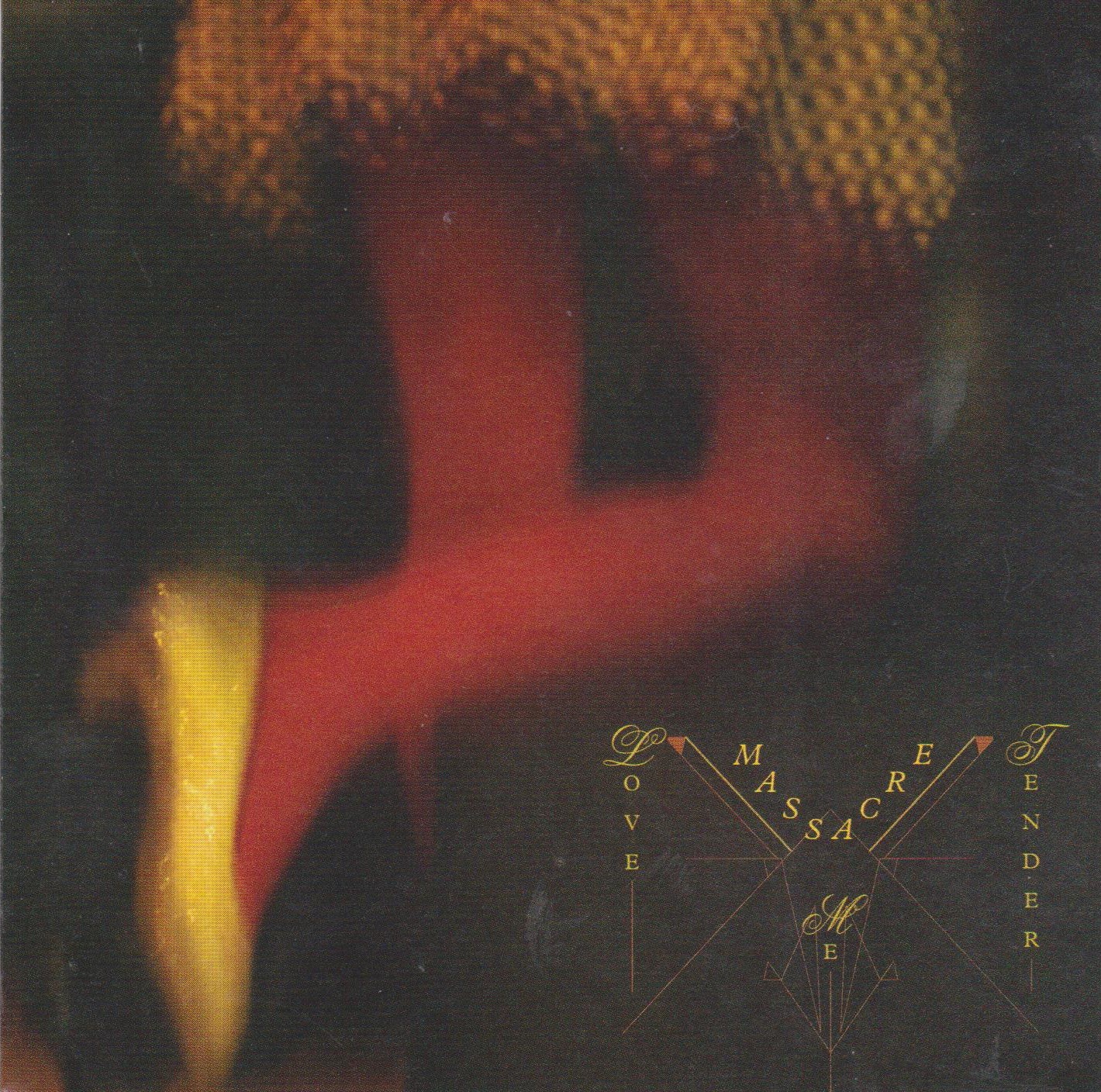
Massacre: Love Me Tender

After the remarkable guitarist Fred Frith left the British group Henry Cow in the late Seventies, he moved to New York and became acquainted with the rhythm section of Material, featuring drummer Fred Maher and bassist Bill Laswell.

Calling themselves Massacre, the trio released a 1981 studio album, Killing Time, and completed a slate of live performances before Maher quit the short-lived group.  Although Frith and Laswell formed another trio with Golden Palominos drummer Anton Fier and performed some Massacre tunes later in the decade, it was not until 1998 that the band was resurrected, this time with British drummer Charles Hayward of This Heat.

Signed to John Zorn's Tzadik label, the group recorded a studio album and two live recordings, one of which, Lonely Heart, was featured here in 2013, before Frith culled the archives of festival performances in Germany and Switzerland in 1999 and a performance in June 2008 in Italy to assemble Love Me Tender, released in 2012.

Because Massacre's music was improvised, it doesn't, to this listener, much matter whether the edited performances come across as "songs," despite the sequencing and titling, the latter drawn from poet Lyn Hjinian's mid-1970s collection Writing is an Aid to Memory.


What makes this album compelling is the wide array of sounds coaxed by Frith from his electric guitar, parallelled in many ways by Laswell's similarly experimental approach to playing the bass.  Hayward plays a bit of melodica and provides some wobbly vocalizations in addition to his steady and reliable drumming, providing a bedrock for his compatriots to build from.

It is difficult generally to point out highlights in terms of the "songs" listed on this recording, but there is one bright exception, which is the staggering "Shadow When Omitted."  Whatever one makes of Hayward's vocals, the performances on this nearly six-minute masterpiece of improvisation by Frith and Laswell are mindblowing.

Laswell spends the first part of the track playing with color and imbre on his playing, using devices common to his work, but as Frith develops a series of virtuoso solos employing his typical wide range of techniques and sounds, Laswell hits a couple of extended sequences of monstrous grooves that are just spectacular.

This, in turn, amplifies Frith's staggering playing, which, as much as he likes to experiment and use different techniques of picking and strumming, including the use of objects, there are solos that show him to be as fast and blistering, or more so, than any more popularly-known "guitar god." Of course, what sets Frith apart is his continuous spirit of experimentation, which is amply demonstrated on the rest of this album.

It is fair to characterize this album as a Frith showcase, though perhaps that has always been the case with Massacre's live and studio work.  This is not meant to downplay the work of Laswell, who is a maestro on an instrument not usually associated as a front-line one, or Hayward, who is an excellent drummer.  But, Frith is the centerpiece of this amazing ensemble and Love Me Tender, more than any of the trio's other releases, confirms this.

And, again, "Shadow When Omitted" is a stunning representation of what this great outfit can do and hopefully with continue to.