A native of Los Angeles, Morton Subotnick is a remarkable composer who works with electronics in highly compelling and very interesting ways. Subotnick is best known for his 1968 work, Silver Apples of the Moon, which was celebrated in Los Angeles recently on the 50th anniversary of the landmark piece. While attention is rightly being given to Silver Apples as a seminal piece of electronic music, this post looks at Subotnick's mid-1980s works, The Key to Songs and Return —A Triumph of Reason, which are amazing works, released on New Albion Records, which has released so much great modern music, utilizing YCAMS, the Yamaha Computer Assisted Music System, with the latter completely generated through that means, while the former utilizes that with acoustic instrumentation.
The Key to Songs comprises, the liners recount, "music for an imaginary ballet" based on a pictorial collage novel by surrealist painter Max Ernst, with one of the chapters labeled "The Key to Songs."
Subotnick uses two pianos, marimba, xylophone, vibraphone, viola and cello along with YCAMS to generate a dramatic and often frenetic score that mimics Ernst's collages, which are said to be dramatic, often erotic and playing with the line between reality and fantasy. Based solely on listening to the music, the latter point is notable in that telling acoustic from electronic instrumentation can be somewhat challenging. The composer even wrote instructions for the musicians to exaggerate their movements so audiences could tell the difference. The piece is dynamic and hypnotic.
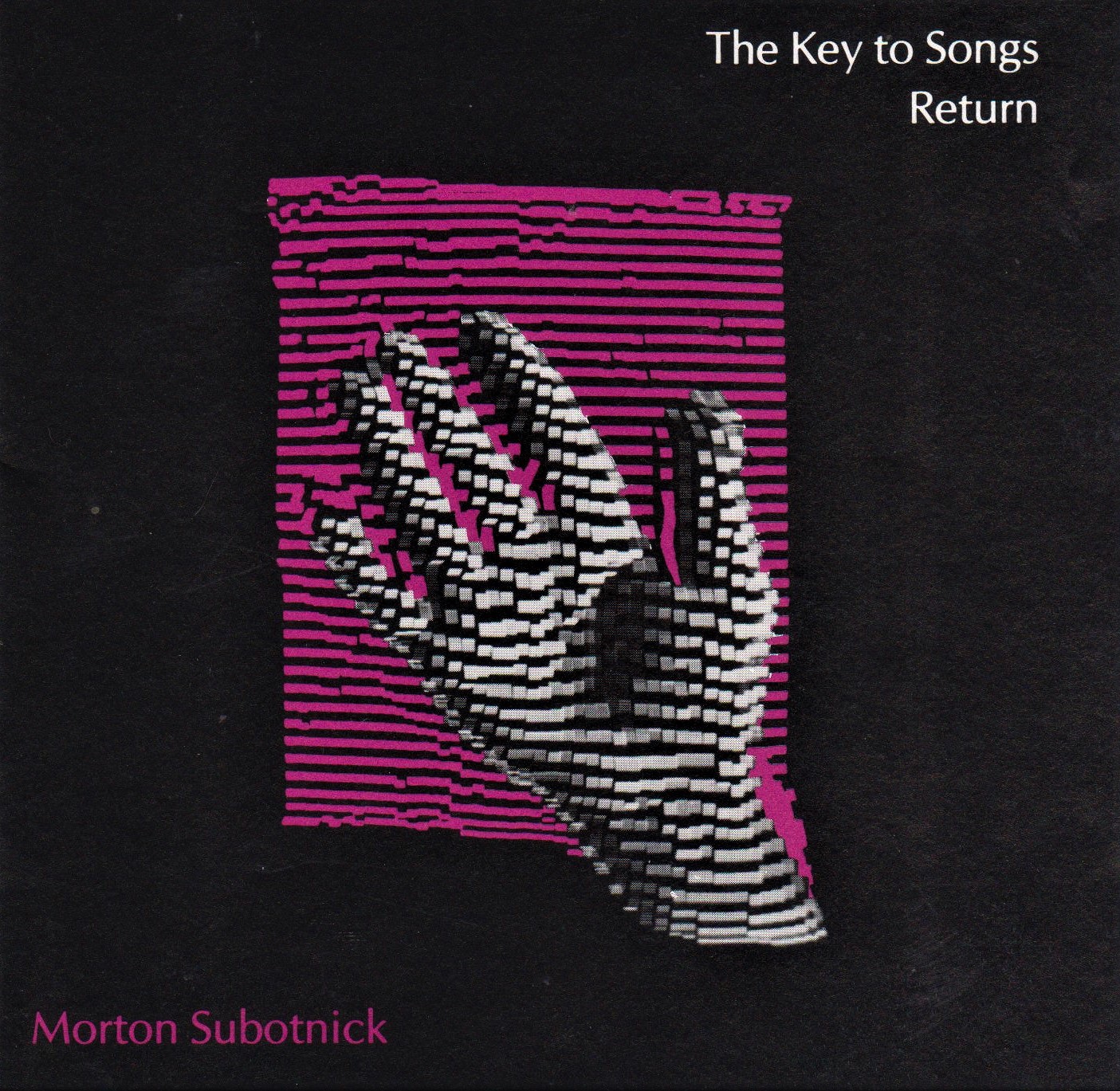
Return was a commission to mark the appearance of Halley's Comet in February 1986 (it had last been seen in April 1910 and is predicted to return in July 2061). Comets were believed in ancient days to the harbinger of ruin and destruction on one hand and the auspicious indicator of great benefit on the other. Edmund Halley, in 1705, determined that a comet seen twenty-three years before would return about every 75 years. Subotnick's score "depicts the comet's passage through time" and the first part reflecting the era to 1758 when the comet's return was given Halley's name and the second for the period after that and to the future. The computer-generated music reflects music heard in the mid-1700s, specifically the work of Baroque composer Domenico Scarlatti and then quiet, contemplative passages alternate with the dymanic, intense bursts of sound marking the onset of the comet and "the triumph of reason" in Halley's work. In the second part, he evokes 18th and 19th century music (Mozart and Liszt), then ragtime for 1910, and electronic sounds for the current and future periods.
Computer and electronic music is often denounced for being cold and emotionless, but here are two fascinating recordings that show how these types can be skillfully blended with acoustic instruments to provide richness or depth or, on its own, created to bring a richness and diversity that belies that criticism. This recording is an ear-opening exploration into the possibillites of electronic music as evocative in ways it is accused of not being.
No criticism, no reviews, no file sharing, just appreciation, on the basic premise that music is organized sound and from there comes a journey through one listener's library. Thanks for stopping in and hope you enjoy!
Showing posts with label New Albion Records. Show all posts
Monday, March 12, 2018
Tuesday, April 23, 2013
Lou Harrison: La Koro Sutro
This New Albion recording, released in 1988, is a brilliant collection of three works by the great composer Lou Harrison (1917-2003).
The title piece is the one for which he is best known and it is a gorgeous rendering on this album with the 100-voice chorus singing from the Buddhist Heart Sutra, rendered here, however, into Esperanto, the language intended to be universal, though it has, so far, been anything but so. In any case, the singing is complemented by harp, organ, and American Gamelan, Western-tuned percussion instruments built by the composer's partner and collaborator William Colvig. Component parts include oxygen tanks, garbage cans, brake drums, sheets of aluminum, a metallophone made of PVC pipe, and other wonderful combinations of material.
Harrison and Colvig titled the instrument to distinguish it from the Indonesian gamelan from which it derived and the effect is, in conjunction with the voices, harp and organ, stunning. "La Koro Sutro" was first performed in San Francisco in 1972 and this November 1987 recording was done by The Chorus and Chamber Chorus of The University of California, Berkeley under the direction of Phillip Brett. The harpist was Karen Gottlieb, the organist was Agnes Sauerbeck and the American Gamelan players were Peter Thielen, Todd Manley, Gino Robair Forlin, Scott Evans, Don R. Baker and director William Winant, also a co-producer of this album. It is a sure sign of a masterpiece when the work is so well constructed that it seems to end far too soon, even though this piece is nearly a half hour.
Fans of Anthony Braxton might recall Gino Robair as one of Braxton's many collaborators--the two making an album of duets in 1987 that this blogger owns. William Winant is very well known as a percussionist, who has frequently performed Harrison's works and has also been on several John Zorn recordings, such as Kristallnacht (featured on this blog), Music for Children, and Elegy, these other two also being in this listener's collection.
The "Varied Trio" for Winant, pianist Julie Steinberg, and violinist David Abel was written for the trio, which has recorded many albums over the years, in 1986 and was first performed in February of the following year. Winant, especially, is outstanding for his playing of the gong, vibraphone, rice bowls played with chopsticks, Chinese drums and bakers' pans. Of the five movements, the fourth is performed without percussion and the interplay between Abel and Steinberg is tremendous. Steinberg and Abel also performed on Zorn's Music for Children.
The last work is "Suite for Violin and American Gamelan" which Harrison and Richard Dee wrote in 1973. Here Abel, who made his concert debut at only age fourteen, gets to demonstrate his skills on the violin in the seven parts of the 28-minute piece. John Bergamo, an avid student of music from India, Bali and Java, conducts this piece, in which the gamelan effect merges so harmoniously with the violin. The delicacy and feeling of this piece is extraordinary and it is as staggering as "La Koro Sutro."
Simply put, this album is a fantastic example of modern music that might be experimental but is also approachable, non-traditional but not off-putting, intellectually stimulating but exudes warmth. Harrison is one of the giants of modern classical music and this record amply demonstrates why.
Lou Harrison: La Koro Sutro (New Albion Records, 1988)
1. La Koro Sutro 28:50
2. Varied Trio 15:19
3. Suite for Violin and American Gamelan 28:14
The title piece is the one for which he is best known and it is a gorgeous rendering on this album with the 100-voice chorus singing from the Buddhist Heart Sutra, rendered here, however, into Esperanto, the language intended to be universal, though it has, so far, been anything but so. In any case, the singing is complemented by harp, organ, and American Gamelan, Western-tuned percussion instruments built by the composer's partner and collaborator William Colvig. Component parts include oxygen tanks, garbage cans, brake drums, sheets of aluminum, a metallophone made of PVC pipe, and other wonderful combinations of material.
Harrison and Colvig titled the instrument to distinguish it from the Indonesian gamelan from which it derived and the effect is, in conjunction with the voices, harp and organ, stunning. "La Koro Sutro" was first performed in San Francisco in 1972 and this November 1987 recording was done by The Chorus and Chamber Chorus of The University of California, Berkeley under the direction of Phillip Brett. The harpist was Karen Gottlieb, the organist was Agnes Sauerbeck and the American Gamelan players were Peter Thielen, Todd Manley, Gino Robair Forlin, Scott Evans, Don R. Baker and director William Winant, also a co-producer of this album. It is a sure sign of a masterpiece when the work is so well constructed that it seems to end far too soon, even though this piece is nearly a half hour.
Fans of Anthony Braxton might recall Gino Robair as one of Braxton's many collaborators--the two making an album of duets in 1987 that this blogger owns. William Winant is very well known as a percussionist, who has frequently performed Harrison's works and has also been on several John Zorn recordings, such as Kristallnacht (featured on this blog), Music for Children, and Elegy, these other two also being in this listener's collection.
The "Varied Trio" for Winant, pianist Julie Steinberg, and violinist David Abel was written for the trio, which has recorded many albums over the years, in 1986 and was first performed in February of the following year. Winant, especially, is outstanding for his playing of the gong, vibraphone, rice bowls played with chopsticks, Chinese drums and bakers' pans. Of the five movements, the fourth is performed without percussion and the interplay between Abel and Steinberg is tremendous. Steinberg and Abel also performed on Zorn's Music for Children.
The last work is "Suite for Violin and American Gamelan" which Harrison and Richard Dee wrote in 1973. Here Abel, who made his concert debut at only age fourteen, gets to demonstrate his skills on the violin in the seven parts of the 28-minute piece. John Bergamo, an avid student of music from India, Bali and Java, conducts this piece, in which the gamelan effect merges so harmoniously with the violin. The delicacy and feeling of this piece is extraordinary and it is as staggering as "La Koro Sutro."
Simply put, this album is a fantastic example of modern music that might be experimental but is also approachable, non-traditional but not off-putting, intellectually stimulating but exudes warmth. Harrison is one of the giants of modern classical music and this record amply demonstrates why.
Lou Harrison: La Koro Sutro (New Albion Records, 1988)
1. La Koro Sutro 28:50
2. Varied Trio 15:19
3. Suite for Violin and American Gamelan 28:14
Subscribe to:
Posts (Atom)

