Star Time, the four-disc anthology issued in 1991 by Polydor Records, of the music of the amazing James Brown, is a remarkable document.
While it is easy to focus attention on the middle two discs, spanning Brown's greatest period from roughly 1965 to 1975, where he released choice hit after hit and refined the diamond-hard grooves that make him one of America's greatest musical figures, it might be easy to overlook the first and last discs, which show his transformation, in the first example, from a fine R&B performer in the 1950s to the Godfather of Soul, and then the gradual decline as the music world changed dramatically after the mid-Seventies.
Yet, there is much to enjoy in those bookend discs. From his early, pleading "Please Please Please" to his successful 1984 track "Unity" with pioneering rapper Afrika Bambaataa, there are many examples of comparison and contrast between the two periods, but also with the pinnacle of the always-busy career of The Hardest Working Man in Show Business.
It is hard, though, to dispute that discs two and three are consistently mind-blowing, with everything from "Papa's Got a Brand New Bag" to "I Feel Good" to "Say It Loud, I'm Black and I'm Proud" to "Mother Popcorn" to "Get Up (I Feel Like Being a Sex Machine" to "Super Bad" and a whole lot more. By the middle of disc 3, it might be apparent that, once Brown got his funk formula refined, it became stuck in a rut, but what a rut!
A great deal of the genius is undoubtedly due to Brown's vocals, including his trademark screams and grunts, but also his often impeccable sense of timing, but a lot of it is having the discipline, and the hardness, to be an effective bandleader. That may be Brown's most underrated quality, being able to hone one of the most efficient and effective bands, in various incarnations, to a T.
At the same time, he also had a very impressive group of musicians with which to work, including the great Maceo Parker on sax, Fred Wesley on trombone, bassist Bootsy Collins and his guitarist brother, Catfish (both of whom went to anchor George Clinton's Parliament/Funkadelic mothership), drummer John Starks, bassist Bernard Odum, drummer Melvin Parker, guitarist Jimmy Nolen, drummer Clyde Stubblefield and his longtime vocal foil and organist Bobby Byrd. Without these amazing players, even Brown's considerable gifts as a singer, bandleader and all-around entertainer could not have sustained the heights that he attained.
This listener had pretty much a passing exposure to the greatness of James Brown before this box set was purchased, but it really opened up an appreciation for just how incredible he and his bands were in creating some of the best and most exciting music this country has ever produced. Brown never lacked for confidence and self-appreciation, which can be off-putting, to say the least, but this is a document that convincingly shows that, at this greatest, Brown could back up the boasting, big time.
No criticism, no reviews, no file sharing, just appreciation, on the basic premise that music is organized sound and from there comes a journey through one listener's library. Thanks for stopping in and hope you enjoy!
Tuesday, August 30, 2016
Wednesday, August 24, 2016
Mahagita: Harp and Vocal Music of Burma
On first approach, this remarkable release from Smithsonian Folkways of Burmese harp music reminded this listener of the amazing kora music from western Africa. That is, until the vocals come in and then there is something very different--a gorgeous and haunting way of using the voice as an instrument to complement the harp playing.
Inle Mint Maung is astonishing on the 16-string harp and is beautifully accompanied by vocalist Daw Yi Yi Thant, whose enunciation is precise and singing highly accomplished. Their performances on the nine pieces, ranging from a little over 6 to 12 minutes in length, are given plenty of room to develop their strengths.
Ward Keeler's excellent introduction in the liners points out that this music has never been popular, "but to those willing to listen, Burma's classical soings are ravishingly beautiful." He noted that the music was refined over a long period, with the royal Burmese court as major patron, until the British takeover in 1885 of "Mandalay." Ironically, the brutal regime of "Myanmar"claimed to support the country's heritage, which seemed to bode well for the survival of what is called "thachin gyi."
Keeler described that "saun gau" or arched harp as being held in the lap of the performer who sits cross-legged on the floor. The player generally uses the thumb and index finger of the right hand on the strings, but Inle Myint Maung did not play this way. Still, the virtuosity of this master is undisputed, with improvisation forming a significant part of the playing.
The singer, Daw Yi Yi Thant, holds two small bells held together by a string, as well as a bamboo or wood clapper. The former, the "si," and the latter, the "wa" are used in place of larger percussion instruments, gongs and drums, heard in larger groups.
Biographical information about Maung and Thant adds to the understanding of the precision and skill they brought to this remarkable recording. Keeler added that, while this music has recently been heard usually on the radio or television, past performance could take place overnight at a home, with a meal in between. The writer stated that in 1987-88 he was able to hear the two musicians perform some songs at the Maung's home, giving a taste of what these domestic performances entailed.
Detailed notes for each piece explain the poetic meaning of the lyrics, as well as give information on the instrumental performance. Befitting many Smithsonian Folkways releases, the liner notes really help newcomers to the music understand and enjoy the experience better.
While this album was in production, Inle Myint Maung died at the relatively young age of 64, so the release of the recording was even more important for preserving the work of this master musician, whose harp playing is so spectacular.
Just after this post was completed, a news item was read about a major earthquake in Burma (Myanmar) that took place today. The 6.8 quake took place more than 50 miles below the earth's surface, so the damage could have been far worse, though some historic pagodas were damaged.
Inle Mint Maung is astonishing on the 16-string harp and is beautifully accompanied by vocalist Daw Yi Yi Thant, whose enunciation is precise and singing highly accomplished. Their performances on the nine pieces, ranging from a little over 6 to 12 minutes in length, are given plenty of room to develop their strengths.
Ward Keeler's excellent introduction in the liners points out that this music has never been popular, "but to those willing to listen, Burma's classical soings are ravishingly beautiful." He noted that the music was refined over a long period, with the royal Burmese court as major patron, until the British takeover in 1885 of "Mandalay." Ironically, the brutal regime of "Myanmar"claimed to support the country's heritage, which seemed to bode well for the survival of what is called "thachin gyi."
Keeler described that "saun gau" or arched harp as being held in the lap of the performer who sits cross-legged on the floor. The player generally uses the thumb and index finger of the right hand on the strings, but Inle Myint Maung did not play this way. Still, the virtuosity of this master is undisputed, with improvisation forming a significant part of the playing.
The singer, Daw Yi Yi Thant, holds two small bells held together by a string, as well as a bamboo or wood clapper. The former, the "si," and the latter, the "wa" are used in place of larger percussion instruments, gongs and drums, heard in larger groups.
Biographical information about Maung and Thant adds to the understanding of the precision and skill they brought to this remarkable recording. Keeler added that, while this music has recently been heard usually on the radio or television, past performance could take place overnight at a home, with a meal in between. The writer stated that in 1987-88 he was able to hear the two musicians perform some songs at the Maung's home, giving a taste of what these domestic performances entailed.
Detailed notes for each piece explain the poetic meaning of the lyrics, as well as give information on the instrumental performance. Befitting many Smithsonian Folkways releases, the liner notes really help newcomers to the music understand and enjoy the experience better.
While this album was in production, Inle Myint Maung died at the relatively young age of 64, so the release of the recording was even more important for preserving the work of this master musician, whose harp playing is so spectacular.
Just after this post was completed, a news item was read about a major earthquake in Burma (Myanmar) that took place today. The 6.8 quake took place more than 50 miles below the earth's surface, so the damage could have been far worse, though some historic pagodas were damaged.
Wednesday, August 17, 2016
Sonny Sharrock: Guitar
Can't say why it's taken almost four years to post a Sonny Sharrock album here, following his masterpiece Ask the Ages, but, in any case, his pure solo album, Guitar, is not far behind on the list of favorite Sharrock records.
Released on Enemy Records in 1986, not long after Sharrock was tracked down by bassist/producer Bill Laswell and convinced to make a comeback in music, this Sharrock/Laswell production was a perfect way to showcase the unbelievable talent that the guitarist possessed.
This is true with his well-known and well-honed slide guitar technique, in which Sharrock ranged and raged up and down the frets like a madman, but it is also true with his affinity for the blues and his knack for melody. It is all these facets and more that made him the master that he was.
So, yes, there is plenty of rapid-fire playing with the slide and without, but there are also some very beautiful sections with plaintive melodies, soaring soloing and a playful humor that goes far beyond the pyrotechnics.
"Blind Willie" has a memorable melodic statement with a drone-like background as well as soloing that demonstrates what Sharrock could be inventive not just fast, though there's some of that, too. "Devil's Doll Baby" has a background howling using that slide, while he solos impressively on top to create a wild effect that maybe explains the the title.
"Broken Toys" starts off in a kind of ambient mode with a pretty theme and then solos over that mellower playing, but in a way that is perfectly complementary even as it has contrasting colors. "Black Bottom" has an old-school rock rhythm motif with a strange, otherwordly background before the soloing takes on a blues direction and includes some of the finest on the record. "Kula Mae" has another excellent example of a rhythm that supports the often-breathtaking soloing that Sharrock was known for.in the first 1:15, and then the tune changes gear completely into another rock rhythm and some blistering fret work.
But it is the "Princess Sonata" in four parts over thirteen minutes that is the centerpiece of this album, taking all those elements of Sharrock's playing mentioned above and crystallizing them into a fully realized piece of music. The "Princess and the Magician" section shows Sharrock blazing away, while "Like Voices of Sleeping Birds" takes him into some "out there" slide work. "Flowers Laugh" has a playful backing, while the guitarists works the frets in a short showcase. "They Enter the Dream" has a pretty backing statement over which the solo soars majestically and shreds in equal measure, providing a great way to end a remarkable album.
Guitar is a perfectly understated title for this showcase of one of the greatest and most underappreciated guitarists in all of music. While Sharrock is generally thought of as a free jazz guitarist, he developed a style that was all-encompassing, taking in rock, blues and other forms, as well as jazz, to the point where, to this blogger, there is no label that applies.
Instead, Sonny Sharrock blazed his own musical path from the mid-80s until his untimely passing in 1994. This album is one of the best ways to appreciate Sharrock in his pure, undiluted artistry, though Ask the Ages is, to this listener, his best work.
Released on Enemy Records in 1986, not long after Sharrock was tracked down by bassist/producer Bill Laswell and convinced to make a comeback in music, this Sharrock/Laswell production was a perfect way to showcase the unbelievable talent that the guitarist possessed.
This is true with his well-known and well-honed slide guitar technique, in which Sharrock ranged and raged up and down the frets like a madman, but it is also true with his affinity for the blues and his knack for melody. It is all these facets and more that made him the master that he was.
So, yes, there is plenty of rapid-fire playing with the slide and without, but there are also some very beautiful sections with plaintive melodies, soaring soloing and a playful humor that goes far beyond the pyrotechnics.
"Blind Willie" has a memorable melodic statement with a drone-like background as well as soloing that demonstrates what Sharrock could be inventive not just fast, though there's some of that, too. "Devil's Doll Baby" has a background howling using that slide, while he solos impressively on top to create a wild effect that maybe explains the the title.
"Broken Toys" starts off in a kind of ambient mode with a pretty theme and then solos over that mellower playing, but in a way that is perfectly complementary even as it has contrasting colors. "Black Bottom" has an old-school rock rhythm motif with a strange, otherwordly background before the soloing takes on a blues direction and includes some of the finest on the record. "Kula Mae" has another excellent example of a rhythm that supports the often-breathtaking soloing that Sharrock was known for.in the first 1:15, and then the tune changes gear completely into another rock rhythm and some blistering fret work.
But it is the "Princess Sonata" in four parts over thirteen minutes that is the centerpiece of this album, taking all those elements of Sharrock's playing mentioned above and crystallizing them into a fully realized piece of music. The "Princess and the Magician" section shows Sharrock blazing away, while "Like Voices of Sleeping Birds" takes him into some "out there" slide work. "Flowers Laugh" has a playful backing, while the guitarists works the frets in a short showcase. "They Enter the Dream" has a pretty backing statement over which the solo soars majestically and shreds in equal measure, providing a great way to end a remarkable album.
Guitar is a perfectly understated title for this showcase of one of the greatest and most underappreciated guitarists in all of music. While Sharrock is generally thought of as a free jazz guitarist, he developed a style that was all-encompassing, taking in rock, blues and other forms, as well as jazz, to the point where, to this blogger, there is no label that applies.
Instead, Sonny Sharrock blazed his own musical path from the mid-80s until his untimely passing in 1994. This album is one of the best ways to appreciate Sharrock in his pure, undiluted artistry, though Ask the Ages is, to this listener, his best work.
Labels:
Bill Laswell,
Enemy Records,
free jazz,
guitar,
jazz guitar,
Sonny Sharrock
Friday, July 29, 2016
Karlheinz Stockhausen: Stimmung
This remarkable recording of Stockhausen's work for chorus, Stimmung, is one of those albums that should be heard with headphones to really appreciate the particular aural dynamics of how he composed for polyphonic singing.
As performed by Paul Hillier's amazing Theatre of Voices, Stimmung is an especially stimulating experience, one that, for some, might be worth hearing after listening to, say, Le Mystere des Voix Bulgares, a Latvian female choir album, or the male Rustavi Choir from the republic of Georgia. There are also sections of overtone singing that are somewhat reminiscent of the Tuva throat singers of Mongolia.
Stockhausen composed Stimmung, which implies tuning voices but can also refer to a calibrating of the soul in a positive way, in early 1968 as his take on madrigals, using text, vocalizations, and his own particular style of composing to create something very different and new. While there is basically a single chord utilized, the use of six pitches and overtones provides a complexity that makes the piece move beyond the idea of that one chord.
Instead of a score, there is a "form scheme" with 51 models that the singers follow with instructions as to who sings, what pitches are employed, and the textual resources (including a selection from 66 "magic names" based on mythological fitures) utilized. There is a call-and-response element to the work with variations and the use of some improvisation and a new lead singer takes over in each model, though the ensemble decided which model goes where within the general scheme.
Interestingly, Hillier stated that Stockhausen offered to assist with the recording, but schedules did not permit it, so a tape of a performance was sent and the composer returned "a detailed critique—whch we found challenging and extremely helpful." This sounds very Stockhausenian, actually, as does the closing comment that the various recordings of Stimmung sound quite different from one another, which is probably to be expected given the extraordinary way the piece was worked out and the demands it places on performers to utilize their individual and collective personalities in the performance.
Finally, Hillier offers that, of all of the experimental works of the 1960s, he feels Terry Riley's In C and Stimming are most representative and that he sees these very different works as being related to the conditions of time (the Sixties) and place (the effects of California on the two men)
Stimmung is, especially heard with headphones, a particularly stimulating and compelling work by one of the most provocative and unique composers in recent decades. The recording quality is also crystalline, which really enhances the effect.
As performed by Paul Hillier's amazing Theatre of Voices, Stimmung is an especially stimulating experience, one that, for some, might be worth hearing after listening to, say, Le Mystere des Voix Bulgares, a Latvian female choir album, or the male Rustavi Choir from the republic of Georgia. There are also sections of overtone singing that are somewhat reminiscent of the Tuva throat singers of Mongolia.
Stockhausen composed Stimmung, which implies tuning voices but can also refer to a calibrating of the soul in a positive way, in early 1968 as his take on madrigals, using text, vocalizations, and his own particular style of composing to create something very different and new. While there is basically a single chord utilized, the use of six pitches and overtones provides a complexity that makes the piece move beyond the idea of that one chord.
Instead of a score, there is a "form scheme" with 51 models that the singers follow with instructions as to who sings, what pitches are employed, and the textual resources (including a selection from 66 "magic names" based on mythological fitures) utilized. There is a call-and-response element to the work with variations and the use of some improvisation and a new lead singer takes over in each model, though the ensemble decided which model goes where within the general scheme.
Interestingly, Hillier stated that Stockhausen offered to assist with the recording, but schedules did not permit it, so a tape of a performance was sent and the composer returned "a detailed critique—whch we found challenging and extremely helpful." This sounds very Stockhausenian, actually, as does the closing comment that the various recordings of Stimmung sound quite different from one another, which is probably to be expected given the extraordinary way the piece was worked out and the demands it places on performers to utilize their individual and collective personalities in the performance.
Finally, Hillier offers that, of all of the experimental works of the 1960s, he feels Terry Riley's In C and Stimming are most representative and that he sees these very different works as being related to the conditions of time (the Sixties) and place (the effects of California on the two men)
Stimmung is, especially heard with headphones, a particularly stimulating and compelling work by one of the most provocative and unique composers in recent decades. The recording quality is also crystalline, which really enhances the effect.
Thursday, July 28, 2016
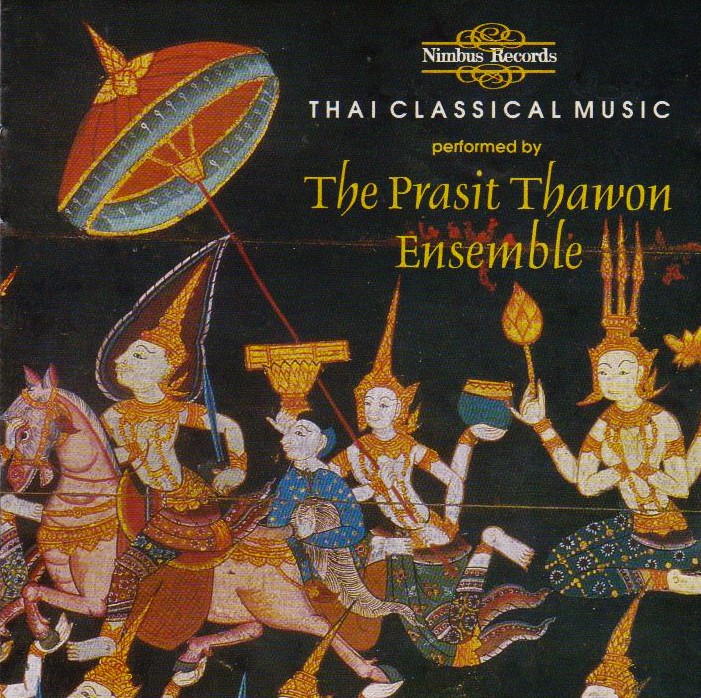
Prasit Thawon Ensemble: Thai Classical Music
This 1994 release on England's Nimbus Records is a beautiful example of the classical music of Thailand, as rendered by The Prasit Thawon Ensemble.
Utilizing horns; percussion including bells, gongs, finger cymbals, and woodblocks; alto and soprano xylophones and vocals, the long tradition of music, whether the pieces are older or new, from the Asian nation is given excellent expression by the ensemble, anchored by the two long centerpieces of the album, the exquisite 23 1/2-minute long "Sumran Dontri Klong" and the nearly 27-minute long "Cherd Chin."
Interestingly, the latter dates from the mid-19th century while the former was newly composed by Prasit Thawon, the leader of the performing ensemble, when this recording was made.
The group was founded in the late 1950s as "The Ensemble of the Dramatic School" at Bangkok and it performed in concerts and for radio and television broadcasts. After Prasit Thawon retired in the mid-1980s, the ensemble was renamed "Sitti Thawon" and then to The Prasit Thawon Ensemble as a further honor to the founder.
The recording was made as part of an international conference devoted to Thailand at a London studio and is a fine representation of the fascingting music of that country.
Utilizing horns; percussion including bells, gongs, finger cymbals, and woodblocks; alto and soprano xylophones and vocals, the long tradition of music, whether the pieces are older or new, from the Asian nation is given excellent expression by the ensemble, anchored by the two long centerpieces of the album, the exquisite 23 1/2-minute long "Sumran Dontri Klong" and the nearly 27-minute long "Cherd Chin."
Interestingly, the latter dates from the mid-19th century while the former was newly composed by Prasit Thawon, the leader of the performing ensemble, when this recording was made.
The group was founded in the late 1950s as "The Ensemble of the Dramatic School" at Bangkok and it performed in concerts and for radio and television broadcasts. After Prasit Thawon retired in the mid-1980s, the ensemble was renamed "Sitti Thawon" and then to The Prasit Thawon Ensemble as a further honor to the founder.
The recording was made as part of an international conference devoted to Thailand at a London studio and is a fine representation of the fascingting music of that country.
Friday, July 22, 2016
Wire: Send
After another lengthy hiatus, beginning in 1992, Wire reemerged a decade later determined to push themselves in an expected direction. With 2003's Send, which followed from and incorporated some songs from the two Read & Burn EPs, the band blazed, blasted and blew (largely) through a blistering barrage of tunes that showed that they were as delightfully idiosyncratic and creative as ever.
Anyone who saw Wire live during that period, as this blogger did for the first time at a Los Angeles show, it was more than a surprising to be confronted with a level of volume that was as loud as any concert experienced before.
But, the songs worked well in that maelstrom. "In the Art of Stopping," "Comet," "The Agfers of Kodack," "Spent," and more are just built for speed and noise. The live album, The Scottish Play: 2004 (a neat little play on The Bard) gives some idea of what Wire's music of that period sounded like in person, though it's obviously not possible to replicate the sonic assault.
But, that's not all that Send and related recordings from those first few years of the 2000s was about. For one thing, although there are electronic treatments added for color and adornment, especially on "Read and Burn" it was great to be able to hear Robert Grey (Gotobed) playing a real drumkit again and performing with his old metronomic reliability. Not that the late 80s version of Wire wasn't great--there was much to enjoy there--but the driving intensity of Send would not obviously have been anywhere near possible without Grey's drumming.
And, of course, there's Colin Newman's ironic, Cockney-inflected vocals--often supremely sarcastic, witty and insightful, and sometimes bellowing, as on the staggering "Spent." Occasionally, Graham Lewis's voice, though definitely cigarette-burnished (or burned), comes out particularly effectively, even if processed, in the raging, biting "The Agfers of Kodack." Though to hear him sing the tune on The Scottish Play reveals painfully what the years of smoking had done.
Finally, there is the production, which somehow manages to sound raw and polished all at the same time, due to the care and consideration taken by Newman, who has mixed all of Wire's music since at his home studio, Swim.
Some bands maintain remarkable longevity by falling back on past glories; others build upon their history while adding new dimensions by looking forward. Wire is definitely the latter, even after Bruce Gilbert departed in 2004. Their subsequent albums have all been great and their latest release, the mini-LP Nocturnal Koreans, shows that they are still very much forward thinking.
Anyone who saw Wire live during that period, as this blogger did for the first time at a Los Angeles show, it was more than a surprising to be confronted with a level of volume that was as loud as any concert experienced before.
But, the songs worked well in that maelstrom. "In the Art of Stopping," "Comet," "The Agfers of Kodack," "Spent," and more are just built for speed and noise. The live album, The Scottish Play: 2004 (a neat little play on The Bard) gives some idea of what Wire's music of that period sounded like in person, though it's obviously not possible to replicate the sonic assault.
But, that's not all that Send and related recordings from those first few years of the 2000s was about. For one thing, although there are electronic treatments added for color and adornment, especially on "Read and Burn" it was great to be able to hear Robert Grey (Gotobed) playing a real drumkit again and performing with his old metronomic reliability. Not that the late 80s version of Wire wasn't great--there was much to enjoy there--but the driving intensity of Send would not obviously have been anywhere near possible without Grey's drumming.
And, of course, there's Colin Newman's ironic, Cockney-inflected vocals--often supremely sarcastic, witty and insightful, and sometimes bellowing, as on the staggering "Spent." Occasionally, Graham Lewis's voice, though definitely cigarette-burnished (or burned), comes out particularly effectively, even if processed, in the raging, biting "The Agfers of Kodack." Though to hear him sing the tune on The Scottish Play reveals painfully what the years of smoking had done.
Finally, there is the production, which somehow manages to sound raw and polished all at the same time, due to the care and consideration taken by Newman, who has mixed all of Wire's music since at his home studio, Swim.
Some bands maintain remarkable longevity by falling back on past glories; others build upon their history while adding new dimensions by looking forward. Wire is definitely the latter, even after Bruce Gilbert departed in 2004. Their subsequent albums have all been great and their latest release, the mini-LP Nocturnal Koreans, shows that they are still very much forward thinking.
Saturday, July 16, 2016
Charles Mingus Sextet with Eric Dolphy: Cornell 1964
This 2007 release on Blue Note Records is another one of those happy musical discoveries--coming about when Sue Graham Mingus, the widow of the great bassist and composer Charles Mingus found a tape of a concert held at Cornell University in upstate New York on 18 March 1964.
The two sets make up the double disc offering here and the programming is, characteristically for Mingus diverse and different. The first tune is a solo romp by pianist Jaki Byard, who creates a piece brimming with upbeat feeling based on stunning virtuosity. Byard then comps quietly behind Mingus, who solos to great effectiveness on a piece by one of his heroes, Ellington's "Sophisticated Lady."
Then comes one of the centerpieces of this record and one of the most politically charged pieces in the leader's impressive catalog of original compositions: "Fables of Faubus." This jibe at the governor of Arkansas, Orval Faubus, who fought the federally ordered desegregation of schools in 1957. While the vocals decrying Faubus are important to hear, and certainly had a place in 1964, the piece is also a gem because of the way the remarkable sextet moved through the tune with its shifting tempos, excellent soloing, and remarkable harmonic interplay. Byars, as just one example, takes a bit of "Yankee Doodle Dandy" and builds upon it in his great solo and Mingus quotes "When Johnny Comes Marching Home Again" in his solo. But, this is a triumph of a band making the most of its ample and impressive resources and led by a composer at the peak of his powers.
"Orange was the Color of Her Dress, Then Blue Silk" is a beautiful ballad, in which we hear the phenomenal Eric Dolphy on bass clarinet, employing all of the explosive, technically imposing, and utterly unique elements of his playing, with Mingus clearly encouraging Dolphy on.
The great composer Billy Strayhorn's "Take the 'A' Train," another piece associated with Ellington, also gets a great workout and Byard's soloing takes in stride playing and other "older" styles in weaving a fascinating history-based performance. Mingus's phenomenal bass solo, in conjunction with Danny Richmond's remarkable drumming, features the bassist talking, grunting, and otherwise having a hell of a time while the crowd laughs and roars in appreciation. Dolphy offers another great solo while the band rumbles and roars behind him and the pieces closes to end a spectacular set.
The second set is anchored by another marathon piece, the mind-blowing "Meditations," which runs over 31 minutes. While it does have its meditative moments, it also has its uptempo sections, where the band, firing on all cylinders, displays all of its stregnths and shows no discernible weaknesses, letdowns, or misfirings. Hearing Clifford Jordan solo on tenor, while Dolphy backs him on bass clarinet, and the rhythm section churns and burns along with them, is really interesting and exciting, especially as the finish pits the horns against Byard's hard block chords and Richmond's stirring drumming and as Mingus can be heard directing the band where to go next.
"So Long Eric" has been taken by many to be a posthumously-titled homage to Dolphy, who died just three months later in Berlin, but it was actually given that title by Mingus as Dolphy left the band to take the tour to Europe that included his untimely passing.
It being the day after St. Patrick's Day, Mingus tossed in a version of "When Irish Eyes Are Smiling" and introduced trumpeter "Johnny O'Coles" as the "only Irishman in the band." The album closes with the Fats Waller gem "Jitterbug Waltz", a fantastic rendering that highlights Dolphy's flute playing and provides more of the leader's great bass work.
It wasn't long after this recording that Mingus' career took a downturn, along with his mental and physical health. There were later highlights like Let My Children Hear Music from the early 70s and the Changes albums from the same period, but the unit he had the year that the Cornell concert was made was exceptional and perhaps the high point of his long and remarkable career.
The two sets make up the double disc offering here and the programming is, characteristically for Mingus diverse and different. The first tune is a solo romp by pianist Jaki Byard, who creates a piece brimming with upbeat feeling based on stunning virtuosity. Byard then comps quietly behind Mingus, who solos to great effectiveness on a piece by one of his heroes, Ellington's "Sophisticated Lady."
Then comes one of the centerpieces of this record and one of the most politically charged pieces in the leader's impressive catalog of original compositions: "Fables of Faubus." This jibe at the governor of Arkansas, Orval Faubus, who fought the federally ordered desegregation of schools in 1957. While the vocals decrying Faubus are important to hear, and certainly had a place in 1964, the piece is also a gem because of the way the remarkable sextet moved through the tune with its shifting tempos, excellent soloing, and remarkable harmonic interplay. Byars, as just one example, takes a bit of "Yankee Doodle Dandy" and builds upon it in his great solo and Mingus quotes "When Johnny Comes Marching Home Again" in his solo. But, this is a triumph of a band making the most of its ample and impressive resources and led by a composer at the peak of his powers.
"Orange was the Color of Her Dress, Then Blue Silk" is a beautiful ballad, in which we hear the phenomenal Eric Dolphy on bass clarinet, employing all of the explosive, technically imposing, and utterly unique elements of his playing, with Mingus clearly encouraging Dolphy on.
The great composer Billy Strayhorn's "Take the 'A' Train," another piece associated with Ellington, also gets a great workout and Byard's soloing takes in stride playing and other "older" styles in weaving a fascinating history-based performance. Mingus's phenomenal bass solo, in conjunction with Danny Richmond's remarkable drumming, features the bassist talking, grunting, and otherwise having a hell of a time while the crowd laughs and roars in appreciation. Dolphy offers another great solo while the band rumbles and roars behind him and the pieces closes to end a spectacular set.
The second set is anchored by another marathon piece, the mind-blowing "Meditations," which runs over 31 minutes. While it does have its meditative moments, it also has its uptempo sections, where the band, firing on all cylinders, displays all of its stregnths and shows no discernible weaknesses, letdowns, or misfirings. Hearing Clifford Jordan solo on tenor, while Dolphy backs him on bass clarinet, and the rhythm section churns and burns along with them, is really interesting and exciting, especially as the finish pits the horns against Byard's hard block chords and Richmond's stirring drumming and as Mingus can be heard directing the band where to go next.
"So Long Eric" has been taken by many to be a posthumously-titled homage to Dolphy, who died just three months later in Berlin, but it was actually given that title by Mingus as Dolphy left the band to take the tour to Europe that included his untimely passing.
It being the day after St. Patrick's Day, Mingus tossed in a version of "When Irish Eyes Are Smiling" and introduced trumpeter "Johnny O'Coles" as the "only Irishman in the band." The album closes with the Fats Waller gem "Jitterbug Waltz", a fantastic rendering that highlights Dolphy's flute playing and provides more of the leader's great bass work.
It wasn't long after this recording that Mingus' career took a downturn, along with his mental and physical health. There were later highlights like Let My Children Hear Music from the early 70s and the Changes albums from the same period, but the unit he had the year that the Cornell concert was made was exceptional and perhaps the high point of his long and remarkable career.
Thursday, June 30, 2016
Wolfgang Amadeus Mozart: Flute Concertos Nos. 1 & 2
Sometimes it's the lesser-known pieces in a master composer's catalog of works that are the most interesting. This is certainly the case with these little gems, comprising the two concertos for flute and a short andante in C major by Wolfgang Amadeus Mozart released by the excellent Naxos label in the late 1980s.
The Capella Istropolitana, a chamber orchestra in Bratislava, Slovakia, conducted by Austrian Martin Sieghart, provides a fine accompaniment to flautist Herbert Weissberg, a native of Vienna, who remained in his music-rich hometown to study at the city's music academy and university and then became principal flautist for the symphony orchestra there.
The helpful liner notes state that Mozart wrote these pieces as part of a concerted (ha!) effort to break free of the limitations imposed upon him by his years under the patronage of the Archbishop in his native Salzburg.
In his very early 20s, about 1777, Mozart composed these concertos for a Dutchman named "De Jean," who was an amateur flautist and someone who had the kind of money Mozart craved, being perpetually in financial distress.
Evidently Mozart did not think highly of the flute and may not have put in the kind of passionate intensity in composition that he did many of his other works. Still, these pieces are melodically solid and harmonically interesting, even if they don't rank among his greatest pieces. The light, fragile sound of the flute dancing above the excellent orchestral background is pleasant and maintains interest.
The Capella Istropolitana, a chamber orchestra in Bratislava, Slovakia, conducted by Austrian Martin Sieghart, provides a fine accompaniment to flautist Herbert Weissberg, a native of Vienna, who remained in his music-rich hometown to study at the city's music academy and university and then became principal flautist for the symphony orchestra there.
The helpful liner notes state that Mozart wrote these pieces as part of a concerted (ha!) effort to break free of the limitations imposed upon him by his years under the patronage of the Archbishop in his native Salzburg.
In his very early 20s, about 1777, Mozart composed these concertos for a Dutchman named "De Jean," who was an amateur flautist and someone who had the kind of money Mozart craved, being perpetually in financial distress.
Evidently Mozart did not think highly of the flute and may not have put in the kind of passionate intensity in composition that he did many of his other works. Still, these pieces are melodically solid and harmonically interesting, even if they don't rank among his greatest pieces. The light, fragile sound of the flute dancing above the excellent orchestral background is pleasant and maintains interest.
Friday, June 24, 2016
Praxis: Transmutation (Mutatis Mutandis)
A week ago, while driving through the parched landscape of the high desert from Bishop to San Bernardino, the two-disc Axiom Funk compilation, Funkcronomicon, provided an unusual soundtrack to the bare hills, Joshua Trees, and the endless ribbon of asphalt that rolled on through the hours.
The great keyboardist Bernie Worrell, the "Wizard of Woo," died today at age 72 from lung cancer. A classical piano prodigy who studied at the prestigious Julliard School of Music and the New England Conservatory of Music, Worrell was propelled to fame with this central role in funkmeister George Clinton's masterful ensemble, Parliament/Funkadelic, for many years.
In the early 1990s, Worrell joined forces with fellow P-Funk bassist Bootsy Collins; D.J. Af Next Man Flip, formerly Afrika Baby Bam of the great hip-hop group Jungle Brothers; drummer Brain (Bryan Mantia, later with Primus, Guns 'N Roses and others) and the phenomenal guitarist Buckethead in the Bill-Laswell produced collective, Praxis.
1992's debut record by the group, Transmutation (Mutatis Mutandis), was mind-blowing and innovative a quarter century ago and is still striking today. The recording is full of interesting and strangely complementary mixes of metal, hip-hop, funk, electronics and other elements and takes great advantage of the talents of its five disparate, but well-synchronized members.
Worrell's organ, clavinet and synthesizer works particularly well as a foil for Buckethead's amazing pyrotechnics and the steady backing of Collins and Brain. Laswell's production work is excellent, providing the right level of mixing for each performer and leaving space in the final product to hear the ensemble in all of its remarkable glory.
"Animal Behavior", with Collins' typically humorous vocal, is the closest thing to a standard tune on the album and its relaxed funk groove included some tasty Worrell organ playing. The end of the tune features some beautiful melodic guitar work from Buckethead. "Crash Victim/Black Science Navigator" is a crazed conglomeration of shredding guitar, sharp organ, and a strong, steady beat from the rhythm section, before Af Next Man Flip does his thing on the second half.
Worrell gets the spotlight in "Seven Laws of Woo," a play on his nickname, and the tune then heads into a metal-inflected jam that rocks hard and has another great Buckethead solo. "Dead Man Walking" highlights Buckethead's astounding guitar abilities before the tune hits a solid funk groove punctuated by all kinds of electronic sounds and turntable work. The "Interworld and the New Innocence" features some more delicate and memorable playing by Buckethead before the band breaks out into a harder-rocking section, where Worrell gets a clavinet workout with his organ accompaniment. The record's 16-minute epic, "After Shock (Chaos Never Died)" includes some more fine Worrell workouts, including some haunting organ playing.
The whole album is fantastic, showcasing the strengths of the quintet with Laswell's crystalline production serving the proceedings very well. This is one of many apt testimonials to the amazing talent of Bernie Worrell.
The great keyboardist Bernie Worrell, the "Wizard of Woo," died today at age 72 from lung cancer. A classical piano prodigy who studied at the prestigious Julliard School of Music and the New England Conservatory of Music, Worrell was propelled to fame with this central role in funkmeister George Clinton's masterful ensemble, Parliament/Funkadelic, for many years.
In the early 1990s, Worrell joined forces with fellow P-Funk bassist Bootsy Collins; D.J. Af Next Man Flip, formerly Afrika Baby Bam of the great hip-hop group Jungle Brothers; drummer Brain (Bryan Mantia, later with Primus, Guns 'N Roses and others) and the phenomenal guitarist Buckethead in the Bill-Laswell produced collective, Praxis.
1992's debut record by the group, Transmutation (Mutatis Mutandis), was mind-blowing and innovative a quarter century ago and is still striking today. The recording is full of interesting and strangely complementary mixes of metal, hip-hop, funk, electronics and other elements and takes great advantage of the talents of its five disparate, but well-synchronized members.
Worrell's organ, clavinet and synthesizer works particularly well as a foil for Buckethead's amazing pyrotechnics and the steady backing of Collins and Brain. Laswell's production work is excellent, providing the right level of mixing for each performer and leaving space in the final product to hear the ensemble in all of its remarkable glory.
"Animal Behavior", with Collins' typically humorous vocal, is the closest thing to a standard tune on the album and its relaxed funk groove included some tasty Worrell organ playing. The end of the tune features some beautiful melodic guitar work from Buckethead. "Crash Victim/Black Science Navigator" is a crazed conglomeration of shredding guitar, sharp organ, and a strong, steady beat from the rhythm section, before Af Next Man Flip does his thing on the second half.
Worrell gets the spotlight in "Seven Laws of Woo," a play on his nickname, and the tune then heads into a metal-inflected jam that rocks hard and has another great Buckethead solo. "Dead Man Walking" highlights Buckethead's astounding guitar abilities before the tune hits a solid funk groove punctuated by all kinds of electronic sounds and turntable work. The "Interworld and the New Innocence" features some more delicate and memorable playing by Buckethead before the band breaks out into a harder-rocking section, where Worrell gets a clavinet workout with his organ accompaniment. The record's 16-minute epic, "After Shock (Chaos Never Died)" includes some more fine Worrell workouts, including some haunting organ playing.
The whole album is fantastic, showcasing the strengths of the quintet with Laswell's crystalline production serving the proceedings very well. This is one of many apt testimonials to the amazing talent of Bernie Worrell.
Saturday, June 4, 2016
Le Mystére des Voix Bulgares
When this blogger started listening to "world music" in 1990, this was one of the first recordings that was purchased, mainly because the 1986-87 (first on the British label 4AD and then on the American Nonesuch Explorer label) re-release of the 1975 Disques Cellier release by Marcel Cellier became something of a surprise world-wide phenomenon.
Obviously, the quality of an experience can't be repeated and, the more distant in time, the less can be recalled. But, listening to the opening polyphonic harmonic vocal gymnastics employed by the two dozen singers of the Bulgarian State Radio and Television Female Vocal Choir, still provokes something of that spine-tingling feeling of just over a quarter century ago.
These are traditional folk songs, from weddings, harvests, dancing, and work, as well as from legend and myth in a part of the world little known to most of us in America, but which has ancient roots and connectivity between east and west that clearly have formed the unique qualities of this remarkable vocal music.
But, there is a distinctively modern "artistic" sheen put on the old folk origins, both in arrangment by Phillip Koutev and Krasimir Kyurkchiyski, and on the recording quality. Purity is often a word used to describe this work and it is true from multiple standpoints: the quality of each singer's voice, in the roots of the material, and in the fine sound recording quality.
To this listener, everything about this album is fantastic and it seems almost unfair to pick out highlights. There are the ensemble passages, solos, and small group harmonizing--all of which have their particular aspects to recommend them. One of the more notable elements, though, is the use of dissonant harmonies in diaphonic singing, described in the notes as "two voices (solo or choral) [which] track each other in parallel intervals.
Koutev and Kuykchiyski took the traditional pieces and reworked them in a modern way utilizing changes in mode and harmonic intervals, but always with an eye to preservation of the magic and power of the source materials, while recalibrating the works for modern presentation.
There are also occasional uses of instruments, such as the gayda, similar to a bagpipe, the kaval, a flute, and the gadulka, or violin, as well as some percussion. These are often introduced as breaks in the vocal pieces or as stand-alones, in addition to accompaniment to the choir.
The writer of the liners, composer Ingram Marshall, points out that the use of a-harmonic materials by Eastern European classical composers like Bartók, Ligeti, Stravinsky, and Penderecki is often derived by folk music found in their native countries, like Hungary or Poland. Marshall concluded his essay by asking "why more Western composers do not work with indigenous singers and instrumentalists as a springboard to creativity." Of course, there are some who have used Eastern music for this purpose, including Lou Harrison and the inspiration he took from Balinese gamelan music.
In any case, Le Mystére des Voix Bulgares is still a stunning listening experience and there are several follow-ups from the ensemble, renamed after the fall of Communism, a few of which will be highlighted here in the future. Finally, one of the most memorable concert-going experiences for this listener was seeing the ensemble perform at UCLA's Royce Hall sometime in the early to mid Nineties--where the recordings could only hint at the power and expressiveness to be found in a high-quality concert hall.
Obviously, the quality of an experience can't be repeated and, the more distant in time, the less can be recalled. But, listening to the opening polyphonic harmonic vocal gymnastics employed by the two dozen singers of the Bulgarian State Radio and Television Female Vocal Choir, still provokes something of that spine-tingling feeling of just over a quarter century ago.
These are traditional folk songs, from weddings, harvests, dancing, and work, as well as from legend and myth in a part of the world little known to most of us in America, but which has ancient roots and connectivity between east and west that clearly have formed the unique qualities of this remarkable vocal music.
But, there is a distinctively modern "artistic" sheen put on the old folk origins, both in arrangment by Phillip Koutev and Krasimir Kyurkchiyski, and on the recording quality. Purity is often a word used to describe this work and it is true from multiple standpoints: the quality of each singer's voice, in the roots of the material, and in the fine sound recording quality.
To this listener, everything about this album is fantastic and it seems almost unfair to pick out highlights. There are the ensemble passages, solos, and small group harmonizing--all of which have their particular aspects to recommend them. One of the more notable elements, though, is the use of dissonant harmonies in diaphonic singing, described in the notes as "two voices (solo or choral) [which] track each other in parallel intervals.
Koutev and Kuykchiyski took the traditional pieces and reworked them in a modern way utilizing changes in mode and harmonic intervals, but always with an eye to preservation of the magic and power of the source materials, while recalibrating the works for modern presentation.
There are also occasional uses of instruments, such as the gayda, similar to a bagpipe, the kaval, a flute, and the gadulka, or violin, as well as some percussion. These are often introduced as breaks in the vocal pieces or as stand-alones, in addition to accompaniment to the choir.
The writer of the liners, composer Ingram Marshall, points out that the use of a-harmonic materials by Eastern European classical composers like Bartók, Ligeti, Stravinsky, and Penderecki is often derived by folk music found in their native countries, like Hungary or Poland. Marshall concluded his essay by asking "why more Western composers do not work with indigenous singers and instrumentalists as a springboard to creativity." Of course, there are some who have used Eastern music for this purpose, including Lou Harrison and the inspiration he took from Balinese gamelan music.
In any case, Le Mystére des Voix Bulgares is still a stunning listening experience and there are several follow-ups from the ensemble, renamed after the fall of Communism, a few of which will be highlighted here in the future. Finally, one of the most memorable concert-going experiences for this listener was seeing the ensemble perform at UCLA's Royce Hall sometime in the early to mid Nineties--where the recordings could only hint at the power and expressiveness to be found in a high-quality concert hall.
Thursday, June 2, 2016
The Complete Blind Willie Johnson
Blind Willie Johnson's voice is something else--a "false bass" growl that bursts forth from his tenor range and pulls the listener in with powerful lyrics generally of a strong religious nature and makes for an unusual deep dark blues and gospel stew. On top of this, the remarkable slide and straight picking acoustic guitar playing might get short shrift with all the attention to Johnson's voice, but it is uniformly excellent playing.
With digital remastering, these 1920s recordings sound more immediate and, perhaps to some more listeners, more claustrophobic, but it is also true that just having the man's voice and guitar is all that is needed for a spectacular performance.
There are some tracks here that are well-known to even casual blues listeners (this blogger doesn't pretend to be a connoisseur), such as "Dark Was The Night, Cold Was The Ground"; "It's Nobody's Fault But Mine"; "Mother's Children Have a Hard Time"; "Let Your Light Shine on Me," which partly dispenses with that guttural growl; "John the Revelator," which has a female backing vocal from Willie B. Harris present on other tracks, as well, and others. The first-named piece is a revelation, with the wordless emotional singing and beautiful guitar playing tingling the spine in ways that few others have.
But, there are many pieces, less familiar to amateurs like this blogger, that amply show the immense talent of a man who never received his due. One standout is "If I Had My Way I'd Tear the Building Down," which has a great rhythmic sense to drive the piece vocally and instrumentally. Another is "I'm Gonna Run to the City of Refuge," another vocal jewel with the female backing vocal on the chorus. "God Won't Never Change" is sung completely in Johnson's straightforward tenor and is a gem. "You'll Need Somebody on Your Bond" is another example of stellar slide guitar and Johnson's "false bass" vocals harmonize nicely (this isn't always true, however--as on "Praise God I'm Satisfied"and others) with his female counterpart. "God Moves on the Water" has some very tasty slide work and a nice, growl-less vocal.
This is a collection of consistently rewarding early recorded blues and gospel from a master of acoustic guitar and deeply personal and stylized vocalizing. Kudos also go to Samuel Charters for his detailed essay on Johnson and his music.
Particularly affecting is the fact that, as Charters tells so well, Johnson was a preacher in Beaumont, Texas, when, in 1945, his house burned down and he was left to live among the charred ruins, catching a fever that developed into pneumonia. According to the woman who was married to him, a hospital refused to treat him because he was blind and Johnson died needlessly at 48. Too many great black musicians of all genres died too young and in shocking circumstances at a time when they were creating some of America's greatest music and not given their due. The story of Blind Willie Johnson may be one of the most heartbreaking of all.
With digital remastering, these 1920s recordings sound more immediate and, perhaps to some more listeners, more claustrophobic, but it is also true that just having the man's voice and guitar is all that is needed for a spectacular performance.
There are some tracks here that are well-known to even casual blues listeners (this blogger doesn't pretend to be a connoisseur), such as "Dark Was The Night, Cold Was The Ground"; "It's Nobody's Fault But Mine"; "Mother's Children Have a Hard Time"; "Let Your Light Shine on Me," which partly dispenses with that guttural growl; "John the Revelator," which has a female backing vocal from Willie B. Harris present on other tracks, as well, and others. The first-named piece is a revelation, with the wordless emotional singing and beautiful guitar playing tingling the spine in ways that few others have.
But, there are many pieces, less familiar to amateurs like this blogger, that amply show the immense talent of a man who never received his due. One standout is "If I Had My Way I'd Tear the Building Down," which has a great rhythmic sense to drive the piece vocally and instrumentally. Another is "I'm Gonna Run to the City of Refuge," another vocal jewel with the female backing vocal on the chorus. "God Won't Never Change" is sung completely in Johnson's straightforward tenor and is a gem. "You'll Need Somebody on Your Bond" is another example of stellar slide guitar and Johnson's "false bass" vocals harmonize nicely (this isn't always true, however--as on "Praise God I'm Satisfied"and others) with his female counterpart. "God Moves on the Water" has some very tasty slide work and a nice, growl-less vocal.
This is a collection of consistently rewarding early recorded blues and gospel from a master of acoustic guitar and deeply personal and stylized vocalizing. Kudos also go to Samuel Charters for his detailed essay on Johnson and his music.
Particularly affecting is the fact that, as Charters tells so well, Johnson was a preacher in Beaumont, Texas, when, in 1945, his house burned down and he was left to live among the charred ruins, catching a fever that developed into pneumonia. According to the woman who was married to him, a hospital refused to treat him because he was blind and Johnson died needlessly at 48. Too many great black musicians of all genres died too young and in shocking circumstances at a time when they were creating some of America's greatest music and not given their due. The story of Blind Willie Johnson may be one of the most heartbreaking of all.
Monday, May 30, 2016
Sam Rivers: Crystals
The great multi-instrumentalist Sam Rivers is remarkably underappreciated, perhaps partly because he created some of his greatest work during the period when jazz was at its lowest point of appreciation in the late 1960s and onward.
Crystals was released in 1974 by Impulse!, the so-called label that John Coltrane built, and it is a towering achievement, compositionally and in terms of performance.
On the first point, Rivers was a master at using melody, rhythm, harmony, instrumental interplay, tempo and chord structures in a way that both recognized jazz tradition with a forward-thinking mentality that seems fresh today.
With regard to the second, this was Rivers' first album using orchestral accompaniment and he made the best possible use of a massive number of instrumentalists. But, rather than overcrowd the pieces, the leader's marshaling of his orchestral resources is such that there is a perfect balance of fullness, richness and power that makes the most of his excellent writing.
In the lines, Rivers stated that he wrote the six pieces between 1959 and 1972, with one track "Exultation" being the sole piece from emanating from the earlier period, as "conceived in 1959 and completed in 1964" and he wrote that he often worked on many pieces at a given time, or, rather, spent time on one, put it aside, and then worked on others, before coming back to the first, often many years later.
The rest of the tracks were more recent, from 1967 on, and it is interesting to note that Rivers stated "the compositions on this album were chosen at random. They could have been any one or sections of more than thirty compositions which have been performed in the New York area, by groups of size ranging from sextet to thirty-five musicians."
In fact, Rivers had recently formed his RivBea Orchestra (the second part of the first word being the name of his wife Bea) and was devoting more of his attention to working with large ensembles at a loft in New York.
Significantly, Rivers' notes refer to the many unusual, fluid and dynamic forces at work in this amazing music. In "Tranquility", the tune is "atonal in concept, with 120 bars of written music with an improvised introduction and ending". With "Postlude", the music comprises "a dense constantly changing mass, each instrument with forty or more bars in its statement, each ending at a different place, then repeating—endless repetition of parts with different entrances produces the ever-changing sound of the whole." And, in "Bursts—Orb—Earth Song", there are "other instruments entering at given times, some written, others improvised, creating a continuous acceleration to a peak."
These are some prime examples of the complex and ever-changing nature of the composer working with a large group of musical resources in personnel and instruments, as well as compositional technique, to create a masterpiece.
Among the musicans are multi-instrumentalist Paul Jeffrey, who headed an octet and worked with Thelonious Monk, Count Basie, Dizzy Gillespie and Duke Ellington; trumpeter Ted Daniel, a sideman for Archie Shepp, Sonny Sharrock and Dewey Redman, as well as his own groups; trombonist Charles Greenlee, a frequent player with Shepp; trummpeter Richard Williams, whose background included stints with Oliver Nelson, the Thad Jones-Mel Lewis Orchestra, and Jaki Byard; and drummer Warren Smith, who was in the Gil Evans Orchestra and Max Roach's percussion ensenble M'Boom; and others.
Rivers also thanked a roster of musicians who were on this album and performed other of his works, leading some reviewers to think all of them played on Crystals, though only some did. In any case, it's an impressive list of players.
The 2002 release on disc, in a mimi-LP sleeve, features updated sound to further enhance the experience of a landmark recording. Some day, hopefully, Sam Rivers will get the attention he is due--as a performer on saxophones, flute and piano and as a composer of the highest abilities.
Crystals was released in 1974 by Impulse!, the so-called label that John Coltrane built, and it is a towering achievement, compositionally and in terms of performance.
On the first point, Rivers was a master at using melody, rhythm, harmony, instrumental interplay, tempo and chord structures in a way that both recognized jazz tradition with a forward-thinking mentality that seems fresh today.
With regard to the second, this was Rivers' first album using orchestral accompaniment and he made the best possible use of a massive number of instrumentalists. But, rather than overcrowd the pieces, the leader's marshaling of his orchestral resources is such that there is a perfect balance of fullness, richness and power that makes the most of his excellent writing.
In the lines, Rivers stated that he wrote the six pieces between 1959 and 1972, with one track "Exultation" being the sole piece from emanating from the earlier period, as "conceived in 1959 and completed in 1964" and he wrote that he often worked on many pieces at a given time, or, rather, spent time on one, put it aside, and then worked on others, before coming back to the first, often many years later.
The rest of the tracks were more recent, from 1967 on, and it is interesting to note that Rivers stated "the compositions on this album were chosen at random. They could have been any one or sections of more than thirty compositions which have been performed in the New York area, by groups of size ranging from sextet to thirty-five musicians."
In fact, Rivers had recently formed his RivBea Orchestra (the second part of the first word being the name of his wife Bea) and was devoting more of his attention to working with large ensembles at a loft in New York.
Significantly, Rivers' notes refer to the many unusual, fluid and dynamic forces at work in this amazing music. In "Tranquility", the tune is "atonal in concept, with 120 bars of written music with an improvised introduction and ending". With "Postlude", the music comprises "a dense constantly changing mass, each instrument with forty or more bars in its statement, each ending at a different place, then repeating—endless repetition of parts with different entrances produces the ever-changing sound of the whole." And, in "Bursts—Orb—Earth Song", there are "other instruments entering at given times, some written, others improvised, creating a continuous acceleration to a peak."
These are some prime examples of the complex and ever-changing nature of the composer working with a large group of musical resources in personnel and instruments, as well as compositional technique, to create a masterpiece.
Among the musicans are multi-instrumentalist Paul Jeffrey, who headed an octet and worked with Thelonious Monk, Count Basie, Dizzy Gillespie and Duke Ellington; trumpeter Ted Daniel, a sideman for Archie Shepp, Sonny Sharrock and Dewey Redman, as well as his own groups; trombonist Charles Greenlee, a frequent player with Shepp; trummpeter Richard Williams, whose background included stints with Oliver Nelson, the Thad Jones-Mel Lewis Orchestra, and Jaki Byard; and drummer Warren Smith, who was in the Gil Evans Orchestra and Max Roach's percussion ensenble M'Boom; and others.
Rivers also thanked a roster of musicians who were on this album and performed other of his works, leading some reviewers to think all of them played on Crystals, though only some did. In any case, it's an impressive list of players.
The 2002 release on disc, in a mimi-LP sleeve, features updated sound to further enhance the experience of a landmark recording. Some day, hopefully, Sam Rivers will get the attention he is due--as a performer on saxophones, flute and piano and as a composer of the highest abilities.
Sunday, May 29, 2016
Györgi Ligeti: Works for Piano, Vol. 3
This amazing recording features the first two books of Ligeti's Etudes for Piano, representing later work from the 1980s and onward, the Musica Ricercata from the early 1950s, and a brief etude from 1995 and the third etude book.
It is an illustration of Ligeti's penchant for building upon a traditional form with a highly personalized modern style, as well as the phenomenal playing of Pierre-Laurent Aimard. There is a great deal of complexity in tempos, range, expressiveness and power in these works, especially the etudes, and in the hands of Aimard, the pieces are staggering in their conception and execution. As a Sony Classical production, the sound is also top-notch and heard on headphones, the album is more exceptional from the standpoint of the clarity.
It is also illustrative to read Ligeti's notes about why he composed etudes:
The initial impetus was, above all, my own inadequate piano technique. . .I would love to be a fabulous pianist! I know a lot about nuances of attack, phrasing, rubato, formal structure. And I absolutely love to play piano, but only for myself . . . that's what I would like to achieve: the transformation of inadequacy into professionalism. I lay my ten fingers on the keyboard and imagine music. My fingers copy this mental image as I press the keys, but this copy is inexact: a feedback emerges between idea and tactile/motor execution . . . the result sounds completely different from my initial conceptions: the anatomical reality of my hands and the configuration of the piano keyboard have transformed my imaginary constructs . . . I call for support upon the four great composers who thought pianistically: Scarlatti, Chopin, Schumann, and Debussy.Ligeti also highlights the polyphony employed in ensemble playing in Africa, specifically Uganda, Malawi and other nations and the playing of the mbira (highlighted here before) and other similar instruments that bear a relation to the piano. Colin Nancarrow, another major modern composer, and the jazz pianists Thelonious Monk and Bill Evans are also mentioned as influences when it comes to the uniqueness of the playing and writing of each.
He also briefly discusses the Musica Ricercata as devolving from his devotion to twelve-tone music as well as his appreciation for Bartok and Stravinsky, noting that that the first of the eleven pieces has two tones transposed through octaves and then each adds another tone, so that the final has all twelve. As Ligeti states, the suite comprises
A severe, almost noble piece, hovering between academic orthodoxy and deep reflection: between gravity and caricature.To go from the later etudes back to the early twelve-tone work is to see how much a composer can evolve over the course of a long, fruitful career. For an amateur seeking a greater appreciation for the range of works for the highly expressive piano, this album was a real eye-opener.
Sunday, May 8, 2016
Dr. L. Subramaniam: Three Ragas for Solo Violin
This is another stellar release in the "Indian Classical Masters" series from Nimbus Records, issued in 1991, of the beautiful and technically superior work of violinist Dr. L. Subramaniam coming out of the Carnatic music tradition of southern India.
Subramaniam was a child prodigy, giving his first solo violin performance at the age of six, and mastered not only the indigenous music of his homeland, but also received a master's degree in Western classical music. He has composed music that fuses the Indian and western forms with his hybrid works performed throughout Europe, the United States and in India.
Obviously, the violin, as a western instrument, came late to India, being introduced, according to the informative liner notes in the early 1800s, though its use as a solo instrument has come in the post-World War II era.
The three ragas performed here are ranging from 20 to 25 minutes in length, giving Subramaniam the fullest opportunity to develop the melodic elements of the pieces and then to employ a great variety of improvised variations, accompanied by the tambura (drone) of Narendra Kotiyan. Throughout, Subramaniam's playing is gorgeous, complex and rich with often thrilling technical displays of virtuosity performed with great precision and control, but also emotionalism.
As explained by Dr. John Marr, Carnatic music (which has been featured here before), has seven degrees in an octave with a variety of talas, or time measures, employed. There are six dozen scales, or melakartas, in the tradition that are formed from the basis of six patterns that refer to hours and minutes and then the augmentation of these. Half come from the "hour and minute" examples and the other half from the augmented melakartas.
Carnatic music revolves around religious pieces called kirtana and kriti and the soloist is known for how they improvise from the basic melodic themes of these songs and it was the vocal work that was the basis for traditional Carnatic music. This was highlighted in the previous posting on this blog of a great album by Ramnad Krishnan.
For many western listeners, these lengthy pieces can be a challenge, but this listener has found, in twenty-five years of enjoying Indian classical music, that having the drone almost as a meditative "bottom" and then treating the soloist as someone developing the western classical notion of "variations on a theme" while waiting eagerly for those virtuosic displays of rapid runs and technical gymnastics is a good way to approach the music.
Ultimately, there is something very meditative in listening to Indian classical music, whether from the Hindustani or Carnatic traditions--that approaching it as a continuous experience that is less dependent on time as it is on development of the melodic themes by improvisational variation makes the music more emjoyable. Dr. L. Subramanian is a masterful performer and this recording is another excellent recording from Nimbus, which has a large catalog of Indian classical music.
Subramaniam was a child prodigy, giving his first solo violin performance at the age of six, and mastered not only the indigenous music of his homeland, but also received a master's degree in Western classical music. He has composed music that fuses the Indian and western forms with his hybrid works performed throughout Europe, the United States and in India.
Obviously, the violin, as a western instrument, came late to India, being introduced, according to the informative liner notes in the early 1800s, though its use as a solo instrument has come in the post-World War II era.
The three ragas performed here are ranging from 20 to 25 minutes in length, giving Subramaniam the fullest opportunity to develop the melodic elements of the pieces and then to employ a great variety of improvised variations, accompanied by the tambura (drone) of Narendra Kotiyan. Throughout, Subramaniam's playing is gorgeous, complex and rich with often thrilling technical displays of virtuosity performed with great precision and control, but also emotionalism.
As explained by Dr. John Marr, Carnatic music (which has been featured here before), has seven degrees in an octave with a variety of talas, or time measures, employed. There are six dozen scales, or melakartas, in the tradition that are formed from the basis of six patterns that refer to hours and minutes and then the augmentation of these. Half come from the "hour and minute" examples and the other half from the augmented melakartas.
Carnatic music revolves around religious pieces called kirtana and kriti and the soloist is known for how they improvise from the basic melodic themes of these songs and it was the vocal work that was the basis for traditional Carnatic music. This was highlighted in the previous posting on this blog of a great album by Ramnad Krishnan.
For many western listeners, these lengthy pieces can be a challenge, but this listener has found, in twenty-five years of enjoying Indian classical music, that having the drone almost as a meditative "bottom" and then treating the soloist as someone developing the western classical notion of "variations on a theme" while waiting eagerly for those virtuosic displays of rapid runs and technical gymnastics is a good way to approach the music.
Ultimately, there is something very meditative in listening to Indian classical music, whether from the Hindustani or Carnatic traditions--that approaching it as a continuous experience that is less dependent on time as it is on development of the melodic themes by improvisational variation makes the music more emjoyable. Dr. L. Subramanian is a masterful performer and this recording is another excellent recording from Nimbus, which has a large catalog of Indian classical music.
Thursday, May 5, 2016
The Durutti Column: LC
This second album from Vini Reilly's The Durutti Column takes its name from Lotta Continua (Continuous Struggle), a far right-wing organization in late 1960s Italy and which is a sort of analog to the band name, which is a misspelling of an anarchist group from 1930s Spain.
Recorded on four-track tape at Reilly's home, the album is a stellar one, featuring Reilly's superb guitar and piano, the first appearance of long-time drummer and manager Bruce Reilly, and a slew of great songs.
These start with the relatively up-tempo "Sketch for Dawn (I)," which has a driving drum beat from Mitchell and rhythm guitar from Reilly to anchor this excellent song. There are many who don't like Reilly's monotonal vocalizations, but this listener finds it better to have the creator sing his own songs, even if his abilities are, technically speaking, lacking.
"Portrait for Frazer" highlights Reilly's uncanny way with achingly beautiful melodies and atmospheric playing, while Mitchell, who is a master at this, plays with great sensitivity and understatement.
"Jacqueline" has one of Reilly's most memorable melodic lines and is another fine example of his playing exactly what needs to be played without overdoing it or relying on flashy solos to show that his gift for simple, spare, but compelling composition is balanced by his talent with the guitar. Again, Mitchell provides the right time of percussive accompaniment.
"Messidor" has a more aggressive percussive element and Reilly multi-tracks guitars to great effect, with another one of his recognizable melodies. While it has a stronger rhythmic element and a faster tempo, it contains a contemplative feeling that is typical of so much of what makes The Durutti Column's music compelling.
"Sketch for Dawn (II)" is a darker and more somber affair. Part of this is Reilly's vocal, but there is a rare bass line, played by him, and a particular percussive feel that contribute to the feeling. Reilly's piano sounds like it is played on an old, beat-up upright, but it may be the 4-track recording process that is much of the reason why.
"Never Known" uses drum machine percussion, a ghostly atmospheric electronic effect, and one of Reilly's most heart-breaking melodies to create another downcast, but achingly beautiful pieces. That peculiar flat vocal, which sounds like he recorded it in an echo chamber, again seems perfectly suited to the emotional content of the piece. That melodic line on the guitar is something else.
"The Act Committed" is brighter and more upbeat, backed by Mitchell's low-key drumming and by a drum machine, with Reilly's bass and more fine multi-tracked guitar, with another excellent set of melodic shapes generated.
"Detail for Paul" has more multi-tracked guitar that utilizes echoed effects and a rising main guitar line almost like a continuous solo, backed by drum programming, that is another absorbing tune, though it ends rather abruptly.
The original album ends with what is undoubtedly Reilly's masterpiece. The astounding "The Missing Boy" has another excellent melodic guitar line, with accompaniment utilizing Reilly's bass and piano, as well as Mitchell's exemplay drumming and propulsive guitar and piano rhythmic accenting. The lyric is said to be about the recent death of Ian Curtis, the troubled and tormented singer from Joy Division, the great band that was, like The Durutti Column, one of the early groups to record for Factory Records. Again, that odd flat, nasally vocal recorded low in the mix seems perfectly suited for the song, which closes out a remarkable record.
Under the Factory Once imprint of remixed and expanded releases from the catalog, the 1996 reissue has several bonus tracks, including the brooding piano piece, "The Sweet Cheat Gone"; the whimsical and strangely affecting "For Mimi" with an angular guitar and Mitchell's simple drumming used to fine effect; "Belgian Friends" which has another strong melody on guitar and piano in a very lo-fi setting, which is only amplified by Mitchell's basic, but perfect, drumming and Reilly's bass, but which makes for a great song; and "Danny," which has another of those great guitar melodic lines that seemed endless in Reilly's long catalog of recordings--this being another exceptional piece.
Rather than throw-aways, the eight additional pieces seem truly more like the "Related Works" that they are described as in the liner notes, with all but one being from the period (1980-81)--the other is "One Christmas for Your Thoughts" from 1988, which is more of the era of The Guitar and Other Machines, which was highlighted here before.
Vini Reilly is truly a remarkable talent and one who doesn't fit the "alternative" "post-punk" environment that surrounded the other groups signed to Factory in 1978. Label owner Anthony Wilson was a devoted champion of Reilly's music, even as he worked in obscurity for so many years, and remained so even when Factory and its successor labels shut down.
For this blogger, discovering The Durutti Column in 1986, wanting to know who one of New Order's opening acts was, remains one of the most memorable discoveries of an unsung musician of them all. Reilly, who was always of delicate health, has been inactive in recent years, but his music over thirty-five years remains inspiring and affecting.
Recorded on four-track tape at Reilly's home, the album is a stellar one, featuring Reilly's superb guitar and piano, the first appearance of long-time drummer and manager Bruce Reilly, and a slew of great songs.
These start with the relatively up-tempo "Sketch for Dawn (I)," which has a driving drum beat from Mitchell and rhythm guitar from Reilly to anchor this excellent song. There are many who don't like Reilly's monotonal vocalizations, but this listener finds it better to have the creator sing his own songs, even if his abilities are, technically speaking, lacking.
"Portrait for Frazer" highlights Reilly's uncanny way with achingly beautiful melodies and atmospheric playing, while Mitchell, who is a master at this, plays with great sensitivity and understatement.
"Jacqueline" has one of Reilly's most memorable melodic lines and is another fine example of his playing exactly what needs to be played without overdoing it or relying on flashy solos to show that his gift for simple, spare, but compelling composition is balanced by his talent with the guitar. Again, Mitchell provides the right time of percussive accompaniment.
"Messidor" has a more aggressive percussive element and Reilly multi-tracks guitars to great effect, with another one of his recognizable melodies. While it has a stronger rhythmic element and a faster tempo, it contains a contemplative feeling that is typical of so much of what makes The Durutti Column's music compelling.
"Sketch for Dawn (II)" is a darker and more somber affair. Part of this is Reilly's vocal, but there is a rare bass line, played by him, and a particular percussive feel that contribute to the feeling. Reilly's piano sounds like it is played on an old, beat-up upright, but it may be the 4-track recording process that is much of the reason why.
"Never Known" uses drum machine percussion, a ghostly atmospheric electronic effect, and one of Reilly's most heart-breaking melodies to create another downcast, but achingly beautiful pieces. That peculiar flat vocal, which sounds like he recorded it in an echo chamber, again seems perfectly suited to the emotional content of the piece. That melodic line on the guitar is something else.
"The Act Committed" is brighter and more upbeat, backed by Mitchell's low-key drumming and by a drum machine, with Reilly's bass and more fine multi-tracked guitar, with another excellent set of melodic shapes generated.
"Detail for Paul" has more multi-tracked guitar that utilizes echoed effects and a rising main guitar line almost like a continuous solo, backed by drum programming, that is another absorbing tune, though it ends rather abruptly.
The original album ends with what is undoubtedly Reilly's masterpiece. The astounding "The Missing Boy" has another excellent melodic guitar line, with accompaniment utilizing Reilly's bass and piano, as well as Mitchell's exemplay drumming and propulsive guitar and piano rhythmic accenting. The lyric is said to be about the recent death of Ian Curtis, the troubled and tormented singer from Joy Division, the great band that was, like The Durutti Column, one of the early groups to record for Factory Records. Again, that odd flat, nasally vocal recorded low in the mix seems perfectly suited for the song, which closes out a remarkable record.
Under the Factory Once imprint of remixed and expanded releases from the catalog, the 1996 reissue has several bonus tracks, including the brooding piano piece, "The Sweet Cheat Gone"; the whimsical and strangely affecting "For Mimi" with an angular guitar and Mitchell's simple drumming used to fine effect; "Belgian Friends" which has another strong melody on guitar and piano in a very lo-fi setting, which is only amplified by Mitchell's basic, but perfect, drumming and Reilly's bass, but which makes for a great song; and "Danny," which has another of those great guitar melodic lines that seemed endless in Reilly's long catalog of recordings--this being another exceptional piece.
Rather than throw-aways, the eight additional pieces seem truly more like the "Related Works" that they are described as in the liner notes, with all but one being from the period (1980-81)--the other is "One Christmas for Your Thoughts" from 1988, which is more of the era of The Guitar and Other Machines, which was highlighted here before.
Vini Reilly is truly a remarkable talent and one who doesn't fit the "alternative" "post-punk" environment that surrounded the other groups signed to Factory in 1978. Label owner Anthony Wilson was a devoted champion of Reilly's music, even as he worked in obscurity for so many years, and remained so even when Factory and its successor labels shut down.
For this blogger, discovering The Durutti Column in 1986, wanting to know who one of New Order's opening acts was, remains one of the most memorable discoveries of an unsung musician of them all. Reilly, who was always of delicate health, has been inactive in recent years, but his music over thirty-five years remains inspiring and affecting.
Wednesday, April 27, 2016
Henry Threadgill: Rag, Bush and All
The great Henry Threadgill has just been awarded a Pulitzer Prize for music for his recent album In for a Penny, In for a Pound. Because this blogger doesn't yet have that album, recognition of Threadgill's achievement is commemorated with the remarkable early 1989 release, Rag, Bush and All. This album was purchased on cassette not long after the masterful Too Much Sugar for a Dime came out four years later.
The record is filled with Threadgill's typically complex, multi-layered harmonic sense, shifting time and compelling melodies. It also features combinations of instruments that are fascinating contrasts in their sonic pallettes, including the leader's alto in contrast with the trumpet and fluegelhorn of Ted Daniels and then the leader's bass flute played off of Bill Lowe's bass trombone. Bassist Fred Hopkins, a longtime member with Threadgill in the amazing trio AIR, has a cellist counterpart in Deidre Murray. Finally, there are two drummers, Newman Baker and Reggie Nicholson.
"Off the Rag" is a wild ride, with its theme stated at the beginning, as expected, but then restated in various ways with differing groupings of instrumentation throughout the nearly 13-minute piece. The cello and bass combination, the various horns, and the dual percussion always provides interesting excursions into sound. This track is definitely one of the more notable in Threadgill's long career.
"The Devil is on the Loose and Dancin' With a Monkey" has a fine solo by Hopkins, as well as a short and bright one by Daniels on trumpet. The rhythm is kept moving by the two drummers and Hopkins and Murray. Threadgill's playful melody is nicely accented by the other horns.
"Gift" starts off quietly with cymbals played as if windchimes softly moved by a breeze. The horns come in with a mounful and contemplative theme with Daniels taking a lead role in generating high-pitched and plaintive sounds above the others with a minimal percussive accompaniment. Threadgill's ghostly bass flute then takes over for a time before the ensemble quietly takes the tune to a conclusion.
"Sweet Holy Rag" has another playful opening melodic statement, almost like something from early 20th century popular music, led by Murray's cello and the horns accompanying. Hopkins plays a catchy bass figure with the drummers rumbling along in sync. Then, the horns generate a separate theme, swirling and climbing until Threadgill's flute is developed with a kind of lumbering rhythm. Again, complexity in time, offbeat instrumental linkages and characteristically unusual melodic themes mark this tune. Threadgill's solo from about three minutes is the centerpiece of the song and is very soulful with his bandmates in counterpoint. Daniels takes an excellent solo about eight minutes or so in and is followed brilliantly by Hopkins and Baker.
Rag, Bush and All is a stunning recording among many in the long, fruitful career of one of jazz's great composers and bandleaders, who always surprises with his use of unusual instrumental combinations, eclectic harmonic devices, and melodies and themes that are simply Threadgillian. His receiving the Pulitzer Prize this year is recognition of Threadgill's singular talent.
The record is filled with Threadgill's typically complex, multi-layered harmonic sense, shifting time and compelling melodies. It also features combinations of instruments that are fascinating contrasts in their sonic pallettes, including the leader's alto in contrast with the trumpet and fluegelhorn of Ted Daniels and then the leader's bass flute played off of Bill Lowe's bass trombone. Bassist Fred Hopkins, a longtime member with Threadgill in the amazing trio AIR, has a cellist counterpart in Deidre Murray. Finally, there are two drummers, Newman Baker and Reggie Nicholson.
"Off the Rag" is a wild ride, with its theme stated at the beginning, as expected, but then restated in various ways with differing groupings of instrumentation throughout the nearly 13-minute piece. The cello and bass combination, the various horns, and the dual percussion always provides interesting excursions into sound. This track is definitely one of the more notable in Threadgill's long career.
"The Devil is on the Loose and Dancin' With a Monkey" has a fine solo by Hopkins, as well as a short and bright one by Daniels on trumpet. The rhythm is kept moving by the two drummers and Hopkins and Murray. Threadgill's playful melody is nicely accented by the other horns.
"Gift" starts off quietly with cymbals played as if windchimes softly moved by a breeze. The horns come in with a mounful and contemplative theme with Daniels taking a lead role in generating high-pitched and plaintive sounds above the others with a minimal percussive accompaniment. Threadgill's ghostly bass flute then takes over for a time before the ensemble quietly takes the tune to a conclusion.
"Sweet Holy Rag" has another playful opening melodic statement, almost like something from early 20th century popular music, led by Murray's cello and the horns accompanying. Hopkins plays a catchy bass figure with the drummers rumbling along in sync. Then, the horns generate a separate theme, swirling and climbing until Threadgill's flute is developed with a kind of lumbering rhythm. Again, complexity in time, offbeat instrumental linkages and characteristically unusual melodic themes mark this tune. Threadgill's solo from about three minutes is the centerpiece of the song and is very soulful with his bandmates in counterpoint. Daniels takes an excellent solo about eight minutes or so in and is followed brilliantly by Hopkins and Baker.
Rag, Bush and All is a stunning recording among many in the long, fruitful career of one of jazz's great composers and bandleaders, who always surprises with his use of unusual instrumental combinations, eclectic harmonic devices, and melodies and themes that are simply Threadgillian. His receiving the Pulitzer Prize this year is recognition of Threadgill's singular talent.
Sunday, April 24, 2016
Tomaso Albinoni: Oboe Concerti
This disc was stumbled upon nearly a quarter century ago when music was still being bought at stores--in this case, the Tower Records in West Covina. It's not clear why this was bought--Albinoni is hardly a known name. Maybe it was the idea that these concerti were featuring the oboe, hardly a spotlight instrument. But, the fact that Albinoni was a baroque composer might have been the allure, given that the style/genre is a favorite of this blogger.
In any case, this Naxos release quickly became a much played disc because of the many beautiful and graceful melodies, smooth and integrated harmonies, and the lilting, gentle and soothing playing of the featured instrument.
With soloists Julia Girdwood and Anthony Camden and the fine ensemble The London Virtuosi, founded by Camden, famed flaustist James Galway and director and violinist John Georgiadis, this is a stunning album and great to rediscover after some years since it was last heard. It brings back memories of the many pleasant surprises when it was bought so long ago.
Albinoni was born in Venice in 1671 and was a singer and violinist, but he didn't belong to the musician's guild, so had to compose and he was known for his operas in his lifetime. But, his sonatas and concertos took up much of his efforts. He was well-provided for by his father's will and could devote himself without worry (no small issue for a composer) to his work.
He was prolific, consequently, having produced some 80 operas, most lost, and about double that many of instrumental works. Though at the time he was viewed in about the same light as Corelli and Vivaldi, these latter are far better known now. He was, as this recording demonstrates, very attached to the oboe, it being then a new instrument in Italy. German baroque masters like Georg Philipp Telemann and Georg Friedrich Handel, though, had already written noted works for the instrument, which arose in France.
Albinoni's most fruitful period was in the first quarter of the 18th century and he seems to have composed little after about 1725. Sadly, most of his published work did not survive the horrors of World War II, especially the devastating bombing of Dresden, where much of his material was housed.
There is, however, an amazing story of a musicologist from Milan who was in the ravaged German city and found a fragment in the ruins of the state library, which was what was left of an adagio by Albinoni. Remo Giazatto reconstructed the movement from the remains and it has become the piece most identified with this nearly-forgotten baroque master.
While all of the works on this disc are uniformly excellent and it is hard to pinpoint favorites, this adagio, only two minutes long in a short 8 1/2 minute concerto in C, is achingly gorgeous and justly renowned, even if might be somewhat different than what Albinoni actually wrote.
The liners by Michael Talbott noted that, whereas someone like Vivaldi would use the oboe almost as a substitute for the violin and that such works were "for" the oboe. Albinoni consciously identified his pieces as "with" the instrument. Moreover, Talbott observed that, as an operatic composer of fame in his era, Albinoni wrote for the oboe as evocative of the operatic voice in an aria. This remark proved to be very helpful in listening to this excellent recording again this evening--the instrument does come across as voice-like.
In any case, this Naxos release quickly became a much played disc because of the many beautiful and graceful melodies, smooth and integrated harmonies, and the lilting, gentle and soothing playing of the featured instrument.
With soloists Julia Girdwood and Anthony Camden and the fine ensemble The London Virtuosi, founded by Camden, famed flaustist James Galway and director and violinist John Georgiadis, this is a stunning album and great to rediscover after some years since it was last heard. It brings back memories of the many pleasant surprises when it was bought so long ago.
Albinoni was born in Venice in 1671 and was a singer and violinist, but he didn't belong to the musician's guild, so had to compose and he was known for his operas in his lifetime. But, his sonatas and concertos took up much of his efforts. He was well-provided for by his father's will and could devote himself without worry (no small issue for a composer) to his work.
He was prolific, consequently, having produced some 80 operas, most lost, and about double that many of instrumental works. Though at the time he was viewed in about the same light as Corelli and Vivaldi, these latter are far better known now. He was, as this recording demonstrates, very attached to the oboe, it being then a new instrument in Italy. German baroque masters like Georg Philipp Telemann and Georg Friedrich Handel, though, had already written noted works for the instrument, which arose in France.
Albinoni's most fruitful period was in the first quarter of the 18th century and he seems to have composed little after about 1725. Sadly, most of his published work did not survive the horrors of World War II, especially the devastating bombing of Dresden, where much of his material was housed.
There is, however, an amazing story of a musicologist from Milan who was in the ravaged German city and found a fragment in the ruins of the state library, which was what was left of an adagio by Albinoni. Remo Giazatto reconstructed the movement from the remains and it has become the piece most identified with this nearly-forgotten baroque master.
While all of the works on this disc are uniformly excellent and it is hard to pinpoint favorites, this adagio, only two minutes long in a short 8 1/2 minute concerto in C, is achingly gorgeous and justly renowned, even if might be somewhat different than what Albinoni actually wrote.
The liners by Michael Talbott noted that, whereas someone like Vivaldi would use the oboe almost as a substitute for the violin and that such works were "for" the oboe. Albinoni consciously identified his pieces as "with" the instrument. Moreover, Talbott observed that, as an operatic composer of fame in his era, Albinoni wrote for the oboe as evocative of the operatic voice in an aria. This remark proved to be very helpful in listening to this excellent recording again this evening--the instrument does come across as voice-like.
Sunday, April 17, 2016
Mali Lolo! Stars of Mali
This stellar 2003 release on Smithsonian Folkways provides a wide array of traditional modern sounds from the west African nation of Mali, where the ages-old tradition of Mandingo griots has been fused with all kinds of external influences.
The kora, balafon, ngoni, talking drums and many other traditional Malian instruments are joined by guitars, drums, basses and other modern instruments with soulful and passionate vocals underpinning the 16 songs, all excellent.
Some names may be familiar, including the great guitarist Ali Farka Toure and the kora master Toumani Diabate, but the other musicians and bands on this compilation show just how musically rich Mali has been over the years, including the Bambara Blues genre that Toure has been known for.
It really is hard to pinpoint particular songs, because they are all so good and have their various notable elements, whether it is the rhythmic intensity, the fine melodies and harmonies in the vocals, with lyrics often hearkening to stories and legends from the country's history, the excellent kora work, skilled use of electric Western instrumentation, and so on.
Habib Koite and Bamada's "Nimato" is very impressive--percolating percussion, an insistent rhythm added to with guitar and bass, and a precise and well-produced sound by seasoned musicians playing in tune with one another. It is a great blend of traditional and modern elements.
Yoro Sidibe's "Noumou Koulouba" is all traditional and is sensational. Fine vocalizing by the leader and the great sound of the ngoni, or lute-like stringed instrument, propels this song with light percussion.
"Ya La" by Oumou Sangare is more pop-driven, but is totally infectious in its driving rhythms, horns, percussion, and title refrain, while the leader is an excellent singer.
The comes the gorgeous "Cheikhna Demba" by Toumani Diabate and Ballake Sissoko and its traditional evocation of one of the most engrossing of all instruments: the staggering kora.
These four songs, comprising only a quarter of this amazing album, showcase the varied elements of Malian music from purely traditional to a mixture of that with modern sounds, but all brought about in a way that is so well done.
There is so much more, though, including Abdoulaye Diabate's masterful vocals on "Fakoli", the guitar work and plantive singing on "Tessalit" by the duo Tinariwen, the call-and-response chanting and percussion on "Iya Heniya" by Tartit, and so on. The rapping on "Pirates" is complemented by traditional stringed instruments and has a topical lyric blasting pirated music to boot.
The liner notes are full of great information about Malian music, the features performers, and the songs. There is a good grounding here for understanding just how vital and alive this music really is.
Thanks to compiler Jon Kertzer, Banning Eyre for his notes,the great Smithsonian Folkways label and, of course, these superior musicians for a memorable recording!
The kora, balafon, ngoni, talking drums and many other traditional Malian instruments are joined by guitars, drums, basses and other modern instruments with soulful and passionate vocals underpinning the 16 songs, all excellent.
Some names may be familiar, including the great guitarist Ali Farka Toure and the kora master Toumani Diabate, but the other musicians and bands on this compilation show just how musically rich Mali has been over the years, including the Bambara Blues genre that Toure has been known for.
It really is hard to pinpoint particular songs, because they are all so good and have their various notable elements, whether it is the rhythmic intensity, the fine melodies and harmonies in the vocals, with lyrics often hearkening to stories and legends from the country's history, the excellent kora work, skilled use of electric Western instrumentation, and so on.
Habib Koite and Bamada's "Nimato" is very impressive--percolating percussion, an insistent rhythm added to with guitar and bass, and a precise and well-produced sound by seasoned musicians playing in tune with one another. It is a great blend of traditional and modern elements.
Yoro Sidibe's "Noumou Koulouba" is all traditional and is sensational. Fine vocalizing by the leader and the great sound of the ngoni, or lute-like stringed instrument, propels this song with light percussion.
"Ya La" by Oumou Sangare is more pop-driven, but is totally infectious in its driving rhythms, horns, percussion, and title refrain, while the leader is an excellent singer.
The comes the gorgeous "Cheikhna Demba" by Toumani Diabate and Ballake Sissoko and its traditional evocation of one of the most engrossing of all instruments: the staggering kora.
These four songs, comprising only a quarter of this amazing album, showcase the varied elements of Malian music from purely traditional to a mixture of that with modern sounds, but all brought about in a way that is so well done.
There is so much more, though, including Abdoulaye Diabate's masterful vocals on "Fakoli", the guitar work and plantive singing on "Tessalit" by the duo Tinariwen, the call-and-response chanting and percussion on "Iya Heniya" by Tartit, and so on. The rapping on "Pirates" is complemented by traditional stringed instruments and has a topical lyric blasting pirated music to boot.
The liner notes are full of great information about Malian music, the features performers, and the songs. There is a good grounding here for understanding just how vital and alive this music really is.
Thanks to compiler Jon Kertzer, Banning Eyre for his notes,the great Smithsonian Folkways label and, of course, these superior musicians for a memorable recording!
Labels:
African music,
balafon,
Bambara blues,
kora,
Mali,
Mali Lolo,
ngoni,
Smithsonian Folkways,
West African music
Monday, April 11, 2016
Cabaret Voltaire: The Crackdown
Once Cabaret Voltaire became a duo of Stephen Mallinder and Richard H. Kirk, after Chris Watson's 1981 departure, a notable change in the group's sound was undertaken. While still experimental, the music also became more accessible, a development first highlighted on the half of the 1982 release, 2x45, highlighted here before.
Then, when CV, which was under contract to Some Bizarre Records, signed a distribution deal with Virgin Records, and the group headed into the studio with noted producer and engineer Flood, who became qiuckly known in the late 1970s and early 1980s for his engineering talents, working on the debut records of New Order and Ministry, for example. Later, he became well-known for his work with U2, Depeche Mode, Nine Inch Nails, The Smashing Pumpkins, PJ Harvey, The Killers and many others.
The result was 1983's The Crackdown, a great record, recorded at the end of the previous year, that retained that edge while moving a little closer to the mainstream (but, fortunately, just a little.) To this listener, it isn't just that the sound is cleaner, but that the layering of sounds is better put together and Mallinder's whispered vocals are largely left unprocessed and more immediately compelling. Kirk's use of guitar, horns, and a wide array of electronic instrumentation is also more effective with Flood's obvious input--yet, the distinctiveness of CV not just remains, but is greatly enhanced.
"24-24" opens the album very effectively, with its electronic hand-claps, washes of keyboards, steady electronic drum beat, sampled voices, and other layered synthesized sounds very cleverly combined with Mallinder's menacing vocalizations.
"In the Shadows" opens with something akin to a fog horn (via Kirk's use of the Japanese shakuhachi) to establish an ambiance, but the big twist is the ethnic percussive touches, and a compelling two-note element to complement the percussion. Mallinder's simple and repetitive three-note bassline, embellished with some variations, holds down the tune nicely. This song is one of several that amply shows the growth in the band.
"Talking Time" opens with an echoed voice calling out "5 minutes" and there is another great mix of sounds and a steady drum pattern to keep things moving smoothly while Mallinder delivers an impressionistic lyric quite effectively, with the mantra "It's just a dream to hold you down" almost meaning something specific, but not quite.
"Animation" moves into dance territory, though in CV's own idiosyncratic way and thanks to an assist from Soft Cell's Dave Ball. Kirk's guitar establishes a simple melodic pattern along with keyboards and that steady drum beat, while Mallinder offers another well-delivered chanted vocal and another simple, but solid, bassline.
"Over and Over" had previously been released, but this reworking is leaner, cleaner and more efficient. Mallinder's vocal is far clearer and comes out better, as well. That background of Kirk's distinctive melodic element on guitar is enhanced by some nice percussive touches, as well.
"Just Fascination" was the first single and it has an interesting ambiance coming out of the gate, with a kind of "spreading" synth line and a four-note repetitive keyboard pattern to define the tune. Mallinder's lyrics are interesting and deals with closed door sexual fantasizing in a detached, clinical way--with a bit of a startling line in "If they knew, you'd shoot yourself" to highlight the shame that results in being found out. Not the kind of lyric to indicate a hit single necessarily!
Then follows a satirical, cynical and off-beat "Why Kill Time (When You Can Kill Yourself)?", though, again, it's hard to discern a literal meaning in Mallinder's chanted lyrics. Musically, Kirk has another strong melodic line and there is a dominant repetituve drum pattern, as well.
Ambiance takes over on the compelling "Haiti," which also appears to include more of the found voices found on 2x45. Discordant horns, echoed keyboards, splashes of piano, and a background wash of electronic sounds create a mood that makes this piece stand out from the others on the album.
The title piece is one of the more effective on the record, with another simple bass line working well with the array of percussion elements, dub like rhythm guitar, and keyboard effects (Ball is on this song, as well) to accompany Mallinder's low-key, but menacing vocals. Towards the end, the tension building through the piece to the distinctive melodic line on the keyboard and then rises up to an intense finish and abrasive keyboard washes ending a remarkable album.
It should be noted that Alan Fish, who toured and recorded with Cabaret Voltaire a good deal in this period, had a hand in much of the percussive effectiveness of the album.
From the first CD release back in the early days of the medium in 1984 onward, The Crackdown was augmented by four pieces that were released in other formats and all of which show the hallmarks of the earlier Cabaret Voltaire sound.
"Diskono" has a strong percussive beat, almost foreshadowing, perhaps, the coming techno and house movement, but with its strange echoed effects, Kirk's simple melodic guitar line doubled by Mallinder's bass and the latter's very processed vocals like that found in previous work. This is a very effective tune, pre-Flood.
"Theme from Doublevision" is a haunting statement, made for the group's own video and record label, Doublevision, which was one of the first such entities for a "rock" group--the cover photo of Kirk and Mallinder with early and bulky video equipment reflects their interest in mixing their distinctive music with video presentations in a "cut up" aesthetic influenced by William S. Burroughs and others.
"Moscow" is another ambient excursion--very dark and unnerving, especially heard through headphones. A variety of processed and found sounds, distant percussive elements, disembodied voices, cymbal washes and other effects are strangely appealing. The influence of avant-garde music is especially obvious in tracks like these last few add-ons.
Which leads to "Badge of Evil"--this last piece sounds like it might have come out of some of the earliest Cabaret Voltaire experiments from the mid-to-late 70s. Kirk's eerie horn lines, another basic Mallinder bass lines, a subtle five-note rhythmic line, what sounds like struck bells from time to time, and a remarkable Mallinder vocal which sounds like it was recorded in a deep, dry well, make for one of the darker ambient tunes in the band's catalog. But, for this listener, it is a highly compelling piece.
The next album, 1984's Micro-Phonies would prove to be the "most popular" album in the lengthy and diverse CV catalog, but The Crackdown might be more complex, varied and diverse, if not as accessible and danceable. In any case, Kirk and Mallinder's controversial (to fans of the Rough Trade era) decision to recalibrate their sound was artistically as well as (somewhat) commercially successful--something that would be much harder to try to do in the EMI years later in the 80s.
Then, when CV, which was under contract to Some Bizarre Records, signed a distribution deal with Virgin Records, and the group headed into the studio with noted producer and engineer Flood, who became qiuckly known in the late 1970s and early 1980s for his engineering talents, working on the debut records of New Order and Ministry, for example. Later, he became well-known for his work with U2, Depeche Mode, Nine Inch Nails, The Smashing Pumpkins, PJ Harvey, The Killers and many others.
The result was 1983's The Crackdown, a great record, recorded at the end of the previous year, that retained that edge while moving a little closer to the mainstream (but, fortunately, just a little.) To this listener, it isn't just that the sound is cleaner, but that the layering of sounds is better put together and Mallinder's whispered vocals are largely left unprocessed and more immediately compelling. Kirk's use of guitar, horns, and a wide array of electronic instrumentation is also more effective with Flood's obvious input--yet, the distinctiveness of CV not just remains, but is greatly enhanced.
"24-24" opens the album very effectively, with its electronic hand-claps, washes of keyboards, steady electronic drum beat, sampled voices, and other layered synthesized sounds very cleverly combined with Mallinder's menacing vocalizations.
"In the Shadows" opens with something akin to a fog horn (via Kirk's use of the Japanese shakuhachi) to establish an ambiance, but the big twist is the ethnic percussive touches, and a compelling two-note element to complement the percussion. Mallinder's simple and repetitive three-note bassline, embellished with some variations, holds down the tune nicely. This song is one of several that amply shows the growth in the band.
"Talking Time" opens with an echoed voice calling out "5 minutes" and there is another great mix of sounds and a steady drum pattern to keep things moving smoothly while Mallinder delivers an impressionistic lyric quite effectively, with the mantra "It's just a dream to hold you down" almost meaning something specific, but not quite.
"Animation" moves into dance territory, though in CV's own idiosyncratic way and thanks to an assist from Soft Cell's Dave Ball. Kirk's guitar establishes a simple melodic pattern along with keyboards and that steady drum beat, while Mallinder offers another well-delivered chanted vocal and another simple, but solid, bassline.
"Over and Over" had previously been released, but this reworking is leaner, cleaner and more efficient. Mallinder's vocal is far clearer and comes out better, as well. That background of Kirk's distinctive melodic element on guitar is enhanced by some nice percussive touches, as well.
"Just Fascination" was the first single and it has an interesting ambiance coming out of the gate, with a kind of "spreading" synth line and a four-note repetitive keyboard pattern to define the tune. Mallinder's lyrics are interesting and deals with closed door sexual fantasizing in a detached, clinical way--with a bit of a startling line in "If they knew, you'd shoot yourself" to highlight the shame that results in being found out. Not the kind of lyric to indicate a hit single necessarily!
Then follows a satirical, cynical and off-beat "Why Kill Time (When You Can Kill Yourself)?", though, again, it's hard to discern a literal meaning in Mallinder's chanted lyrics. Musically, Kirk has another strong melodic line and there is a dominant repetituve drum pattern, as well.
Ambiance takes over on the compelling "Haiti," which also appears to include more of the found voices found on 2x45. Discordant horns, echoed keyboards, splashes of piano, and a background wash of electronic sounds create a mood that makes this piece stand out from the others on the album.
The title piece is one of the more effective on the record, with another simple bass line working well with the array of percussion elements, dub like rhythm guitar, and keyboard effects (Ball is on this song, as well) to accompany Mallinder's low-key, but menacing vocals. Towards the end, the tension building through the piece to the distinctive melodic line on the keyboard and then rises up to an intense finish and abrasive keyboard washes ending a remarkable album.
It should be noted that Alan Fish, who toured and recorded with Cabaret Voltaire a good deal in this period, had a hand in much of the percussive effectiveness of the album.
From the first CD release back in the early days of the medium in 1984 onward, The Crackdown was augmented by four pieces that were released in other formats and all of which show the hallmarks of the earlier Cabaret Voltaire sound.
"Diskono" has a strong percussive beat, almost foreshadowing, perhaps, the coming techno and house movement, but with its strange echoed effects, Kirk's simple melodic guitar line doubled by Mallinder's bass and the latter's very processed vocals like that found in previous work. This is a very effective tune, pre-Flood.
"Theme from Doublevision" is a haunting statement, made for the group's own video and record label, Doublevision, which was one of the first such entities for a "rock" group--the cover photo of Kirk and Mallinder with early and bulky video equipment reflects their interest in mixing their distinctive music with video presentations in a "cut up" aesthetic influenced by William S. Burroughs and others.
"Moscow" is another ambient excursion--very dark and unnerving, especially heard through headphones. A variety of processed and found sounds, distant percussive elements, disembodied voices, cymbal washes and other effects are strangely appealing. The influence of avant-garde music is especially obvious in tracks like these last few add-ons.
Which leads to "Badge of Evil"--this last piece sounds like it might have come out of some of the earliest Cabaret Voltaire experiments from the mid-to-late 70s. Kirk's eerie horn lines, another basic Mallinder bass lines, a subtle five-note rhythmic line, what sounds like struck bells from time to time, and a remarkable Mallinder vocal which sounds like it was recorded in a deep, dry well, make for one of the darker ambient tunes in the band's catalog. But, for this listener, it is a highly compelling piece.
The next album, 1984's Micro-Phonies would prove to be the "most popular" album in the lengthy and diverse CV catalog, but The Crackdown might be more complex, varied and diverse, if not as accessible and danceable. In any case, Kirk and Mallinder's controversial (to fans of the Rough Trade era) decision to recalibrate their sound was artistically as well as (somewhat) commercially successful--something that would be much harder to try to do in the EMI years later in the 80s.
Monday, April 4, 2016
Max Roach and Cecil Taylor: Historic Concerts
Lee Jeske's liner notes to this album are titled "Percussive Pianist Meets Melodic Drummer" and it's certainly a notable way to decribe this amazing 2-disc recording from the McMillin Theatre at Columbia University in New York from December 1979 and released on the Italian label Soul Note.
After a strange, halting introduction from an unknown announcer, Max Roach comes right out and shows why he wasn't just a powerful, fast and precise drummer, but one who used all of the resources of his kit to play in unfailingly complex rhythms and, yes, strong melodic strains. In the nearly 5-minute intro, though, he was really just warming up.
For nearly the same amount of time, just under 5 minutes, Cecil Taylor turned in a solo performance that came out highly melodic and relaxed, as if he intended to show the audience that it wasn't all about the key pounding, astounding fast runs, and complex chords for him. It is absent of the pounding, manic playing that is so intoxicating for fans--it anticipates, perhaps, the idea that playing with Roach would be a different experience for him and the listener. This performance, too, sounds like a warm up.
The forty-minute duet that follows is encapsulated by Roach's view that he and Taylor "co-existed" during the concert, finding, in an entirely improvised performance, where they could come to a meeting of the minds (and hands and feet). What the drummer excelled at, especially, is his uncanny way of working within Taylor's iconoclastic style, playing with and not against the pianist's uncompromising way of performing, which may have been at its peak in the late 1970s and early 1980s.
A particularly interesting element in Roach's playing comes at about the 30 minute mark when he plays for a couple minutes on a snare tuned to make a strange high-pitched sound, almost like you might hear in some forms of Chinese drumming. A few minutes later, a "sliding" type of cymbal work distinguishes Roach's way of accompanying Taylor.
The second duet, just a couple of minutes shorter than the first, finds Roach playing a variety of percusion instruments beyond his standard kit as Taylor works on a more melodic, richer sounding, and not quite as rapid a manner. Here, Roach's use of a wide array of sounds isn't just a novelty, it's another way of working with Taylor's orchestral and percussive approach. Things are relatively mellow and low-key until about eight minutes in when the playing gets incredibly dense and intense.
After some intense playing for some 25 minutes, Taylor turns things over to Roach for another solo and the drummer goes initially for melodic approaches initially, than to the display of virtuosity and percussive pyrotechnics. It's a brief interlude and Taylor reenters somewhat quietly and more muted--well, for him--and Roach responds accordingly, executing some excellent rolls and fills along the way. But, as the piece nears its end, the two go off in the stratosphere again, with thrilling effects. The crowd's enthusiastic response shows the appreciation they felt for the amazing performance.
No greater contrast, probably, can be found in the way Roach works with Taylor than comparing this concert with the intriguing, but strange, 1977 show Taylor did with Mary Lou Williams and her highly orthodox rhythm section, including drummer Mickey Roker, who later said that the music was confusing, not fun, and that he simply tried to forget even playing that show.
Roach, though, took the challenge of playing with Taylor and made it work, which is just one of any number of reasons why he was one of the great drummers of all time. He did what Roker wouldn't or couldn't do--found ways to play within and without Taylor's immense power, speed and dazzling technique. Roach is, in a word, spectacular precisely because he knew what to do to "co-exist."
The last 17 minutes of disc 2 is comprised of a radio show, featuring interviews with the two masters, interspersed with excerpts from the concert. There is much of interest in these segments as the two discuss how the concern came to be, their admiration for each other, the lack of a need to rehearse for the show because of their mutual understanding, and their place in modern jazz.
Roach, in particular, has some notable things to say about playing with Taylor, noting that it was work, a combination of ego and love, an intense experience that radiates to the audience as they see how the players react to each others.
These interviews are a nice way to end one of the great duet recordings of experimental and explorative music.
After a strange, halting introduction from an unknown announcer, Max Roach comes right out and shows why he wasn't just a powerful, fast and precise drummer, but one who used all of the resources of his kit to play in unfailingly complex rhythms and, yes, strong melodic strains. In the nearly 5-minute intro, though, he was really just warming up.
For nearly the same amount of time, just under 5 minutes, Cecil Taylor turned in a solo performance that came out highly melodic and relaxed, as if he intended to show the audience that it wasn't all about the key pounding, astounding fast runs, and complex chords for him. It is absent of the pounding, manic playing that is so intoxicating for fans--it anticipates, perhaps, the idea that playing with Roach would be a different experience for him and the listener. This performance, too, sounds like a warm up.
The forty-minute duet that follows is encapsulated by Roach's view that he and Taylor "co-existed" during the concert, finding, in an entirely improvised performance, where they could come to a meeting of the minds (and hands and feet). What the drummer excelled at, especially, is his uncanny way of working within Taylor's iconoclastic style, playing with and not against the pianist's uncompromising way of performing, which may have been at its peak in the late 1970s and early 1980s.
A particularly interesting element in Roach's playing comes at about the 30 minute mark when he plays for a couple minutes on a snare tuned to make a strange high-pitched sound, almost like you might hear in some forms of Chinese drumming. A few minutes later, a "sliding" type of cymbal work distinguishes Roach's way of accompanying Taylor.
The second duet, just a couple of minutes shorter than the first, finds Roach playing a variety of percusion instruments beyond his standard kit as Taylor works on a more melodic, richer sounding, and not quite as rapid a manner. Here, Roach's use of a wide array of sounds isn't just a novelty, it's another way of working with Taylor's orchestral and percussive approach. Things are relatively mellow and low-key until about eight minutes in when the playing gets incredibly dense and intense.
After some intense playing for some 25 minutes, Taylor turns things over to Roach for another solo and the drummer goes initially for melodic approaches initially, than to the display of virtuosity and percussive pyrotechnics. It's a brief interlude and Taylor reenters somewhat quietly and more muted--well, for him--and Roach responds accordingly, executing some excellent rolls and fills along the way. But, as the piece nears its end, the two go off in the stratosphere again, with thrilling effects. The crowd's enthusiastic response shows the appreciation they felt for the amazing performance.
No greater contrast, probably, can be found in the way Roach works with Taylor than comparing this concert with the intriguing, but strange, 1977 show Taylor did with Mary Lou Williams and her highly orthodox rhythm section, including drummer Mickey Roker, who later said that the music was confusing, not fun, and that he simply tried to forget even playing that show.
Roach, though, took the challenge of playing with Taylor and made it work, which is just one of any number of reasons why he was one of the great drummers of all time. He did what Roker wouldn't or couldn't do--found ways to play within and without Taylor's immense power, speed and dazzling technique. Roach is, in a word, spectacular precisely because he knew what to do to "co-exist."
The last 17 minutes of disc 2 is comprised of a radio show, featuring interviews with the two masters, interspersed with excerpts from the concert. There is much of interest in these segments as the two discuss how the concern came to be, their admiration for each other, the lack of a need to rehearse for the show because of their mutual understanding, and their place in modern jazz.
Roach, in particular, has some notable things to say about playing with Taylor, noting that it was work, a combination of ego and love, an intense experience that radiates to the audience as they see how the players react to each others.
These interviews are a nice way to end one of the great duet recordings of experimental and explorative music.
Saturday, March 26, 2016
Music of Bali: Gamelan Semar Pegulingan
This excellent Lyrichord release, from field recordings made in the Balinese village of Ketewel at a Hindu temple, presents five tracks of gamelan music.
This blogger first encountered gamelan in the early Nineties and was immediately captivated by its otherworldly sounds, stately, gently hypnotic and highly rhythmic.
The liner notes by Wayne Vitale, who recorded the music, observe that there are some 20 variants of gamelan on Bali, with some of the oldest elements of the form played by an ensemble representing the Gamelan Semar Pegulingan, basing its work on the Balinese god of love, Semara.
Twenty-five musicians comprise the ensemble with families of instruments grouped together and the music utilized paired tuning, in which the tone of one instrument has a partner in another, tuned just higher or lower, for a mesmerizing effect through the use of tremolo, which gives that distinctive shimmering sound for which gamelan is so noted.
There are several metallophones, tuned at different octaves; tuned gongs; drums and cymbals, and flutes which accompany the main metallophone (the gender tetulas).
This music was performed for royalty for the purposes of relaxation, so it has the elements of manis (sweet) and halus (refined) sounds dedicated to that end, but in the village of Ketewel, the music takes on a religious dimension for rituals and celebrations at the temple. The structure and the instruments used in the recording are said to date back more than 400 years.
The instruments are considered sacred and can only be used after offerings and rituals have been made and carried out to provide the proper spiritual environment for the making of the music and the ritualized masked dancing that accompanies some of it.
It is believed that this type of gamelan has healing powers and there are many people throughout the world who say that music does just that--has a restorative power for the health of the listener. Westerners may tend to be skeptical of the medicinal effects of music, but there is no question that this music, once a listener accounts for the type of tuning and scales used and the melodic bent entailed in it, is strikingly beautiful and relaxing. Why couldn't this be conducive to an improved mental, if not physical, well-being?
This blogger first encountered gamelan in the early Nineties and was immediately captivated by its otherworldly sounds, stately, gently hypnotic and highly rhythmic.
The liner notes by Wayne Vitale, who recorded the music, observe that there are some 20 variants of gamelan on Bali, with some of the oldest elements of the form played by an ensemble representing the Gamelan Semar Pegulingan, basing its work on the Balinese god of love, Semara.
Twenty-five musicians comprise the ensemble with families of instruments grouped together and the music utilized paired tuning, in which the tone of one instrument has a partner in another, tuned just higher or lower, for a mesmerizing effect through the use of tremolo, which gives that distinctive shimmering sound for which gamelan is so noted.
There are several metallophones, tuned at different octaves; tuned gongs; drums and cymbals, and flutes which accompany the main metallophone (the gender tetulas).
This music was performed for royalty for the purposes of relaxation, so it has the elements of manis (sweet) and halus (refined) sounds dedicated to that end, but in the village of Ketewel, the music takes on a religious dimension for rituals and celebrations at the temple. The structure and the instruments used in the recording are said to date back more than 400 years.
The instruments are considered sacred and can only be used after offerings and rituals have been made and carried out to provide the proper spiritual environment for the making of the music and the ritualized masked dancing that accompanies some of it.
It is believed that this type of gamelan has healing powers and there are many people throughout the world who say that music does just that--has a restorative power for the health of the listener. Westerners may tend to be skeptical of the medicinal effects of music, but there is no question that this music, once a listener accounts for the type of tuning and scales used and the melodic bent entailed in it, is strikingly beautiful and relaxing. Why couldn't this be conducive to an improved mental, if not physical, well-being?
Saturday, March 12, 2016
Al Green: Greatest Hits
For several years in the early to mid 1970s, the combination of great songwriting, the amazing vocal gymnastics of Al Green and the rock-solid production of Willie Mitchell, produced some of the greatest music of the era.
Released on Mitchell's Hi Records out of Memphis, the singles and albums that this duo churned out from 1971 to 1977 were a perfect melding of Green's superior singing with the excellent performances of mainly unheralded musicians, and Mitchell's steady hand at the mixing desk.
In 1975, at the peak of Green's career, a greatest hits album was released, picking the ten best-known of the songs and twenty years' later, five more selections, taken from a second album of greatest hits, were added. The result is a stellar album, especially with those first ten tracks and particularly when "Love and Happiness" replaced "How Can You Mend a Broken Heart?," though the last five songs have their great moments, as well.
Greatest Hits is filled with songs that match Green's peerless singing with instrumental accompaniment that works in the service of the singer and the song, all supervised and assembled by a producer who knew how to make the most of the material and the personnel.
To this listener, the album builds with great tracks like "Tired of Being Alone" and "Here I Am (Come and Take Me)" to the pinnacles of the groove-laden "Love and Happiness" and the vocal masterpiece, "Let's Stay Together" before gradually winding down through "I Can't Get Next to You" and "You Oughta Be With Me."
Even if the last five tracks don't quite measure up to the sheer greatness of the earlier tunes, there are still plenty of memorable moments in "Look What You Done For Me", "Sha-La-La", "L-O-V-E" and "Full of Fire." Green's vocal pyrotechnics on "Belle" are a great way to close the album, though he was then, in 1977, at the end of his peak years.
Earlier this week, George Martin's death was a reminder of the importance of a great producer for a great band of performer. Willie Mitchell's work as the architect of the sound behind the unmatched singing of Al Green is, to this listener, much the same as that of Martin to The Beatles.
Something has to be said, too, about the great musicians on Greatest Hits including the three Hodges brothers, known as The Impalas, who formed the core of the studio band on most of these songs, including guitarist Teenie, bassist Leroy, and organist/pianist Charles, the remarkable drummer Al Jackson, Jr. whose expansive snare and shimmering cymbal work is understated but always steady, and the horn section and backing vocalists who supplemented the excellence of these recordings.
After a 1978 record that didn't do well among changing times, mainly the peak of the disco era, Green turned to religious music for many years, though recently he has been mixing secular and sacred concerns in his work. But, Greatest Hits captured Al Green at his peak, working with Willie Mitchell and great musicians to make dynamic music on a plane unmatched for their time and any time.
Released on Mitchell's Hi Records out of Memphis, the singles and albums that this duo churned out from 1971 to 1977 were a perfect melding of Green's superior singing with the excellent performances of mainly unheralded musicians, and Mitchell's steady hand at the mixing desk.
In 1975, at the peak of Green's career, a greatest hits album was released, picking the ten best-known of the songs and twenty years' later, five more selections, taken from a second album of greatest hits, were added. The result is a stellar album, especially with those first ten tracks and particularly when "Love and Happiness" replaced "How Can You Mend a Broken Heart?," though the last five songs have their great moments, as well.
Greatest Hits is filled with songs that match Green's peerless singing with instrumental accompaniment that works in the service of the singer and the song, all supervised and assembled by a producer who knew how to make the most of the material and the personnel.
To this listener, the album builds with great tracks like "Tired of Being Alone" and "Here I Am (Come and Take Me)" to the pinnacles of the groove-laden "Love and Happiness" and the vocal masterpiece, "Let's Stay Together" before gradually winding down through "I Can't Get Next to You" and "You Oughta Be With Me."
Even if the last five tracks don't quite measure up to the sheer greatness of the earlier tunes, there are still plenty of memorable moments in "Look What You Done For Me", "Sha-La-La", "L-O-V-E" and "Full of Fire." Green's vocal pyrotechnics on "Belle" are a great way to close the album, though he was then, in 1977, at the end of his peak years.
Earlier this week, George Martin's death was a reminder of the importance of a great producer for a great band of performer. Willie Mitchell's work as the architect of the sound behind the unmatched singing of Al Green is, to this listener, much the same as that of Martin to The Beatles.
Something has to be said, too, about the great musicians on Greatest Hits including the three Hodges brothers, known as The Impalas, who formed the core of the studio band on most of these songs, including guitarist Teenie, bassist Leroy, and organist/pianist Charles, the remarkable drummer Al Jackson, Jr. whose expansive snare and shimmering cymbal work is understated but always steady, and the horn section and backing vocalists who supplemented the excellence of these recordings.
After a 1978 record that didn't do well among changing times, mainly the peak of the disco era, Green turned to religious music for many years, though recently he has been mixing secular and sacred concerns in his work. But, Greatest Hits captured Al Green at his peak, working with Willie Mitchell and great musicians to make dynamic music on a plane unmatched for their time and any time.
Thursday, March 10, 2016
Milton Babbitt: An Elizabethan Sextette/Solo Piano Works/Groupwise/Vision and Prayer
Milton Babbitt has often been criticized for being cold, mechanical, and overly intellectual, with his interests in electronics and twelve-tone composition lacking human elements. However, a recent read of his Words About Music, a compilation of lectures he gave about his views on Schoenberg's system and other aspects of music, while often very technical and beyond this amateur's understanding, revealed someone who had a quick sense of humor, a way of lecturing to students and others and, more importantly, a total passion for his calling.
It's one thing not to like someone's work because it just doesn't reach you, but it's quite another to dismiss it because of perceptions about a composer's qualities.
This recording, then, is an excellent example of showing Babbitt in a variety of settings, including some beautiful vocal works that amply demonstrate a very human approach to composition. "An Elizabethan Sextette" is, of course, a series of a half-dozen love poems from the Elizabethan era, including one by the famed queen. The singing is in six parts, so this sense of polyphony adds to the lushness and captivating nature of the works.
Alan Feinberg's piano work on five pieces, four of which are under 2 1/2 minutes with the last, "About Time" running over twelve, is recorded with great clarity, his performance precise, and the composition compelling. The piano is inherently an evocative instrument and, whatever views there are about twelve-tone composition, the range of sounds generated in these pieces show, to this untutored listener, a certain warmth, as well as of virtuosity and the interesting combinations and recombinations of twelve-tone technique utilized.
"Groupwise," is a concerto for flute, alto flute and piccolo with a piano and string trio accompaniment. The flute is almost constantly soloing, but the range of sounds generated by the other instruments in conjunction with the main one is striking and alluring. The piano has its own sort of sound world, while the string trio has its, as well and then there are duos of violin and cello and what appears to be a viola and cello. Exploring low and high registers, using pizzicato techniques, and unusual arrays of long and short notes are just a few examples of what this untrained ear can pick out as far as notable sound elements. Simply put, what's attractive about this is the way the various instrument combinations "speak" to one another within the recombinations of the twelve tone set.
Dylan Thomas's poem "Vision and Prayer" is rendered into a striking piece with Babbitt's use of electronic tape from the classic Mark II RCA Synthesizer at the pioneering Columbia-Princeton Electronic Music Center (another recently-read book, Electronic Sound, discussed this instrument and center at some length by author and composer, Joel Chadabe) and the now-90 year old Bethanie Beardslee's utterly amazing soprano vocals from a recording many years earlier than the late 1980s ones on the rest of this album. Here is a way for the electronics to mesh with the human voice so it isn't overly harsh or forbidding--unless you just don't like electronic sound to begin with.
Thursday, February 25, 2016
Takini: Music and Chants of the Lakota Sioux
This is a fascinating recording from the French Le Chante du Monde label of twenty songs recorded at the Pine Ridge Reservation of the Lakota Sioux Indians in 1994 by the Takini Dance Group, an ensemble of professional dancers from various reservations. Hearing the chants, flute music and other songs performed by modern Sioux is as close as we can get to a snapshot of the time-honored musical traditions of their ancestors.
It is easy to overly romanticize native peoples and understandable to a significant degree because of the brutality to which they were subjected in the relentless move across the continent by Euro-Americans during the 19th-century and then the poor treatment of them by the government afterward.
Still, listening to these songs representing a variety of aspects of everyday life, from dance music, to the celebration of animals, a victory song, an honor song--some of which are traditional, others modern compositions in the spirit of ancient traditions--there is a strong sense of dignity, respect for the natural environment in which the Sioux have lived, pride, and communal understanding.
Most importantly, perhaps, these songs are a vibrant reminder that, for all that has been done to them, the Sioux have survived by holding fast to the kinds of traditional lifeways and practices emboided in this music, as well as in other ways.
The brief, but informative, liner notes give historical context to the music and then an explanation of what the songs are generally about and that the music is based on the pentatonic scale and the use of higher registers for vocalizing along with percussion for keeping time and reflecting the heartbeat during dances at pow-wows.
Interestingly, the continuing interest in warrior songs from times that are becoming more and more remote is their identification with modern warriors, Lakota Sioux that have and are fighting in the American military. The social songs are a way for today's Sioux to have a deeper, spiritual connection to their ancestors, the land, and the ways of life which their people have maintained, even in crisis, for centuries.
A remarkable photo is reproduced in the liners of an Omaha Dance from the summer of 1891, the year after the horrific Wounded Knee Massacre. It, like this album, is a testament to native resilience and determination in the face of grave threats to a worldview and a way of life.
It is easy to overly romanticize native peoples and understandable to a significant degree because of the brutality to which they were subjected in the relentless move across the continent by Euro-Americans during the 19th-century and then the poor treatment of them by the government afterward.
Still, listening to these songs representing a variety of aspects of everyday life, from dance music, to the celebration of animals, a victory song, an honor song--some of which are traditional, others modern compositions in the spirit of ancient traditions--there is a strong sense of dignity, respect for the natural environment in which the Sioux have lived, pride, and communal understanding.
Most importantly, perhaps, these songs are a vibrant reminder that, for all that has been done to them, the Sioux have survived by holding fast to the kinds of traditional lifeways and practices emboided in this music, as well as in other ways.
The brief, but informative, liner notes give historical context to the music and then an explanation of what the songs are generally about and that the music is based on the pentatonic scale and the use of higher registers for vocalizing along with percussion for keeping time and reflecting the heartbeat during dances at pow-wows.
Interestingly, the continuing interest in warrior songs from times that are becoming more and more remote is their identification with modern warriors, Lakota Sioux that have and are fighting in the American military. The social songs are a way for today's Sioux to have a deeper, spiritual connection to their ancestors, the land, and the ways of life which their people have maintained, even in crisis, for centuries.
A remarkable photo is reproduced in the liners of an Omaha Dance from the summer of 1891, the year after the horrific Wounded Knee Massacre. It, like this album, is a testament to native resilience and determination in the face of grave threats to a worldview and a way of life.
Sunday, February 21, 2016
PainKiller: The Prophecy
This mindblowing release appears to be something of a cousin to another recent Tzadik (John Zorn's label) release, Massacre's Love Me Tender (2013).
Love Me Tender, featuring Charles Heyward on drums, Bill Laswell on bass and Fred Frith on guitar, was a pastiche of live recordings in Europe edited by Frith and which shows the improvising power trio in a wide variety of aural settings, though dominated by Frith's remarkable fret work.
Similarly, The Prophecy, which came out in 2013, as well, is also a compilation of European live performances by a power trio, with Laswell joined by drummer Yoshida Tatsuya, best known from the Japanese band Ruins, in support of Zorn's wailing, screaming and probing alto sax. As with Frith on the other recording, Zorn is the primary figure here and for fans, he delivers all of the great playing expected of the master.
But, although he is the front man, as Frith was for Massacre, the value of rhythm section should not be understated. Laswell is not just a phenomenal bass player who can keep the bottom held down in support of soloists as well as anyone, but he can instantly switch with an array of pedals to a fuzztone, move into heavy and deep dub playing, morph into something like an electric guitarist, and throw in the riff from Black Sabbath's "Iron Man" seamlessly into the mix.
As for Tatusya, he is the third drummer to work with Zorn and Laswell as part of the PainKiller project. Founding member Mick Harris, formerly of Napalm Death, was the (or one of the) creators of the "blast beat," and his playing was largely limited to the range of percussion he worked with in the grindcore world. In fact, it has been said his sense of inadequacy when playing with the likes of Zorn and Laswell led him to forego drumming to move into electronics.
The great Hamid Drake, who mainly has played in the jazz realm, turned in an excellent performance in 2003's live recording for Zorn's 50th birthday celebrations. His training gave a flexibility, variety and fluidity that notably transformed the sound.
With Tatsuya, there is something of a combination. More or less a rock drummer, but with a wider range than Harris, if not as nimble and elastic as Drake, he turns in a very solid performance and meshes well with Laswell, while providing a solid foundation behind Zorn. Tatsuya is given several minutes to solo and turns in a fine one.
The brief note on the OBI strip doesn't suggest this, but reviews indicate that The Prophecy might be viewed as a summary statement on the PainKiller project. It is true that the last gig of the band was in Paris in 2008, when Harris surprisingly turned up to play drums and longtime Zorn collaborator Mike Patton contributed the screaming vocals Harris used to deliver in the early days.
Whether this album is the final word from PainKiller or not, it is another fantastic improvisational journey with Zorn and Laswell, with Tatsuya doing an excellent job. A word has to be said about the crystalline engineering job by Oz Fritz, who has done a great deal of work with Laswell over the years, and makes the sound as good as can be obtained from a live gig. Finally, Heung-Heung Chin's gorgeous artwork, a trademark of Zorn's Tazdik label, is worthy of noting, including the use of the photographic subjects of bones, teeth and the like, which are typically PainKiller-like.
Love Me Tender, featuring Charles Heyward on drums, Bill Laswell on bass and Fred Frith on guitar, was a pastiche of live recordings in Europe edited by Frith and which shows the improvising power trio in a wide variety of aural settings, though dominated by Frith's remarkable fret work.
Similarly, The Prophecy, which came out in 2013, as well, is also a compilation of European live performances by a power trio, with Laswell joined by drummer Yoshida Tatsuya, best known from the Japanese band Ruins, in support of Zorn's wailing, screaming and probing alto sax. As with Frith on the other recording, Zorn is the primary figure here and for fans, he delivers all of the great playing expected of the master.
But, although he is the front man, as Frith was for Massacre, the value of rhythm section should not be understated. Laswell is not just a phenomenal bass player who can keep the bottom held down in support of soloists as well as anyone, but he can instantly switch with an array of pedals to a fuzztone, move into heavy and deep dub playing, morph into something like an electric guitarist, and throw in the riff from Black Sabbath's "Iron Man" seamlessly into the mix.
As for Tatusya, he is the third drummer to work with Zorn and Laswell as part of the PainKiller project. Founding member Mick Harris, formerly of Napalm Death, was the (or one of the) creators of the "blast beat," and his playing was largely limited to the range of percussion he worked with in the grindcore world. In fact, it has been said his sense of inadequacy when playing with the likes of Zorn and Laswell led him to forego drumming to move into electronics.
The great Hamid Drake, who mainly has played in the jazz realm, turned in an excellent performance in 2003's live recording for Zorn's 50th birthday celebrations. His training gave a flexibility, variety and fluidity that notably transformed the sound.
With Tatsuya, there is something of a combination. More or less a rock drummer, but with a wider range than Harris, if not as nimble and elastic as Drake, he turns in a very solid performance and meshes well with Laswell, while providing a solid foundation behind Zorn. Tatsuya is given several minutes to solo and turns in a fine one.
The brief note on the OBI strip doesn't suggest this, but reviews indicate that The Prophecy might be viewed as a summary statement on the PainKiller project. It is true that the last gig of the band was in Paris in 2008, when Harris surprisingly turned up to play drums and longtime Zorn collaborator Mike Patton contributed the screaming vocals Harris used to deliver in the early days.
Whether this album is the final word from PainKiller or not, it is another fantastic improvisational journey with Zorn and Laswell, with Tatsuya doing an excellent job. A word has to be said about the crystalline engineering job by Oz Fritz, who has done a great deal of work with Laswell over the years, and makes the sound as good as can be obtained from a live gig. Finally, Heung-Heung Chin's gorgeous artwork, a trademark of Zorn's Tazdik label, is worthy of noting, including the use of the photographic subjects of bones, teeth and the like, which are typically PainKiller-like.
Subscribe to:
Posts (Atom)