Sunday, June 21, 2015

Luciano Berio: Sequenzas I-XIV

This is a spellbinding and utterly absorbing three-disc set of performances, released by the Naxos label in 2006, on an array of solo instruments written by the Italian composer over a forty-four year period from 1958 until just a year prior to his death in 2003.

The lengths of the sequences run from just over five minutes for the first of the lot for flute to sequence ten on trumpet with piano resonance at just over seventeen minutes.  Other instruments featured are harp, piano, trombone, viola, oboe, violin, clarinet, guitar, bassoon, accordion, cello, soprano saxophone, alto saxophone, and the female voice.

The recordings were made between 1998 and 2004 and are uniformly stunning in the composing, beautiful in the playing, and especially crystalline in the recording.  In fact, the use of St. John Chrysostom Church in Newmarket, Ontario, Canada provided a very particular environment in which the sounds emanating from the instrument filled the structure and almost makes the venue another instrument with the rich timbres and sustained echo adding so much to each performance.

Of particular note is Berio's extensive use of extended techniques beyond traditional methods of performance on any given instruments.  These can be done any number of ways in terms of tapping rhythms on the body of an instrument, overblowing through a mouthpiece to create multiphonic sounds, bowing or plucking strings on a different part of a fret or rethinking how an instrument is generally used (such as a harp being played more aggressively through tapping on the body as well as varied strumming.)


Perhaps the most interesting of the extended techniques comes in the aforementioned sequence ten, in which the trumpeter blows into an open piano to generate the resonance referred  to in the title.  Also amazing is the sequence for bassoon (twelve), in which it appears that the player is utilizing circular breathing to continue the performance all the way through--this is truly amazing to hear.

It is probably too much to attempt to listen to all three discs and fourteen sequences at one time, but with each disc running at approximately an hour, taking them individually makes for an easier digesting of the rich content of the compositions and a fuller appreciation for the playing and, again, for that venue.

This listener, very new to Berio, having only heard his vocal masterwork Coro, approached the box that way, taking each disc on its own and absorbing what was heard before moving on to the next. Also very helpful are Richard Whitehouse's liner notes, pointing out that the complexity of the composing and technical virtuosity are matched by the emotive expressiveness brought to the performances by the musicians.

Perhaps the most impressive achievement in this series, though, is the way in which Berio wrote in a modern fashion while making reference to tradition.  This is not an extraordinarily difficult set of recordings to listen to--at least, not in three doses as noted above.

Someone who doesn't have a particular interest in so-called avant garde classical music, but may be willing to venture beyond traditional expressions on a variety of largely tried and true instruments, might find that taking the sequenzas in one disc at a time can be highly rewarding.  This listener has even listened to these recordings in two consecutive home gym workouts, which might (or might not) mean something in terms of the power and complexity of the sounds developing a strong sense of highly creative energy.

As is so often the case, Naxos is to be commended for putting together such a gorgeously-recorded, stunningly-performed and very affordable set of this remarkable music.

Thursday, June 18, 2015

Flamenco Live!

This 4-disc box set, issued by the British Nimbus label in 2000, is a collection of four previously-released live albums from the label.  Three of the four feature singers and guitarists performing cante with the traditional-style vocals of María la Burra, María Soleá, José de la Tomasa, Chano Lobato, Manuel de Paula, Gaspar de Utrera, Miguel Funi, El Cabrero, Tina Pavón, Emilia Jandra, Rafael Calderón, Manuel Márquez, and Monica Dominguez--all of whom deserve mention because they are all excellent in conveying the passion and intensity of the form.

On two of the cante discs, the guitarists, who play with great dexterity, emotion and the use of variations are Paco del Gastor and his brother Juan.  They provide a perfect accompaniment to the vocalists in the environments of flamenco clubs, with a few in larger concert settings.  The fourth disc, another cante, features guitarist Manolo Dominguez, whose daughter Monica is one of the five vocalists, with the material also recorded in clubs.

The third disc is a spotlight for Paco del Gastor, whose talents took him from his native Morón de la Frontera, where much of this music was recorded and where the del Gastor dynasty of excellent guitarists were from, to the Spanish capital Madrid.  After hearing three recordings of cante, in which the singers are justly at the fore, demonstrating their various talents and abilities to the fullest, it is a bit jarring to hear a solo guitar performance--at least at the beginning.  But, Paco del Gastor is such an amazing performer that any sense of disconnect melts away quickly as the listener is absorbed in the work of this master.


That said, the highlight of this box, at least for this listener, are the two performances at the end of the second disc, Cante Flamenco, in which the del Gastor brothers take a back seat to the remarkable talents of El Cabrero (José Dominguez Muñoz), who had a twelve-year partnership with Paco del Gastor.

That synergy definitely shows on these pieces, recorded at a larger festival, but El Cabrero is the main attraction, with his vocals featuring a distinctive ululating at the end of certain phrases, a very strong elongating of the syllables that characterize the cante, but in a way that appears more like a plaintive and anguished cry, and politicized lyrical content.

There is a lot of material in this set, four-and-half hours worth, but most of it consists of rare instances of traditional pieces recorded in small flamenco clubs in Andalucia, the cradle of the form, and this is a paramount reason to shell out for the whole set, though the individual discs are available from Nimbus.  Those who favor the guitar work over the vocals would be advised to search out the Flamenco de la Frontera disc from Paco del Gastor, or the several albums on Nimbus from Paco Peña, another giant of the flamenco guitar.

For this listener, relatively new to the music, though, the vocals seem essential in conveying the passion and intensity as reflected in the cante that is ultimately the heart and soul of flamenco.

Monday, June 15, 2015

Black Uhuru: The Dub Factor


It was probably Fall 1984, not long after this blogger saw Black Uhuru open a wondrous double bill with the phenomenal King Sunny Ade, when I bought this album on vinyl.  From the first listen, the recording made a huge impression because it was the first of many excursions into the heart of dub, that amazing offshoot of reggae featuring a wide palette of processed sounds injected into the instrumental mix of a song, with occasional samples of the vocals by lead singer Michael Rose and backing vocalists Puma Jones and founder Duckie Simpson.
.
When reggae shifted gears into dancehall and other genres after the mid-80s, it was years before I went and bought a CD version of this album and all of the great memories of the sonic experience flooded back.  Recently, several albums of choice dub from the likes Augustus Pablo, King Tubby, Lee "Scratch" Perry and the Trojan Records label have rekindled that interest in the outer limits of reggae that dub embodies.

Black Uhuru's The Dub Factor is a reworking of tracks, largely from the great Chill Out album from 1982, which immediately preceded this dub masterpiece.  A few songs, principally "Youth" and "Puffed Out" from Red's "Youth of Eglington" and "Puff She Puff" come from other sources.  The 2003 remastered version adds three tracks, including takes on "Carbine" and "Journey", also from Red, a take on the title track from Chill Out called "Destination Unknown."

As great as the dubs are with the echo, reverb and other effects rendered to the instrumental backbone of these songs, as well as the disembodied vocal samples, the greatness of Black Uhuru, in addition to the excellent musicians and the preeminent Riddim Twins of Robbie Shakespeare (Basspeare) and Sly Dunbar (Drumbar), was the top-notch songwriting of Rose.  He wrote so many memorable songs for the band in that first half of the 80s, when classic reggae was gradually giving way to a digital movement and Black Uhuru reigned as the supreme band in the genre after the untimely demise of Bob Marley.

In addition to the production skills of Dunbar and Shakespeare, who embraced the technological movement to electronics through syndrums and other devices, this album is testament to the skill of Paul "Groucho" Smykle, an Island Records producer, who remixed the record.  Even though The Dub Factor has a crystalline sound benefiting from the latest in studio wizardry, the album delves deeply into the dub aesthetic, combining the studio sheen with a sense of audio adventure.

Following this recording, Black Uhuru issued one more album, 1985's Anthem, which won the first Grammy for a reggae album.  Yet, there was a lack of passion, energy and urgency to that ultra-sleek sounding record that was a precursor to Rose leaving the group.  Though there were several versions of the band over the years, Black Uhuru never again approached anywhere near the heights of its early 80s heyday.  Rose was away from the scene for a time and then returned with dancehall-infused solo albums that sold decently, but were a far cry from his peak as a socially-conscious crusader.  For a brief period a decade ago, Rose rejoined Black Uhuru, but it was a very brief reunion.

It's hard to believe that it has been over 30 years since that record was first heard by this blogger, but its qualities as a landmark in reggae and dub are as obvious as ever.

Friday, June 12, 2015

Ornette Coleman: Town Hall, 1962

The death of the great Ornette Coleman yesterday at age 85 means the loss of another master of creative musical expression, not just in jazz, but in all music.

This blogger has vivid memories of buying, in the same day in 1990, John Coltrane's My Favorite Things and an album of Atlantic outtakes from Coleman's years there, The Art of the Improvisors, especially its opening, frenetic "The Circle with a Hole in the Middle."  That recording let quickly to purchases of such classics as The Shape of Jazz to Come, Change of the Century, Free Jazz and many others.

Coleman's approach to harmony, his melodic sense, and the total freedom given to the musicians to play what felt right, provided they were listening and responding to each other, was revolutionary, drawing scorn and appreciation across the spectrum.

While his influence wasn't such that covers of his pieces are very common, outside of a few iconic tracks like "Lonely Woman" or the rare tribute album, like John Zorn's amazing Spy vs. Spy, his legacy is perhaps best represented in the spirit of expression that the murkily-defined concept of harmolodics, in which harmony is given equal weight with melody in the context of free expression concerning time, rhythm and other structures, embodied.

Now, in 1990, this listener, new to jazz, did not appreciate much of these notions, but was drawn to the playful, celebratory, light and crisp sounds of those Atlantic recordings that were made at the peak of Coleman's notoriety.

Of course, Coleman continued to probe, explore and express through his years at Blue Note, Columbia and then on to his electric group, Prime Time, and more modern pursuits, including the remarkable Sound Grammar, the fantastic collaboration with Pat Metheny, Sound X, and the little-discussed duet with Joachim Kuhn, Colors, a rare instance of the use of piano in Coleman's music.  That live recording in Leipzig from the mid-1990s represented Coleman's unceasing explorations in instrumentation, as well as sound, and may have had a precursor from over thirty years before.


This was the Town Hall concert of 21 December 1962, recorded by Blue Note Records, but then released on the fledgling ESP-Disk label, which went on to a notable career of releasing free jazz, underground rock and other cutting edge sounds.  Having left Atlantic and not feeling appreciated for his utterly original approach to music, Coleman decided to use his own limited funds to rent New York's Town Hall and present a concert that took evolving ideas of composition and expression to a level beyond what he had done at Atlantic.  Bernard Stollman, who founded ESP-Disk, was also Coleman's manager at the time.

He had the perfect rhythm section for his new phase in drummer Charles Moffett, whose cymbal work in particular was notable, as well as the stunning bassist David Izenzon, whose clasically-dervived bowing technique was phenomenal in addition to his pizzicato playing.  On this record, there are two short pieces, "Doughnut" and "Sadness," in which these two masters utilized their individual and collective strengths to give Coleman a new palette of textures and colors from which to solo.

"Dedication to Poets and Writers," written for a string quartet played by violinists Selwart Clark and Nathan Goldstein, celloist Kermit Moore and Julian Barber on viola, was Coleman's first attempt at a notated piece along classical lines.  Coleman had been involved in a project of so-called Third Stream music, blending modernist classical music with jazz, through its most noted promoter, Gunther Schuller, in which the composer wrote "Abstractions" specifically for Coleman.

Remco Takken's notes point out that Izenzon's classical training and approach to bowing on his double bass provide a bridge between the string quartet and the trio performances at this show and this listener totally agrees that what could have been disparate, jarring contrasts became more of an organic, unified program because of Izenzon's way of playing.  Coleman's approach to harmolodics, which was always being refined and redeveloped, is also detectable on close listening.

"The Ark" probably represents the closest linkage between the trio and string quartet sections of the concert.  A sprawling, multi-faceted, and fascinating excursion into all the tools Coleman had to offer at the time, the piece really is a stunning effort, with Coleman exploring the full range of his alto, Moffett using his highly effective and understated approach, even on his fine soloing, on the kit, highlighted by his shimmering cymbal work, and Izenzon demonstrating why he was a marvel of playing the bass in both the arco and pizzicato styles.

Coleman, however, was thoroughly demoralized by the conditions surrounding his music in terms of what he felt was a lack of appreciation as well as financial concerns and went on a self-imposed hiatus from public performance and recording that lasted two years.  During 1963 and 1964, however, he worked busily on his compositional approaches through harmolodics and looked for new ways of expression through learning two new instruments.  Although his technique was rough, the emotive content of his playing on trumpet and violin added new dimensions of sound, in terms of color and texture.  These are, probably, best exemplified by the stunning recordings from the Golden Circle in Copenhagen from 1965, released on Blue Note.

As a document that was, simultaneously the end of an era from the big splash he made in New York in 1959 and the harbinger of a new phase that was delayed for a couple of years, Town Hall, 1962 is probably, along with a record like Colors, among the least appreciated of Coleman's half-century of recorded work.

Listening to this album tonight evokes clear recollections of the 1990 trio performance (intended to be a reunion of the 1959 quartet, but trumpeter Don Cherry had to bow out because of the flu) at the Orpheum Theater in Los Angeles during Peter Sellars' Los Angeles Festival.  Charlie Haden and Billy Higgins were certainly different in their approaches as the rhythm section, but the full integration of drummer and bass player with the leader is striking in both cases.


Finally, from the perspective of remembrance, this blogger is grateful to have heard Coleman in one of his last local performances, at UCLA's Royce Hall nearly five years ago.  It was typically probing, with two bassists, Coleman's son Denardo playing with great mastery on the drumkit (amazing that his father was derided for using his 10-year old son, along with the late, great Charlie Haden on bass, on 1966's The Empty Foxhole), a Japanese singer employing wordless and otherworldly vocals, and then, for a couple pieces, bassist Flea, from the Red Hot Chili Peppers but also a huge jazz fan, joining the quartet and showing that his jazz chops were substantial.

Even at 80, Coleman demonstrated his lifelong commitment to expressing, fully and freely, the wonder of sound.  That may be his legacy:  taking himself, his fellow musicians, and listeners on an uncharted journey into the ineffable joys of music.

Now, as "The Ark" has just ended and the applause fades, this is the time to say to Ornette Coleman, one of the great creative artists of our time, rest in peace and thank you for sharing your wonder with us.

Thursday, June 4, 2015

Johann Sebastian Bach: Concerti for Harpsichords, Recorders, Flute and Violins

This excellent recording on the Naxos label by the Cologne Chamber Orchestra conducted by Helnut Müller-Brühl features four concertos by the great composer with emphasis on the lighter-sounding instruments of harpsichord, recorder, flute and violin.  With all of the harmonic richness and melodic expressiveness representative of the baroque style mastered by Bach, the disc provides a great cross-section of concertos, an area of Bach's work which received relatively scant attention compared to his organ and clavier (pre-piano) work.

The Concerto in A Minor for harpsichord, violin and flute is, as the liner notes observe, a companion piece of the fifth Brandenburg Concerto, a famed series, though it is in a slower tempo and with a more restrained sense of dynamics.  Copies of the score, however, are from students who made their transcriptions after Bach's death in 1750, so estimates place the composition at around 1740.

The Concerto in F major for two recorders and harpsichord is immediately familiar with its bright and famed melody being the precursor of the fourth Brandenburg Concerto.  Dating also to about 1740, the work includes a single violin part reproduced on the harpsichord, while it is fascinating to hear the complement of recorders with violin.


Utilizing three harpsichords, the Concerto in D Minor is complicated and brisk piece and appears to date to 1730.  It was also said to be a featured piece for the master and two sons, Wilhelm Friedemann and Carl Philipp Emanuel, to perform.  The second movement is slower and more stately with a lilting dance movement guiding it.  Finally, the third movement, performed in a fugue form, is a dense and uplifting one, providing a nice closure to the piece.

The final of the four concertos is in C is also for three harpsichords, though it is performed with violins here.  Two separate works are combined here and the performance is very beautiful with the sweeping grace of the violins contrasting with the crisp sounds of the keyboards.  A simpler, more subdued second movement has a slower tempo and a yearning melody of great emotional content.  Returning to a faster tempo and more complex harmonization, much like in the first movement, the third contains pretty performances on the violin and provide an excellent way to end a very entertaining disc.

Bach's amazing compositions with their palette of refined harmonics, gorgeous melodies, and demands placed on the soloists and accompanying musicians is on full display and the Cologne Chamber Orchestra deserves kudos for their sensitive renderings of these fine works.

Tuesday, May 26, 2015

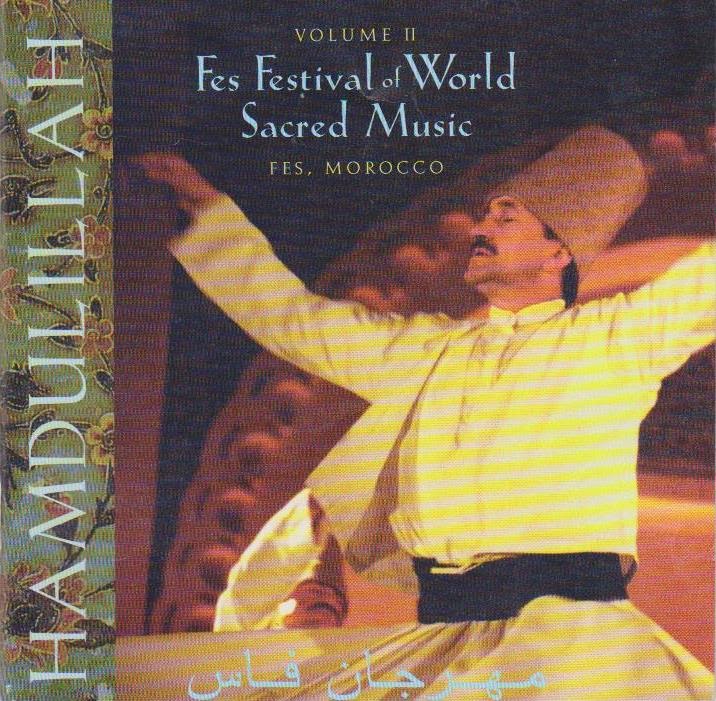
Hamdulillah: Fes Festival of World Sacred Music, Volume II


The 2015 edition of the Fes Festival of World Sacred Music in Fes, Morocco is going on right now, having started last Friday the 22nd and ending this Saturday the 30th.  Established in 1994 by Association Fes Saiss, which is concerned with "artistic preservation, international cooperation, and other humanitarian causes," the festival presents a wide array of music from around the world.  This year's lineup, for example, includes musicians from sub-Saharan Africa, Scotland, Iraq, Portugal, India, China, Azerbaijan, Spain and even the current lineup of The Temptations!

This recording consists of two discs sampling some of the amazing music from the 1997 and 1998 Fes festivals.  Musics included in the set provide a fascinating array of performers.    On disc one, featured performers include The Ahmed Piro Ensemble, representing Arab-Andalusian (medieval Arab Spanish origins) music, was joined by the impressive Amina Alaoui on vocals.  The ensemble Taqtouqa Al Jabaliyya performs Taqtouga music from the Rif Mountains region of Morocco.  Ustad Zia Fariduddin Dagar brings classical Indian vocals from the Hindustani region.  The remarkable Children of Abraham is a consortium of choirs featuring Christian, Jewish and Muslim youth.  The great Alim Oassimov, from Azerbaijan, demonstrated his remarkable vocalizations from Sufi-inspired chants.  The gorgeous voice of Francoise Atlan, of France, emphasizes Jewish Sephardic song traditions.  Albert Bouhadanna is joined by the Arab-Andalusian Orchestra of Mohammed Briouel for a performancebased on the piyyout, a Jewish music from Morocco.

The second disc includes Central Asian sufi music as performed by Monajat Yulcheva of Uzbekistan; the Iraqi maqam tradition of mystical texts and poetry performed by Hussayn Al Azami and the Al Kindi Ensemble.  The breathtaking sound of Javanese gamelan is represented by the Wacana Budaya Gamelan group.  The amazing vocalist Sharam Nazeri of Iranian Kurdistan (a people who have been much oppressed in Iran, Iraq and Turkey) is backed by the excellent Dastan Ensemble.  Finally, there is the monumental 39-minute rendering of the phenomenon of The Whirling Dervishes of Konya representing the fantastic traditions of the Sufi mystic and poet, Jallaluddin Rumi--a stunning end to a fantastic sampling of music from the two festivals.

The Sounds True label, much like the Ellipsis Arts label, has released a great deal of spiritual material of all kinds, much of which has New Age connotations.  Whatever one makes of some of this, there are some excellent recordings of spiritual musics from around the world released by the label, including a fine album by the late, great Sudanese oud master  Hamza el-Din, as well as some excellent compilations, including this one.

The quality of sound from these live productions is very good and is clear and crisp.  Notably, the hauntingly beautiful Children of Abraham performance was engineered by Steve Van Zandt, presumably the guitarist best known for his work with Bruce Springsteen, while the rest was done by another engineer.  A handsomely-produced booklet details each track with photos and information on the performers.

There is a companion volume, the first, called Bismillah: Highlights from the Fes Festival, sampling from earlier editions of the festival. Hopefully, a copy can be located and highlighted here sometime.  Meantime, anyone interested in music from the Middle East, northern Africa and central Asia would benefit greatly from picking up a copy of this stunning album.

Saturday, May 16, 2015

Horace Tapscott: The Giant Is Awakened

It's hard to believe it's been a quarter century since this blogger went to the Los Angeles County Museum of Art on a Friday evening and, before going to see the exhibits, happened to stop to hear a free jazz concert out in the museum's plaza.  There was the mesmerizing, powerful, brilliant pianist Horace Tapscott, whose The Dark Tree, Volume One was highlighted here previously.

Tapscott forsook what could have been a major career in jazz to stay in Los Angeles, work for his South Central community, raise his family, and create a number of ensembles to play his remarkable music.  While largely unknown to the public, if not to musicians, Tapscott's dedication and devotion to community was amazing.

In 1969, producer Bob Thiele, who had left Impulse Records, where he worked closely with John Coltrane and others on that major label's roster, was developing his own imprint, Flying Dutchman.  When he contacted Tapscott about recording with him, the pianist was suspicious, echoing the general concern black jazz musicians had about record labels and producers and the exploitation that was usually the case in these situations.  Thiele, however, convinced Tapscott to enter the studio and the result was the stunning The Giant Is Awakened.


Tapscott's quintet included stalwarts of his Pan Afrikan Peoples Arkestra big band, most of whom are all but unknown, including the rhythm section of bassists Walter Savage, Jr. and David Bryant and drummer Everett Brown, Jr., but the trio play beautifully and sensitively (Brown especially) behind the soloists, comprised of Tapscott and "Black Arthur Blythe," the altoist, who later dispensed with the first part of that name, but also went out to become one of the great saxophonists for the 1970s and 1980s, best known as a member of the great World Saxophone Quartet.

In fact, this album is largely an opportunity to hear some of the earliest recorded work of this master and Blythe is just staggering with his phrasing, power, clarity and confidence.  He proves to be a perfect counterpoint to Tapscott, whose command of the piano is no less impressive here than in the later records for which he had some reputation, particularly The Dark Tree live albums and the solo work he did for Nimbus West, of which some examples will be featured here subsequently.

"The Dark Tree" is, in fact, present on this recording, but in a much shorter and less awe-inspiring version than would be found on the 1989 live performances.  Instead, the title track here is the centerpiece, at over seventeen minutes, and it is actually no less impressive than the later versions of "The Dark Tree."  Much of this is due to Tapscott's writing and arranging, in which he brings out the most of tension, space, power and energy to give himself and Blythe all of the opportunities for expression in their solo work that they can give to the piece, with the bottom held firm by the rhythm section.  "The Giant Is Awakened" should have, in a better world, been more than true to its title and given Tapscott more recognition for his talents.

The too-short "For Fats" is a contribution by Blythe with its staccato rhythm and dual melodic statement by the alto and piano providing a memorable structure and then a bit of an avant-garde touch behind Blythe's keening and very impressive soloing, particularly on the second run.

The misnamed "Nyja's Theme," rendered as "Niger's Theme" is a tune Tapscott would revisit a number of times.  Here a dual-note phrase by the bass and piano leads into a statement by Tapscott with a martial drumbeat and then the memorable melodic statement rendered by the piano and Blythe's crystalline alto.  Blythe solos first and pours out a torrential fire of a solo, showing why he would become one of the greats on his instrument.  Tapscott, from the 5 minute mark on, then issues forth some of his signature soloing techniques, including dramatic block chords, the use of the sustain pedal to create atmospheric mood and uniquely angular phrasing.

Tapscott's reticence in working with a major label was such that he requested involvement in the mixing--an entirely reasonable suggestion given the care he put into every aspect of his music.  However, that promise was broken, only reinforcing the mistrust the pianist and composer felt about the music industry.  It would be a full decade before he recorded again and then only for small labels that dealt with Tapscott more fairly.

It's a shame that this arrangement couldn't have worked out better, because The Giant Is Awakened is an amazing record, assured, confident, performed with great skill and comprised of three works by the leader that showed his genius for composition and performance.  By all rights, this man should have been given some of the opportunities afforded other pianists of the time--if Keith Jarrett could have gotten an ECM behind him, why couldn't have Tapscott had something similar?

At least, we have this one masterpiece to show the talent the late, great Horace Tapscott possessed.

Friday, May 15, 2015

The Best of B.B. King: The Millenium Collection

The announcement yesterday of the death at 89 of the great B.B. King takes away one of the last of that generation of classic blues performers.  King's piercing, keening and sharp soloing and that slightly husky and emotive singing style are among the most easily recognizable in music over the last fifty plus years.

This greatest hits compilation by MCA is a brief survey of a stellar career that is mostly from material recorded from 1966 to 1976, excepting his mid-80s hit "Into the Night," which was wisely put at the end of the collection as it is obviously different in production values and intent.

You can't find a better example of the pure soulfulness of King's work than the opening track, "The Thrill is Gone," which features his voice more than his guitar.  This 1969 masterpiece is easily one of the great songs of the last fifty years.

By contrast is the upbeat "Ain't Nobody Home," where King's restrained vocals backed by a female trio and including organ, piano, horns in a bigger band, but a thinner sound.  This pleasant piece is then followed by a rollicking live version of "Let The Good Times Roll" with the irrepressible Bobby Bland working with King to take the sound to a higher level.  It's a fantastic version and King gets in some tasty soloing, as well.

The party gives way to one of the sweetest and finest ballads of King's work, introduced by a highly soulful and mournful solo backed by horns and piano in the excellent "Guess Who," from 1972.  Here, though, it's King voice that  takes center stage and his singing is just beautiful.


"I Like to Live the Love" has the horns, basslines, and, especially, the drum tuning that is pretty clearly an attempt to emulate the Al Green sound, since that soul singer was at the top of his game in 1973 when the tune was recorded.  King, though, sings with great effectiveness, even putting in a little Green-like effect on the chorus.  A nice addition, as well, is the percussion (conga drums and so on), though there isn't much guitar at all.

On 1966's "Don't Answer the Door," the first of a trio from blues central in Chicago, there is a deep blues groove with the high trebly guitar intro over an organ drone sounding like it is in another room, but it is a sweet solo to start. King's vocal is outstanding, imploring, shouting and showing the man at his best.  It's quite a contrast to the previous song and shows King at the peak of his classic blues period.

Another great live tune, also from '66, is "Sweet Sixteen," another slow blues groove where King's soloing at the start has a lower range than on "Don't Answer the Door" until he moves higher up in range and lets loose some hot licks, before his impassioned vocals, accompanied by a sax, elicit screams, yells and other loud affirmations from a highly-appreciative crowd.

The short, radio-ready, "Paying the Cost To Be the Boss," shuffles along nicely behind the short opening solo until King hits his soulful stride in his vocal.  With some tasty horns, percolating organ, a sinewy and prominent bassline and a nice steady drum beat, this is another classic King tune from 1967.

1971's "I Got Some Help I Don't Need," has a short intro with a bit of an organ solo before King launches his vocal, mixed in an interesting way, but it's great because his singing his outstanding.  The drums are also mixed in a strange way, though the crystalline cymbals work well.  It may be that the sound came out as it did because the tune was produced by Ed Michel, who did a ton of great jazz records for Impulse! and other labels at the time.

That leaves "Into the Night," which is definitely an artifact of that mid-1980s film soundtrack era.  The synthesizers, at least two of them, and the bass are jarring compared to the other pieces on the record, but there is some good soloing by the guitar master and his singing is given a blues shouter gusto, especially as he bellows out the title, that does offset to a significant degree the instrumental backing.  It's as if King knew that he had to turn up the heat on his singing to take attention away from the rest of the performance!

R.I.P. B.B.
Clearly, B.B. King enthusiasts will point to any number of proper albums or other compilations as more representative of the greatness of this outstanding blues legend.  The Best of B.B. King is, however, a good overview of a decade of some of the master's best work, even if "Into the Night" is a bit out of place.

Wednesday, May 13, 2015

Arnold Schoenberg: Chamber Symphony No. 2/Die Gluckliche Hand/Wind Quintet

Conductor Robert Craft's series of recordings of the work of the renowned modernist composer Arnold Schoenberg for the Naxos label includes this interesting combination of works showing the range of material produced by Schoenberg over a long, productive career.

The Chamber Symphony No. 2 was begun in 1906 when the composer was in his early thirties and the first of the two movements bore the hallmarks of the romantic approach to lush melodies and fairly standard harmonies of the era, but with a new ending and different instrumentation when Schoenberg completed the work in 1939.

The second and longer movement, however, is reflective of the changes in the composer's approaches in the three decades since his first attempt.  In a rapid allegro tempo, the movement emphasized polyphony, a syncopated rhythm and a complexity that makes the performing far more challenging from the musicians than the simpler first movement.

A "drama with music," the four movement "Hand of Fate" from 1913, just after Schoenberg's famed "Pierrot Lunaire.  It was an impressionistic pantomime for two silent performers, the main being "The Man," or Schoenberg as an artist, who confronts the ego and its desire for fame.  The opening scene finds a Greek-style chorus offstage mocking "The Man" for his blatant desires as he lies outstretched on the stage.

A woman then appears with a goblet for the man who, taking the drink, does not acknowledge the woman, who then leaves with another man, but later returns, before once again departing.  This mirrored Schoenberg's painful experience of having his wife elope with an artist, who then hung himself, and the spouse, at the urging of the composer's student, Anton Webern, returned to her husband.


In a third scene, the man finds a goldsmithng operation in a cave and determines to do the work better than the workers there.  In so doing, he inadvertently creates a jeweled crown of incredible proportions while crushing the anvil in the shop.  As he gives the object to the stunned workers, they attack him.  Suddenly the woman and the third man she'd left with earlier return and the female ascends a high mountain with the artist in pursuit.  From the pinnacle, however, she flings a large rock down and crushes the artist.

In the final scene, there is a return to the beginnings of the pantomime with the chorus again mocking the prostrate man.

The symbolism is also musical with the artist representing Schoenberg's new method of composing (serialist, twelve-tone row) crushing the tonality of tradition (the anvil) and revealing the crown (atonal music), which he attempts to give to the workers (composers trapped in old forms) who, of course, attack him for his impudence.

Speaking of which, the Wind Quintet of 1923-24, finds Schoenberg deep in the early stages of his serial development, composing a symphonic sonata in four movements that stretches for nearly forty minutes.  Between the new sounds expressed in twelve-tone form, the length of the work, and the fact that it is a technically demanding piece for the tempos involved, this work contrasts significantly with the others.

Adjusting for the atonal form of hearing twelve tones, rather than a piece developed around a single note (or tone, expressed as the tonic), ordered in a row called a "basic set," which forms the basis, but is not the entirety, for the piece, as the tones relate to one another without a dominant tonic.

There is a richness, nimbleness, and range of fascinating instrumental contrasts in this work that can be very rewarding, even for amateurs who don't fully appreciate the systemic concepts embodied in the serial technique.  There is no question, even for the untrained ear, that the dispensing of traditional tonal and harmonic approaches gives the music a more "open ended" form that, to this listener, finds the "speech patterns" among the various instruments compelling and intriguing.

This disc is an excellent survey of different aspects of Schoenberg's evolution as a composer over a thirty-plus year timespan, carried out by Craft's passion and expertise in developing the project of recording all of Schoenberg's published pieces for Naxos.

Sunday, May 10, 2015

Global Meditation: Authentic Music from Meditative Traditions of the World


So, the title sounds very New Age-y and the label, Ellipsis Arts, which issued this four-disc box set in 1992, was devoted to products that emphasized the deeply spiritual in a highly earnest, if dated, manner.

However, the musical content and the sound quality of Global Meditation is top-notch.  The set is divided thematically, with the first disc dealing with "Voices of the Spirit: Songs and Chants."  From Norway, Albania, Australia, Bali, Hawaii, the pygmies of Central Africa, Japan, Tibet, and Russia are a broad array of vocal music that, philosophizing aside, represent a fantastic cross-section of sounds from around the world.

The second disc, "Harmony and Interplay: Ensembles," takes on large group performances from the Gnawa of Morocco, gamelan from Java, African group playing, the amazing Nusrat Fateh Ali Khan and Pakistani qawwali music, and Indian and Egyptian pieces, as well.  Putting gnawa, gamelan and qawwali on one disc is reason enough to hear this amazing music.

"The Pulse of Life: Rhythm & Percussion" provides a wide range of pieces that should make any percussion lover very happy.  African, Indian, Haitian, and Japanese taiko ensembles predominate here, with a New Age selection by Glen Velez tossed in, though it is a pretty good piece.

Finally, the box ends with "Music of the Heart: Melody," including works Ireland, Turkey, Korea, India, Armenia, China, Egypt and Japan showcasing instruments like the Celtic harp, the Indian bamboo flute, the duduk, and the shakuhachi, among others.  Much of this is solemn, contemplative and very beautiful melodic work.

There is a 32-page booklet giving concise, but very useful, information on the performances, players and traditions from which they developed, as well as some photos of musicians.   Compiler Brooke Wentz and associates did a remarkable job in finding and licensing from many record labels such a diverse range of material and, as explained in the booklet's introductory note, should be congratulated for doing so despite the project representing "a sizable task for our lean staff."

Global Meditation is a great survey of some of the world's most interesting and compelling music.  For those not spiritually oriented, but are interested mainly in the musical quality of the set, there is a bounty of great performances here that are well worth hearing if a copy can be located.

Thursday, May 7, 2015

Funkronomicon: Axiom Funk

Courtesy of the prolific and diverse Bill Laswell came this 1995 release on his Island Records-distributed Axiom imprint, highlighting a varied selection of funk-related music comprised of some previously-recorded tracks and material that had not been released.

With its fundamental contributions from keyboardist Bernie Worrell and bassist Bootsy Collins and an appearance on one track by George Clinton, the lineage with Parliament-Funkadelic is clear, but there are also elements representative of new formulations shepherded by Laswell that add to the appeal of this masterpiece.

For example, who else other than Laswell could get reggae rhythm legends Robbie Shakespeare (bass) and Sly Dunbar (drums) to appear with Clinton and Collins, as well as jazz pianist Herbie Hancock and alto master Henry Threadgill, all on one tune, "Under the Influence (Jes Grew)?  How about violinist Lili Haydn and the amazing guitarist Buckethead teamed with Collins and Blackbyrd McKnight (formerly with Hancock's Headhunters, P-Funk, Red Hot Chili Peppers and others)?

In addition, you've got among the last recordings of the phenomenal guitarist Eddie Hazel, the great alto sax player Maceo Parker, the amazing guitarist Gary Shider, a rare appearance from Sly Stone, Abiodun Oyowole and Umar bin Hassan from the legendary Last Poets, organist extraordinaire Amina Claudine Myers, and other fine musicians added to the mix.


Finally, what would an album like this be without the artwork of Pedro Bell, who illustrated so many classic P-Funk covers?   From the front cover image shown here, to a fantastic collage of images on another panel to the hilarious cartoon "Funkcronomixx: Wot Da Hell Is up?!", the use of Bell's work is a perfect capstone to a great album and it is worth noting that, in the credits, after Bell's listing is the phrase, ". . .And may we be forgiven for we know not what we've done."

A short essay (statement) on Funkcronomicon (a play on Necronomicon), employing clever wordplay, playful nonsense, a nod to the late Eddie Hazel, and possibly a hint of seriousness about what funk can do to shake up a complacent, overly-ordered and jaded word is attributed to Sir Lleb of Funkadelia!

Considering that the funk embodied by Clinton's Parliament-Funkadelic collective had its heyday in the late 1970s, Laswell's embodiment of "collision music," in putting together so many diverse musicians on Funkcronomicon nearly twenty years later is an impressive achievement.  Those expecting a rehash of the prime P-Funk era will be disappointed, but that would be the easy way out.  Channeling the spirit of the collective while moving the music in new and compelling directions is what makes this album so good.

As the label on the packaging calls it, this is music "probing the depths of futuristic funkadelia."  It is a great recording from Laswell and his P-Funk and other partners.

Sunday, May 3, 2015

John Zorn: Voices in the Wilderness

Last night was an event a quarter century in the waiting--the opportunity to see John Zorn and Bill Laswell live.  Saturday was a marathon for Zorn, who had a series of performances at the Los Angeles County Museum of Art during the day and then an evening of concerts at U.C.L.A.'s Royce Hall.  The latter featured Zorn compositions performed by Abraxas, Secret Chiefs 3 and Bladerunner.

The first group was led by bassist Shanir Ezra Blumenkranz and included a duo of dueling lead guitarists and a blisteringly fast drummer while Blumenkranz held down the bottom with his bass and the Gnawa instrument, the gimbri, on a couple of pieces.  The band generated huge amounts of fast, loud and virtuosic energy, broken up on occasion by slower, quieter passage, and were well-received.

Secret Chiefs 3 is led by guitarist Trey Spruance, formerly of Mr. Bungle and Faith No More, who led an sextet with a keyboardist, bassist, drummer, second guitarist and violin and, while the volume and speed were usually milder than that of Abraxas, the musicianship was remarkable and there was still plenty of powerful playing.  This group got more of a response, possibly because there were a number of Faith No More and Mr. Bungle fans in the audience.

Then came the headlining Bladerunner, with Zorn on alto, Laswell on bass and former Slayer drummer Dave Lombardo.  Given that Zorn and Laswell's Pain Killer is a well-known project, mainly with ex-Napalm Death drummer Mick Harris, comparisons were obvious for those familiar with that earlier group.  Lombardo, however, is a supremely-talented drummer, who could not only provide sheer energy, volume and force, but has the technical facility and agility to give a more complex percussive backing for both Zorn and Laswell.  The bassist employed several types of playing on his instrument using a bank of effects pedals and his techniques were familiar to those who know his work.  Laswell and Lombardo provided a huge bottom that rattled seats and bodies for Zorn to explore the full tonal range of his instrument.

And that he did!  At 61, Zorn shows no sign of slowing down as a composer and performer.  He wailed, screamed, honked and blew with tremendous power and employed his circular breathing techniques to display his staying power.  There were times, however, when the music slowed down, Lombardo relied on complex cymbal work and Laswell simpler bass lines and Zorn played more melodically and showed fantastic control and coloration.

Maybe there'll be a live recording coming from this "Triple Threat," as it was known, because it would be great to have a document of this stunning concert from three amazing ensembles.


Meantime, over the last few days, while working out in the home gym and doing yardwork, this listener had the pleasure to revisit Zorn's masterpiece, Voices in the Wilderness, a 2003 double-disc release on the composer's non-profit label, Tzadik.  This staggering recording features two-dozen pieces from the Masada songbook and represented the second of five releases commemorating the tenth anniversary of the project which marked Zorn's rediscovery of his Jewish heritage.

Each of the pieces was arranged by friends and musicians of the composer and the stylistic range, instrumentation and approaches in arranging are really something to behold.  Moreover, the performances by the many musicians are just remarkable.

Blumenkranz's group, Pharoah's Daughter, pianist Uri Caine's trio, the trio of Medeski, Martin and Wood, altoist Peter Apfelbaum, pianist Anthony Coleman, tenor player Larry Ochs, keyboardist Wayne Horvitz, clarinetist Chris Speed, vocalist Jewlia Eisenberg, bass clarinetist Marty Ehrlich, guitarist Eyal Maoz (who was fantastic with Abraxas last night), laptop electronics player Ikue Mori, vocalist Mike Patton, percussionist William Winant, guitarist Nels Cline, keyboardist Jamie Saft and drummer Kenny Wollesen are among the dozens of musicians whose work is represented on this standout album.

Zorn had not played in Los Angeles since 1990, the year this blogger got into his music, and Laswell has not often appeared in this area over the years either, so last night was a "bucket list" type of evening, with the added pleasure of hearing the high caliber of performers in Abraxas and Secret Chiefs 3.

Wednesday, April 29, 2015

Albert Ayler: Spirits Rejoice


This entry is in response to the death on 19 April of Bernard Stollman, the attorney who founded ESP-Disk in response to hearing the amazing Albert Ayler perform live in 1964 and told him he was founding a label and wanted the tenor sax player to be his first artist.

Stollman, whose first release on ESP-Disk was actually a record about Esperanto, the universal language that has never caught on, liked to advertise that with his label, "the artists alone decide what you hear on their ESP-Disk."  And, however true that may have been, the label recorded some of the most expressive and off-putting (to most ears) of the so-called free jazz players from the middle and late sixties.  Ayler was perhaps the most notorious of them.

Stollman, however, was roundly criticized from musicians who recorded for the label and found themselves receiving little or no royalties and having no control over their music.  At the same time, the label made so little money that it was closed after about a decade, though revived again in 2005.  This version of Spirits Rejoice was issued in 2012 with a new design and layout and remastering.

Recorded at Judson Hall in New Tork on 23 September 1965, Spirits Rejoice is a prime example of Ayler's peak ecstatic phase, in which the songs largely revolve around spiritual themes exemplified by references to martial, New Orleans, R&B and other genres.  In a rare occurrence, another sax player, altoist Charles Tyler, recorded with Ayler, whose brother Donald also marks his debut as a rather raggedy, but very emotional, trumpeter.

The three horns are generally either playing the strangely uplifting themes or tearing into powerful solos, but they sound quite harmonic in the former, while moving in different directions, but with an ear to each other, into the outer limits of jazz on the latter.

Meanwhile, the remarkable Sunny Murray, eerily moaning most of the way through, plays his drums with the kind of meterless freedom that allows the soloists to play however they'd like, while keeping a sense of order to the proceedings.

The drummer is joined by bassists Henry Grimes and Gary Peacock, who are often not heard well in the mix unless soloing, even with a good remastering job.  This is a bit of a shame because both played often with Ayler and knew how to use their instruments, particularly Peacock, in the service of the music.

On at least one piece, "Angels," Ayler pairs up with the much older harpsichordist Call Cobbs, whose instrument was often used in pop, rock and jazz in the Sixties and sounds quaint, yet oddly appealing.  The again, hearing enough of Ayler's music and its obsession with spiritual concerns, Cobbs' playing does have an uncanny way of harmonizing with the somewhat maudlin melody of the piece.

Through Bernard Stollman and ESP-Disk, much of Ayler's best and most challenging work was released (even if Ayler received very little money for his work, if the accusations against Stollman are true) and we are fortunate to have the documentation of music from one of jazz's most intriguing musicians.  Throughout, Ayler's huge tone, melodic simplicity, utter sincerity, and his frenetic and fantastic solo work present him as one of the era's most distinctive performers.

Tuesday, April 28, 2015

Franz Schubert: Trout Piano Quintet/String Quartet in A Minor


In addition to immediately being drawn to the music of the great Franz Schubert back when discovering him in 1990, this listener was particularly attuned to the work of the Austrian master in 2008 for a variety of reasons.

Schubert only lived thirty-one years, but was similar to Mozart and his contemporary Mendelssohn in being a prodigy and prolific.  This Durkin Hayes-released album by the British Royal Philharmonic Chamber Ensemble, recorded early in 1994, presents two of the composer's best-known chamber works.

The gorgeous, stately and highly emotive melodies of the Piano Quintet in A Major, known as the "Trout", was completed in 1819 when Schubert was 22, but was not published until 1829, the year after his death.  In addition to the time-honored beauty of the melodies and harmonic richness of the score, there is the matter of the unusual instrumentation and structure.  The name derives from the piece's connection to a lied (song) called "The Trout" that the composer used in the fourth movement.

Normally, works like this match the piano to the standard string quartet of two violins, viola and cello, but Schubert removed one of the violins and inserted a double bass instead, which provided a deeper, richer bottom end that worked particularly well with the slower, more somber aspects.  Moreover, the composer  wrote the piece in five movements, instead of the usual four.  This allowed him to develop more variations on themes and, because of the wealth of wonderful motivic material found in the piece, the expanded movement structure gives the listener that much more to enjoy.

The "Rosamunde" string quartet, in A Minor, is another masterpiece with a series of gorgeous melodies that have endured.  Achingly beautiful and simple, the theme is followed by a section with a strong sense of drama and tension, one anchored in a deep wellspring of emotion.

The composer had his upbringing in a musical family that performed chamber music at home and he began writing fine string quartets at a young age (not unlike Rossini).  Of the numbered set of fifteen quartets attributed to Schubert, the A minor is the thirteenth and often called the "Rosamunde."  It was completed in the first months of 1824 and was not as popular in later years as his epic "Death and the Maiden" which was completed at the same time.  Yet, it was the only of his quartets published in his lifetime.

The name "Rosamunde" came from the fact that part of the piece was extracted from a song included in Schubert's incidental music for a play of that name and included in the slow second movement.  In terms of his amazing knack for highly lyrical themes, sense of powerful dynamics and complex textures, Schubert, in the "Rosamunde", creates a masterpiece that, coupled with "Death and the Maiden" set a high standard for the string quartet form.

Saturday, April 25, 2015

Navajo Songs


Earlier this month, a trip to New Mexico and Colorado included an excursion to the Four Corners Monument.  While there was plenty of the obligatory posing for photos with hands and feet in each of the states of Arizona, Colorado, New Mexico and Utah, there was also a chance to browse the stands of Indian artists and purchase some nice examples.

However, because the monument is on the sovereign lands of the Navajo people, it was also a reminder of one of the more interesting recordings issued in 1992 by the Smithsonian Folkways label, Navajo Songs.  This album, in a cassette version, was first purchased by this blogger shortly after its release and had a big impression then.  A repurchase on CD a couple of years ago reinforced that perception.

This is because these recordings, made by Laura Boulton in 1933 and 1940, are about as close as we can get to authentic tribal music before the introduction of "modern" instrumentation and, as one critic noted, before associations with "cheesy new age music" became standard!

There are fourteen tracks on this album, with the first half-dozen coming from the Yeibichei ritual ceremony that, the detailed and highly informative liners observe, involve "groups of about a dozen masked dancers who impersonate male and female deities . . ." and are composed of "chanting, sandpainting ritual, prayers, and prayer offerings."  Dancers use gourd rattles and sing in hauntingly beautiful, energetic and powerful ways.

There are also two songs that were performed to accompany corn grinding, one purely with vocals and the other with the accompaniment of someone beating rhythms on an overturned basket.  Notably, the singers were men who performed to make the hard work of grinding more palatable for the women who did these tasks.

Another set of four songs are from the Enemyway ceremony and deals with songs that involve combating the influence of souls of dead enemy fighters, such as the Pueblo Indians of Taos, New Mexico, east of Navajoland. or monsters who were affecting human lives.  Interestingly, modern versions have dealt with the problems Navajo soldiers had in the American armed forces or have been exposed to non-Navajo spirits.

There are two collections of sway songs, with percussive accompaniment on water drums and water-filled clay pots, and are so named because the performers swayed from side to side while singing.

These are followed by two groupings of circle dance songs, performed to chase out bad spirits and there is an element which mimics the return of a chief who had attacked Taos and then shared the booty he confiscated and shared it with the women at home.  The singing is followed by a statement about how performers shared money with their dancing partners in recollection of the historic return from battle.  All of the above were recorded in the 1940 sessions.

Finally, the remaining pieces accompany the moccasin game, an ancient gambling pastime, in which participants sing songs like those on this recording to accompany the game.  This involved having a quartet of moccasins on the floor of a hogan between two teams.  One team covers the shoes while a member places a stone or ball in one of them and the other team has to guess in which shoe the object is located.  There were hundreds of songs that were performed during the games, ten of which are provided on the disc.  The moccasin songs here came from the 1933 sessions.

Navajo Music is not just a valuable historical document of Indian singing and performance, but also reflects the fact that most music by our ancestors was based on everyday activities concerning religious and spiritual practice, work, and play.  Music was more directly connected with daily events and rituals, not as abstracted as it is for many societies today.  Laura Boulton is to be remembered for her preservation of these recordings from 75 and 80 years ago and Smithsonian Folkways thanked for its curating of this and other remarkable recordings.

Friday, April 24, 2015

Julius Hemphill: Five-Chord Stud

The great altoist and composer Julius Hemphill had a heart condition that cut short his life at 57 and he was unable to play on this fantastic Black Saint recording from November 1993, though he composed and conducted all the pieces by a sextet composed entirely of horns.

The overall sound is reminiscent of the amazing World Saxophone Quartet, of which Hemphill was a key composer and performer until his health worsened.  The amazing altoist Tim Berne, a Hemphill acolyte; baritone sax player Fred Ho; tenors James Carter and Andrew White; and altoists and soprano sax performers Marty Ehrlich (a longtime Hemphill associate) and Sam Furnace play together beautifully and are fully in tune with Hemphill's pieces, which he conducted.


The interplay is something and Hemphill's ability to work in his composing to blend and contrast the tonal range of the various saxes is something to behold.  Some pieces are bluesy, others more abstract, but the writing is sure and steady and the performances highly sympathetic to Hemphill's compositional characteristics.  Soul, blues, free jazz and other elements abound with a couple of the pieces being really "out," while others having a welcoming accessibility even without traditional rhythmic accompaniment from a bass, drums, piano and the like.

Two pieces were listed as collective improvisations with no individual soloing, while a third had a trio improvisation by Ehrlich, Furnace and Carter and then a group improvisation.  The other six tracks featured at least one soloist and up to five, as in the title track.

Five-Chord Stud was also one of five Hemphill albums rereleased as part of a Black Saint box set repackaging and it is a highlight of the set and his career generally.  Even if too ill to play, his distinctive writing and arranging is keenly heard throughout and Berne, Ehrlich, Carter and White in particular are exceptional.

Tuesday, April 21, 2015

The Rounder Records Story

For sheer volume, the 25th anniversary box set, The Real Music Box, issued in 1995 by the amazing Massachusetts label, Rounder, is pretty tough to beat for value, as it includes four double-disc sets on Louisiana-based, blues, folk and bluegrass music, plus a bonus disc with a wide variety of material on it.

However, the 40th anniversary four-disc compilation, The Rounder Records Story, is highlighted here because, though it offers less music, it does provide overviews by each of the four decades, including, of course, material from the latter half of the 1990s and the 2000s, giving a different kind of range of the prodigious and diverse output of this exemplary record label.

The other attraction to this set is that, by going through the four decades, the music is intermingled, so that a bluegrass piece is followed by a zydeco tune, which then is followed by a blues song and so on.  That kind of sequencing is more jarring and gives something of a different sense of adventure to the listener than music organized around a genre (this is, by no means, a big knock on The Real Music Box, which is a real pleasure to listen to, as well.)


Starting from a song from its first artist, bluegrass legend George Pegram, up through material by Robert Plant and Alison Krauss, and from the Holy Modal Rounders to Rush, and from Buckwheat Zydeco to George Thorogood, the music may be highly differentiated in sound, but there is one characteristic that spans the whole set.  That is the absolute devotion of the founders of Rounder to present American "roots" music in all of its diversity and quality.  Well, not quite all American--there is a song from African kora master, Alhaji Bai Konte  and another from the great Jamaican reggae outfit, Culture (the albums from which these songs came were favorites of this blogger back in the early 90s, but were on cassette--CD versions are hard to come by.)

It's hard to pick out highlights, but there are some standouts, including the amazing but troubled piano James Booker and his "Classified"; the amazing The Three Pickers of Earl Scruggs, Doc Watson and Ricky Skaggs in a stirring live "Roll in My Sweet Baby's Arms"; teen sensation Mar O'Connor's "Tom and Jerry" from the mid-70s; a great "Down to the Wire" by Son Volt; the intricate lyrics of Bill Morrissey in "Birches"; Plant and Krauss's "Please Read the Letter"; anything Krauss, actually; Thorogood's popular version of "Who Do You Love"; "La Porte Dans Arriere" by D.L. Menard and the Louisiana Aces; Bela Fleck's banjo workout, "Whitewater"; the strange, but really pleasurable "Tipitina" by Professor Longhair; Charles Brown's "A Virus Called the Blues"; Linda Thompson's beautiful "Versatile Heart"; Tish Hinojosa's plaintive protest song, "Something in the Rain"; and the aforementioned Alhaji Bai Konte's "Jula Jekere" and Culture's "Babylon's Big Dog."

Again, though, there are dozens of great songs in this set of 87 tracks, but the biggest takeaway from this set for this listener was the material relating to bluegrass and Cajun and other Louisiana-based music.  This is simply because these arenas of music were not familiar at all, as opposed to the blues, rock, folk and other forms represented.  The quality of the performances by so many violinists, banjoists, horn players and singers is uniformly excellent and opened this blogger's eyes to large swaths of American music that had, regrettably, been unheard before.

So, kudos to Rounder for 45 years of great work and for issuing box sets that really give a nice cross-section of the immense music the label has issued over the near quarter century since its very modest start in 1970.

Sunday, April 19, 2015

John Adams: The Death of Klinghoffer

At the time this opera premiered in March 1991, the United States had just unleashed the firepower of the first Gulf War on Iraq, but the searing memories of the murder of Leon Klinghoffer by Palestinian terrorists on the cruise ship Achille Lauro were all-too-fresh and the accompanying controversy overshadowed just what a beautiful, haunting and poignant work this piece is.  The CD release was on Nonesuch Records, the longtime label of Adams' highly-interesting and varied work.

Working with librettist Alice Goodman and director Peter Sellars (the choreography was by Mark Morris), who collaborated with Adams on his somewhat lighter first opera, 1987's Nixon in China, the composer delivered a masterpiece of power, tension, a wide range of dynamics, emotion and contemplation.  Over time, resistance to the idea of performing the piece has gradually lessened among many, though, understandably, a great many Jews are loath to support the work because it does give voice to the hijackers.


The work's connection to the Bach Passions, its use of dual roles for performers, the presence of choral prologues and at the end of the scenes, and a direct reference to Satie's Gymnopedie hearken back to time-honored traditions of music and stage performance from the ancient Greeks on.  In the hands of Adams and Goodman, a definite modern twist is put into the composition that recognizes antecedents, while looking forward.

It is notable that the work ends with the very powerful and moving lament of the widow Marilyn Klinghoffer, whose vocalized responses range from tender to fiery and full of love for her murdered husband to anger to the ship's captain and rage against her husband's killers.  Hearing the work and reading the lyrics, it is hard to imagine how the opera could be seen as any kind of mitigating apologia for the horrible acts perpetrated by the hijackers, though some of the points raised on behalf of the Palestinians do provide some sense of balance.  It was (and, for many, is) the emotion behind the heinousness and cold-bloodedness of the crime and the eternal conflict it represents that generates the strong feelings about his masterful work of art.

As noted above, twenty-five years on, The Death of Klinghoffer is gradually becoming staged more frequently and Adams and Goodman afforded more positive recognition for the excellence of their work.  Just last October, the work received its first performance at the Met in New York, but not without heated criticism of the institution and its Jewish general manager, as well as of Adams and Goodman and on-the-spot acrimony directed by protesters at attendees.

An excellent review and essay about the performance in The New Yorker is really worth reading as author Alex Ross spends considerable time addressing protests, as well as the performance and the piece, noting that there is nothing in The Death of Klinghoffer that "supports" the murder or the perpetrators.  What Ross does perceptively point out is that the Klinghoffers don't appear until Act II, while the Palestinians take up a considerable amount of the first act--this, Ross speculated with good effect, might be at the heart of much of the anger directed toward the composer and librettist.  Moreover, Ross highlighted the powerful end as represented by Marilyn Klinghoffer and offered the interesting observation that the orchestral aspect of the work was as important as the vocal.

Click here for a link to this very fine article.

Tuesday, April 14, 2015

Hindustani Classical Vocal

This triple-disc box set issued by the UK-based label, Nimbus Records, features three-and-a-half hours of spellbinding, evocative and expertly sung and played vocal music from the Hindustani classical tradition of northern India.  Highlighted are three legendary female singers:  Sulochana Brahaspati, Girija Devi, and Shruti Sadolikar, who are each given a disc of at least sixty-five minutes to show their amazing talents and vocal gymnastics.

As typical for this breathtaking style of music, the ragas tend to start slow and, anchored by the drone of the tambura and occasional striking of the tabla, atmospheric. For the longer pieces, lasting in one case nearly an hour, the gradual buildup of tension and tempo is a wonder to behold, at least for those with the patience to listen that long.  Something of a concentrated effort on listening to the unfolding, however, is well worth the time invested.


Brahaspati, now approaching her eighties, is given that one-hour Raga Bilakshani Todi to demonstrate the full range of her impressive vocal prowess, and her miniature (well, at sixteen minutes in comparison to the first piece) Raga Mishra Bhairavi is also a tour-de-force.  Recorded at the Nimbus Records studio in England in late September 1991, the then 57-year old vocalist has a deeper voice than her compatriots, and is accompanied by sarangi player Sultan Khan and tabla performer Anindo Chatterjee.

Shruti Sadolikar is much younger, though now in her mid-sixties, and is from a subsequent generation than the other women on this set.  She has two longer ragas, the Miyan-ki Todi and the Bibhas, the former being over thirty-five and the latter twenty-seven minutes in length.  She concludes with a shorter fourteen-minute Raga Bhairavi.  Anand Krishna Kunte plays the sarangi, Chatterjee is again on tablas, and there are two tambura players, Uma Mehta and Kamaljit Kaur.  This disc was recorded at the end of February 1992 in France.

Finally, there is Girija Devi, who was recorded at the Nimbus studio, a couple of weeks after Brahaspati in October 1991.  Her first raga, the Maru Bihag, is just over a half-hour.  She has by far the shortest piece in the set, the Raga Desh at just under seven minutes, followed by the sixteen-minut Raga Pilu and the eleven-minute Dadra.  Devi is accompanied by tambura player Sudha Datta, tabla performer Subhen Chatterjee, and Ramesh Misra on sarangi.

While not as well-known as the instrumental music embodied by such internationally-acclaimed performers as Ravi Shankar, Alla Rakha, Ali Akbar Khan, and Zakir Hussain, the female vocalists featured on this box set are as technically breathtaking and emotionally evocative as their male instrumental counterparts.

Tuesday, March 31, 2015

Anthony Braxton: Quartet (London) 1985


This remarkably original saxophonist's music has often been viewed as too difficult, obtuse, impenetrable, dense, cerebral and daunting and, to a great extent, it is not too hard to hear why.  Braxton's ideas about music, its place in the world (or, rather, universe), its possible structures and concepts and his way of explaining and expressing can be bewildering.  But, they can also be exhilarating, as the musicians on this London recording from Fall 1985, released on CD on Leo Records in 1990, demonstrate through their interplay and sensitivity in applying Braxton's ideas.

For this listener, however, a great deal of the excitement is in trying to understand and, at the same time, to feel what Braxton is trying to say in his amazing and widely varied body of work.  A few years ago, Graham Lock's Forces in Motion was avidly read, as Lock followed the quartet on its short English tour and had the opportunity to see the ensemble perform, discuss music with Braxton and his fellow musicians, and then attempt to explain some of the more esoteric notions of the evolving body of work of this true original.

As explained by Lock in the book and, in digest form in the liners, Braxton's music in the mid-1980s was grounded in what was called "pulse track structures."  Explained as an alternative to traditional vertical harmony, the idea was to have "a sequence of notated materials interspersed with brief, five to ten-second spaces for improvisation" by the rhythm section (here drummer Gerry Hemingway and bassist Mark Dresser), "while the remaining two players (in this case, Braxton on all manner of horns and the great Marilyn Crispell on piano) either improvise or execute other notated material.

In some cases, a Braxton piece has pulse tracks integrated into the work, while elsewhere, a song has independent pulse tracks added to it.  There are not only varying lengths in the pulse tracks, but there could be standard notation for musicians to play or abstract drawings, somewhat akin perhaps to the impressionistic song "titles" that identify most Braxton pieces, that can be reinterpreted.

Lock observed that there was a precursor called "sound attacks" dating to Composition 23G from 1975, "in which the bass and drums suddenly come together at widely-spaced, notated points."  From this, Braxton felt that "something was happening which could really be extended," and this led to the pulse track structure concept.

Another component was that earlier Braxton compositions could provide impetus for pulse tracks application, especially pre-existing duo pieces that could be worked into newer works as pulse tracks.  From this, there was the development of other concepts, the "collage form structure" and the "universe structure."  With these, the quartet could simultaneously perform two to four Braxton works, both in planned solos as well as at other points, such as the accompaniment to a soloist.  By introducing these varied structures into the quartet's repertoire, Braxton had another name: "multiple logic music."

He also had another interesting and cosmic analogy:  the pulse tracks operate as orbits around different planets as a "solar system music," while the universe built by the multiple logics of performing several pieces at once wind up being a "galaxy music," with the solar systems operating in one broad sound space.

There are other structures, as well, including "transitional collective improvisation," as the group moves from concept to concept; "extreme intervallic distances," or quiet spaces between intervals; "chromatic phase formings,"  having to do with accidental notes outside the pervading scale used in a piece; "a static time/space block structure," in which continuous music involves, in Braxton's words, "a constant rotation of events juxtaposed against each other, like a puzzle that can go together in any order," implying the reusing of musical material in whatever way makes logical sense; and "signature logics" for recurring notated elements that become signposts within the changing soundscape.  There's much more, but the idea is that Braxton has constructed fully-integrated and blindingly complex structures that have evolved over the course of his long career.

Lock also noted that Braxton's live work had lately been continuous and uninterrupted, with, however, identified pieces labeled as "primary territories," including two variations of Composition 40, which was a mainstay of the quartet album highlighted on this blog a couple of years ago.  These "primary territories," then were interwoven and interacting with snippets of other compositions that could come and go whenever needed.

What is truly amazing is how fully well-schooled Braxton's compatriots had to be in order to so quickly move through the "primary territories" and the bits and pieces of the other works and to choose when, where and how to use the varied material available to them.  Crispell, often viewed as a Cecil Taylor acolyte but who is far more than this, performs with great flexibility, agility and creativity.  Hemingway is listed as a percussionist, rather than a drummer, for very good reason, as his playing reflects a nuanced approach to a standard drum kit in terms of tone, color, and texture, as well as rhythm.  Dresser is simply remarkable--never looking to do anything but fully integrate with his fellow musicians, while providing a range of sound to accompany Braxton and Crispell and establish constantly shifting rhythms with Hemingway.

Braxton's preoccupation with reworking structure, developing new models for sound, and systematizing his complex ideas is rooted in his conception of music as a force enveloped in unrevealed mystical notions as well as philosophical and political ideas which he has expounded upon over the years.  As Lock noted, Braxton's publishing company is called Synthesis Music for a reason: the composer sincerely believes that his music is synthesized with his views of universal philosophical, political, and, evidently (as hidden) mystical beliefs.  As Braxton once stated, "what you hear and how you organize and unify, in terms of how you hear, is very important to how you are."

That last statement is, actually, quite clear, if not specific.  Lock wrote that the synthesis of music and philosophy (or religion) has been explored in many societies throughout the world.  Perhaps our post-Enlightenment world has blunted the linkage of music and spirit/soul/whatever?  Yet, Braxton's allegedly forbidding music has many of the same underpinnings of John Coltrane's late explorations that made direct allusions to space and mysticism, or Albert Ayler's ecstatic cries embodied in "music is the healing force of the universe," (which was an album title for the late altoist), or other similar identifications of music with mysticism.

Lock concludes his extremely helpful notes, however, by stating that, however a listener approaches the formal structures of Braxton's "difficult" music, "once the quartet hit[s] that first note you need only to listen to hear a music that challenges, inspires and is vibrantly alive in all the corners of its sonic cosmos."  To paraphrase the most helpful advice on listening to "difficult" music this blogger has encountered, courtesy of Donald Ayler, brother of the aforementioned Albert Ayler, "try to follow the sound, not the notes."  Even if Anthony Braxton has formulated a body of music that is dizzyingly complicated, listening to his work need not be confusing or difficult or forbidding.  With the masterful musicians working with the composer on this dual-disc live recording from thirty years ago, the approach to Braxton should not be so daunting.  Challenging, yes, but also highly rewarding in its order, beauty, variety and expressiveness.

Sunday, March 29, 2015

Robert Fripp: Exposure

In July 1974, having finished the recording of the remarkable Red, Robert Fripp dissolved King Crimson, fully intending to never resurrect the band.  He made the amazing Evening Star with Brian Eno in 1975, but largely left music aside while attending to self-improvement.  This was during the period when rock was overwhelmed by the rising tide of punk, which, in turn, flamed out quickly.

Somehow, Fripp made the prescient decision to relocate to the Hell's Kitchen area of Manhattan in New York City, which was the ferment of a music scene that included Richard Hell and the Voidoids, Television, Talking Heads, Blondie and many others during those final years of the Seventies.  He states in the liners to Exposure that he fully intended to avoid music making because of frustration with industry greed, ego and other negative attributes.

In 1977, however, Eno and David Bowie called with a request for Fripp to travel to Berlin and record some guitar parts for a tune on a Bowie album.  On the title track of Heroes, Fripp recorded an amazing and distinctive guitar line that energized the song and his own career.

Part of the new trajectory was Fripp's emergence as a producer and he worked with Peter Gabriel on his second self-titled solo record, the Roches on their debut, and, surprisingly, white soul singer Darryl Hall on his first solo recording while on a break for the highly-successful Hall and Oates.  The original notes to Exposure indicate that Fripp's solo effort was the last of a trilogy including the Gabriel and Hall records and, sure enough, those two made significant contributions to the album.

So did Hell's Kitchen, New York City in general, and the music scene there.  Exposure is a stunning break from the environments in which Fripp worked from 1967 to 1974 and represent a bold leap into the future that was unlike anything his contemporaries had and have done (Robert Plant's more recent solo and collaborative work might be one of the few exceptions.)  It is also described by its creator as autobiographical as he attempted to find a new place for himself in a radically changing music world, but one, that for a brief period, in the post-punk world allowed for some self-development.  Or, as Fripp liked to call it--a drive to 1981 as a "small, mobile, intelligent unit."


Fripp's production work on Hall's Sacred Songs did not meet the approval of Hall's agent or label, which fretted about its lack of popular appeal and imposed stringent condition on its release and, as well, on Hall's contributions to Exposure.  The 1979 release of the latter, then, involved changes necessitated by those conditions.  A 1985 rerelease, based on a 1983 remix, restored Hall's vocals to three of the songs.  This allowed for a two-disc version on Fripp's own Discipline Global Mobile label in 2006.

The recording is a mixture of record conversations and snippets of speeches by a spiritual leader, J.G. Bennett, whom Fripp followed; ambient pieces of the form developed with Eno and dubbed Frippertronics by a then-girlfriend of the guitarist; short guitar-led instrumentals, and a wide variety of songs.  These latter include lovely ballads, such as "Mary," sung by Terry Roche, and the gorgeous "North Star" with vocals by Hall, more uptempo and hard rocking pieces like "You Burn Me Up, I'm a Cigarette," sung by Hall and "Disengage"; "Chicago," which were sung by Hall, but then by Van der Graaf Generator vocalist Peter Hamill, when Hall's versions were not authorized for release; and the duet between Hammill and Roche, "I May Not Have Enough of Me, But I've Had Enough of You."

The tracks that stood out most to this listener, in addition to "North Star" and "Disengage," are the disturbing, but compelling "NY3" and the stunning "Here Comes the Flood."  The former features recordings made by Fripp through the wall of his apartment of his neighbors fighting about a daughter's drug use and unwanted pregnancy and is a remarkably creative expression of music and found sound from someone coming out of the antiquated 1960s, but with both feet firmly planted in the future.  "Here Comes the Flood", on the other hand, is a picture perfect ballad, written with and sung by Gabriel, with Fripp and Eno providing minimal accompaniment.  More relevantly, the lyrics talk about the effects of environmental degredation--hardly the subject of much lyrically in rock, but, of course, of great timely import now.

In addition to the collaborators already mentioned, there is a bevy of talented performers including Phil Collins, then relatively unknown outside of hardcore Genesis fans, but soon to be a megastar with that group and as a solo performer; drummer Jerry Marotta, a sideman of longstanding; Micheal Narada Walden, another session stalwart on drums; XTC organist Barry Andrews, who would next collaborate with Fripp on the short-lived, but interesting and lively League of Gentlemen; steel and rhythm guitarist Sid McGinnis; and the great bassist Tony Levin, who'd been working and still does work with Gabriel, but became a member of the revived King Crimson and is still with that band today.

It is noteworthy that Fripp, who has made many solo recordings since, but all instrumental in the Frippertronics and then its successor, the digitally-made Soundscapes, modes, has not attempted anything like Exposure.  Not that this highly-creative artist should be expected to duplicate this record, but to go back to largely song-based structures with collaborators of the range and quality as those who appeared on it would be interesting to hear.  Almost forty years later, Exposure does not sound at all like an artifact of its time, but has a timeless and rovingly innovative quality that is a standout in the career of a remarkable artist.