No criticism, no reviews, no file sharing, just appreciation, on the basic premise that music is organized sound and from there comes a journey through one listener's library. Thanks for stopping in and hope you enjoy!
Tuesday, July 30, 2013
World Saxophone Quartet: Live at Brooklyn Academy of Music
Hailing from St. Louis, where a great many top-notch jazz musicians came up from, the members of the World Saxophone Quartet formed an ensemble that was unparalleled in its unity, intertwined sense of harmony, and able to generate a sound that was almost symphonic in its power and dynamics.
The Quartet made a series of fine records for Nonesuch in the later 1980s and early 1990s, prior to the death of alto and soprano saxophonist Julius Hemphill and have recorded since with several guest members, but they recorded several albums for the Italian label Black Saint that are also phenomenal.
One of the great recordings by this outfit is the 1986 release Live at Brooklyn Academy of Music, in which the group performed six pieces at an early December 1985 concert with tremendous emotion, tight efficiency, and a startling sense of interplay that made them one of the best, if under-recognized and under-appreciated, jazz ensembles of that, or perhaps any, era.
Hemphill contributed three pieces, the opener "One/Waltz/Time" as well as the two closing pieces "Open Air (For Tommy)" and "Georgia Blue." He was probably the most adventurous of the contributors and his amazing big band album profiled here recently demonstrates more of what he brought to the jazz scene from the early 1970s until his passing in the mid-90s.
Yet, all the tracks are strong, including David Murray's "Great Peace," Oliver Lake's "Kind'a Up" and Hamiett Bluiett's "Paper Works." Bluiett, in particular, makes great use of his baritone sax and alto clarinet, to give a rich, gritty tone that really holds down the bottom. Murray's tenor, augmented by bass clarinet, has a strong, clear tone, showing why he was something of a young phenom when he emerged as a solo performer in the mid-1970s. Lake's alto and soprano playing complement that of Hemphill as they harmonize extremely well together, as well as with the other two players.
The sound on this live recording is excellent, courtesy of engineer Kazunori Sugiyama, an executive with the Japanese DIW label which recorded the Art Ensemble of Chicago, David Murray, and other great jazz players in the late 1980s and early 1990s and who co-founded John Zorn's Tzadik label, for which Sugiyama is often a co-producer and general administrator.
While it is unusual to have a group of like instruments without an established rhythm section of bass and drums, but the reality is that the WSQ did have a rhythm section and front line blended together in a perfect (OK, near perfect) sense of harmonic interplay that was unrivaled at its peak. It's too bad that this great ensemble didn't get more attention for what they put together in those glory years of the 1980s and 1990s. They certainly deserved it with excellent albums like this one.
Monday, July 29, 2013
PainKiller: Execution Ground
John Zorn, Bill Laswell and Mick Harris have all been profiled on this blog before, but their project called PainKiller, which existed primarily from 1991 to 1998 and featured a brief reunion in Paris five years ago, featured a form of musical expression borne largely out of Zorn's late 1980s fascination with "grindcore."
This genre of metal consisting of extremely fast, intense, short bursts of buzz-saw guitars, guttural grunted and/or high pitched screamed vocalizing, rapid and intense "breakbeat" drumming, and imagery and lyrical content (should one find printed versions, because deciphering the vocals was all but impossible) largely pioneered by Napalm Death, for which Harris was drummer until he left in 1990. Zorn's grindcore obsession first manifested itself in his Naked City project, launched in 1988, but which included a typical Zornian smorgasbord of sounds from country to cartoon music to lounge jazz to surf music, as well as those blasts of grindcore played by such luminaries as guitarist Bill Frisell, drummer Joey Baron and the mighty Fred Frith on bass (rather than his usual guitar pyrotechnics.)
While Harris spent most of his career forsaking the drum set for projects like the so-called "darkwave" electronic music of Scorn, the glacial and involving ambient sounds of Lull, and a host of other projects including the mind-blowing collaboration of Eyeless in Gaza's Martyn Bates in the phenomenal trilogy of Murder Ballads recordings, he did resume his work with the kit in PainKiller for the golden opportunity of playing with two musical masters in Laswell's stellar bass work and the idiosyncratic alto sax playing of Zorn.
The first two records, Guts of a Virgin and Buried Secrets, both recorded in 1991 and released on the Earache label (Napalm Death's label), were short albums of roughly 25 minutes each featuring generally brief pieces of grindcore-influenced music, albeit with superior musicianship from Laswell and Zorn. The latter recording actually did feature longer pieces, two of which topped the six-minute mark (which in the early Napalm Death days could include a half-dozen or more pieces,) but there was only a slight derivation in overall sound.
After a hiatus, however, PainKiller reunited in June 1994 for the third album, the fascinating Execution Ground, which was released initially on the Subharmonic label which released Laswell's frenetic output at the time. Reflecting Laswell's growing interests in dub, ambient, and world music, this album featured some of the pounding grindcore sound, but more often morphed into strange and compelling excursions into wide-open sonic spaces largely influenced by dub and ambient textures, while the titles reflected the fascination Laswell had with India. There was an entire disc devoted to ambient reworkings of two of the three tracks on the first CD and reveal a side to the PainKiller project in which ample space proved to be no problem for the trio to revise their sound into something different but highly compelling.
Later in 1994, the trio embarked on a tour of Japan, a place that proved highly receptive to PainKiller's music. In fact, there were eventually three live recordings generated from Japanese performances over the band's lifespan.
When, however, Zorn sought to reunite the group for his amazing 50th birthday series of live performances and recordings in 2003, Harris declined to take part, his insecurity in his drumming having grown more prominent over the years. Hamid Drake, an excellent percussionist, filled in and a great performance was had, though purists might balk at not having Harris present.
As noted above, a one-time reunion show was played in Paris in 2008 and Harris reluctantly took his place behind the kit. He seemed, from the videos available on YouTube, to have played well enough, but no recordings have been issued and it appears likely that PainKiller has ceased to exist.
This is certainly difficult music and its intensity, power, disturbing cover art, and more is probably forbidding to most. But, for those who like adventurous music and can leaven their grindcore with dub and ambient (how many of you are actually out there?), Execution Ground is up your alley and then some. It is truly a unique and memorable musical excursion, even if it might leave you with disturbed dreams afterward!
The album, with excellent engineering from Oz Fritz on the first disc and Robert Musso, assisted by Layng Martine on the ambient disc, was packaged in 1997 with the first two albums and a live recording in Osaka as the four-disc box set Collected Works and kudos have to be given to Tomoyo T.L. for some of the most evocative and hauntingly beautiful cover art likely to be found anywhere--a trait found with many projects released on Zorn's Tzadik label.
PainKiller: Execution Ground (Subharmonic, 1994; Tzadik, 1997)
Disc One
1. Parish of Tama (Ossuary Dub) 16:05
2. Morning of Balachatudasi 14:45
3. Pashupatinath 13:47
Disc Two
1. Pashupatinath (Ambient) 20:00
2. Parish of Tama (Ambient) 19:19
This genre of metal consisting of extremely fast, intense, short bursts of buzz-saw guitars, guttural grunted and/or high pitched screamed vocalizing, rapid and intense "breakbeat" drumming, and imagery and lyrical content (should one find printed versions, because deciphering the vocals was all but impossible) largely pioneered by Napalm Death, for which Harris was drummer until he left in 1990. Zorn's grindcore obsession first manifested itself in his Naked City project, launched in 1988, but which included a typical Zornian smorgasbord of sounds from country to cartoon music to lounge jazz to surf music, as well as those blasts of grindcore played by such luminaries as guitarist Bill Frisell, drummer Joey Baron and the mighty Fred Frith on bass (rather than his usual guitar pyrotechnics.)
While Harris spent most of his career forsaking the drum set for projects like the so-called "darkwave" electronic music of Scorn, the glacial and involving ambient sounds of Lull, and a host of other projects including the mind-blowing collaboration of Eyeless in Gaza's Martyn Bates in the phenomenal trilogy of Murder Ballads recordings, he did resume his work with the kit in PainKiller for the golden opportunity of playing with two musical masters in Laswell's stellar bass work and the idiosyncratic alto sax playing of Zorn.
The first two records, Guts of a Virgin and Buried Secrets, both recorded in 1991 and released on the Earache label (Napalm Death's label), were short albums of roughly 25 minutes each featuring generally brief pieces of grindcore-influenced music, albeit with superior musicianship from Laswell and Zorn. The latter recording actually did feature longer pieces, two of which topped the six-minute mark (which in the early Napalm Death days could include a half-dozen or more pieces,) but there was only a slight derivation in overall sound.
After a hiatus, however, PainKiller reunited in June 1994 for the third album, the fascinating Execution Ground, which was released initially on the Subharmonic label which released Laswell's frenetic output at the time. Reflecting Laswell's growing interests in dub, ambient, and world music, this album featured some of the pounding grindcore sound, but more often morphed into strange and compelling excursions into wide-open sonic spaces largely influenced by dub and ambient textures, while the titles reflected the fascination Laswell had with India. There was an entire disc devoted to ambient reworkings of two of the three tracks on the first CD and reveal a side to the PainKiller project in which ample space proved to be no problem for the trio to revise their sound into something different but highly compelling.
Later in 1994, the trio embarked on a tour of Japan, a place that proved highly receptive to PainKiller's music. In fact, there were eventually three live recordings generated from Japanese performances over the band's lifespan.
When, however, Zorn sought to reunite the group for his amazing 50th birthday series of live performances and recordings in 2003, Harris declined to take part, his insecurity in his drumming having grown more prominent over the years. Hamid Drake, an excellent percussionist, filled in and a great performance was had, though purists might balk at not having Harris present.
As noted above, a one-time reunion show was played in Paris in 2008 and Harris reluctantly took his place behind the kit. He seemed, from the videos available on YouTube, to have played well enough, but no recordings have been issued and it appears likely that PainKiller has ceased to exist.
This is certainly difficult music and its intensity, power, disturbing cover art, and more is probably forbidding to most. But, for those who like adventurous music and can leaven their grindcore with dub and ambient (how many of you are actually out there?), Execution Ground is up your alley and then some. It is truly a unique and memorable musical excursion, even if it might leave you with disturbed dreams afterward!
The album, with excellent engineering from Oz Fritz on the first disc and Robert Musso, assisted by Layng Martine on the ambient disc, was packaged in 1997 with the first two albums and a live recording in Osaka as the four-disc box set Collected Works and kudos have to be given to Tomoyo T.L. for some of the most evocative and hauntingly beautiful cover art likely to be found anywhere--a trait found with many projects released on Zorn's Tzadik label.
PainKiller: Execution Ground (Subharmonic, 1994; Tzadik, 1997)
Disc One
1. Parish of Tama (Ossuary Dub) 16:05
2. Morning of Balachatudasi 14:45
3. Pashupatinath 13:47
Disc Two
1. Pashupatinath (Ambient) 20:00
2. Parish of Tama (Ambient) 19:19
Tuesday, July 16, 2013
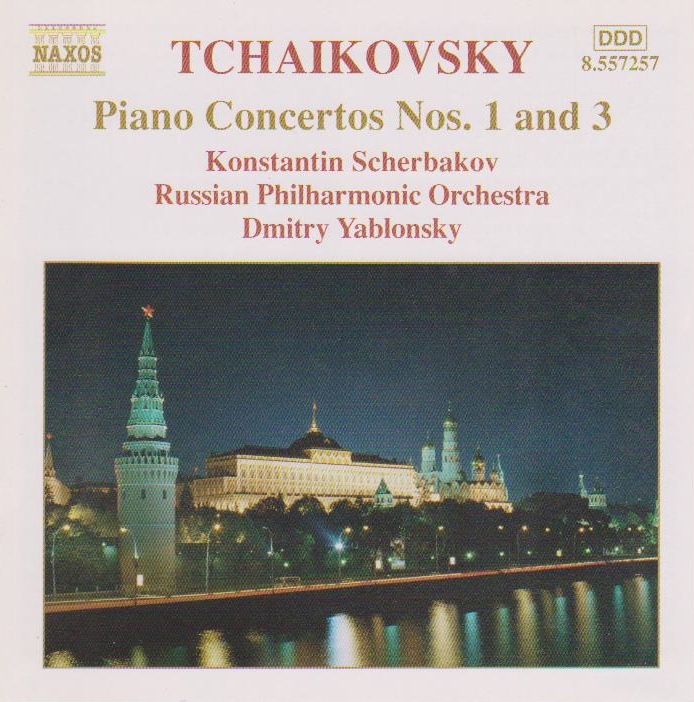
Pyotr Ilyich Tchaikovsky: Piano Concertos No. 1 and 3
Tchaikovsky's Piano Concerto Number 1, composed in 1874-75, is among the most popular pieces of all classical music, much less of his repertoire and it is easy sometimes to put too much emphasis on that gorgeous melody that anchors the piece and forget how intricate and beautiful the 33-minute concerto is throughout its long first movement and shorter second and third ones. It has also been easy for some critics to dismiss it as showy, superficial and trite.
Obviously, Tchaikovsky's old-fashioned "romanticism" was increasingly at odds with the work of many of his contemporaries and the growing popularity of the concerto aroused increasing disdain among some listeners. Yet, the work has endured and this 2003 performance by the Russian Philharmonic Orchestra and soloist Konstantin Scherbakov is impressively performed and beautifully recorded.
The third piano concerto was salvaged from a symphony began by the composer in late 1891 before being abandoned. In July 1893, Tchaikovsky reworked the first movement of the discarded work into a piano concerto, spanning sixteen minutes in a single movement. The 53-year old maestro's untimely death in November occurred before the concerto's publication the following year.
Moreover, one of his protégés, Sergei Taneyev, was requested by Tchaikovsky's brother, Modest, to take unfinished elements of the symphony and mold them into finished pieces. In 1897, these were published as "Andante and Finale, Op. 79," and his nearly twenty-minute work is included in this disc, presumably because of the historical interest in linking them with the reworked concerto. In the 1950s, a Soviet composer, Semyon Bogatyrev, examined Tchaikovsky's notes, incorporated the third piano concerto, and the Taneyev andante and finale, and put together what has been referred to as Tchaikovsky's "seventh symphony."
The concerto does not have the instantly gratifying melody of the first, nor the unity and precision of the second, but there is some breathtaking piano solo portions around the eight minute mark that demonstrate impressive virtuosity. The andante and finale do not have as much interesting material, which obviously seems why the composer abandoned their initial drafts. Still, the opening of the andante is hushed, contemplative and pretty and Taneyev did give plenty of room in both movements for expressive and emotive soloing, especially in more energetic and declarative finale.
Pyotr Ilyich Tchaikovsky: Piano Concertos Nos. 1 and 3 (Naxos, 2004)
1. Piano Concerto No. 1 in B flat minor, Op. 23
Allegro non troppo e molto maestoso-Allegro con spirit 19:42
Andantino semplice-Prestissimo-Tempo I 6:42
Allegro con fuoco 6:54
2. Piano Concerto No. 3 in E flat major, Op. 75
Allegro brilliante 16:02
3. Andante and Finale, Op. 79 (orchestrated by Sergei Taneyev)
Andante 11:21
Allegro maestoso 8:31
Friday, July 12, 2013
Linton Kwesi Johnson: Independant Intavenshan: The Island Anthology
In the late 1970s and early 1980s, when reggae was at its apex in popularity, the best-known performers were those based in Jamaica, notably Bob Marley and the Wailers, Burning Spear, Black Uhuru, Culture, and others.
In England, however, were many Jamaicans resided, there was a growing and important reggae scene and, by the mid-Eighties, groups like the UB40, Steel Pulse and Aswad were quite popular. While lesser known, the great Linton Kwesi Johnson was, to this observer, the most important British-based reggae performer of that era. Born in Jamaica in 1952, LKJ emigrated to England at age 11 to join his mother. Coming of age in the civil rights era and a transforming British social structure in the late 60s, he used his writing talents to great effect in political contexts. Encouraged to put his work to music, he did so by the late 1970s and emerged as a major force in English reggae.
From 1978 to 1983, he released a series of excellent albums on the Virgin and Island labels, including Dread Beat 'N Blood (1978), Forces of Victory (1979), Bass Culture (1980), and Making History (1983.) What distinguished LKJ from other reggae artists was that he was an established poet and he fused that talent with tightly performed and well-produced music by British musicians to create memorable political statements at a time when British society was roiled by race issues, including police mistreatment of West Indian blacks, job discrimination, and others. Johnson became a leading voice in expressing the frustration and anger felt by young blacks in Thatcherite England.
This observer first bought an LKJ live album that came out in 1985 and it quickly became a favorite for its rousing versions of classics that appear in studio and dub versions on the 1998 compilation Independant Intavenshan issued by Island.
This double disc survey of Johnson's work is filled with great tunes like "Want Fi Go Rave," "It Noh Funny," the phenomenal "Reality Poem," "Bass Culture," "Reggae Fi Peach," the soulful and jazzy masterpiece "Wat About Da Workin' Claas?" and the mind-blowing "Di Great Insohreckshan." LKJ's strong lyrical content is supported beautifully by his band, which included mainstays like keyboardist, bassist, mixer, engineer and producer Dennis Bovell, guitarist John Kpiaye (who has excellent solos on tracks like "Reality Poem"), bassist Vivian Weathers and drummer Jah Bunny.
By the time, though, that the great live album referred to above came out in 1985, reggae had peaked. Marley had been dead several years, Black Uhuru lost its vocalist and chief songwriter Michael Rose, and other factors led to a decline in the music, which was supplanted by dancehall or ragga, a digital distillation that took away the live bass, drums and other instrumentation, as well as the social and political lyrical commentary, that marked what became known as "roots reggae."
While LKJ occasionally performed live and released albums, his career was never the same after the mid-80s. Independant Intavenshan, though, is abundant evidence that Linton Kwesi Johnson was a unique and powerful voice, using his poetry skills and great support from musicians to build a body of work that ranks among the very finest in reggae.
In England, however, were many Jamaicans resided, there was a growing and important reggae scene and, by the mid-Eighties, groups like the UB40, Steel Pulse and Aswad were quite popular. While lesser known, the great Linton Kwesi Johnson was, to this observer, the most important British-based reggae performer of that era. Born in Jamaica in 1952, LKJ emigrated to England at age 11 to join his mother. Coming of age in the civil rights era and a transforming British social structure in the late 60s, he used his writing talents to great effect in political contexts. Encouraged to put his work to music, he did so by the late 1970s and emerged as a major force in English reggae.
From 1978 to 1983, he released a series of excellent albums on the Virgin and Island labels, including Dread Beat 'N Blood (1978), Forces of Victory (1979), Bass Culture (1980), and Making History (1983.) What distinguished LKJ from other reggae artists was that he was an established poet and he fused that talent with tightly performed and well-produced music by British musicians to create memorable political statements at a time when British society was roiled by race issues, including police mistreatment of West Indian blacks, job discrimination, and others. Johnson became a leading voice in expressing the frustration and anger felt by young blacks in Thatcherite England.
This observer first bought an LKJ live album that came out in 1985 and it quickly became a favorite for its rousing versions of classics that appear in studio and dub versions on the 1998 compilation Independant Intavenshan issued by Island.
This double disc survey of Johnson's work is filled with great tunes like "Want Fi Go Rave," "It Noh Funny," the phenomenal "Reality Poem," "Bass Culture," "Reggae Fi Peach," the soulful and jazzy masterpiece "Wat About Da Workin' Claas?" and the mind-blowing "Di Great Insohreckshan." LKJ's strong lyrical content is supported beautifully by his band, which included mainstays like keyboardist, bassist, mixer, engineer and producer Dennis Bovell, guitarist John Kpiaye (who has excellent solos on tracks like "Reality Poem"), bassist Vivian Weathers and drummer Jah Bunny.
By the time, though, that the great live album referred to above came out in 1985, reggae had peaked. Marley had been dead several years, Black Uhuru lost its vocalist and chief songwriter Michael Rose, and other factors led to a decline in the music, which was supplanted by dancehall or ragga, a digital distillation that took away the live bass, drums and other instrumentation, as well as the social and political lyrical commentary, that marked what became known as "roots reggae."
While LKJ occasionally performed live and released albums, his career was never the same after the mid-80s. Independant Intavenshan, though, is abundant evidence that Linton Kwesi Johnson was a unique and powerful voice, using his poetry skills and great support from musicians to build a body of work that ranks among the very finest in reggae.
Sunday, June 30, 2013
Thelonious Monk Quartet with John Coltrane at Carnegie Hall
The six months that John Coltrane spent with Thelonious Monk in the latter part of 1957 has long been heralded as one of the great partnerships in jazz and for good reason. Coltrane finally kicked a longtime heroin habit earlier in the year after being fired by Miles Davis, under whom the tenor saxophonist had gotten his first major recognition. Monk, after years as an under-recognized innovator of the so-called "bop" movement, was also starting to get long overdue attention for his work, including the amazing 1956 record, Brilliant Corners, with the tenor giant Sonny Rollins. When Davis fired Coltrane, Monk was quick to get the sax player to join his quartet.
For most of the last part of 1957, the quartet had a residency at the Five Spot Café and as the year closed the band's legend grew. While Coltrane had to calibrate his staggering work ethic to the demands of playing with the highly unorthodox Monk, the rapport and effort the two put forward paid off handsomely during the engagement. Less talked about, however, was the solid backing of bassist Ahmed Abdul-Malik and, especially, drummer Shadow Wilson.
Unfortunately, the quartet was at all well recorded--Trane made appearances on the Monk's Music record, but it was not until 1961 that producer Orrin Keepnews cobbled together a few unreleased studio pieces from July 1957, at the beginning of Coltrane's tenure and some outtakes from the Monk's Music record along with one solo performance from the leader's Thelonious Alone album for the Thelonious Monk Quartet with John Coltrane, which was released in 1961 when Trane had become a major star.
The result was that the legend of the Monk/Coltrane outfit was one perpetuated by those who had seen the band live, particularly as the six-month residency matured and developed. This was especially noteworthy as the studio recordings all came when Trane was still learning to play with Monk's singular style and complex arrangements.
Then, in early 2005 a stunning discovery was made at the Library of Congress and its Voice of America international radio program collection. the LOC's recording lab supervisor Larry Appelbaum, as he explains in his short note, was "thumbing through some VOA acetate tapes awaiting digitization" when he "noticed several reels labeled 'Carnegie Hall Jazz 1957."
There was a Thanksgiving performance on 29 November at the famed New York venue with a stunning lineup of Billie Holiday, Dizzy Gillespie, Ray Charles, Chet Baker with Zoot Sims, Sonny Rollins, and "Thelonious Monk quartet with John Coltrane." And, one of the tape boxes, Appelbaum found, was labeled "T. Monk" and listed song titles. As he remembered, "When we played it, I recognized both Thelonious Monk and John Coltrane and my heart started racing."
Appelbaum had found a "holy grail" that had been searched for diligently by Coltrane biographer Lewis Porter, who contributed his own essay, as did Amiri Baraka (the former LeRoi Jones), Ira Gitler, Ashley Kahn, Stanley Crouch and Robin D. G. Kelley. This is a formidable lineup of jazz critics and writers testifying to the importance of this astonishing discovery.
There were two shows recorded that day for broadcast on the Voice of America and the music is just spectacular. These are fully realized versions of some of Monk's greatest compositions, from "Crepuscule with Nellie" to "Epistrophy" to "Sweet and Lovely" to "Monk's Mood." The leader sparkles throughout with his unique way of writing, arranging, soloing and comping behind Trane, while the latter appeared totally comfortable with his surroundings and displays much of that rapid-fire, intricately developed, and carefully orchestrated soloing style that Gitler, to his regret, termed, at that time, as "sheets of sound."
Again, though, it's easy to overlook the rhythm section--guys who were not given the kind of attention provided to others of the time, but whose way of supporting Monk and Trane were perfectly suited for the tunes, the sound and the personnel. Wilson, in particular, is fine form.
This is one of those rare recordings that matches its historical significance with peak performance. Not long after, however, Coltrane would return to work with Miles Davis on some of that trumpeter's greatest albums, including Milestones, recorded just a few months after this performance, and 1959's Kind of Blue, just highlighted on this blog, while also moving closer to establishing himself as a major leader, beginning with Blue Train, also with Blue Note and recorded in 1957, and leading to Giant Steps in 1959 and everything that came after.
Monk and Coltrane only played together for six months, mostly unrecorded at the Five Spot residency, but this hidden gem shows just what they had accomplished towards the end of their partnership. It is one of the high points in all of jazz, without exception.
For most of the last part of 1957, the quartet had a residency at the Five Spot Café and as the year closed the band's legend grew. While Coltrane had to calibrate his staggering work ethic to the demands of playing with the highly unorthodox Monk, the rapport and effort the two put forward paid off handsomely during the engagement. Less talked about, however, was the solid backing of bassist Ahmed Abdul-Malik and, especially, drummer Shadow Wilson.
Unfortunately, the quartet was at all well recorded--Trane made appearances on the Monk's Music record, but it was not until 1961 that producer Orrin Keepnews cobbled together a few unreleased studio pieces from July 1957, at the beginning of Coltrane's tenure and some outtakes from the Monk's Music record along with one solo performance from the leader's Thelonious Alone album for the Thelonious Monk Quartet with John Coltrane, which was released in 1961 when Trane had become a major star.
The result was that the legend of the Monk/Coltrane outfit was one perpetuated by those who had seen the band live, particularly as the six-month residency matured and developed. This was especially noteworthy as the studio recordings all came when Trane was still learning to play with Monk's singular style and complex arrangements.
Then, in early 2005 a stunning discovery was made at the Library of Congress and its Voice of America international radio program collection. the LOC's recording lab supervisor Larry Appelbaum, as he explains in his short note, was "thumbing through some VOA acetate tapes awaiting digitization" when he "noticed several reels labeled 'Carnegie Hall Jazz 1957."
There was a Thanksgiving performance on 29 November at the famed New York venue with a stunning lineup of Billie Holiday, Dizzy Gillespie, Ray Charles, Chet Baker with Zoot Sims, Sonny Rollins, and "Thelonious Monk quartet with John Coltrane." And, one of the tape boxes, Appelbaum found, was labeled "T. Monk" and listed song titles. As he remembered, "When we played it, I recognized both Thelonious Monk and John Coltrane and my heart started racing."
Appelbaum had found a "holy grail" that had been searched for diligently by Coltrane biographer Lewis Porter, who contributed his own essay, as did Amiri Baraka (the former LeRoi Jones), Ira Gitler, Ashley Kahn, Stanley Crouch and Robin D. G. Kelley. This is a formidable lineup of jazz critics and writers testifying to the importance of this astonishing discovery.
There were two shows recorded that day for broadcast on the Voice of America and the music is just spectacular. These are fully realized versions of some of Monk's greatest compositions, from "Crepuscule with Nellie" to "Epistrophy" to "Sweet and Lovely" to "Monk's Mood." The leader sparkles throughout with his unique way of writing, arranging, soloing and comping behind Trane, while the latter appeared totally comfortable with his surroundings and displays much of that rapid-fire, intricately developed, and carefully orchestrated soloing style that Gitler, to his regret, termed, at that time, as "sheets of sound."
Again, though, it's easy to overlook the rhythm section--guys who were not given the kind of attention provided to others of the time, but whose way of supporting Monk and Trane were perfectly suited for the tunes, the sound and the personnel. Wilson, in particular, is fine form.
This is one of those rare recordings that matches its historical significance with peak performance. Not long after, however, Coltrane would return to work with Miles Davis on some of that trumpeter's greatest albums, including Milestones, recorded just a few months after this performance, and 1959's Kind of Blue, just highlighted on this blog, while also moving closer to establishing himself as a major leader, beginning with Blue Train, also with Blue Note and recorded in 1957, and leading to Giant Steps in 1959 and everything that came after.
Monk and Coltrane only played together for six months, mostly unrecorded at the Five Spot residency, but this hidden gem shows just what they had accomplished towards the end of their partnership. It is one of the high points in all of jazz, without exception.
Monday, June 24, 2013
The Wailers: Burnin'
On the spine of the deluxe editions of the first two Island records of this staggering reggae band, it reads, "Bob Marley and the Wailers," while on the discs and cover art it, as it should, sports the name "The Wailers." This was undoubtedly due to some contractual stipulation that existed after the great original line-up broke up shortly after this 1973 album was released.
Of course, it was certain that, once The Wailers began to achieve success outside Jamaica with their Catch a Fire and, especially, Burnin' albums, the band was going to be driven by Bob Marley and this led Bunny Wailer, first, and then Peter Tosh to pursue their own solo careers. While these latter two had moments of great success in the 1970s, the Marley phenomenon skyrocketed and led to some of the greatest music made anywhere through his untimely death from cancer in 1981.
And, in listening to this record, it is also obvious that the best tracks are from Marley, even though there are some fine contributions by Wailer and Tosh, and that three genuine classics come from his work (one of them, however, was co-written by Tosh.) Essential, also, to the success of this great band was the rhythm section of bassist Aston "Family Man" Barrett and his brother Carlton on drums and the keyboardist Earl "Wire" Lindo.
The first track is one of those timeless works, the commanding "Get Up, Stand Up," which was a collaboration between Marley and Tosh. This is followed by Wailer's "Hallelujah Time," which starts off in a middling fashion, but becomes a stronger track later.
Then comes the most famous Wailers tune of all, though it took a cover by Eric Clapton (which, while a good rendering, cannot come close to the brilliance of the original--but this is usually so and Clapton deserves credit for his excellent taste and in helping to spread the word about the originators!) to get it international attention. "I Shot the Sheriff" is a tour-de-force and testament to Marley's genius.
Hardly less impressive to this listener, though, is the sublime "Burnin' and Lootin'" which established Marley as a political tunesmith without peer in the Jamaican reggae scene. And, what could perhaps be termed "minor classics" followed with the excellent Marley pieces, "Put It On" and "Small Axe."
Then, it was time for Wailer's strongest contribution, the gospel-tinged and soulful "Pass It On," which also highlights the phenomenal harmonies that made the Wailers the best of the best in their genre. Truthfully, the harmonizing is strong throughout the record, but it seems to have peaked on this excellent tune.
Marley's "Duppy Conqueror" is another of those "minor classics" with a catchy chorus that is among the most memorable of the many that the master composed over his long career and it is followed by Tosh's strong chorus and organ-drenched opening in the very strong "One Foundation." The closer, the traditional "Rasta Man Chant" as arranged by Marley, ends the album with that pointed religious vibe inherent in Rastafarianism, including the nyabinghi drumming part of that system's rituals.
The deluxe edition features some additional tracks by Wailer and Tosh that featured strongly in their subsequent solo work, including Wailer's excellent "Reincarnated Souls," which was a centerpiece of his awesome Blackheart Man album; Tosh's "No Sympathy," another strong track, excepting perhaps some harsh synthesizer accents, which was on the fantastic Legalize It record; and Wailer's "The Oppressed Song," another stunning work with an acoustic guitar opening that may be one of his best compositions and which also was a standout on Blackheart Man. The extras are rounded out with an alternate take and edited single version of "Get Up, Stand Up." That's an amazing roster of extras, for sure!
As if that weren't enough, the second disc includes a live performance at Leeds, England in late November 1973, as part of a short American and British jaunt. Wailer had departed the band after making the Burnin' record in April and during the tour, called the Catch A Fire Tour, that followed. So, for the Leeds Polytechnic gig, Marley and Tosh shared lead vocal duties, with Tosh abandoning the bass range from the trio's work and focusing on the higher notes in harmonizing with Marley's lead vocals. Tosh, however, does some solo guitar work that was not heard on the studio recordings.
The performance features classics from the two Island recordings and is a nice extra to have after hearing both Catch A Fire and Burnin' in their studio incarnations. It's a shame that Bunny Wailer didn't remain with the band through the 1973 tours, but this is still a strong performance with the longer playing times reflecting the band's ability to stretch out, play with great soul, tightness, and unity, and not fall prey to too much noodling, wandering and tangential playing, even though "Lively Up Yourself" does run almost 14 minutes!
So, while it was inevitable that Bob Marley's ascendency would lead to the departures of Wailer and Tosh after nearly a decade together, Burnin' shows just how awesome this band was when clicking on all cylinders and, for the most part, it was on this record. Tosh and Wailer went on to some success in their solo careers, but the retooled Bob Marley and The Wailers became an international phenomenon under the charismatic leadership and vocalizing and strong songwriting of its undisputed leader.
Friday, June 21, 2013
Charles Ives: An American Journey
Charles Ives was the head of a successful insurance agency in Connecticut who happened to also be a masterful composer, though this was largely unknown until the 1930s and afterward. He produced a body of work through 1926 that was a striking combination of modern experimentalism and eclecticism with a timely concern for older American music traditions that were disappearing as American modernized, industrialized and urbanized.
It was not until he was in his early seventies that real recognition came, thanks for the tireless work of his admirer, the California composer Lou Harrison, who conducted a performance of Ives' Third Symphony, which was then given a Pulitzer Prize in 1947. Ives gave Harrison half the money that came with the honor and waved off the attention. Slowly, however, Ives' work began to be performed more often, mainly in Europe, although Michael Tilson Thomas, who has been the music director at the San Francisco Symphony since 1995, has been a champion of the composer.
Hence this interesting compilation that gives some idea of the vast range of types of music created by Ives from the 1890s to the mid-1920s. Much of these have march-like qualities, not surprising since Ives' father was a band master and, during the Civil War, led a Union Army band. A number of these are songs with vocals by baritone Thomas Hampson and they are redolent of Ives' fascination with everyday people and their lives. One piece, "Charlie Rutlage: is about a cowboy; another evokes popular music played in what appears to be a small-town opera house; there is one about a circus band; a couple deal with the horrors of the First World War; and so on.
The opening piece, "From the Steeples and the Mountains," has the soaring quality the title implies, but there are interesting contrasts between tolling bells and wild and wonderful brass playing. The Things Our Fathers Loved," with its brief lyrics referencing small town bands, religion and patriotism, is a subtle and beautiful work.
The staggering "Three Places in New England" include a dreamy, atmospheric first section dedicated to a monument that commemorated a segregated black military unit in the Union Army during the Civil War; a wildly diverging second movement with dramatic shifts that almost seems like a travelogue through the bracing combination of traditional and new forms of music that Ives championed and which took its theme from the Revolutionary War. The third returns to a quieter, stately mood with a chorus beautifully singing "The Housatonic at Stockbridge," which was inspired by a walk by the composer on his honeymoon along the titular river in Massachusetts. This movement was initially instrumental, but Tilson Thomas recorded the choral element in the spirit of what Ives had done elsewhere by adding choral performance to instrumental works.
Other works include lyrics directly from Ives' childhood or are religious expositions with one of these based on the poet John Greenleaf Whittier or pay tribute, via the poem of Vachel Lindsay, to the founder of The Salvation Army (General William Booth.) These are the kinds of themes that animated so much of Ives' work as he surveyed the landscape of American society through new, evocative forms of music fused with earlier styles.
The liners are very helpful in understanding the amazing breadth and depth of what Ives did in his three or so decades of active composition, with one written by Tilson Thomas and the other Jan Swafford. To a novice like YHB, they were exceedingly helpful in identifying what motivated Ives in his fascinating work and this album is a remarkable survey of the long and diverse career of one of America's great musical masters.
Charles Ives: An American Journey (RCA, 2002)
1. From the Steeples and the Mountains 4:15
2. The Things Our Fathers Loved 1:47
3. The Pond (Remembrance) 1:42
4. Memories 2:30
5. Charles Rutlage 2:38
6. The Circus Band 3:02
7-9. Three Places in New England 18:19
10. In Flanders Fields 2:41
11. They Are There! 2:52
12. Tom Sails Away 2:48
13. Symphony No. 4—III: Fugue 6:38
14. Psalm 100 1:35
15. Serenity 2:00
16. General William Booth Enters Into Heaven 5:42
17. The Unanswered Question 6:19
It was not until he was in his early seventies that real recognition came, thanks for the tireless work of his admirer, the California composer Lou Harrison, who conducted a performance of Ives' Third Symphony, which was then given a Pulitzer Prize in 1947. Ives gave Harrison half the money that came with the honor and waved off the attention. Slowly, however, Ives' work began to be performed more often, mainly in Europe, although Michael Tilson Thomas, who has been the music director at the San Francisco Symphony since 1995, has been a champion of the composer.
Hence this interesting compilation that gives some idea of the vast range of types of music created by Ives from the 1890s to the mid-1920s. Much of these have march-like qualities, not surprising since Ives' father was a band master and, during the Civil War, led a Union Army band. A number of these are songs with vocals by baritone Thomas Hampson and they are redolent of Ives' fascination with everyday people and their lives. One piece, "Charlie Rutlage: is about a cowboy; another evokes popular music played in what appears to be a small-town opera house; there is one about a circus band; a couple deal with the horrors of the First World War; and so on.
The opening piece, "From the Steeples and the Mountains," has the soaring quality the title implies, but there are interesting contrasts between tolling bells and wild and wonderful brass playing. The Things Our Fathers Loved," with its brief lyrics referencing small town bands, religion and patriotism, is a subtle and beautiful work.
The staggering "Three Places in New England" include a dreamy, atmospheric first section dedicated to a monument that commemorated a segregated black military unit in the Union Army during the Civil War; a wildly diverging second movement with dramatic shifts that almost seems like a travelogue through the bracing combination of traditional and new forms of music that Ives championed and which took its theme from the Revolutionary War. The third returns to a quieter, stately mood with a chorus beautifully singing "The Housatonic at Stockbridge," which was inspired by a walk by the composer on his honeymoon along the titular river in Massachusetts. This movement was initially instrumental, but Tilson Thomas recorded the choral element in the spirit of what Ives had done elsewhere by adding choral performance to instrumental works.
Other works include lyrics directly from Ives' childhood or are religious expositions with one of these based on the poet John Greenleaf Whittier or pay tribute, via the poem of Vachel Lindsay, to the founder of The Salvation Army (General William Booth.) These are the kinds of themes that animated so much of Ives' work as he surveyed the landscape of American society through new, evocative forms of music fused with earlier styles.
The liners are very helpful in understanding the amazing breadth and depth of what Ives did in his three or so decades of active composition, with one written by Tilson Thomas and the other Jan Swafford. To a novice like YHB, they were exceedingly helpful in identifying what motivated Ives in his fascinating work and this album is a remarkable survey of the long and diverse career of one of America's great musical masters.
Charles Ives: An American Journey (RCA, 2002)
1. From the Steeples and the Mountains 4:15
2. The Things Our Fathers Loved 1:47
3. The Pond (Remembrance) 1:42
4. Memories 2:30
5. Charles Rutlage 2:38
6. The Circus Band 3:02
7-9. Three Places in New England 18:19
10. In Flanders Fields 2:41
11. They Are There! 2:52
12. Tom Sails Away 2:48
13. Symphony No. 4—III: Fugue 6:38
14. Psalm 100 1:35
15. Serenity 2:00
16. General William Booth Enters Into Heaven 5:42
17. The Unanswered Question 6:19
Wednesday, June 19, 2013
The Art of Paco Peña
Flamenco music is a newfound interest and this 1993 compilation from the British label Nimbus gathers material from several recordings for that label by the Spanish maestro, Paco Peña.
A generous 65-minute album culls 15 tracks, including a collaboration with Eduardo Falú. a noted guitarist, composer and singer from Argentina with whom Peña extensively toured Europe in the mid-1980s.
Several tracks are pieces from pioneers in the flamenco style, namely Ramón Montoya and Niño Ricardo.
The remainder of the pieces are Peña's own work and he is joined on some of these by Tito Losada. Finally, there is an excerpt from the unusual religious work, the Misa Flamenco, or Flamenco Mass, composed by Peña and premiered at Wroclaw, Poland in 1988, though the version on this record came from a London presentation a few years later. In this sampling, there are four flamenco singers, four guitarists, two percussionists, and the chorus of The Academy of St. Martin in the Fields.
Peña is heralded for not only his superlative technique, but for his firm grasp of traditional methods with modern conceptual attributes. This is an enjoyable record, probably, for even the most seasoned fan of flamenco music, but it is a great introduction for greenhorns like yours truly.
The Art of Paco Peña (Nimbus Records, 1993)
1. Solquena 5:04
2. La Rosa 4:31
3. Milonga Uruguaya 1:58
4. Seguiriyas 6:03
5. Gloria 4:13
6. Salobre 5:06
7. La Cuartelera 2:59
8. Alegrías 3:54
9. Riomar 4:05
10. Santo 2:55
11. Soleá 4:28
12. Claroscuro 5:25
13. Valse Criollo 3:11
14. Tarantas 5:17
15. Canto Eucaristico y Despedida (excerpt) 6:17
Monday, June 17, 2013
Miles Davis: Kind of Blue
Miles Davis's landmark 1959 album Kind of Blue is so commonly cited as one of the great recordings in jazz, if not just American music generally, that there seems to be little necessary to say about it. An entire book by Eric Nisenson has been written about it for those (moi, for example) who just had to get deeply into the background, events and personalities involved in this spectacular masterwork.
Suffice to say that the sextet of Davis, tenor sax giant John Coltrane, alto sax titan Julian "Cannonball" Adderley, pianist Bill Evans, bassist Paul Chambers and drummer Jimmy Cobb (pianist Wynton Kelly appears on the blues "Freddie Freeloader," apparently because Evans' softer approach didn't work well for that piece) melded perfectly on five sublime pieces that are all classic works, these being "So What;" "Freddie Freeloader;" "Blue in Green;" "Flamenco Sketches;" and "All Blues."
The opening track is probably the most well-known, deriving its title from one of Davis's pat phrases, but its memorable two-note horn phrase with Chambers' distinctive bass riff is one of jazz's most easily recognizable snippets. "All Blues" is likely the piece that gets the most attention after "So What" with its catchy melodic line (again two notes from the horns with Evans' light touch on piano) being another classic phrase.
Suffice to say that the sextet of Davis, tenor sax giant John Coltrane, alto sax titan Julian "Cannonball" Adderley, pianist Bill Evans, bassist Paul Chambers and drummer Jimmy Cobb (pianist Wynton Kelly appears on the blues "Freddie Freeloader," apparently because Evans' softer approach didn't work well for that piece) melded perfectly on five sublime pieces that are all classic works, these being "So What;" "Freddie Freeloader;" "Blue in Green;" "Flamenco Sketches;" and "All Blues."
The opening track is probably the most well-known, deriving its title from one of Davis's pat phrases, but its memorable two-note horn phrase with Chambers' distinctive bass riff is one of jazz's most easily recognizable snippets. "All Blues" is likely the piece that gets the most attention after "So What" with its catchy melodic line (again two notes from the horns with Evans' light touch on piano) being another classic phrase.
Also highly regarded is the gorgeous "Flamenco Sketches" and anyone familiar with Davis's sublime work with the great arranger Gil Evans, which dated to 1948, will know of the fantastic Sketches of Spain which the two created a couple of years after Kind of Blue. That interest in Spanish music "sketched" here developed into full flower with the later masterpiece.
While "Freddie Freeloader," another blues and "Blue and Green" are not as well-known, they are fine pieces that seamlessly work with the more famous tracks. The record, then, has the "modal" element of working of a given key and a group of scales, rather than chord changes, that gives more space for soloists and develops an atmosphere and an ambience in tandem with the relaxed mid-tempo feel that permeates the record. Simply put, the record flows effortlessly from one tune to the next.
Tellingly, Davis brought rough sketches of tunes to the session without the band members having heard or seen anything of them before. This forced the group to develop its improvisatory skills and keen group dynamics to full focus in the recording. Notably, when Coltrane began recording his famed Giant Steps album just a couple of weeks later, he employed the same strategy.
1959 was a year of masterpieces in the jazz world: the aforementioned Coltrane record and Ornette Coleman's mind-blowing The Shape of Jazz to Come, which was recorded a month after Kind of Blue come immediately to mind. While those two works were considered in the so-called "avant garde," Davis's Kind of Blue was a more refined album and its popularity was such that it became the highest-selling jazz record of all time, selling a staggering 4 million copies in a genre where tens of thousands in sales is considered a success.
Yet, Kind of Blue also marked the end of an era for Davis and the start of new ones for three of his band members. Coltrane soon left the group to embark on a seven-year odyssey that put him at the pinnacle of the jazz world's experimental domain. Adderley also soon left to front his own band and became a success with the so-called "Soul Jazz." Bill Evans, meanwhile, who had already left Davis but returned for these sessions, formed a trio with bass wizard Scott LaFaro and drummer Paul Motian (later known for his work with Keith Jarrett and his own bands) that made memorable music for two years before LaFaro's untimely death in 1961.
Today, Jimmy Cobb, at 84, is the sole surviving member of the seven musicians who worked on Kind of Blue and still plays, working with his "So What" band as a tribute to his work on the album and with Davis.
A 1997 reissue with 20-bit remastering features Evans's original liner notes about group improvisation more than the personalities or the songs as well as critic Robert Palmer interesting observations.
Miles Davis: Kind of Blue (Columbia Records, 1959)
1. So What 9:22
2. Freddie Freeloader 9:46
3. Blue in Green 5:37
4. All Blues 11:37
5. Flamenco Sketches 9:26
6. Flamenco Sketches (alternate on a 1997 remastered reissue) 9:32
Friday, May 31, 2013
Cabaret Voltaire: The Conversation
While such albums as Micro-Phonies, The Crackdown, and Red Mecca are usually the more acclaimed recordings from Cabaret Voltaire, YHB has always found the last album from the duo of Richard H. Kirk and Stephen Mallinder, 1994's The Conversation, to be a favorite.
Maybe this is partially because, after the debacle that was the short tenure with conglomerate EMI, CV was able to pick up the pieces and move back into an experimental stance while also going forward with a sound that looked ahead to what electronica was heading toward in the early 90s.
This was no small feat, given the Cabs were able to reinvent themselves at least three times during their lengthy career and to do so generally successfully (with the later EMI years being a notable exception.) It does have to be noted, though, that Mallinder's involvement in the last three albums, under the duo's Plastex imprint, was considerably less than previously and The Conversation appears to be almost completely, if not entirely, Kirk's doing as there are no vocals from Mallinder, who last performed them a few albums back, though he may have had a hand in the pieces that was more subtle than previous contributions.
The double disc album is solid all the way through, from the bookmarked intro and outro of Exterminating Angel to the sharp grooves of Brutal But Clean to the smooth machine funk of Let's Start and the unusual The Message (An Original Hollywood Theme).
But, the centerpiece of this great album is the mind-blowing sound collage piece Project 80, which spans 53 minutes, but almost operates like a electronic concerto or symphony with several movements. Washes of sound, often heavily treated with echo and other effects, sampled voices, and other sources are densely layered into a compelling mix that doesn't drag or peter out, but transforms into another "movement" and changes the dynamic of the piece. It's hard to believe that it's been almost 20 years since this record comes out, but Project 80 never fails to impress and stands as an apt culmination to two decades of remarkable work from a truly remarkable group.
Richard Kirk's solo work really began to accelerate in the early 90s and Mallinder's move to Australia marked the end of CV or at least its suspension, though there were some unrealized plans for a 1998 return to recording and live performance.
While Mallinder did some recording "down under" and continues to make music now in England after completing a PhD, using his music background as his field of research and writing, Kirk has made dozens of fascinating recordings under a slew of monikers, showing that he remains a highly productive and imaginative manipulator of sound.
There have been a couple of projects in which Kirk has resurrected the Cabaret Voltaire name on his own, these being remix albums for young groups, including Kora and The Tivoli, though it has been a few years since the last of these and there hasn't been any indication of new recordings utilizing the CV name.
In any case, The Conversation is an album that holds up as well to this listener as any in Cabaret Voltaire's extensive discography, even if not as well recognized as its early to mid-1980s "classics."
Cabaret Voltaire: The Conversation (Plastex/Instinct, 1994)
Disc One:
1. Exterminating Angel (Intro) 5:47
2. Brutal But Clean 11:05
3. The Message (An Original Hollywood Theme) 8:16
4. Let's Start 8:11
5. Night Rider 9:54
6. I Think 8:56
7. The Heat 7:52
8. Harmonic Parallel 10:52
Disc Two:
1. Project 80 53:05
2. Exterminating Angel (Outro) 8:01
Maybe this is partially because, after the debacle that was the short tenure with conglomerate EMI, CV was able to pick up the pieces and move back into an experimental stance while also going forward with a sound that looked ahead to what electronica was heading toward in the early 90s.
This was no small feat, given the Cabs were able to reinvent themselves at least three times during their lengthy career and to do so generally successfully (with the later EMI years being a notable exception.) It does have to be noted, though, that Mallinder's involvement in the last three albums, under the duo's Plastex imprint, was considerably less than previously and The Conversation appears to be almost completely, if not entirely, Kirk's doing as there are no vocals from Mallinder, who last performed them a few albums back, though he may have had a hand in the pieces that was more subtle than previous contributions.
The double disc album is solid all the way through, from the bookmarked intro and outro of Exterminating Angel to the sharp grooves of Brutal But Clean to the smooth machine funk of Let's Start and the unusual The Message (An Original Hollywood Theme).
But, the centerpiece of this great album is the mind-blowing sound collage piece Project 80, which spans 53 minutes, but almost operates like a electronic concerto or symphony with several movements. Washes of sound, often heavily treated with echo and other effects, sampled voices, and other sources are densely layered into a compelling mix that doesn't drag or peter out, but transforms into another "movement" and changes the dynamic of the piece. It's hard to believe that it's been almost 20 years since this record comes out, but Project 80 never fails to impress and stands as an apt culmination to two decades of remarkable work from a truly remarkable group.
Richard Kirk's solo work really began to accelerate in the early 90s and Mallinder's move to Australia marked the end of CV or at least its suspension, though there were some unrealized plans for a 1998 return to recording and live performance.
While Mallinder did some recording "down under" and continues to make music now in England after completing a PhD, using his music background as his field of research and writing, Kirk has made dozens of fascinating recordings under a slew of monikers, showing that he remains a highly productive and imaginative manipulator of sound.
There have been a couple of projects in which Kirk has resurrected the Cabaret Voltaire name on his own, these being remix albums for young groups, including Kora and The Tivoli, though it has been a few years since the last of these and there hasn't been any indication of new recordings utilizing the CV name.
In any case, The Conversation is an album that holds up as well to this listener as any in Cabaret Voltaire's extensive discography, even if not as well recognized as its early to mid-1980s "classics."
Cabaret Voltaire: The Conversation (Plastex/Instinct, 1994)
Disc One:
1. Exterminating Angel (Intro) 5:47
2. Brutal But Clean 11:05
3. The Message (An Original Hollywood Theme) 8:16
4. Let's Start 8:11
5. Night Rider 9:54
6. I Think 8:56
7. The Heat 7:52
8. Harmonic Parallel 10:52
Disc Two:
1. Project 80 53:05
2. Exterminating Angel (Outro) 8:01
Thursday, May 30, 2013
Johann Sebastian Bach: Multiple Concerti
This is another excellent Naxos label recording from 1995 by the Cologne (Germany) Chamber Orchestra of four concerti by the great baroque master, J. S. Bach. In this case, the use of the harpsichord and recorder provide for original instrumentation that give a close approximation of how this amazing music would have sounded when the composer wrote and performed the pieces over three centuries ago.
Except that it is not known what instruments were utilized by Bach when these were created, except for the harpsichord. Existing necrologies, catalogs of the works, only, as the liner notes by Peter Wollny indicate, listed, "a quantity of other instrumental works of all kinds and for various instruments," although a given concerto could include up to four harpsichords.
Bach's works for organ and the harpsichord or other keyboard instruments are far more known than the most ensemble pieces, such as these, though the Brandenburg Concertos are very popular, but he did compose a great many concertos and the author of the notes speculated that the sheer quantity may have precluded specific descriptions of the instrumentation used for them by his son, Carl Philip Emanuel Bach and Johann Friedrich Agricola in their necrology. Alternatively, he worked much of his life in the employ of German royalty and may have left many of his concerto manuscripts in the places he worked as part of his contracts.
In any case, these are beautiful works, light, stately, filled with gorgeous melodies and harmonic interplay between the instruments. As pointed out in the notes, one of these, the F Major, was the original version of the famed fourth Brandenburg Concerto, with the original's organ part transcribed for the violin, while the first in the set, the A Minor (also known as the Triple Concerto, because of its instrumentation of harpsichord, flute and violin), is related to the fifth Brandenburg in style. Moreover, we learn from the liners that the first two movements come from earlier works, namely the Prelude with a Fugue and the Trio Sonata for organ.
The D Minor is for three harpsichords and the orchestra and it was thought by some that Bach wrote this for himself and his two older sons for their development as musicians, though the author of the notes disputes this on the basis of how the solo instruments were scored.
The D Major, of which surviving versions are for either two or three harpsichords and orchestra, but accepted practice is to use three violins or violin and oboe. Wollny observes that it "is a work of great density and almost symphonic dimensions," which is why an orchestra was employed in those surviving versions. As he notes, the soloists perform very complex and difficult sections in the first movement and there the allegro tempo is repeated in the third movement, while a very beautiful melodic line comes in the second movement's adagio form.
It is still hard to believe that, in his time, Bach was better known as an organist than a composer, with his reputation in the latter not coming to the fore until over a half-century after his death. These concertos are great examples of his genius and are well performed by an excellent chamber ensemble and issued by a superior budget label.
Johann Sebastian Bach: Multiple Concerti (Naxos, 1995)
Concerto in A Minor 21:56
Concerto in F Major 15:03
Concerto in D Minor 13:24
Concerto in D Major 16:32
Except that it is not known what instruments were utilized by Bach when these were created, except for the harpsichord. Existing necrologies, catalogs of the works, only, as the liner notes by Peter Wollny indicate, listed, "a quantity of other instrumental works of all kinds and for various instruments," although a given concerto could include up to four harpsichords.
Bach's works for organ and the harpsichord or other keyboard instruments are far more known than the most ensemble pieces, such as these, though the Brandenburg Concertos are very popular, but he did compose a great many concertos and the author of the notes speculated that the sheer quantity may have precluded specific descriptions of the instrumentation used for them by his son, Carl Philip Emanuel Bach and Johann Friedrich Agricola in their necrology. Alternatively, he worked much of his life in the employ of German royalty and may have left many of his concerto manuscripts in the places he worked as part of his contracts.
In any case, these are beautiful works, light, stately, filled with gorgeous melodies and harmonic interplay between the instruments. As pointed out in the notes, one of these, the F Major, was the original version of the famed fourth Brandenburg Concerto, with the original's organ part transcribed for the violin, while the first in the set, the A Minor (also known as the Triple Concerto, because of its instrumentation of harpsichord, flute and violin), is related to the fifth Brandenburg in style. Moreover, we learn from the liners that the first two movements come from earlier works, namely the Prelude with a Fugue and the Trio Sonata for organ.
The D Minor is for three harpsichords and the orchestra and it was thought by some that Bach wrote this for himself and his two older sons for their development as musicians, though the author of the notes disputes this on the basis of how the solo instruments were scored.
The D Major, of which surviving versions are for either two or three harpsichords and orchestra, but accepted practice is to use three violins or violin and oboe. Wollny observes that it "is a work of great density and almost symphonic dimensions," which is why an orchestra was employed in those surviving versions. As he notes, the soloists perform very complex and difficult sections in the first movement and there the allegro tempo is repeated in the third movement, while a very beautiful melodic line comes in the second movement's adagio form.
It is still hard to believe that, in his time, Bach was better known as an organist than a composer, with his reputation in the latter not coming to the fore until over a half-century after his death. These concertos are great examples of his genius and are well performed by an excellent chamber ensemble and issued by a superior budget label.
Johann Sebastian Bach: Multiple Concerti (Naxos, 1995)
Concerto in A Minor 21:56
Concerto in F Major 15:03
Concerto in D Minor 13:24
Concerto in D Major 16:32
Wednesday, May 29, 2013
Tibetan Buddhism: Tantras of Gyuto
When this was first purchased on cassette in the early 90s, it came fairly close to the reading of the Tibetan Book of the Dead, so there was attempt, even if not looking to practice Buddhism, then at least to be open to other ideas beyond Western ones and to see this recording as something beyond music, though many might question where this is actually music.
Recorded in 1972 at the Gyütö Tantric College at Dalhousie, India, where thousands of Tibetans moved to at the invitation of India's prime minister Jawaharlal Nehru after the Chinese invasion and conquest of Tibet in 1959, the project was supervised by David Lewiston, who compiled so many fantastic performances of music around the world for the great Nonesuch Explorer series.
Tantras of Gyütö consists of two long pieces. The first, "Sangwa Düpa" is a 41-minute excerpt from a tantra, lasting seven and a half hours and performed by forty lamas and monks chanting a text that has to do with the universe and the energy the chanters draw from its immovable sacred characteristic. From the strength derived from the contemplation of the universe, participants become more attuned to the compassion and wisdom of the Buddha.
The chanting features a "one-voice chording," in which each person sounds a chord in a low bass running between B and D, as well as another note more than two octaves higher. A remarkable production is that another note can be heard in conjunction with the expressed one. The example in the very informative liner notes by Lewiston and Francesca Freemantle is that "When the C two octaves below middle C is sounded, the E above middle C is heard clearly."
Moreover, there is actually another E note a full octave above that that is not easily heard by the untutored ear! There are also overtones or augmented notes and the great complexity of this style of chanting required some three or more years for the monks to master. The text is also memorized, which also takes a great deal of practice and repetition.
Also of note is that, while an individual might chant in a monotone or a short melody and two or three might share the same pitch, a larger group brings together different pitches and mantras are also rhythmically free, each monk reciting at his own pace. This adds to the rich and powerful effect of the overall recitation.
With Buddhism's main concern of moving past the vain illusion of ego and into an identification with the great void of the universe, free from earthly constrictions and constructions, the chanting and singing of ancient mantras, picturing or visualizing the nature of the universe in a freed mind, and other practices are essential to tantric practice.
Chanting in a metrical form by the group forms the basis for the piece, with solo voices indicating the beginning of a new chapter or a new section within one and an extended vocalizing of a given chord would occur with the end of verses. "Sangwa Düpa" has origins dating back at least 1500 years ago and perhaps as far as nearly two millenia.
The second, shorter piece, "Mahakala" is eighteen and a half minutes in duration and the subject matter deals with a transcending awareness in the form of a demon-like god with horrifying physical features, but which manifests a protection to the Buddhist against selfishness. There is a wrath in the battle against the ego, but it leads to a total sense of peace in the conquest of the self.
This tantra is traced directly to the Buddha and it made its way to Tibet about 1000 years ago and it can be, like the "Sangwa Düpa," be performed with voice only or, as on this recording, with instruments, including drums, cymbals and the powerful radong, a six-foot long bass melody trumpet, although the a capella version does include a rhythmic slapping of the celebrants' hands on rosary. Some recitations of the Mahakala can take twelve hours, though the use of excerpts over a three to five hour period is more typical.
It is striking that, at the time of the Chinese invasion of Tibet in 1959, between 10 and 20 percent of the male population of that country, some 300,000 to 600,000 in all, were monks in Buddhist monasteries. The occupation of Tibet by the Chinese over a half-century has been very controversial and the subject of much discussion throughout the world. More recently, self-immolation has been a common method for Tibetans to protest the Chinese takeover of their country.
However it is taken, whether by someone practicing the Tibetan form of Buddhism or by a listener who is open minded and curious, the effect of hearing this amazing recording can be striking. This listener has found that listening with headphones with concentrated attention has a strong effect, even if the goal is not to try and follow Buddhist tenets. Something powerful and, hopefully, long lasting, is still attained.
Tibetan Buddhism: Tantras of Gyütö (Nonesuch Explorer, 1988)
1. Sangwa Düpa 41:18
2. Mahakala 18:31
Tuesday, May 28, 2013
Tim Berne's Caos Totale: Pace Yourself
This was another early foray into the adventurous side of jazz and an early CD purchase as a brand-new release, way back in 1991, from the German label JMT (Jazz Music Today.) Berne's Caos Totale, a sextet, has a wide-ranging array of instrumentation, from the leader's alto sax and the highly expressive Mark Dresser's bass to Bobby Previte's energetic drumming and Marc Ducret's excellent electric guitar playing to the trombone of Steve Swell and multi-instrumentalist Herb Robertson's trumpet, cornet, flute, fluegelhorn, whistles and other sounds.
If anything can be expected from Berne, it is that he has richly arranged pieces that can often go on at great length, although Pace Yourself is somewhat restrained, with four of its six tunes clocking in at under ten minutes, "Sam's Dilemma," which is this listeners' highlight, at over thirteen, and the expansive "The Legend of P-1" extending over 26 minutes. Sometimes, though, the length has to be viewed in the context of changes in tempo, new melodies and what might be thought of as movements.
The opener, "Bass Voodoo," is perhaps most notable for its pairings of guitar and bass and trumpet and trombone duets, which reveal the great sensitivity the members of the band have for each other, an essential quality between "total chaos" and an "aware freedom." The second piece, "The Noose," contains an excellent drum solo from Previte, whose playing throughout the record in tandem with the always-compelling Dresser is stellar. "The Usual" is a more ambient, down-tempo, and softer tune and provides a bit of a respite from the frenetic and complex sounds that embody much of Berne's work.
As noted above, "Sam's Dilemma" is the favorite track on this album. Ducret's searing and searching electric guitar intro lays the groundwork and Previte's percussion is exceptional. There is also a probing and inventive bass solo from Dresser, which is no surprise to anyone who's heard his work with Anthony Braxton (or read Graham Lock's Forces in Motion about the British tour headed by Braxton and including Dresser.) Dresser then plays the melody that leads into the finale with the full band and it's a fantastic way to end a great tune.
"The Legend of P-1" has an atmospheric and soft opening that continues for several minutes gradually building to a fuller sound. This work is a showcase for how Berne utilizes shifting tempos and changing melodic and rhythmic ideas and with a band as sensitized to the way the leader writes, arranges and plays, this lengthy piece doesn't drag or wander. It's a testament to how solid a composer and arranger Berne is that the tune never fails to hold interest, even at 26 plus minutes.
The closer, "Luna," is another slower, softer, almost ambient piece and here Berne gives a nice expression, almost mournful or somber, to his alto sax work. It's a nice way to end an album that shows all of the dynamic interplay of an excellent band working with some inspired material. Those who have heard Julius Hemphill, whose big band record was highlighted here recently, will recognize his influence on his student, but Berne also has his own style or way of expressing himself and "Pace Yourself" is an apt title for a record that runs the gamut of the various tempos, melodic concepts, harmonic interplay and rhythmic variety that is a Berne hallmark.
Tim Berne's Caos Totale: Pace Yourself (JMT, 1991)
1. Bass Voodoo 9:57
2. The Noose 7:34
3. The Usual 8:15
4. Sam's Dilemma 13:33
5. The Legend of P-1 26:21
6. Luna 4:32
If anything can be expected from Berne, it is that he has richly arranged pieces that can often go on at great length, although Pace Yourself is somewhat restrained, with four of its six tunes clocking in at under ten minutes, "Sam's Dilemma," which is this listeners' highlight, at over thirteen, and the expansive "The Legend of P-1" extending over 26 minutes. Sometimes, though, the length has to be viewed in the context of changes in tempo, new melodies and what might be thought of as movements.
The opener, "Bass Voodoo," is perhaps most notable for its pairings of guitar and bass and trumpet and trombone duets, which reveal the great sensitivity the members of the band have for each other, an essential quality between "total chaos" and an "aware freedom." The second piece, "The Noose," contains an excellent drum solo from Previte, whose playing throughout the record in tandem with the always-compelling Dresser is stellar. "The Usual" is a more ambient, down-tempo, and softer tune and provides a bit of a respite from the frenetic and complex sounds that embody much of Berne's work.
As noted above, "Sam's Dilemma" is the favorite track on this album. Ducret's searing and searching electric guitar intro lays the groundwork and Previte's percussion is exceptional. There is also a probing and inventive bass solo from Dresser, which is no surprise to anyone who's heard his work with Anthony Braxton (or read Graham Lock's Forces in Motion about the British tour headed by Braxton and including Dresser.) Dresser then plays the melody that leads into the finale with the full band and it's a fantastic way to end a great tune.
"The Legend of P-1" has an atmospheric and soft opening that continues for several minutes gradually building to a fuller sound. This work is a showcase for how Berne utilizes shifting tempos and changing melodic and rhythmic ideas and with a band as sensitized to the way the leader writes, arranges and plays, this lengthy piece doesn't drag or wander. It's a testament to how solid a composer and arranger Berne is that the tune never fails to hold interest, even at 26 plus minutes.
The closer, "Luna," is another slower, softer, almost ambient piece and here Berne gives a nice expression, almost mournful or somber, to his alto sax work. It's a nice way to end an album that shows all of the dynamic interplay of an excellent band working with some inspired material. Those who have heard Julius Hemphill, whose big band record was highlighted here recently, will recognize his influence on his student, but Berne also has his own style or way of expressing himself and "Pace Yourself" is an apt title for a record that runs the gamut of the various tempos, melodic concepts, harmonic interplay and rhythmic variety that is a Berne hallmark.
Tim Berne's Caos Totale: Pace Yourself (JMT, 1991)
1. Bass Voodoo 9:57
2. The Noose 7:34
3. The Usual 8:15
4. Sam's Dilemma 13:33
5. The Legend of P-1 26:21
6. Luna 4:32
Wednesday, May 15, 2013
Nick Drake: Pink Moon
Nick Drake was almost completely unknown in his short lifetime, released three albums between 1969 and 1972 that were a particularly distinctive kind of folk-rock, if it could be called that, and then disappeared further into depression and died in 1974 at age 26 from an overdose of antidepressants. As is so often the case with young sensitive artists, a cult developed around Drake that has remained small, but strong, over the years.
This final recording, Pink Moon, is extraordinary in its insular simplicity, but with Drake's accomplished acoustic guitar playing, his penchant for plaintive melodies, and his affecting but unaffected vocal style, the album has a powerful pull on the listener through the course of its eleven songs in just over 26 minutes.
Only the title track, which opens the record, has instrumentation aside from Drake's guitar and vocals, as he overdubbed some piano on the piece, and this spare setting and crystalline production is part of the immersive experience, particularly if listened to on headphones. To this blogger, it feels as if the experience is like that of a concert performed with only the listener as the audience.
"Know" has almost a bluesy riff in the guitar, while "Horn" is an extremely sparse instrumental with single note phrasing creating a hushed and expectant atmosphere. "Place to Be" has a memorable melodic statement, as does "Things Behind the Sun."
"Parasite" is, to this listener, is the centerpiece of the record. Its hypnotic guitar playing dovetails beautifully with Drake's impressionistic lyrics and straightforward vocalizing and is a mesmerizing performance. "Ride" has some wonderful guitar strumming and picking with another distinctive melody and chorus.
The short "Harvest Breed" might be the strangest piece on Pink Moon with its lyrics all but indecipherable, but it provides an interesting contrast to the closer, the gorgeous, "From the Morning," a tune that almost seems like the coda to a brilliant, short career that ended with Drake's almost total withdrawal from a world in which he was never comfortable and unable to find a place.
Often, the most powerful and affecting musical statements are those that are stripped down to essences. After the somewhat baroque presentations of the first two albums, Five Leaves Left and Bryter Later, which are excellent recordings, Pink Moon distilled Drake's unique aesthetic to its barest attributes—to the point where Drake is said to have uttered that, after finishing the album, he had nothing further to say musically. It is a phenomenal record that doesn't seem dated at all, but has a timeless acoustic purity that will likely remain a cult favorite for a very long time.
Nick Drake: Pink Moon (Island Records, 1972; Rykodisc reissue on CD)
1. Pink Moon 2:00
2. Place to Be 2:39
3. Road 1:58
4. Which Will 2:56
5. Horn 1:19
6. Things Behind the Sun 3:23
7. Know 2:23
8. Parasite 3:30
9. Ride 2:57
10. Harvest Breed 1:00
11. From the Morning 2:25
Tuesday, May 7, 2013
Franz Liszt: Piano Sonata in B Minor and Dante Sonata
Born of German ancestry in Hungary in 1811, Franz Liszt was first known as the most brilliant pianist of his age, with an astounding technique and a flair for the dramatic that made him, in modern terms, a "rock star," complete with fawning, adoring women as his fan base. Between 1839 and 1847, his tours of Europe made him so famous that the era is known for its "Lisztomania."
This condition, which seems to have burst forth when he played in Berlin at the end of 1841, was marked by extreme reactions by followers who were transported, it is said, into a mystical ecstasy-like state when the pianist performed. Fans clamored for his personal effects, his hair, cigar butts, coffee grounds and broken piano strings and they wore his portrait to performances. How much of the reporting of Liszt fever was based on psychology, politics or other lenses through which to view the phenomenon has been oft-debated, but there is no question that the sheer brilliance of his playing and his dramatic and romantic style and persona were fundamental to the condition.
In any case, after 1847, Liszt ceased most public performing and turned his attention to developing himself as a composer. He spent most of the next fourteen years at Weimar where he was a Kapellmeister, composed his most memorable works, taught students and wrote about upcoming composers like Hector Berlioz and Richard Wagner, who later married Liszt's daughter, Cosima.
In the late 1850s, Liszt joined a Franciscan order and, after being denied marriage to his long-time consort and losing two children to early deaths, he entered a monastery in 1863 and received minor orders, becoming known as an abbe. He occasionally composed, including a Hungarian coronation for Austro-Hungarian Emperor Franz Joseph I in 1866 and traveled frequently to give courses on the piano through the 1870s. After ill health beset him following a fall in 1881, he died in 1886 from pneumonia at Bayreuth, Germany, where Wagner and Liszt's daughter Cosima conducted their annual music festival to promote Wagner's works.
This 1990 disc by Russian pianist Elisabeth Leonskaja showcases some of Liszt's great piano works, including the 33-minute Piano Sonata in B Minor, which, though in one continuous movement, has distinctive sections in which dramatic, florid and complex elements are interspersed with introspective and quiet passages with gorgeous melodic and thematic statements. This sonata is often considered one of the composer's great, if highly controversial, works and was composed in 1852-53 and published in 1854, dedicated to the great Robert Schumann, who had just been committed to an asylum where he spent the remainder of his life.
The 17-minute closer, the Dante Sonata, is a technically demanding piece, which had its origins in 1837 after Liszt's spent considerable time in Switzerland and Italy, was revised in 1849 and then classified in the late 1850s with other pieces in the "Years of Pilgrimage" series that emanated from that 1835 to 1839 era. Liszt, who was not highly educated, became a devoted admirer of literature and composed many programmatic works and symphonic poems based on literary themes. Again, there are heavier, dramatic sections contrasted with gentle, reflective melodic passages and this is also one of the composer's most famous pieces.
In between are two of the three Petrarch Sonnets, composed in 1838 in Italy, published in 1846 and then included in the 1858 classification of the "Years of Pilgrimage" collection mentioned above. The first of these pieces, Sonnet 104, is more intense as a lover's longing lament , while Sonnet 123 has a more lyrical and languid character that reflects the poem's ecstatic content.
Leonskaja performs these pieces with the strength and power when required and then the necessary grace, refinement, and light touch when called for. Her work on the demanding Dante Sonata is particularly spectacular. Now 67 and a resident of Vienna since leaving the Soviet Union in 1978, Leonskaja is still active in recording, performing and instruction. Incidentally, there is a fantastic performance by her of Schubert's sublime E-flat Impromptu on a YouTube link in this interview (click here) that is well worth seeing.
Franz Liszt: Piano Sonata in B Minor and Dante Sonata (Teldec, 1990)
1. Piano Sonata in B Minor 32:53
2. Petrarch Sonnet Number 104 6:50
3. Petrarch Sonnet Number 123 8:06
4. Dante Sonata 16:51
This condition, which seems to have burst forth when he played in Berlin at the end of 1841, was marked by extreme reactions by followers who were transported, it is said, into a mystical ecstasy-like state when the pianist performed. Fans clamored for his personal effects, his hair, cigar butts, coffee grounds and broken piano strings and they wore his portrait to performances. How much of the reporting of Liszt fever was based on psychology, politics or other lenses through which to view the phenomenon has been oft-debated, but there is no question that the sheer brilliance of his playing and his dramatic and romantic style and persona were fundamental to the condition.
In any case, after 1847, Liszt ceased most public performing and turned his attention to developing himself as a composer. He spent most of the next fourteen years at Weimar where he was a Kapellmeister, composed his most memorable works, taught students and wrote about upcoming composers like Hector Berlioz and Richard Wagner, who later married Liszt's daughter, Cosima.
In the late 1850s, Liszt joined a Franciscan order and, after being denied marriage to his long-time consort and losing two children to early deaths, he entered a monastery in 1863 and received minor orders, becoming known as an abbe. He occasionally composed, including a Hungarian coronation for Austro-Hungarian Emperor Franz Joseph I in 1866 and traveled frequently to give courses on the piano through the 1870s. After ill health beset him following a fall in 1881, he died in 1886 from pneumonia at Bayreuth, Germany, where Wagner and Liszt's daughter Cosima conducted their annual music festival to promote Wagner's works.
This 1990 disc by Russian pianist Elisabeth Leonskaja showcases some of Liszt's great piano works, including the 33-minute Piano Sonata in B Minor, which, though in one continuous movement, has distinctive sections in which dramatic, florid and complex elements are interspersed with introspective and quiet passages with gorgeous melodic and thematic statements. This sonata is often considered one of the composer's great, if highly controversial, works and was composed in 1852-53 and published in 1854, dedicated to the great Robert Schumann, who had just been committed to an asylum where he spent the remainder of his life.
The 17-minute closer, the Dante Sonata, is a technically demanding piece, which had its origins in 1837 after Liszt's spent considerable time in Switzerland and Italy, was revised in 1849 and then classified in the late 1850s with other pieces in the "Years of Pilgrimage" series that emanated from that 1835 to 1839 era. Liszt, who was not highly educated, became a devoted admirer of literature and composed many programmatic works and symphonic poems based on literary themes. Again, there are heavier, dramatic sections contrasted with gentle, reflective melodic passages and this is also one of the composer's most famous pieces.
In between are two of the three Petrarch Sonnets, composed in 1838 in Italy, published in 1846 and then included in the 1858 classification of the "Years of Pilgrimage" collection mentioned above. The first of these pieces, Sonnet 104, is more intense as a lover's longing lament , while Sonnet 123 has a more lyrical and languid character that reflects the poem's ecstatic content.
Leonskaja performs these pieces with the strength and power when required and then the necessary grace, refinement, and light touch when called for. Her work on the demanding Dante Sonata is particularly spectacular. Now 67 and a resident of Vienna since leaving the Soviet Union in 1978, Leonskaja is still active in recording, performing and instruction. Incidentally, there is a fantastic performance by her of Schubert's sublime E-flat Impromptu on a YouTube link in this interview (click here) that is well worth seeing.
Franz Liszt: Piano Sonata in B Minor and Dante Sonata (Teldec, 1990)
1. Piano Sonata in B Minor 32:53
2. Petrarch Sonnet Number 104 6:50
3. Petrarch Sonnet Number 123 8:06
4. Dante Sonata 16:51
Monday, April 29, 2013
Bahia Black: Ritual Beating System
Another stellar release on Bill Laswell's short-lived, but spectacularly-diverse Axiom imprint from Island Records, Ritual Beating System is a variation on the so-called "collision music" concept in which Laswell puts musicians of very different backgrounds in a studio to create a hybrid of not just "world music" but music, generally.
In this case, the centerpiece is Brazilian guitarist, percussionist and singer Carlinhos Brown and the drumming ensemble Olodum, the latter a ten-piece group from that same country. Laswell then brings in many of the "usual suspects" in his roster of musical masters.
These include jazz giants sax player Wayne Shorter, working on the soprano here, and pianist Herbie Hancock, best known as part of Miles Davis' classic 1963-68 quartet; the masterful Henry Threadgill, an alto sax player who focuses, however, on flute on this recording; and the great Parliament/Funkadelic keyboardist Bernie Worrell. Also on board are Larry Wright and David Chapman on buckets (yes, buckets) and Tony Walls on drums and metal.
Wright, in particular, has been a legendary plastic bucket drummer in New York and was all of 16 or 17 years old when this record was made and Walls was also known in the city's subway culture as "Tony Pots and Pans" for his creation of a drum kit made entirely of metal objects. The inclusion of the New York street musicians is an obvious contrast and comparison to the street musicians of Brazil's favelas (shanty towns.)
The disc begins with a gentle and mellow short piece by Brown on guitar and vocals called "Retrato Calado," that leads into "Capitão do Asfalto," in which Olodum provides their percussion background for Brown's sung vocals and rapping that sounds as if it has a scatting element to it. Threadgill's flute is nice touch, as well. "The Seven Powers" has another Olodum backing percussion rhythm with Hancock's piano and Shorter's soprano getting lots of excellent solo time.
Brown and Wright then collaborate on the mesmerizing "Uma Viagem del Baldes de Larry Wright," which naturally gives much emphasis on Wright's astounding technique on those plastic buckets! With that comes a self-titled Olodum showcase that emphasizes an orchestral approach to a consistent rhythm that reminds this listener a bit of the Drummers of Burundi, who will get their feature here some day.
After the drumming workouts comes another cool, laid-back and catchy Brown tune called "Guia Pro Congal" with the Olodum drummers keeping their loy-key steady rhythm and interesting touches towards the end and Worrell providing a nice flow of organ accompaniment. A second collaboration between Olodum, Hancock and Shorter is "Gwagwa o De," an eight-minute workout that starts with the deep and thundering rhythms of the drumming collective before Hancock enters followed quickly by Shorter's darting, soaring and gorgeous soprano work. Hancock plays in almost avant-garde way behind Shorter with hypnotic, shimmering figures. It is interesting to compare the work of these two jazz legends with their duo record "1 + 1", a 1997 record that is absent of any rhythmic accompaniment.
The Tony Walls feature "Follow Me," is an interesting piece that features him on what appears to be conventional traps with metal pieces and, evdently, some accompaniment by other percussionists, though whether Brown or members of Olodum or both are not noted. Again, the juxtaposition of Brazilian and American percussionists, in their own way working with African drumming origins with New World modifications, is very interesting and totally cool to here.
Finally, Brown concludes with "Nina in the Womb of the Forest," a short piece with metallic drumming and other percussion textures that takes on a hypnotic ambient vibe as if directly melding African, Brazilian and "Western" elements in a dense electronic and percussive stew. It's quite a way to end a diverse and fascinating album, another excellent contribution to Laswell's Axiom catalog.
Bahia Black: Ritual Beating System (Axiom, 1992)
1. Retrato Calado 2:02
2. Capitão do Asfalto 5:05
3. The Seven Powers 7:04
4. Uma Viagem del Baldes de Larry Wright 3:30
5. Olodum 3:26
6. Buia Pro Congal 5:20
7. Gwagwa o De 8:08
8. Follow Me 4:22
9. Nina in the Womb of the Forest 2:26
Thursday, April 25, 2013
Julius Hemphill Big Band
Another sadly underappreciated but masterful jazz performer and composer, Julius Hemphill (1938-1995), released his only big band recording for the Elektra Musician label in 1988 and this was an early jazz album purchased by this blogger a few years afterward.
Hemphill was known to this listener because of his work with the World Saxophone Quartet, another great jazz group that will be covered here subsequently. But, he also had some amazing solo recordings from the early 1970s until his death and some of these will be featured here later, as well.
In the meantime, Julius Hemphill Big Band is a fabulous recording of complex, adventurous and intricately-performed arrangements that develop their own styles but one can hear echoes of influences, perhaps, from Ellington to Mingus and others.
"At Harmony" begins with a building buzz of sound from the ensemble and then the rumbling drums of Ronnie Burrage before giving a platform for fine solos from trombonist Frank Lacy, Marty Ehrlich on soprano sax, John Stubblefield's tenor, Burrage's drums and the leader's own alto playing.
This piece is followed by the contemplative, moody and gorgeous "Leora" in which Hemphill is the featured soloist and performs with great complexity, depth, feeling and beauty.
"C/Saw" is a fleet, uptempo tune with more great interplay between the band and Hemphill's alto solo followed by a nice electric guitar workout from Jack Wilkins, Lacy's trombone and a solid solo from tenor sax player John Purcell. Jerome Harris's bass and Burrage's drums hold down the rhythm quite well and Harris's work has a strong funk quality to this listener.
"For Billie," named clearly for the legendary singer Billie Holiday, is a stately, lithe ballad and Hemphill's alto introduces a gorgeous theme with his crystal clear, highly controlled, and highly evocative feeling being well suported by a variety of horns and the rhythm section. His performance here is just outstanding and is followed by Wilkins's guitar and the unusual pairing of French horns, played by Vincent Chancey and John Clark.
The eight-part, eighteen and a half minute, sprawling epic, "Drunk on God," often gets criticized because of K. Curtis Lyle's abstract, psychedelic and obtuse poetic musings that talk about peyote in Mexico, a character named Nago, the jazz center of Kansas City, and a lot else. He published Drunk on God & From Out of Nowhere, among his several volumes of work, in 1975. This blogger has never been bothered by Lyle's contribution and Hemphill's arrangment comes across as seamless with the text, as well as experimental and yet accessible.
Instrumentally, the work begins quietly and slowly builds with some notable percussion effects by Gordon Gottlieb standing out in the opening sections. Then, the band begins to raise the intensity and the complex interactions of the horns in particular are striking in the fourth section, "Motion as the Terrible Language of the Future," and Harris's strong bass work anchors the ensemble's work here.
About halfway through the band lays low for a few seconds and then launches into another fantastic section of wild and wonderful sounds for about a minute and then halts while Lyle recites the opening lines of "Gates of Kansas City." Burrage and Gottlieb lay down some cool rhythms, Hemphill comes out with some striking lines and the ensemble returns just after the 12-minute mark with a toe-tapping groove behind more Hemphill blowing.
A little over a minute later is a nice, laidback trumpet solo from David Hines and at about 14:30 there is a typically soaring, eruptive and distinctive guitar solo from Bill Frisell, who recorded a number of interesting albums for the Elektra Musician/Nonesuch label in the late 80s and into the 90s, while the band backs him up with a bluesy groove.
Then at about 16 minutes, an R & B like pattern, very catchy, is laid down and the band begins to move with Lyle into the grand finale, building into a richly complex crescendo and a phenomenal release of tension. This piece is exhilirating and inspiring, whether or not Lyle's highly stylized poetry and recitation is tangential or not.
This great album concludes with "Bordertown," a nine and a half minute ballad with another fine, wistful and fragile melody by Hemphill, who also plays a somewhat rare solo on soprano saxophone. After a few minutes, the pace picks up and has a strong blues feel with another fine solo from Frisell. After some more inspired ensemble playing behind Frisell's keening and wailing, the move abruptly shifts back to the relaxed theme and brings the proceedings to an end with a bit of a funky groove and more excellent horn interplay behind Hemphill's slightly abrasive soprano before coming to an abrupt close.
It's too bad Hemphill didn't get to make more big band records; too bad he died just a few years later, after being incapacitated by heart surgery and diabeted; too bad he didn't get more recognition. He did have devoted students, however, most notably Ehrlich, who carried on Hemphill's work in performances and on recordings, and the distinctive and highly experimental altoist Tim Berne, who will be covered here soon.
Julius Hemphill Big Band is not easy to find, but is well worth the effort and funds if hearing inventive and expressive modern big band music is appealing. It is a superior work by a great, if little known, artist.
Julius Hemphill Big Band (Elektra Musician, 1988)
1. At Harmony 8:55
2. Leora 5:53
3. C/Saw 8:19
4. For Billie 8:24
5. Drunk on God 18:38
6. Bordertown 9:27
Hemphill was known to this listener because of his work with the World Saxophone Quartet, another great jazz group that will be covered here subsequently. But, he also had some amazing solo recordings from the early 1970s until his death and some of these will be featured here later, as well.
In the meantime, Julius Hemphill Big Band is a fabulous recording of complex, adventurous and intricately-performed arrangements that develop their own styles but one can hear echoes of influences, perhaps, from Ellington to Mingus and others.
"At Harmony" begins with a building buzz of sound from the ensemble and then the rumbling drums of Ronnie Burrage before giving a platform for fine solos from trombonist Frank Lacy, Marty Ehrlich on soprano sax, John Stubblefield's tenor, Burrage's drums and the leader's own alto playing.
This piece is followed by the contemplative, moody and gorgeous "Leora" in which Hemphill is the featured soloist and performs with great complexity, depth, feeling and beauty.
"C/Saw" is a fleet, uptempo tune with more great interplay between the band and Hemphill's alto solo followed by a nice electric guitar workout from Jack Wilkins, Lacy's trombone and a solid solo from tenor sax player John Purcell. Jerome Harris's bass and Burrage's drums hold down the rhythm quite well and Harris's work has a strong funk quality to this listener.
"For Billie," named clearly for the legendary singer Billie Holiday, is a stately, lithe ballad and Hemphill's alto introduces a gorgeous theme with his crystal clear, highly controlled, and highly evocative feeling being well suported by a variety of horns and the rhythm section. His performance here is just outstanding and is followed by Wilkins's guitar and the unusual pairing of French horns, played by Vincent Chancey and John Clark.
The eight-part, eighteen and a half minute, sprawling epic, "Drunk on God," often gets criticized because of K. Curtis Lyle's abstract, psychedelic and obtuse poetic musings that talk about peyote in Mexico, a character named Nago, the jazz center of Kansas City, and a lot else. He published Drunk on God & From Out of Nowhere, among his several volumes of work, in 1975. This blogger has never been bothered by Lyle's contribution and Hemphill's arrangment comes across as seamless with the text, as well as experimental and yet accessible.
Instrumentally, the work begins quietly and slowly builds with some notable percussion effects by Gordon Gottlieb standing out in the opening sections. Then, the band begins to raise the intensity and the complex interactions of the horns in particular are striking in the fourth section, "Motion as the Terrible Language of the Future," and Harris's strong bass work anchors the ensemble's work here.
About halfway through the band lays low for a few seconds and then launches into another fantastic section of wild and wonderful sounds for about a minute and then halts while Lyle recites the opening lines of "Gates of Kansas City." Burrage and Gottlieb lay down some cool rhythms, Hemphill comes out with some striking lines and the ensemble returns just after the 12-minute mark with a toe-tapping groove behind more Hemphill blowing.
A little over a minute later is a nice, laidback trumpet solo from David Hines and at about 14:30 there is a typically soaring, eruptive and distinctive guitar solo from Bill Frisell, who recorded a number of interesting albums for the Elektra Musician/Nonesuch label in the late 80s and into the 90s, while the band backs him up with a bluesy groove.
Then at about 16 minutes, an R & B like pattern, very catchy, is laid down and the band begins to move with Lyle into the grand finale, building into a richly complex crescendo and a phenomenal release of tension. This piece is exhilirating and inspiring, whether or not Lyle's highly stylized poetry and recitation is tangential or not.
This great album concludes with "Bordertown," a nine and a half minute ballad with another fine, wistful and fragile melody by Hemphill, who also plays a somewhat rare solo on soprano saxophone. After a few minutes, the pace picks up and has a strong blues feel with another fine solo from Frisell. After some more inspired ensemble playing behind Frisell's keening and wailing, the move abruptly shifts back to the relaxed theme and brings the proceedings to an end with a bit of a funky groove and more excellent horn interplay behind Hemphill's slightly abrasive soprano before coming to an abrupt close.
It's too bad Hemphill didn't get to make more big band records; too bad he died just a few years later, after being incapacitated by heart surgery and diabeted; too bad he didn't get more recognition. He did have devoted students, however, most notably Ehrlich, who carried on Hemphill's work in performances and on recordings, and the distinctive and highly experimental altoist Tim Berne, who will be covered here soon.
Julius Hemphill Big Band is not easy to find, but is well worth the effort and funds if hearing inventive and expressive modern big band music is appealing. It is a superior work by a great, if little known, artist.
Julius Hemphill Big Band (Elektra Musician, 1988)
1. At Harmony 8:55
2. Leora 5:53
3. C/Saw 8:19
4. For Billie 8:24
5. Drunk on God 18:38
6. Bordertown 9:27
Wednesday, April 24, 2013
Fripp & Eno (No Pussyfooting)
In early September 1972, Brian Eno, having just left Roxy Music and pondering a future in exploring sound for its own sake rather than as a basis as song, invited Robert Fripp, whose latest iteration of King Crimson had been a thoroughly mixed bag and had just dissolved, to his home studio to try out an experiment with two reel-to-reel tape decks that would create a continuous loop with Fripp's guitar augmented with the guitarist's clear and fluid soloing over the top. The technique was later dubbed Frippertronics and Fripp created several albums and engaged in short tours performing that way in the late 1970s and early 1980s. In the mid-1990s, he developed a digital version called Soundscapes that spawned more solo recordings, live performances and occasional inclusions of the format in the later lineups of King Crimson.
The experiment was done in one sitting and proved so inspiring that the two decided it was a finished work. Fripp suggested that the 21-minute piece be called "The Transcendantal Music Corporation," a reflection of some his philosophical interests, but Eno thought the title too serious and opted for "The Heavenly Music Corporation," which is what stuck.
Considering where rock music was in late 1972, even though tape loops were pioneered by modern "classical" composers like Terry Riley and Steve Reich, both featured here previously, the result is astounding. Eno established an ambient environment that allowed a masterful guitarist like Fripp to weave his crisp soloing through the tape loops and create a warm recording, where much ambient music is often considered mechanical and harsh.
This listener has become quite interested in ambient music over the years, beginning with the cruder efforts of Cabaret Voltaire, whose work, heavily influenced by Eno, in sound manipulation began in 1974, just after this record was released in September 1973. The difference here is that, like Eno, the trio in CV (Kirk, Mallider and Watson) never claimed to be musicians, but Fripp is an estimable guitarist, playing complex and creative lines and runs without trying to overly impress with speed, volume, and effect. Eno's supportive recording techniques maximize the guitarist's inventiveness in a way that separates this record from anything before or since.
Eno has more a presence, via a VCS3 synthesizer, used by King Crimson in its 1971-72 incarnation, as well as a digital sequencer and the Revox tape recorders that he modified, on the second track, "Swastika Girls," which was recorded at a professional studio, Command in London (where Crimson did much of its early recording.) A swirling looping figure starts the piece and Fripp brings in his Gibson Les Paul in with a sort of chiming sound supplemented by a simple one-note bass-like background. About 7 1/2 minutes in, Fripp comes in with more sweeping, but harsher, guitar figures that breaks up the repetitious, but hypnotic, foundation laid over that first portion. Fripp's playing is fascinating as he sustains his notes, then bends them and opens up their sound in a series of variations.
"Swastika Girls", incidentally, got its name from a magazine article page Eno stumbled upon that had women in various stages of dress/undress with Nazi uniforms. Eno taped the page to the mixing desk in the studio and the track had its name.
The record had a subtitle of (No Pussyfooting), with the brackets often omitted in later references, and this was a way for Fripp and Eno to remind themselves not to compromise with their experiments in the face of negative feedback from Eno's Island Records label, which was preparing to release his debut solo record Here Come the Warm Jets, which appeared in January 1974, and Fripp's new bandmates in the 1973-74 edition of King Crimson.
In 2008, Eno and Fripp supervised a reissue on Fripp's Discipline Global Mobile label that included a rarity: in December 1973 the remarkable BBC DJ John Peel, who championed a vast array of experimental and unusual musicians and bands, played "The Heavenly Music Corporation" on his show, except that the reel was wound "tail out" instead of "front out." Consequently, the piece was played reversed and when Eno called to alert Peel and his producer to the fact, the call was treated as a hoax. So, there are reversed versions of both pieces.
Moreover, a half-speed edition of "The Heavenly Music Corporation" was also issued because it was a practice of some people to listen to vinyl records on the 16 2/3 rpm setting on the turntable (half of the 33 1/3 standard, of course) and try to pick up on the technique and nuances in the music. This provides a 42-minute version of the track, interesting and more ominous and foreboding (but in a good way) on its own.
The truth is: this record was way ahead of its time or, perhaps, in its own time. Years later, ambient music became, more or less, a sub-genre to some of electronic and techno, but it basically started here when it comes to the rock/pop dimensions of it. Play most music from 1972-73 and see how dated the pieces might be and then try this one. It just doesn't sound like that era, or any era for that matter.
The magic of (No Pussyfooting) is its essential timelessness, at least for those who appreciate its approach to sound. Two years later, in 1975, the duo created Evening Star, a refinement of the process begun on (No Pussyfooting) and another essential recording to be covered here at a future date. Although Fripp guested on other Eno projects subsequently, the two did not reconvene for a follow-up until 2004's The Equatorial Stars, which is decidedly more ambient and less overtly guitar oriented than the earlier work. Perhaps some day, the two will work together again and it is amazing to think that their collaboration began four decades ago this year.
Fripp & Eno (No Pussyfooting) (2008 remaster, Discipline Global Mobile)
Disc 1:
1-5: The Heavenly Music Corporation 20:52
6-7: Swastika Girls 18:58
8-12: The Heavenly Music Corporation (reversed) 20:52
Disc 2:
1-5: The Heavenly Music Corporation (half-speed) 41:49
6-7: Swastika Girls (reversed) 18:54
Tuesday, April 23, 2013
Lou Harrison: La Koro Sutro
This New Albion recording, released in 1988, is a brilliant collection of three works by the great composer Lou Harrison (1917-2003).
The title piece is the one for which he is best known and it is a gorgeous rendering on this album with the 100-voice chorus singing from the Buddhist Heart Sutra, rendered here, however, into Esperanto, the language intended to be universal, though it has, so far, been anything but so. In any case, the singing is complemented by harp, organ, and American Gamelan, Western-tuned percussion instruments built by the composer's partner and collaborator William Colvig. Component parts include oxygen tanks, garbage cans, brake drums, sheets of aluminum, a metallophone made of PVC pipe, and other wonderful combinations of material.
Harrison and Colvig titled the instrument to distinguish it from the Indonesian gamelan from which it derived and the effect is, in conjunction with the voices, harp and organ, stunning. "La Koro Sutro" was first performed in San Francisco in 1972 and this November 1987 recording was done by The Chorus and Chamber Chorus of The University of California, Berkeley under the direction of Phillip Brett. The harpist was Karen Gottlieb, the organist was Agnes Sauerbeck and the American Gamelan players were Peter Thielen, Todd Manley, Gino Robair Forlin, Scott Evans, Don R. Baker and director William Winant, also a co-producer of this album. It is a sure sign of a masterpiece when the work is so well constructed that it seems to end far too soon, even though this piece is nearly a half hour.
Fans of Anthony Braxton might recall Gino Robair as one of Braxton's many collaborators--the two making an album of duets in 1987 that this blogger owns. William Winant is very well known as a percussionist, who has frequently performed Harrison's works and has also been on several John Zorn recordings, such as Kristallnacht (featured on this blog), Music for Children, and Elegy, these other two also being in this listener's collection.
The "Varied Trio" for Winant, pianist Julie Steinberg, and violinist David Abel was written for the trio, which has recorded many albums over the years, in 1986 and was first performed in February of the following year. Winant, especially, is outstanding for his playing of the gong, vibraphone, rice bowls played with chopsticks, Chinese drums and bakers' pans. Of the five movements, the fourth is performed without percussion and the interplay between Abel and Steinberg is tremendous. Steinberg and Abel also performed on Zorn's Music for Children.
The last work is "Suite for Violin and American Gamelan" which Harrison and Richard Dee wrote in 1973. Here Abel, who made his concert debut at only age fourteen, gets to demonstrate his skills on the violin in the seven parts of the 28-minute piece. John Bergamo, an avid student of music from India, Bali and Java, conducts this piece, in which the gamelan effect merges so harmoniously with the violin. The delicacy and feeling of this piece is extraordinary and it is as staggering as "La Koro Sutro."
Simply put, this album is a fantastic example of modern music that might be experimental but is also approachable, non-traditional but not off-putting, intellectually stimulating but exudes warmth. Harrison is one of the giants of modern classical music and this record amply demonstrates why.
Lou Harrison: La Koro Sutro (New Albion Records, 1988)
1. La Koro Sutro 28:50
2. Varied Trio 15:19
3. Suite for Violin and American Gamelan 28:14
The title piece is the one for which he is best known and it is a gorgeous rendering on this album with the 100-voice chorus singing from the Buddhist Heart Sutra, rendered here, however, into Esperanto, the language intended to be universal, though it has, so far, been anything but so. In any case, the singing is complemented by harp, organ, and American Gamelan, Western-tuned percussion instruments built by the composer's partner and collaborator William Colvig. Component parts include oxygen tanks, garbage cans, brake drums, sheets of aluminum, a metallophone made of PVC pipe, and other wonderful combinations of material.
Harrison and Colvig titled the instrument to distinguish it from the Indonesian gamelan from which it derived and the effect is, in conjunction with the voices, harp and organ, stunning. "La Koro Sutro" was first performed in San Francisco in 1972 and this November 1987 recording was done by The Chorus and Chamber Chorus of The University of California, Berkeley under the direction of Phillip Brett. The harpist was Karen Gottlieb, the organist was Agnes Sauerbeck and the American Gamelan players were Peter Thielen, Todd Manley, Gino Robair Forlin, Scott Evans, Don R. Baker and director William Winant, also a co-producer of this album. It is a sure sign of a masterpiece when the work is so well constructed that it seems to end far too soon, even though this piece is nearly a half hour.
Fans of Anthony Braxton might recall Gino Robair as one of Braxton's many collaborators--the two making an album of duets in 1987 that this blogger owns. William Winant is very well known as a percussionist, who has frequently performed Harrison's works and has also been on several John Zorn recordings, such as Kristallnacht (featured on this blog), Music for Children, and Elegy, these other two also being in this listener's collection.
The "Varied Trio" for Winant, pianist Julie Steinberg, and violinist David Abel was written for the trio, which has recorded many albums over the years, in 1986 and was first performed in February of the following year. Winant, especially, is outstanding for his playing of the gong, vibraphone, rice bowls played with chopsticks, Chinese drums and bakers' pans. Of the five movements, the fourth is performed without percussion and the interplay between Abel and Steinberg is tremendous. Steinberg and Abel also performed on Zorn's Music for Children.
The last work is "Suite for Violin and American Gamelan" which Harrison and Richard Dee wrote in 1973. Here Abel, who made his concert debut at only age fourteen, gets to demonstrate his skills on the violin in the seven parts of the 28-minute piece. John Bergamo, an avid student of music from India, Bali and Java, conducts this piece, in which the gamelan effect merges so harmoniously with the violin. The delicacy and feeling of this piece is extraordinary and it is as staggering as "La Koro Sutro."
Simply put, this album is a fantastic example of modern music that might be experimental but is also approachable, non-traditional but not off-putting, intellectually stimulating but exudes warmth. Harrison is one of the giants of modern classical music and this record amply demonstrates why.
Lou Harrison: La Koro Sutro (New Albion Records, 1988)
1. La Koro Sutro 28:50
2. Varied Trio 15:19
3. Suite for Violin and American Gamelan 28:14
Monday, April 22, 2013
Olatunji! Drums of Passion
Released in early 1960 on the powerhouse Columbia label, Drums of Passion was among the first so-called "world music" recordings made and released in the U. S. Its impact was stunning: five million copies were eventually sold and the album transcended the novelty-chic that accompanied its release as it became a true classic. In a way, the record is a hybrid, substantively based on west African rhythms, specifically from Nigeria, but the presence of several Americans, especially in the chorus, added another dimension to the music that may actually had aided in its appeal to Western audiences. In any case, Drums of Passion has great historical as well as musical interest.
Babatunde Olatunji, born in 1927 in a small village in southwestern Nigeria, came to the United States in 1950 to study on a Rotary International scholarship. He attended Morehouse College, a black college in Atlanta, and created a percussion group to play his native music while going to school. In 1957, he was signed to Columbia and Drums of Passion was his surprisingly successful debut.
Olatunji's emergence might be tied in general ways to the post-World War II period was one in which African independence movements had a kindred response from many black Americans participating in the civil rights movement in the U.S. It seems impossible to imagine him being able to accomplish what he did in the pre-1950 era and it could be a fascinating, if ultimately fruitless, endeavor to try to explain what, socially and politically, the influences were in the acceptance of this record. Unless, the appeal was purely musical, which is entirely possible.
In any event, Olatunji became quite close to one of the giants of the early 1960s era, jazz saxophonist John Coltrane, who named the song "Tunji" after the percussionist of the 1962 Coltrane album. He also assisted Olatunji in opening up a musical and cultural center in Harlem and, in fact, Coltrane's last recorded public performance was for a 1967 benefit at the center just a few months before his death from liver cancer.
There were a couple of follow-up albums on Columbia and the percussionist guested on jazz albums led by Randy Weston, a devoted follower of African music who later lived in Morocco, Cannonball Adderly, Max Roach and Abbey Lincoln and others. By the mid-1960s, however, Olatunji's wave has crested, though there was comeback of sorts in the 1980s, when Grateful Dead drummer Mickey Hart, among others, championed Olatunji's resurgence. A Rykodisc release from 1989 called Drums of Passion: The Beat was an early example of "world music" in this listener's collection shortly afterward. Olatunji continued to work and teach until his death in 2003 the day before his 76th birthday.
The eight tracks on this record provide a spectrum of percussion sounds, vocalizations and themes. The opener, "Akiwowo," pays tribute to a noted trainman in Nigeria and the rhythms mimic the repetitive sounds of a train and the singers pay homage to the subject. "Oya" is the sole original piece by Olatunji and concerns the development of fire as an early human tool, hence the translated title of "Primitive Fire." It is a showpiece for the hypnotic, powerful drumming that makes this album so memorable.
After a New Year's Day piece comes one of the most distinctive of the record's songs, the title track, "Jin-Go-Lo-Ba" or "Drums of Passion. A duet between different types of drums, the liner notes describe this as "a symphonic drum drama." It certainly has that feeling of expansiveness and power. The most melodic of the pieces, to this listener, is "Kiyakiya" or "Why Do You Run Away?" which reflects the changing pace of life in then-modern Africa as people were increasingly hurrying to and fro and the rhythm details the fast-paced life that proves so worrisome.
A fliratation dance duet between Olatunji and drummer Aquasiba Derby is followed by a tune "Oyin Momo Ado" or "Sweet as Honey" which includes the thumb piano, a ubiquitous native African instrument. These interludes lead to the staggering closer, "Shango", or "Chant to the God of Thunder," which builds to a frenzied climax of impassioned drumming and ululations, shouts, cries and other vocalizing. It is a fantastic end to a remarkable record that sounds as timeless as the tradition that birthed it.
The mark of a great album is that it never fails to thrill even upon repeated listenings. Drums of Passion is one of those.
Olatunji! Drums of Passion (Columbia Records, 1960)
1. Akiwowo
2. Oya
3. Odun De! Odun De!
4. Jin-Go-Lo-Ba
5. Kiyakiya
6. Baba Jinde
7. Oyin Momo Ado
8. Shango
Subscribe to:
Posts (Atom)