Wednesday, April 7, 2021

Marilyn Crispell: Highlights from the 1992 American Tour

This is a great album, though it is strange that the dustjacket for this Leo Records release says "Trio With Reggie Workman & Gerry Hemingway On Tour," the disc and rear tray card says "Highlights From the 1992 American Tour" and the side of the case says "Highlights from the Simmer of 1992 American Tour."  One wonders why a more creative title couldn't have been devised that would reflect the remarkable music on this disc.

Marilyn Crispell has been highlighted here before as a solo pianist and, while a lot has been made of the inspiration she derived from the late, great Cecil Taylor, she, like any creative artist, absorbs influences from a variety of sources but develops her own style.  This is also very much true in her group work, especially in later years when her playing changed, likely as a reflection of her evolution as well as to distance herself from the constant Taylor comparisons.

So, with this package of seven tunes from four performances, we really see, as Art Lange rightly points out in his notes, that there is a big diffrence in how Crispell works with the other musicians from what Taylor did.  Lange observes that "Taylor's trios feed off of a juxtaposition of rhythmic motivation" and sometimes appeared to be working exclusive of each other.  Taylor was, of course, a very percussive pianist, brilliantly so.  But, for Crispell, Lange continues, she "builds her music in layers upon the foundation of the bass and drums."

That can be clearly heard throughout these performances, Hemingway, on drums, and Workman, veteran of so many years of playing with a dizzying array of artists on bass, are totally in sync with the leader and with each other.  Hemingway was, with Crispell, a member of easily one of the most memorable ensembles led by the great Anthony Braxton and Crispell and Workman long had a series of collaborations, so the ability of these three masters to generate amazing music is hardly a surprise.

Saturday, March 20, 2021

Elisabetta Brusa: Orchestral Works, Volume 1

This great recording, issued by Naxos, presents five works by Elisabetta Brusa, who injects her symphonic pieces with a powerful sense of dynamic range, deep emotion and a keen appreciation for the evocation of history and literature.  Her Florestan from the late Nineties, for example, "reflects the fiery, passionate and fantastic side of [Robert] Schumann's own character," as the composer wrote in the notes, adding "I also consider it an autobiographica portrait."  The Messidor also from that era is inspired by various musical and literary renderings under the heading of A Midsummer Night's Dream.  1994's La Triade is a symphonic poem "freely inspired by a fable by Aesop" with text by Brusa's father Giuseppe.

The Nittemero Symphony, composed over three years in the Eighties has three movements that "reflect the course and variations of feelings and moods during the entire 24-hour cycle of a day according to the astronomical definition of ancient Greek times" and the ones evoked here are of afternoon, night and morning, respectively.  Brusa was also sure to utilize "new techniques, no-tonal (in part minimalist)" in conjunction "with traditional contrapuntal techniques."  Finally, Fanfare "is a free fantasy" deriving its spirit from musical works "written throughout the centuries for ceremonial and celebratory occasions."  Here again, traditional concepts are "fused within a neo-tonal language and techniques."


This is what makes Brusa's work so fascinating: she intertwines modern compositional concepts with traditional methods and elements so that these works do feel both new and old, but seamlessly so.  The 2001 performance by the National Symphony Orchestra of Ukraine, conducted by Fabio Mastrangelo, is excellent in bringing out the dynamic diversity of the composer's pieces and the sound of the recording is great, as well.

The rear card states that Brusa's explanation for what her music seeks includes "messages of faith and hope for a positive and peaceful future at a time of uncertainty and anxiety."  We are obviously in a hyper-realized period of those feelings and the music on this excellent disc is listened to with her comments in mind.

Monday, March 15, 2021

Folk Songs of Nepal

This is an extraordinary recording taking the listener to one of the most isolated nations on the planet, Nepal, generally only known because of its bordering the massive Himalayan peaks like Mount Everest, the world's tallest mountain.  Featured here are the folk songs of the tribal groups of the Newars and Tamangs Sherpas.  Ethnomusicologist Stefano Castelli wrote in the liners that "preference was given to social rather than musical values" in choosing the material, so the lyrics of some reflect class and economic concerns, often relating to the exploitation of town laborers or general struggles to make enough money, while some songs deal with the overall conditions of humans, and a heart-wrenching letter to a soldier from home.  Other songs are of courtship and love or relate to religious and philosophical themes and sentiments.

Of course, a listener not knowing the language won't get much out of the social aspect unless particular attention is paid to the translated lyrics and Castelli's admittedly interesting summaries.  The musical interest is in the solo and duo vocalizations that, in general, are reminiscent of singing found in other parts of the world, such as the interior of Africa, or in Papua New Guinea, where isolated tribes sing of everyday themes with very little accompaniment, save percussion or rudimentary string and wind instruments.  In this case, it is all percussion, but often utilizing everyday items like benches.

A song like "Song of Manu Tamang" has an appealing melody that sounds similar to folk tunes from the West and its striking story of is of the title figure, who was homeless after being abandoned by a German woman who promised to take him back to her country, but left him in Kathmandu, where he was a thief and sold LSD to make a meager living.  He also sang another tune with the same title rendered in Italian that was a courtship song with modern references to jeans and radios.  Another highlight is "Jhyaure Evening" and its percussion helping the singer stay on track and the succeeding "Jhyaure of Dharma" with its unusual backing vocalization.  The "Jhayangri", a three-part piece nearly 12 minutes long of shaman therapy by the titular figures who are mysterious nomadic healers, is fascinating with its drums, bells and chants, evocative of ancient practices.

Folk Songs of Nepal is another great release of world music from Lyrichord and provides a remarkable musical glimpse into a mysterious country so far removed from our own.

Saturday, March 13, 2021

Led Zeppelin: How the West Was Won

From George Crumb to Led Zeppelin.  Maybe this is a pandemic-induced escape from harsh reality and a yearning for them good ol' days of yore when untold legions of teenage boys rocked out to the bombast and bravado of the mighty Zep, but recent months found a rekindled interest in the mothership. How the West Was Won arrived in the mail a couple of days ago and yesterday the triple-disc set, recorded in Los Angeles and Long Beach in June 1972, was listened to twice and it's playing again now.

So, yes, the wails, extemporaneous yelps and other utterances of Robert Plant have been criticized a lot as the apex (or nadir) of so-called "cock rock," and, sure, 25 minutes of "Dazed and Confused" might leave some listeners in those states (though that diversion into "The Crunge" is fun), and, OK, excess may be found in many forms, but, this 2003 compilation from the archives is, as Jimmy Page simply stated in the briefest of notes (no booklet, no photos, or fawning commentary): "Led Zeppelin at its best."

First, this is a band that strode the stages of the stadia of the world like a colossus and the playing is exceptional (and there is quite a comparison to be made to The Song Remains the Same, the only live document we knew at the time and the film of which was seen at a couple of midnight showings at a local theater).  Jimmy Page's jaw-dropping skills (not just the monster and endless supply of riffs and fleet, complex solos, but all aspects of his phenomenal playing, including the filigree, like a little Baroque quote and other touches here and there, and flourishes) is everywhere in ample evidence.  Plant, allowing for his over-enthusiasm, displayed impressive power and has to be credited for projecting to massive crowds above the maelstrom.

The real joy for this listener, though, returning to this material after four decades (!), though, is a fuller appreciation for John Bonham's incredible drumming (his "Moby Dick" showcase aside, cool as that is for someone who does like drum solos), with its diversity, drive and impeccable timing.  Then, there is the quiet, unobtrusive, but essential, contributions of John Paul Jones, who held so much of this together.  A bass player par excellence, a solid keyboardist, and a very fine mandolin player, to boot, Jones really deserves more appreciation for what he provided to the band.

How the West Was Won is bursting with great performances, too many to mention, but two elements really stand out.  The 23 minutes of "Whole Lotta Love" include some fun excursions into "Let's Have a Party," "Hello Marylou," and "Going Down Slow," that show how important early rock was to these guys and which are just plain fun.  Then, there's a staple of Zep concerts from the era, which importantly broke up the aural pummeling, in the form of the acoustic interlude.  The trio of "Going to California," "That's the Way," and "Bron-Yr-Aur Stomp" are really gorgeous, with Plant's more restrained vocals working very well, buy especially with Jones and Page beautifully playing in sync on mandolin and guitar.

There is diversity, a bit of experimentation (whatever listeners then and now make of that), sheer power, undeniable fluency, ambition tending occasionally to excess, and, yes, fun.  While Zep were routinely knocked for lacking the artistry of The Beatles, The Stones, or The Who, comparisons can be unfair and their gargantuan 3-plus hour shows were diverse and, most importantly, entertaining, which is supposed to be the point.  So, whatever the point, a revisitation after forty years is proving to be fun, at a time when that has been sorely lacking.

Thursday, March 11, 2021

George Crumb: Complete Crumb Edition, Volume 11

Still with us at age 91, George Crumb is one of the most fascinating of modern composers, creating a wide range of music for ensembles of many sizes and pieces that go from the immensely powerful and dramatic to the mysterious and subtle.  This blogger's first exposure to his music came with the Kronos Quartet's 1990 album Black Angels and Crumb's title piece was staggering to hear for a complete novice to classical, much less the so-called "avant-garde," music.

In acquiring a number of albums of the composer's works over the years, among the most enjoyable are several of the Complete Crumb Edition series by the great Bridge Records.  Today's featured volume is the eleventh which spans time and type in a very enjoyable and enlightening way.  The first third, roughly, of the album consists of an early work "Variazoni" for orchestra and it definitely provides plenty of variation with elements of the ensemble, as well as the whole orchestra, and a range of powerful intense movements to quieter, contemplative ones with plenty of space left to enhance the sense of mystery or foreboding.

Nearly a half-century later is "Otherworldly Resonances" for a pair of amplified pianos and which is considered the second part of "Zeitgeist," featured in the fourth volume of the series (which this blogger also has).  The first movement's "Double Helix" utilizes an ostinato and ornamentation that suggests the DNA structure, while the following "Celebration and Ritual" explores a range of sounds that include ebullient and dynamic exchanges and what the composer called "mysterious and brooding" elements.  "Palimpsest" features a trio of layered sections moving from "shadowy, ghostly" sounds to  "pale and distant" element and finally what is denoted to be a layer that "projects most clearly and vividly."

The remaining roughly half-hour highlights a major collaborator of Crumb's, the incredible mezzo-soprano Jan DeGaetani, who is showcased with her remarkable range of styles with such pieces as "Night of the Four Moons," written after the 1969 moon landing and which includes unusual instrumentation like banjo, electric cello and percussion along with woodwinds, while DeGaetani sings from poems by Crumb's favorite poet, Federico GarcĂ­a Lorca (tragically murdered by Franco's Fascist police in Spain in the 1930s).  Also included are 1984's "The Sleeper" based on a poem by Edgar Allan Poe and "Three Early Songs," written by a teenage Crumb for his future wife and utilizing poems from obscure poets Robert Southey (early 19th century) and Sara Teasdale (early 20th century.)  There is a tremendous range of musical and vocalized elements here and provide an excellent bookend to the orchestra work that began this fine retrospective of nearly six decades of a great composer.

Wednesday, March 10, 2021

DJ Cheb i Sabbah: Krishna Lila

DJ Cheb i Sabbah (born Haim Serge El Baz) (1947-2013) was from Algeria and of Berber and Jewish descent, but his long career involved the melding of many types of sounds from Africa and Asia, most notably from India.  After some years as a DJ in Paris and New York, he settled in San Francisco and adopted the moniker by which he became well-known as well as by his nickname Chebiji.

He made a series of recordings for the Six Degrees label, based in San Francisco, that deeply explored his passion for beat-driven electronics, Indian and north African music, including the excellent Krishna Lila, which has two parts, "The South," and "The North," reflecting the general variations between Carnatic and Hindustani musics in India.  There are no long ragas or other forms and the pieces are shorter for the first part and more extended for the latter with a specific emphasis on bhajan, or devotional and spiritual songs in praise of the Hindu god Krishna.

Sabbah worked with several ensembles of Indian musicians to seamlessly blend the distinctive forms from the northern and southern parts of that vast nation with subtle electronics and, thanks to the ever-present Bill Laswell, some sympathetic bass guitar to create a compelling and mesmerizing musical experience.  The performing is fantastic, the production is excellent, and the album incorporates its disparate elements with nuance and deep respect for its historical classical Indian sources.

Being a DJ, Sabbah puts an emphasis on rhythm and groove, but the electronics and bass are in full support of the classic instrumentation (violin, harmonium and the vina, a sitar-like instrument) and vocals.  Karsh Kale, an Indian who plays traditional percussion as well as a Western-style drum kit, also provides more rhythmic punch, but, again, in service to the music.  Sabbah's approach is a deeply respectful fusion of sounds and Krishna Lila works beautifully because of his commitment to the core of India's traditional classical music with a subtle modern touch.

Monday, March 8, 2021

Myra Melford Extended Ensemble: Even the Sounds Shine

For this International Women's Day, this post highlights the vastly underappreciated pianist and bandleader Myra Melford, whose extended ensemble's recording of Even the Sounds Shine, recorded in 1994 and re-released on Hat Hut Records in 2003, is astounding in its compositional complexity, richness and diversity and in the playing by a remarkable quintent, including trumpeter Dave Douglas, alto saxophonist and clarinetist Marty Ehrlich, bassist Lindsey Horner and drummer Reggie Nicholson.

The title is taken fom a poem by Fernando Pessoa and Myford wrote in her liner notes that "I have this habit of collecting seemingly unrelated buts of information: a title, a texture, a melody or phrase, that somehow in my subconscious belong together.  It's through creation that the different elements become juxtaposed or integrated into a whole."  She was in Portugal just prior to recording the album and came across Pessoa's reference to "in broad daylight even the sounds shine," though it went beyond an apt title to some thing that struck Melford "as an idea that expresses music and as an idea that I'd like to express through my music."

She was later in Austria for a music festival and heard a bird singing in such a way that is sounded like a melding of Ornette Coleman and another underappreciated master, violinist Leroy Jenkins, and Melford transcribed what she heard.  She added that the next morning "I awoke to the most beautiful sounds I've ever heard" and that the bird and other animals were singing and making other sounds so that "the texture had a clarity, vitality and gentleness to it that was very moving."

There is an abundance of all three of those attributes on this amazing album and her trio of the time is enriched and diversified by the stunning playing of Douglas (whose work in John Zorn's Masada project has been featured here before) and Ehrlich (who has also been mentioned through his association with the great Julius Hemphill.) Nicholson, too, has appeared in this blog through the appreciation of two recordings by the sublime Henry Threadgill.  As for Melford, her incredible solo work, reminiscent of Cecil Taylor and Marilyn Crispell, but definitely with her own imprint, and her compositional brilliance, are wonders to behold.

There are few women in jazz who get the credit they deserve and Myra Melford is one of those who should have far more recognition for her achievements.

Saturday, March 6, 2021

Wire: 154

From 1977 to 1979, Wire transformed mightily from cheeky art punk rockers to an outfit that found expression in 154 (the number of shows played by the band to date) that featured expanded song structures, electronics and atmospherics, and experiments with producer Mike Thorne in the studio that was, in many ways, a world away from their debut Pink Flag, while a further extension from the follow-up Chairs Missing.  

The quartet of Colin Newman (vocals, guitars), Graham Lewis (vocals, bass), Bruce Gilbert (guitar, vocals), and Robert Gotobed (Grey) on drums delivered an album filled with diversity, quirkiness, drama and tension, and a solid balance of catchy hooks and experimental stylings.  Standouts for this listener include "2 People In A Room." "The 15th," "A Touching Display," "I Should Have Known Better," "Blessed State," "40 Versions," and "Map Ref. 41 [degrees]N, 93 [degrees]W," though the whole original album is strong.

There are a few bonus tracks that can be interesting, especially as a couple hint at what Lewis and Gilbert would do with their fascinating Dome project, which followed after Wire called it a day not long after 154 was released.  Newman's A-Z solo record purported contained much of what would have been the band's fourth album, but that would wait until Wire reformed in the mid-Eighties and significantly retooled their sound.

Then there was the remarkable chaos that was Document and Eyewitness that followed 154 and the title of which reflected the disintegration as it was happening on stage, but we'll see if that appears here at a future date!

Monday, February 15, 2021

Anthony Braxton Quartet (Dortmund) 1976

For all of the amazing music, the prolific and profound Anthony Braxton has created for more than a half-century, it is hard to find any endeavor of his that was more exciting and accomplished as the quartet that lasted just a half of a year in 1976. Featuring the remarkable rhythm section of Dave Holland on bass and Barry Altschul on drums and percussion, with the leader playing his usual array of horns (alto, contrabass, and sopranino saxes, and Eb, contrabass and standard clarinet), the additional element that powered this ensemble was the introduction of the amazing George Lewis on trombone.

This Hat Hut release is from the inaugural Dortmund Jazz Festival held in Germany on Halloween and the group, which disbanded after a show in Berlin several days later, plays at a peak of precision, passion (not something usually associated with Braxton by critics), power and, fun (also not highlighted in reviews).  It helps that the group plays three versions of Composition 40, one of the most common pieces that Braxton played, and that the opener with version F is, through a Holland solo, transitioned to Composition 23J, another oft-performed work. The combined pieces take us on a stunning 26-minute journey, with a mind-blowing solo by Braxton that generates a burst of enthusisastic applause, with Lewis offering his own masterful solo after that!

Composition 40 (O) follows with some remarkable sounds, like birdcalls from Altschul and a panoply of "honks, grunts, quacks and howls" from Lewis and Braxton, "with Dave Holland tight on their tails," as expressed by Graham Lock in his thorough and enormously helpful notes.  Then there is Composition 6(C) which Braxton indicated "was composed to be a circus march type of music," though by the Dortmund concert "has provided an ideal vehicle for 'collage' improvisation."  This, Lock explains, means "a parade-ground melee" with the horns tossing off "marching riffs in glorious profusion."  Finally, there is Composition 40(B) which, Braxton observed, "was composed with respect to the implications" of such jazz giants as Fletcher Henderson, Duke Ellington, Charlie Parker, Lennie Tristano, Charles Mingus, Ornette Coleman and Eric Dolphy— but with Braxton's unique perspective.

It must be said that, complicated as Braxton's concepts can be, Lock does as a good a job as can be expected at explaining what's behind this whirlwind's approaches.  As complex as Braxton's work is, and it can be daunting, suspending preconceptions of what jazz is supposed to be, much less other forms of music, and just letting him and his compatriots take you on their wild and wonderful journey can be highly rewarding.

Sunday, February 14, 2021

Jean Sibelius: Kullervo

Jean (Johan) Sibelius (1865-1957) was born in Finland from a family, whose language and culture were, however, Swedish, while his country was an autonomous part of the Russian empire, and he preferred the French version of his birth name.  Yet, his exposure to Finnish literature including epic Kalevala led him to be acclaimed as a nationalist composer, known for such works as Finlandia, the Karelia, and his first major success Kullervo, a symphonic tone-poem for orchestra, vocal soloists and choir, based on an episode from the Kalevala.  

Between the end of the 19th century and the mid-1920s, Sibelius wrote his Finlandia, a symphonic poem called Tapiola, music for Shakespeare's The Tempest, and a violin concerto, but most of his energies went toward seven symphonies and these, along with The Tempest suite and Kullervo, were collated into one of the hard-to-find "White Box" sets issued by the Naxos label.


Kullervo is a remarkable work, heavily influenced by the Third Symphony of another favorite Anton BrĂĽckner and by Richard Wagner's massive mythological works.  Premiering in Helsinki in April 1892, the piece was greeted rapturously, with one reviewer gusing "he brings the most beautiful pearls of our national epic before our eyes and caresses our ears with Finnish strains that we immediately identify as our own, even though we have never heard them before."  As Smetana and Dvorak had done with Czech nationalist works, Sibelius's Kullervo is a testament to the traditions and character of the Finnish people and is grand, majestic, emotive and powerful, but he did not allow performances after a few years because he thought it would be seen by those outside the country as too Finnish.  Not until after this death, in 1958, was it performed publicly again.

In fact, after World War I, the composer's output slowed considerably and he even destroyed his eighth symphony, finished in 1929.  For almost three decades prior to his passing, he produced no music and, while still admired in England and the U.S., he was largely left out of the repertoire of orchestras in continental Europe.  Yet, the Naxos set is full of great symphonic music, including the striking Kullervo.

Saturday, February 13, 2021

Music of the Shi People: Songs Accompanied by Likembe

Ever since an early introduction to "world music" came through the mail order in 1990 of a sampler CD from the JVC World Sounds series, it has been great when the opportunity to pick up a disc from this hard-to-find series has presented itself.  This recording in what was then known as Zaire and now the Democratic Republic of the Congo is a fascinating example of music at its most fundamental level and came about apparently by accident.

Tsutomu Oohashi was traveling in summer 1983 to the Ituri forest of that nation to record the remarkable music of the Mbuti pygmies, but, when he got to Lwiro and went to the Institut de Recherche Scientifique, he came across a quartet of mjisicians who played the likembe, or thumb piano, percussion instruments, and sang.  In his liners, he wrote that "I was astonished at the resemblance of their music to the authentic blues style practised in the United States between the 1920s and the 1950s . . . this was truly the world of the blues" and that the only difference was the use of the likembe as opposed to the guitar.  Oohashi claimed "I felt I had discovered the original source of the blues."

Others suggest that American blues was connected to west Africa and the griots singing and playing the kora and in the work of musicians of the vast savanna regions of the continent.  Oohashi suggests that "the great racial diversity of the peoples of Africa and their complex interrelationships" created a complex cultural mix and that the Shi people of Lwiro were "in the heart of the African continent" and their music reflected elements from many parts of it.  He was particularly taken with the distinctive vocal qualities of Rhulinobo Elige, who sang "with exquisite refinement" and Joker Shamavu "whose voice rings out like a wind across the savanna."

For this listener, enjoying the music of this quartet is based on its own terms, though any connection to the blues is interesting enough to ponder, as sometimes the most powerful performances are those at an elemental level: vocals, a predominant instrument, and supplementary and complementary percussion.  The Music of the Shi People is an immersive experience in central African sounds and it does feel like the music comes from ancient origins.

Saturday, February 6, 2021

Cabaret Voltaire: Shadow of Fear

 As an admirer of this group for thirty-five years, I pre-ordered this album, the first under the name in over a quarter-century, from the great Mute Records as soon as it was announced last summer and received it just before Thanksgiving.  I wanted time to give the album several listens before highlighting it here, but Shadow of Fear has been a constant listen, especially in the last month or so.  Whatever qualms some fans have had about this being a Richard H. Kirk solo vehicle, his point that the other members, Christopher Watson and Stephen Mallinder, chose to leave and the fact that he has carefully, and very effectively, curated the band's output for many years is all that needs to be said.

As for this record, with its reliance on old equipment after a computer crash, it is both redolent of a variety of hallmarks of CV from the past (the drum machine from "Nag, Nag, Nag," or certain keyboard touches and "electro" drums from the mid-Eighties, and electronic sounds from the first half the following decade, much less the ominous voice samples tuned lower for even more of a sense of dread and mystery.)  Yet, as Kirk was clear to say in interviews, this is also forward-looking in that is new and very strong material.

Favorites here include "The Power (Of Their Knowledge)," "Night of the Jackal," and "Universal Energy," though all the pieces are excellent in their own way and the sequencing is such that the album moves smoothly from one track to the next and the variety keeps the attention locked in.  There's been a lot of comment about how the recording is apt and fitting for our COVID-19 pandemic environment, though Kirk pointed out that most of the work was done well before the outbreak and that his tendencies toward paranoiac musical musings seem more timely.

In any case, Shadow of Fear is a great album and another monument to Kirk's admirable and relentless focus on forging ahead and not dwelling too much on the past, which acknowledging antecedents in Cabaret Voltaire's long history.  He has just released a three-track EP, Shadow of Funk, and announced a pair of upcoming drone projects, Dekadrone, out on 26 March, and BN9Drone, released on 26 April and both available by pre-order now.  So, we'll see how the obviously inspired Kirk continues the retooled CV project!

Monday, February 1, 2021

Tim Berne's Bloodcount: Unwound

In his mid-60s, Tim Berne, always a prolific producer of incredible experimental jazz, dating back some four decades, decided to ramp up his releases in 2020, issuing several recordings during the pandemic.  Dedicated to his music and uncompromising in his vision, Berne has been a remarkable and fascinating figure, working with all kinds of ensembles and in small duo and trio settings, churning out just amazing music.

One of his more impressive projects is Bloodcount, in which the alto and baritone sax master is joined by Chris Speed on tenor sax and clarinet, bassist Michael Formanek and drummer Jim Black.  This three-disc set, released by Berne's DIY Screwgun label, of live recordings in spring 1996 from Berlin and Ann Arbor, Michigan allows for Berne's ideas to be stretched out, more fully developed and, ultimately, richer because of the incredible interplay and brilliant solo work found throughout.

The shortest track here, "Loose Ends" is thirteen minutes and "What Are the Odds?" is well over forty minutes, but all of these pieces have their individual segments in which group interaction, solos, points of intensity and then of introspection are so well played and projected that the music never drags.  The quieter (if often foreboding) passages provide a break and contrast from the powerful sections and Berne's uniquely angular approach to composition and group dynamics always guarantee suprises and interesting twists and turns.

Berne and Speed are compelling in their harmonization and their soloing, during which the other horn player often riffs in interesting ways.  Black is a dynamic present behind the kit, playing thunderous and often highly complex solos, while always beautifully supporting the others.  Formanek is perhaps the glue that holds all this together with his amazing and supple presence and really interesting solos.  Berne has always been masterful in juxtaposing power and ambience and making the most of group interplay and Bloodcount and this set represent the best of how this is manifested live.

Sunday, January 31, 2021

Christian Wolff: Pianist: Pieces

Christian Wolff, who is still among us as he approaches his 87th birthday, has survived all of his compatriots in the so-called New York School of experimental composers centered around John Cage and his theories and approaches to sound and including Morton Feldman, Earle Brown and David Tudor.  The exploration of the possibilities of expression of sound through prepared instrumentation, the use of indeterminacy and chance operations (using, for example, the I Ching to determine what to play next), and other aspects, can be understandably off-putting, though, with an open mind and ears, the ride can be quite intriguing and fascinating.

An example is the three-disc set issued by the Belgian label Sub Rosa called Pianist: Pieces and which provides the dramatic contrast between Wolff's early work during the 1950s heyday of the New York School and a slew of pieces issued between 2000 and 2010 after he retired from teaching from Dartmouth.  Perfomer Philip Thomas provided very useful and interesting notes, observing, for example, that Cage felt that Wolff was the most musical of the group and Thomas outlines how the experimentation and pedigree of musicality through Ives, Webern, Bach, Schumann, Hayden and others can be discerned in the music.


Most helpful is Thomas' evocation of how Wolff utilized discontinuity, silences, isolated and fragmented sounds and indeterminacy of notation. This latter involves indications of which fingers to use, but not which notes; unspecified duration of notes; playing notes in any octave or clef; leaving out instructions for tempo, articulation and dynamics and the "wedge," or a pause or breath of any length.  This allows tremendous freedom, along with significant challenges for the player in working towards a "meeting point" with the composer.  Thomas stated that the experiences of working with Wolff's work "provoke me to play in ways I would not ordinarily consider."

For the listener, at least this one, this also is the case, in that listening to experimentalists like Wolff leads to new ways of hearing music, though none of this is anywhere nearly as shocking and unnerving as it was to those confronting such approaches to sound back in the Fifties.  It is also apt that, when the set was burned to my computer, the pieces were not arranged in the order by disc, but, rather so that the three track 1s are followed by the three track 2s and so on.  This discontinuity and a sort of indeterminacy seems more than fitting and does not, in the least, affect the enjoyment of hearing Wolff's particularized approaches to composing for the piano.

Thursday, December 24, 2020

The Hugo Masters: An Anthology of Chinese Classical Music, Volume 2

Aik Yew Goh, who hails from Singapore but moved to Hiong Kong, launched the HUGO label (the word is a play on his name) to record and release a wide range of incredibly broad spectrum and history of Chinese music, classical and contemporary.  Eckhart Rahn, a native of Germany who started the Celestial Harmonies label based in Tucson, Arizona, approached Yew Goh about a "Hugo masters" concept, in which the latter would select tracks from his voluminous HUGO library for a four-disc series.  Each disc focuses on instrument types, so the first, highlighted here previously, concerned bowed strings.  The second, featured in this post, takes in plucked strings, while the others are for wind instruments and percussion.

These amazing recordings were not released outside of Hong Kong and the representative material and excellent performances are complemented by the latest recording technology available in the early 1990s.  The instruments here are from the lute, zither and dulcimer families, with the former including the main example of the p'i-p'a, as well as the luiqin (a smaller version of the p'i-pa), the zhongruan (a medium size lute), and the san-hsien (which has a longer neck and three, instead of four, strings.  The ch'in, another popular mainstay of Chinese music, is a zither with seven strings and thirteen studs, while the cheng is smaller with higher pitches and has generally sixteen strings.  The dulcimer is the yanh ch'in and there are two bamboo sticks used to strike the strings along five sound bridges.  There are fast and dramatic pieces representing battles and war, gorgeous melodic excursions evocative of nature like "Petrel," suites with ranges of emotion and elegant courtly works.  Virtuosos performing on ths remarkable album were mainly from Shanghai, with others from Nanjing, Guangzhou, Suzhou and Beijing and the entire series is phenomenal, with the third and fourh volumes to be highlighted here in the future.

Wednesday, December 23, 2020

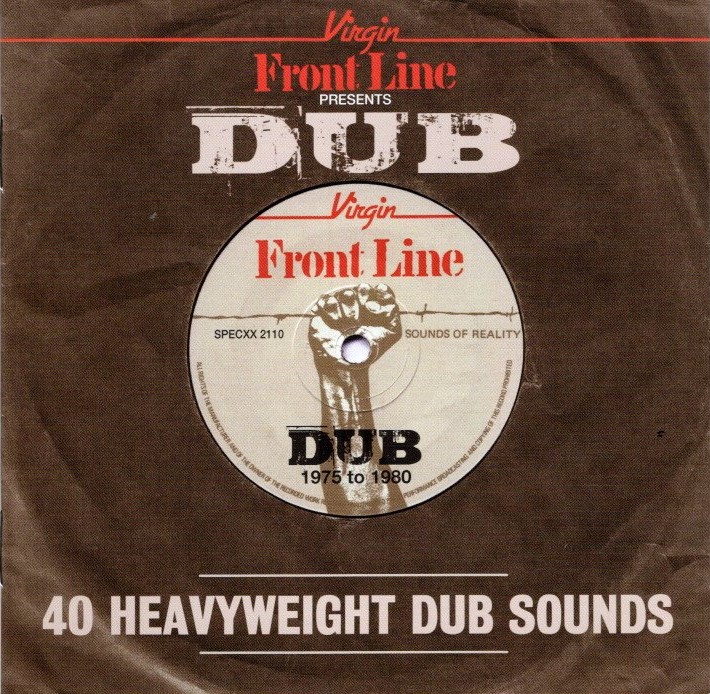
Front Line Presents Dub: 40 Heavyweight Dub Sounds

The Front Line series of reggae recordings from Virgin Records had a short, but remarkable, life of a couple of years at the end of Seventies, when the music was at its peak.  This blogger first heard some of the Front Line albums in the very early 90s, including amazing recordings by such figures as U-Roy and I-Roy.  But, then there's the dub material and it was great to find a few years back the great compilation series put out by Virgin of two-disc sets presenting some of the greatest examples of dub available, including 40 Heavyweight Dub Sounds, issued in 2014, and packed with mind-blowing excursions into the studio wizardry of that storied era.

There are so many great reggae performers on this set, including U-Roy, Linton Kwesi Johnson (Poet and the Roots), The Gladiators, The Twinkle Brothers, Prince Far I, Culture, The Mighty Diamonds, Gregory Isaacs, and Johnny Clarke, AND, crucially, for the dub element, such remarkable musicians like drummer Sly Dunbar and his bassist partner Robbie Shakespeare and guitarists, keyboardists, horn players and drummers and percussionists who were part of "stables" of prominent studio players on the scene.  Some of the tunes here were recorded by these musicians and released under such names as "The Aggrovators" and "The Revolutionaries" while two were by Dunbar.  This is a treasure trove of prime dub from 1975 to 1980 released in just two or so years by Virgin and is a great complement to the 37 Classic Roots Cuts that will be highlighted here in the future.

Tuesday, December 22, 2020

Ornette Coleman/Charlie Haden: Soapsuds, Soapsuds

While Ornette Coleman was creating some fascinating music with his electric ensemble, Prime Time, he took a detour and engaged in a side project with Charlie Haden, his long-time bass playing colleague, and recorded Soapsuds, Soapsuds, a series of absorbing and revealing duets, in January 1977, released the next year on Coleman's Artist House label and later reissued on his Harmolodic label through Verve.  In his long, remarkable career, Coleman didn't record a lot of duet albums, but they can be among the most amazing of his projects, such as when he worked with pianist Joachim KĂĽhn or with guitarist Pat Metheny, when the interplay between the two musicians reflects that they are truly listening to each other.  This was certainly the case with Coleman and Haden, who first played together two decades before, and who would continue working together occasionally after the bassist left Ornette's band about this time.  

There is an intimacy to many duet performances that draw the listener in as if you're hearing the performers in a private concert and this is one of those examples, all the more striking given the dense and usually exciting Prime Time performances of the era.  Haden was always a master of supporting the other musicians, never feeling the need to overplay or over-impress, and he was particularly brilliant here in giving Coleman the space to play some of the most beautiful tenor work (Ornette primarily being an alto player) he'd recorded.  In his rare, but typically cryptic notes, Ornette does say simply: "this music . . . has . . . a very simple message: these performers are playing for the sake of making music for people to enjoy their own concept of hearing."  Those last few words are particularly noteworthy.  As for Haden, he observed "most of what I have learned about the art of listening can be directly attributed to playing with Ornette. In order to contribute totally to his music, one must listen to every note he plays . . . and then come the endless possibilities."  This really is an immersive experience when focused concentration is directed to what these two masters brought to this stunning recording.

Sunday, December 20, 2020

French Sacred Music of the 14th Century, Vol. 1

This time of year seems particularly appropriate and, with the trying circumstances of this period especially, listening to early sacred music is both relaxing and renewing.  The Early Music Series by Lyrichord Discs Inc. has a large selection of great recordings, this one dating to 1994.  Recorded at Emmanuel Church in Boston, the seventeen pieces are performed by Schola Discantus, comprised of a quintet including two countertenors (a tough range to achieve for men), a pair of tenors and a baritone, and the director and producer is Kevin Moll.

As Moll explains in his lengthy and detailed notes, the earliest pieces are likely from about 1320 and some are early in the next century and come from a collection of roughly a hundred Mass settings from the era.  Moreover, he explains that "many, perhaps most, of the Mass settings on this disc were presumably sung at one time or another in the papal choir at Avignon during the so-called 'Babylonian captivity' of the papacy (1309-1377) or under the succeeding anti-popes there during the period of the papal schism (1378-1417), when there were popes at both Rome and Avignon."  So, there is historical context of interest along with the intrinsic beauty of the polyphonic singing by the quintet, mainly performed in trios, and greatly enhanced by the setting of the 1861 Gothic Revival church, albeit Episcopal, just off the Boston Common.  This is a beautiful recording for contemplation during the Christmas season, whether or not the listener is a believer.

Saturday, December 19, 2020

Mohammed Aman: The Tradition of Hejaz (Saudi Arabia)

Having just read Karen Armstrong's history of Islam, this was a good time to revisit this excellent recording of the traditional music of the Hejaz region of Saudi Arabia by the powerful singer and oud player Mohammed Aman and ensemble, released by the French label Ocora in 2001. Aman is said in the very informative liners by ethnomusicologist Jean Lambert to be "the last exponent in a long line of hijazi style musicians" and performs pieces both a capella, accompanying himself on the oud, a lute-like instrument, or with an ensemble utilizing the qanun, or zither, the violin, and a variety of percussion instruments, like the tar, darbuka, masga and naqrazan.

The first piece, sung solo by Aman and a prime example of his mastery of melisma (the singing of a group of notes for one syllable in a lyric), is a religious poem about the holy city of Mecca, while songs concern pilgrimage sites including Mecca, love poems, and a paean to the prophet Mohammed, some of these including lines dating back to the 8th century, whereas the "Ya ahi al-hawa" or "To People of Passion," has a poem written by Ibrahim Khafaji (1926-2017,) who composed the national anthem of the country.  As stated by Lambert, the history of music from the Hejaz has not been well documented or known but "thanks to the generosity of Mohammed Aman and his musicians, music-lovers in both the Levant and the West now have access to this heritage."  The Ocora label has many amazing releases of music from around the world and this is an excellent example from the Middle East.

Monday, December 14, 2020

King Crimson: THRAK

In 1994, while poring through the stacks at a Tower Records store (seems like ancient history), I picked up the VROOM EP by a reformed King Crimson and, while I enjoyed the preview of the "double trio" lineup that marked the return of the band after a decade of inactivity, I did not keep up with the band's following work and did not return to listening to KC for another fifteen years.  It's too bad I didn't follow-up, because 1995's THRAK is a stunning and powerful album, reflective of Robert Fripp's admirable determination to keep the band thinking and moving in a decidedly forward direction.  His decision to double the instrumentation— for guitar (with the great Adrian Belew on vocals and co-lead guitar), bass (having the underappreciated Trey Gunn on Chapman stick paired with the sublime Tony Levin) and drums (where Pat Mastelotto provided innovative percussion with the phenomenal Bill Bruford)—created a sonically stunning version of KC that, ultimately, proved unwieldy and impossible to maintain, for a variety of musical and personal reasons, beyond this recording, some really great live work, and a failed attempt at producing a second studio album.  The decision at the end of the decade to "frakctalise" into sub-groups to seek the next direction for the band was innovative and intriguing (more on that in a future post), but the next iteration proved to be the more practical, if less exciting, quartet format of the early oughts.


THRAK is a combination of monster metallic workouts, like the title track and bookends "VROOM" and "VROOM VROOM," atmospheric instrumental interludes with the "Inner Garden" and "Radio" pieces, the great "B'Boom" drum feature, and some of the best songs penned by Belew and Fripp, including "Dinosaur" and "Walking on Air."  The result is a well-sequenced and paced album that never flags and features some of the best performances and presentations in the long annals of KC.  The approving AllMusic review of the 40th Anniversary release of the album on Fripp's Discipline Global Mobile label calls it "high-quality prog," but Fripp had long before steered the band away from that long-derided label, starting with the truly new directions of Larks Tongues in Aspic and the following records, as well as the early 80s incarnation, beginning with the startling Discipline and THRAK was still another dramatic shift in emphasis and orientation, reflecting the greatness of this incomparable band. As expressed years later by Bill Bruford in the liners for the remixed 40th Anniversary edition from five years ago: "it just seems to have so much musical information on it in comparison to a standard rock record that you would think of today.  It's oozing hot spices and extra special gravy.  A rich meal indeed!"

Sunday, December 13, 2020

Lennie Tristano: Intuition

Lennie Tristano (1919-1978) is another of one those tragically unheralded musical masters, a pianist and composer who was the first to use "free improvisation" in jazz in seminal late Forties recordings.  Born in Chicago, his sight was severely impaired from birth and he was totally blind by the time he was ten.  Despite this, he had immense musical talent, playing horns, guitar, drums and piano, the latter becoming his main instrument.  He studied at the American Music Conservatory in his hometown, finishing the course in three years but denied his diploma because of a financial dispute and continuing with graduate work and he performed and taught, with one of his students being saxophonist Lee Konitz, later a major figure in jazz and who died this past spring at age 92 from COVID-19.  While Tristano achieved some recognition during the full ferment of the bebop years of last half of the 1940s and into the next decade, he moved further into teaching and less with recording and performing.  Tristano died at age 59 and was largely forgotten, leading, it was said, to bitterness and disappointment on his part.  His aversion to commercialism and his dedication and devotion to his musical vision left him underappreciated and under-recognized over the years, though he was greatly admired by Miles Davis, Bill Evans, Anthony Braxton and Charlie Parker, among many others.

This great four-disc overview of Tristano's work between 1945 and 1952 issued by the British label Proper Records in 2005 shows just how forward-thinking this amazing musician could be, but it can also be understood (sorta) why his innovations did not connect with a wider jazz-loving public.  It wasn't just the revolutionary free improvisation employed in tunes like "Intuition" and "Digression" recorded in spring 1949 and which definitely prefigured what Ornette Coleman and Cecil Taylor would do years later, but Tristano's approach to harmony and tonality were distinctive, even if, usually, the rhythm sections played very much "straight-ahead," leading to the critique that the music lacked swing and was cold and formal.  The first two discs have plenty of interesting material, including some great piano solo work and fine trio recordings, with the excellent "Out on a Limb" and a series of tunes, some with an added clarinet, recorded on the last day of 1947 being standouts for this listener.  

It is disc three, though, that astounds, with an all-star workout from 3 January 1949 including Dizzy Gillespie, Miles Davis and Fats Navarro on trumpet, Parker, J.J. Johnson and Kai Winding on trombone, Shelly Manne on drums, Charlie Ventura on tenor, and Tristano blowing through "Victory Ball;" some great work with a quartet and quintet session about a week later, featuring Konitz; a sextet with Konitz and Marsh in March with "Wow" named for a reason as the sax players play a phenomenal intertwined passage; and that free session in May, also with the two sax masters.  Disc four has the great benefit of mainly consisting of live material offering greatly extended renditions of tunes with much longer soloing, including a Christmas Eve 1949 performance with Konitz and Marsh of two tunes at a Parker-headlined concert at Carnegie Hall, and a half-dozen tunes recorded in Toronto in summer 1952, again with his primary soloists.  There are also a couple of pieces recorded in the trio format in fall 1951 for Tristano's short-lived label and including a young Roy Haynes—a master drummer who is still with us and who will be 96 in March.

With a four-disc set, there's a lot more that could be said, but, generally, as was the case with the long-neglected Herbie Nichols, given some of the great material, innovations, and beautiful playing found throughout, the one word that stands out, with Marsh and Konitz melding their horns together so excellently is: Wow.

Saturday, December 12, 2020

Philip Glass: Koyaanisqatsi

Philip Glass is one of those "classical music" composers who defies easy categorization.  Though Julliard-trained and identified with the so-called "minimalist" school, Glass largely worked outside of conventional, even for modernists, formats and venues for the presentation of his work.  His work with the great sitar virtuoso Ravi Shankar while studying with Nadia Boulanger along with a desire to work with theater, opera, dance, pop, film and classical worlds reflect a truly admirable multi-disciplinarian approach that bridges normally segregated musical genres and has had a tremendous influence over the decades.  One of his best-known adventures tying sound to the visual image of film is the amazing Koyaanisqatsi, which first appeared as a soundtrack and then redone as a longer album.  It is also the first of five discs in the set Philip on Film, released by Nonesuch Records in 2001.

Released in 1982 and produced and directed by Godfrey Reggio, Koyaanisqatsi eschewed dialogue and traditional narrative, including aural, to present images and music that, as expressed on Glass' website, "is an apocalyptic vision of he collision of two different worlds—urban life and technology versus the environment."  Yet, it is added that the film "is not so much about something" as much as it is a provocation "to raise questions that only the audience can answer."  There is no assigned meaning, which would be propaganda, but an encouragement for the viewer to find a meaning that is "whatever you wish to make it."  The music, heard apart from the visuals of the film, is tightly constructed and played, and often stunningly beautiful, with brass punctuating the continuous flow and vocals accompanying the hypnotically repetitive rhythms, but there is a strong emotive element not often associated with the "minimalism."  On its own terms, the music here is remarkable, but the obvious next step for this listener is to actually watch the film.


Friday, December 11, 2020

Chocolate: Peru's Master Percussionist

 Among the most impactful aspects of "world music" is the syncretic nature of so much of it, with influences from one or more places transmuting the music of another.  An excellent example is that of Chocolate (Choco-LAH-tay), the nickname of Julio Algendones (1934-2004), a percussionist of great skill and high renown in Peru.  The descendant of Africans brought to work in the horrific conditions in the silver and hold mines of the Andes Mountains of Peru and later on haciendas where cotton and sugar cane were grown, Chocolate devoted his musical life to maintaining the traditions of African drumming in the context of the Cincha area of the southern part of the country or in El Carmen a suburb of the capital Lima, both being areas predominantly inhabited by Afro-Peruvians.

Chocolate, the liner notes tell us, was born in a poor black farming community, where his mother picked cotton, but his talent led him to perform in the capital, where he achieved fame as "the most faithful representative of the cajon [a wood box-shaped drum] and this tradition of ritual drumming which a very people in Pery have maintained and kept alive in its purest form."  The religious elements of santeria and makumba, events like baptisms, weddings and funerals, and everyday opportunities for music and dance permeate the music, with percussionists like Chocolate "seen as a short of shaman who calls or evokes the spirits" and who "is a mediator between heaven and earth since the spirits are expressed through his rhythms."  It is this aspect, the core of rhythm in human life (the heartbeat most fundamentally) and its most basic accessibility to even the poorest of people for "a music for which all that was needed was your body and the nearest objects from which to make sounds," that comes through in the hands of a master like Julio "Chocolate" Algendones, who performed the three pieces on this album, released by Lyrichord in 1993, in 1990 under the auspices of producer J. Blue Sheppard.

Thursday, December 10, 2020

Harold Budd, Simon Raymonde, Robin Guthrie, Elizabeth Fraser: The Moon and the Melodies

The composer Harold Budd, generally celebrated for his "ambient" works and best known, probably, for his collaborations with Brian Eno, died Tuesday from complications of the COVID-19 virus at age 84.  Budd, a native of Los Angeles, was fascinated by jazz heard in the clubs of South-Central Los Angeles and took a course in music theory at Los Angeles Community College.  During a stint in the Army, he played in a band with Albert Ayler, who went on to a gloriously noisy, joyful, and sadly short-lived career before his untimely drowning death in 1970.  Budd then studied at Cal State Northridge and the University of Southern California and, while he influenced by such modern "classical music" figures as John Cage (in attitude if not compositionally), Morton Feldman and Terry Riley, he was profoundly affected by the immense spiritual qualities of the great saxophonist Pharoah Sanders.  After an avant-garde period in his composing, Budd, by the early Seventies, taught himself piano and moved into his ambient avocation, which included his association with Eno by the later part of that decade.

In 1986, Budd moved to London and found he could make a living with his music there and in Europe, rather than in America.  That year, he met the Cocteau Twins, a group ubiquitously labeled as "etheral" and this "unlikely collaboration," as expressed in Budd's website bio, was also his "first foray into popular music."  Purportedly, the composer's admirers were dismayed, but I bought the album when it was released on 4AD in fall 1986 and was very impressed with the merging of Budd's piano and the atmospherics generated by the band, especially on a track like "The Ghost Has No Name" where Richard Thomas (Dif Juz) plays a haunting saxophone accompaniment.  My later interest in ambient electronic music has only added to the appreciation of this fine recording.  It helps, perhaps, not to think of this as a Cocteau Twins album, no more than it is a Harold Budd record, but as a true collaboration.  In fact, Budd and Robin Guthrie, the sonic architect of CT, went on to work together on several subsequent projects and the composer collaborated with such "pop" figures as Jah Wobble, David Sylvian, Andy Partridge and Hector Zazou in addition to his own works.  His eager embrace of other music and musicians, outside of his "genre," was particularly admirable and The Moon and the Melodies is an especially notable example.

Wednesday, December 9, 2020

Eric Dolphy: Iron Man

 Another of many musical masters who left this world far too soon, multi-instrumentalist Eric Dolphy was a phenomenal performer, writer and arranger who was so underappreciated and over-criticized for his stunning innovations in the first half of the Sixties.  Yet, some of the most far-seeing of jazz musicians, including Charles Mingus, George Russell, Ornette Coleman, John Coltrane and Andrew Hill recognized his brilliance and encouraged him to pursue his singular path.  Sadly, Dolphy, who like so many American jazz musicians was embraced far more by Europeans, died from the misdiagnosed complications of diabetes in Berlin in June 1964 and who knows what he would have gone on to do if he'd lived beyond the mere 36 years he had.


Iron Man is one of two albums, the other being Conversations, recorded in early July 1963 under the guidance of producer Alan Douglas, who worked at United Artists and later had a controversial association with Jimi Hendrix.  While the Conversations album was issued the same year, it was decided to shelve Iron Man, purportedly because it was considered more experimental, and it did not see the light of day for five years.  This album, however, is one of the best Dolphy recordings out there, with his signature angular melodic statements, unusual arrangements, and complex band interplay on the title track, "Mandrake" and "Burning Spear" juxtaposed with the beautiful duets with the stunning bassist Richard Davis (still with us at age 90!) on Duke Ellington's "Come Sunday," where Dolphy's amazing talents on the bass clarinet are again highlighted, and Jaki Byard's "Ode to C.P. [Charlie Parker]" with the leader playing with great sensitivity on flute.  The band, including Davis, drummer J.C. Moses, bassist Eddie Khan, alto saxist Sonny Simmons (credited as "Huey Simons" that being his given first name and who is also still living at age 87), flautist Prince Lasha, Clifford Jordan on soprano sax, the young Woody Shaw on trumpet, and the great Bobby Hutcherson (apparently the "iron man" of the album and song titles) on vibraphone, is just great, as well, in handling the leader's challenging and highly rewarding compositions, which so richly deserve more hearing.