Showing posts with label electronic music. Show all posts

Saturday, August 29, 2026

Alien Community (Pete Namlook and Jonah Sharp): Alien Community 2


Pete Namlook's incredibly prolific career in electronic music of diverse stylings through his FAX (well, FAX +49-69/450464, to be exact) label includes some fantastic excursions into a universe (space being an obsession for Peter Kuhlmann) of sound that continue to be a fascination for this blogger.  That started with the Outland and Psychonavigation series of recordings carried out with Bill Laswell, but has expanded, when discs can be had at a somewhat reasonable price, to other releases.

Jonah Sharp, who also collaborated with Laswell, hails from Scotland and has long resided in San Francisco and was a jazz drummer before embarking on his electronic endeavors, notably through his Spacetime Continuum moniker.  As Alien Community, Namlook and Sharp, on this second release produced at the latter's San Francisco studio, launched "A Long and Perilous Voyage," which, though it is technically divided into a dozen five-minute sections, is an hour-long trip, on various levels.

Ambient techno is probably the most common term used for music like this, it was 1994 and that time was certainly replete with recordings of this general impress, and it's hard to know who makes what contributions, though one reviewer, EMCritic, refers to Namlook's synthesizer pads and manipulation of transistors along with Sharp's electronic rhythms and "spaced-out acid tweaks."  An AllMusic review of the pairing of the two AC recordings calls the music "transcendental" and refers to the second as "clearly a showcase for Sharp" calling it "driving music for flying cars" as well as something of an homage to Brian Eno.

For this listener, there is less concern about the devices used and who contributed what elements than about the enjoyment of being transported on this electronic musical journey, though what the peril is would perhaps be good to know.  There is, in the evolution of the piece and extremely quiet as it is for the opening moments, enough variety in the sounds, including percussive components, to easily hold the attention.  As observers have noted, it ca be somewhat challenging to find FAX recordings at prices that aren't too jarring, but it does take some patience.  In this case, it was well worth it.  

Thursday, February 26, 2026

Pauline Oliveros: Lion's Eye/Lion's Tale

From the mid-1960s, composer Pauline Oliveros employed a variety of means to develop her concept of Deep Listening, including innovative uses of electronics, works based on gamelan music from Southeast Asia, drawing from atmospheres in unusual recording locations and much more.  In the last half of the 1980s, she created music from gamelan influences, including the two pieces for this recording released in 2006.

This blogger's first experience with gamelan was about 35 years ago through one of the many amazing recordings from the Nonesuch Explorer series and the effect on hearing this amazing music was powerful and immediate.  The hypnotic effects of percussion, chanting and singing and the instruments was just phenomenal and it was great to later see how classical composers like Lou Harrison and King Crimson guitarist and songwriter Robert Fripp adapted it to their work.

Oliveros, in the liners for this excellent recording, observed that "in Gamelan music the interlocking elements of traditional forms create a colorful, shimmering global sound.  The color shifts in beautiful and subtle ways with many instruments playing the same melody, but with a variety of ornamentation and punctuation peculiar to each instrument."

The 46-minute "Lion's Eye for Gamelan," dating to the mid-1980s and recorded with The Berkeley Gamelan Ensemble, finds Oliveros writing the orchestration so that the instruments are clearly heard, which distinguishes it from traditional performance.  Another notable element is that while higher pitched instruments are played faster or lower ones slower in gamlan, Oliveros used a computer-controlled sampler to sustain notes for up to a minute or longer, as well as having some at speeds as fast as 1,800 beats per minute.  The intent was to create an environment in which those rhythms might sound like waves.

Oliveros added that the piece could be played with a gamelan ensemble or with a sampler and music programming language called HMSL (Hierarchical Music Specification Language), which creates changing patterns every 30-beat measure, with the tempo going as fast as 72 beats per measure.  For the album, Carter Scholz of the Berkeley Gamelan wrote and performed the sampled portion.  "Lion's Tale for Sampler" was created four years later and involves speeds of up to 1,800 bpm with intricate patterning of polymetrics and polyrhythms and Oliveros added that it could be reprogrammed in new versions, as well as one in the MIDI format for keyboardists.

While computers and electronics are utilized heavily on this record, they work beautifully with the gamelan style and structure, enhancing its deeply immersive and spiritual character and truly reflecting Oliveros' concept of Deep Listening.


Thursday, April 25, 2024

Cabaret Voltaire: Plasticity

This one, a 2-LP vinyl set, was bought just after its October 1992 release at a Portland, Oregon record store and, a few years removed from Groovy, Laid-Back and Nasty, with the 44-minute EP Colours and Body and Soul as precursors that found CV trying to rebound from that strange 1990 relic, Plasticity was a welcome move into a new (and final) phase for Cabaret Voltaire. 

Released on the Plastex label set up by Stephen Mallinder and Richard H. Kirk after their EMI debacle, the recording was the first of three releases, followed by International Language (1993) and a personal favorite, The Conversation (1994), in which the music was all-instrumental.  While it has been said that Mallinder still had an active role, it sounds like Kirk exercised more control over these albums.  They can also be compared to such projects as Sandoz and Electronic Eye from that era.

In any case, a favorite CV track, "Low Cool," opens the record with a sample of Los Angeles gang members casually talking about the violence and nihilism of their world. "Soul Vine (70 Billion People)" took found sound from the 1981 underground dance floor hit, "Yashar," while "Inside the Electronic Revolution" is a highlight, as is "Neuron Factory."  More ambient tunes like "Resonator" and "Deep Time" nicely provide alternates to the flow of the album, while "Soulenoid (Scream at the Right Time)" hits the sample peak with an eerie and unsettling series of female screams to end a fascinating record.

The CD version omits "Brazilia" and "UFO" erasing almost 13 minutes from the double vinyl version and a planned 60-minute video was shelved because of financial concerns, but, despite this, Plasticity rates high among the mammoth CV catalog and showed the Kirk and Mallinder were able to find redemption and relevancy after a significant bump in the long road of their 20-year career.  The duo managed to stay abreast of changes in electronic music, while keeping the core of what made them so great going back nearly two decades, including abundant sampling, unnerving ambience and potent up-tempo elements.

Tuesday, April 4, 2023

Agents with False Memories

For over 45 years, Richard H. Kirk made some of the most distinctive and idiosyncratic music in the so-called "electronic" genre, beginning in his teens with the embryonic Cabaret Voltaire, experimenting with primitive sequencers, processers, synthesizers, drum machines and tape along with guitar, wind instruments, bass and other more traditional instruments.  Over roughly twenty years, CV which originally included Christopher Watson, whose environmental recordings have been featured here, as well as Stephen Mallinder, who continues making great music today, evolved from harsh, uncompromising "industrial" sounds to more accessible recordings (including a brief major label period in the late 80s) to a final phase, in the first half of the Nineties, that was a balance between experimentation and accessibility.

After Mallinder moved to Australia by the mid-1990s, Kirk, who'd launched some great side projects like Sandoz and Sweet Exorcist, entered into an incredibly fertile period, including recordings under his own name and a dizzying array of aliases (Electronic Eye, Nitrogen, Orchestra Terrestrial, Dark Magus, Al-Jabr, Blacworld and a great many others that were generally one-offs for individual songs or on compilations like the fantastic Step, Write, Run double-disc of works under his Alphaphone label).

One of the more interesting of his releases during this era was 1996's Agents with False Memories, issued by Ash International, a label run by Mike Harding, co-owner, with Jon Wozencroft, of Touch, which put out many albums by Kirk and Watson.  The single, 53-minute long track might be considered a close kin to "Project 80," the mind-blowing long-form piece from Cabaret Voltaire's The Conversation (1994) that was the last album until Kirk resurrected the name and released the very strong Shadow of Fear in 2020.  In turn, they might well be descendants of his 1982 solo work, "Dead Relatives."


Agents with False Memories is a compelling wash of electronic programming and percussion accompanying a great many samples of found sounds, including an interview with Orson Welles, a visit to Kirk's hometown of Sheffield, England by an American evangelist calling forth the Holy Spirit, a quote from President George H.W. Bush, a discussion on the technical innovations of the racist 1915 film The Birth of a Nation, expositions by scientists and a great deal else.  On the heels of "Project 80," the piece is a standout in a very long career with a great deal of diversity in it.

While Ash International's description referenced the album as a soundtrack for a film of the same name by Oregon-based Guy van Stratten, this was a little joke by the label and Kirk as van Stratten was the name of a Welles character from the 1955 film, Mr. Arkadin.  Kirk was fascinated by Welles, as found, just with a couple of examples, Cabaret Voltaire's take on the theme from A Touch of Evil and Kirk's "Sons of Harry Lime" as rendered by Orchestra Terrestrial on his Intone label's Unreleased Projects, Volume 3.

Kirk's death in September 2021 at age 65 ended the incredible career of a phenomenally productive creator, who left, for those who enjoy his work, an amazing legacy spanning six decades.  The exhaustive discography concluded, just months before his passing, with the final Cabaret Voltaire albums, BN9Drone and Dekadrone, that were further explorations in long-form music.  For those with adventurous tastes in "electronic music," Kirk's many albums are worth pursuing and hearing, with Agents with False Memories a definite highlight.

Tuesday, September 21, 2021

Richard H. Kirk: Shadow of Fear/Dekadrone/BN9drone

This morning came the terrible news of the death, at age 65, of Richard H. Kirk, who I have listened to and admired deeply for thirty-five years.  This innovator of electronic music, beginning with Cabaret Voltaire in 1973 and including a staggeringly productive solo career, featuring many, many aliases, always put the music first and, for those who know, his body of work and his legacy is not just massive in scope and scale, but impressive in its diversity and ingenuity.

It had been planned to soon highlight on this blog Kirk's remarkable return as Cabaret Voltaire through the release through Mute Records in fall 2020 of the great album, Shadow of Fear, followed this past spring with the issuing of the drone recordings, Dekadrone and BN9drone.  This trio showed that there was no diminution of RHK's forward-thinking, yet past-respecting, talents with the recordings made, by virtue of the failure of (somewhat) newer recording equipment, with old-school technology, but sounding fresh and vital now.

For months after receiving Shadow of Fear, that album was being listened to very regularly and such tracks as "The Power (Of Their Knowledge)," "Night of the Jackal," and "Universal Energy" being particularly powerful and compelling, though the recording is strong from start to finish.  Whatever criticism Kirk received for reviving the name in 2010 without longtime collaborator Stephen Mallinder, whose tweet this morning expressed concisely that relationship between the two, he deserves eternal credit for releasing a record that built off the past while moving resolutely forward.

The Dekadrone and BN9drone albums are also really interesting offshoots of what he did in putting Shadow of Fear together and, in this pandemic environment with climate change making its visceral impact fully clear, these unsettling excursions into the netheworld of electronic manipulation are relevant soundtracks to the upheavals and uncertainties that are emblematic of these times.

Today is definitely a time to delve deeply into these sound worlds formed by a highly creative and particularly singular artist whose uncompromising devotion to his sonic architecture is deserving of so much more attention than he has received.  Since 1986, when I put CV's Drinking Gasoline EP on the turntable and then spent days trying to wrap my young head around what was being projected through the speakers, I've regularly listened, absorbed and enjoyed the unique musical vision of Richard H. Kirk, who was influenced by so many, including the masters of dub like the late Lee "Scratch" Perry, who will be featured in the next post.

Kirk lives on through his remarkable music spanning close to a half-century and let's hope that he will continue to be heard and appreciated in all his diversity, aliases, and prodigious output.

Saturday, February 6, 2021

Cabaret Voltaire: Shadow of Fear

 As an admirer of this group for thirty-five years, I pre-ordered this album, the first under the name in over a quarter-century, from the great Mute Records as soon as it was announced last summer and received it just before Thanksgiving.  I wanted time to give the album several listens before highlighting it here, but Shadow of Fear has been a constant listen, especially in the last month or so.  Whatever qualms some fans have had about this being a Richard H. Kirk solo vehicle, his point that the other members, Christopher Watson and Stephen Mallinder, chose to leave and the fact that he has carefully, and very effectively, curated the band's output for many years is all that needs to be said.

As for this record, with its reliance on old equipment after a computer crash, it is both redolent of a variety of hallmarks of CV from the past (the drum machine from "Nag, Nag, Nag," or certain keyboard touches and "electro" drums from the mid-Eighties, and electronic sounds from the first half the following decade, much less the ominous voice samples tuned lower for even more of a sense of dread and mystery.)  Yet, as Kirk was clear to say in interviews, this is also forward-looking in that is new and very strong material.

Favorites here include "The Power (Of Their Knowledge)," "Night of the Jackal," and "Universal Energy," though all the pieces are excellent in their own way and the sequencing is such that the album moves smoothly from one track to the next and the variety keeps the attention locked in.  There's been a lot of comment about how the recording is apt and fitting for our COVID-19 pandemic environment, though Kirk pointed out that most of the work was done well before the outbreak and that his tendencies toward paranoiac musical musings seem more timely.

In any case, Shadow of Fear is a great album and another monument to Kirk's admirable and relentless focus on forging ahead and not dwelling too much on the past, which acknowledging antecedents in Cabaret Voltaire's long history.  He has just released a three-track EP, Shadow of Funk, and announced a pair of upcoming drone projects, Dekadrone, out on 26 March, and BN9Drone, released on 26 April and both available by pre-order now.  So, we'll see how the obviously inspired Kirk continues the retooled CV project!

Monday, November 16, 2020

Pete Namlook/Klaus Schulze/Bill Laswell: The Dark Side of the Moog VII

This fascinating series of excursions deep into the realm of ambient electronic music comprising eleven volumes from 1993 to 2008 from FAX Records impresario Pete Namlook (Peter Kuhlmann), Klaus Schulze (briefly in Tangerine Dream), and, on four of the albums, the ubiquitous bassist and producer Bill Laswell, is not only given an excellent punning title, but the word play continues with individual tracks further playing off the output of Pink Floyd.  In this case the 50-minute piece in this seventh volume released in 1998 is called "Obscured by Klaus" in reference to that band's seventh album, Obscured by Clouds.  Namlook noted, though, that there was no connection or homage to the British group, other than having fun with puns.


There is plenty of diversity in the sound elements when listening to this recording, either at high volume (as in the car) or, even better, with headphones.  Washes of sound, varied textures, often strong rhythms, found voices and other components work well over the course of the six parts, which are well organized and programmed.  There is often a beguiling beauty in the more ambient sections, but the variety with more percussive sections and a range of electronics with the Moog as the backbone make this an excellent entry in the series.

Monday, April 29, 2019

Mick Harris: Hednod Sessions

This two-disc set released in 2004 on Hidden Art Recordings were culled from sessions created by the former Napalm Death drummer who turned to dark, slow tempo electronics in all kinds of guises including Scorn, Lull, Quoit and in many collaborations, but who has largely been silent for a number of years.

Harris' forte consists forbidding washes and undercurrents of processed sound over steady, heavy beats, or, as often was the case with Lull, pulses.  Variability is often subtle and slowly evolving and the simplicity can be deceiving when he introduces change in ways that are disarming.  While Scorn was generally very heavy on the beats and Lull increasingly mitigated them with a glacial pace of change in pulse, the Hednod Sessions strike something of an (un)happy medium.

These thirty tracks were created in 1999 in Harris' minuscule home studio, a converted bathroom labeled "The Box."  They were initially issued as a quartet of 12" singles on the hushhush label with additional tracks provided to subscribers of a series comprising the four sessions and five bonus pieces added later.


As befits the location where these works were created, there is often a claustrophobic, or, if preferred, intimate sense in hearing these pieces.  Some of this is the muted percussion, but a great deal of the effect comes from the eerie employment of sound sources.  There is something compellingly immersive about listening to these recordings, especially with headphones.

In instances like this, Harris can be at his most appealing and interesting when he creates that atmosphere and environment in music that essentially consumes the full attention of a dedicated listener.  Again, the results tend to be best appreciated by focusing attention on the subtleties of the sound as it works through and around the steady application of rhythm.

When this set was purchased new some fifteen years ago, the shock was that it was acquired extremely cheaply—literally a few dollars on eBay—for reasons that remain a mystery.  This is hardly a "you get what you pay for" statement, but it did seem like a stroke of great fortune in getting such a bargain for such utterly absorbing sound worlds.

Monday, December 31, 2018

Richard H. Kirk: Dasein

Released at the end of June 2017 through his Intone Productions label, Dasein is a great Richard H. Kirk album in many ways.  Recorded at intervals over a three-year period from late 2012 to late 2015, while Kirk worked on other projects, it reintroduces voice (albeit heavily treated samples of his vocalizing) and, especially, guitar, which has not been heard on any of his recordings for a long time.  These add a level of depth and richness to the music and are welcome reintroductions to his work..

The pieces are uniformly excellent, filled with the dub-influenced electronic melange that Kirk has mastered over many decades.  The titles hint at some of his usual concerns, including "Nuclear Cloud," "Radioactive Water," "Invasion Pretext," and "Sub/Antarctic/H2O," the latter appearing to have some reference to climate change (maybe).


This is a strong release from someone whose electronic music has been challenging and invigorating this listener for over thirty years and is an indication that the creative spirit is far from diminishing in Kirk's monumental body of work. 

As a sidenote, just having finished the often-difficult reading of an anthology of German philosopher Martin Heidegger, a core concern of his was the nature of dasein, or being.  So, it seemed quite a coincidence that I bought the CD last year and then followed up, unintentionally, with the purchase of the Heidegger anthology.

Saturday, March 17, 2018

Sandoz: Dark Continent

After the dissolution of Cabaret Voltaire in 1994, after twenty years of some of the most adventurous and compelling electronic music around, Richard H. Kirk threw himself into a prodigious period of work, releasing many recordings under a panoply of nom de plumes.

One that he'd started in CV's last phase of work and then expanded on afterward was Sandoz, launched in 1992 and named for the Swiss pharmaceutical laboratory where LSD was developed in the late 1930s.  There have been several Sandoz releases over the years and Dark Continent, which came out in 1996 on tJon Wonzencroft's great Touch label, is a particular favorite.  The album is culled from two sessions, starting with a six-song extended play that appeared in 1993 and then another quartet of pieces recorded three years later for the CD release.


Sandoz has strong elements of African rhythm and percussion, as well as reggae and dub touches (a Sandoz album, the excellent Chant to Jah, was devoted to the latter) layered in with often lush electronic sounds.  Dark Continent is a very consistent recording in terms of the quality of the pieces which always manage to provide distinctive aural touches among the steady repetition of rhythms and beats.

In late 2016, Mute Records issued a box set of Sandoz recordings from 1992-1994 including a remastered version of Dark Continent, the original of which has long been out of print and can be hard to find.  That set and a larger collection of Kirk solo work issued at the same time provide a great overview of the work of a prolific and diverse artist using electronic musical resources to always compelling effect.

Monday, March 12, 2018

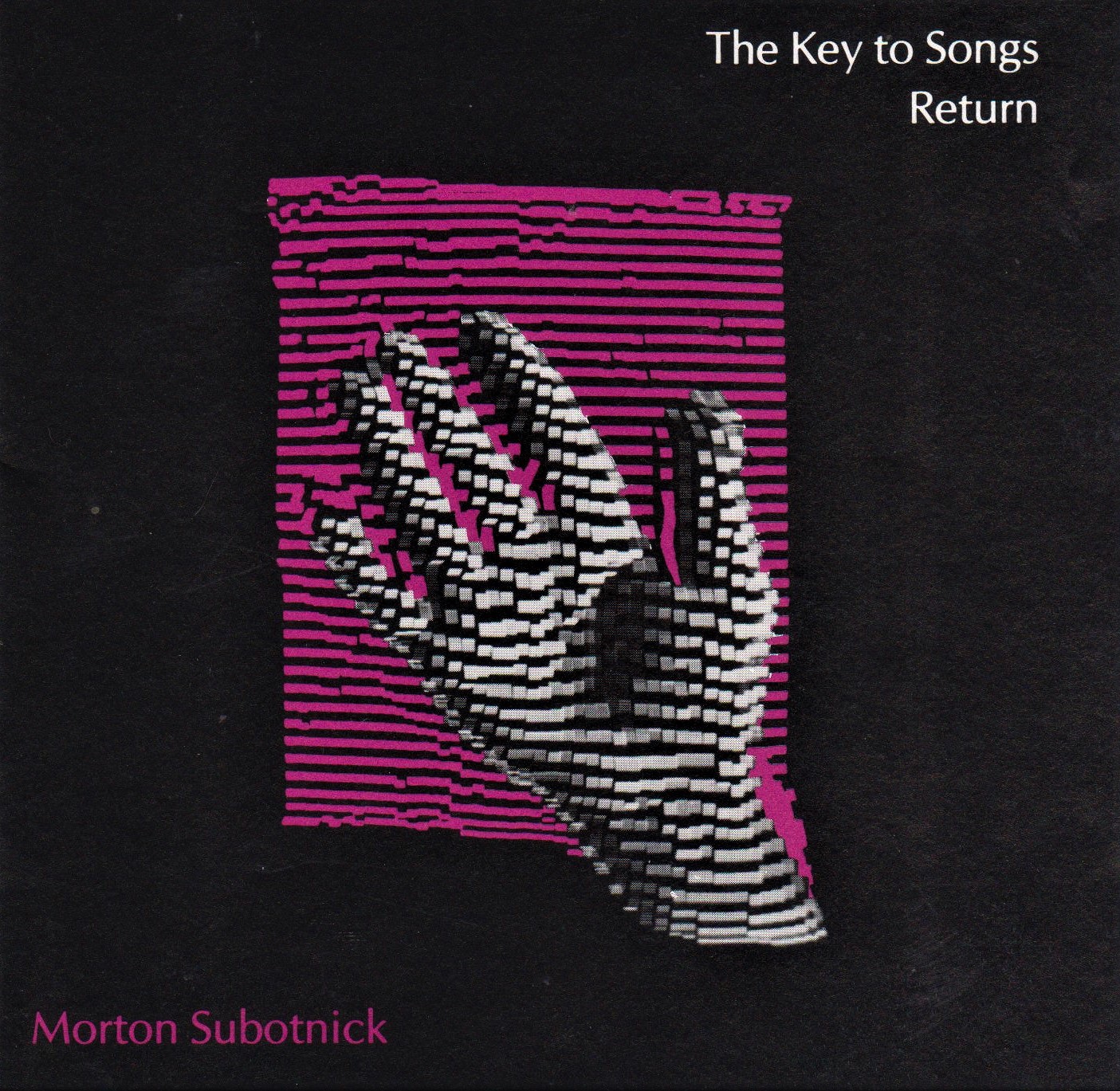
Morton Subotnick: The Key to Songs/Return

A native of Los Angeles, Morton Subotnick is a remarkable composer who works with electronics in highly compelling and very interesting ways.  Subotnick is best known for his 1968 work, Silver Apples of the Moon, which was celebrated in Los Angeles recently on the 50th anniversary of the landmark piece.  While attention is rightly being given to Silver Apples as a seminal piece of electronic music, this post looks at  Subotnick's mid-1980s works, The Key to Songs and Return —A Triumph of Reason, which are amazing works, released on New Albion Records, which has released so much great modern music, utilizing YCAMS, the Yamaha Computer Assisted Music System, with the latter completely generated through that means, while the former utilizes that with acoustic instrumentation.

The Key to Songs comprises, the liners recount, "music for an imaginary ballet" based on a pictorial collage novel by surrealist painter Max Ernst, with one of the chapters labeled "The Key to Songs."
Subotnick uses two pianos, marimba, xylophone, vibraphone, viola and cello along with YCAMS to generate a dramatic and often frenetic score that mimics Ernst's collages, which are said to be dramatic, often erotic and playing with the line between reality and fantasy.  Based solely on listening to the music, the latter point is notable in that telling acoustic from electronic instrumentation can be somewhat challenging.  The composer even wrote instructions for the musicians to exaggerate their movements so audiences could tell the difference.  The piece is dynamic and hypnotic.


Return was a commission to mark the appearance of Halley's Comet in February 1986 (it had last been seen in April 1910 and is predicted to return in July 2061).  Comets were believed in ancient days to the harbinger of ruin and destruction on one hand and the auspicious indicator of great benefit on the other.  Edmund Halley, in 1705, determined that a comet seen twenty-three years before would return about every 75 years.  Subotnick's score "depicts the comet's passage through time" and the first part reflecting the era to 1758 when the comet's return was given Halley's name and the second for the period after that and to the future.  The computer-generated music reflects music heard in the mid-1700s, specifically the work of Baroque composer Domenico Scarlatti and then quiet, contemplative passages alternate with the dymanic, intense bursts of sound marking the onset of the comet and "the triumph of reason" in Halley's work.  In the second part, he evokes 18th and 19th century music (Mozart and Liszt), then ragtime for 1910, and electronic sounds for the current and future periods.

Computer and electronic music is often denounced for being cold and emotionless, but here are two fascinating recordings that show how these types can be skillfully blended with acoustic instruments to provide richness or depth or, on its own, created to bring a richness and diversity that belies that criticism.  This recording is an ear-opening exploration into the possibillites of electronic music as evocative in ways it is accused of not being.


Tuesday, March 6, 2018

FAX Compilation 1

My introduction to the remarkable electronic sound world of Pete Namlook (real name Peter Kuhlmann—check the surname backwards) came through his many collaborations with one of my favorite musicians, Bill Laswell, in the multi-volume Psychonavigation and Outland series of recordings for Namlook's FAX label.  I have most of the entries in both series and have enjoyed them immensely.

It is always admirable when a musician working in a very uncommercial environment can create their own sustainable label and the FAX label is a good example of this.  Until his untimely death in 2012, just before his 52nd birthday, the prolific German artist released a major catalog of his own recordings and of many others through the label.


This compilation is one of several released by FAX over the years and appeared in 1994.  In addition to Namlook's work under the nom de plumes of The Putney, Air and 4Voice, there are collaborations with Richie Hawtin and Tetsu Inoue and contributions from Inoue, Atom Heart, longtime Laswell collaborator Robert Musso, and others.

This two-disc set is filled with excellent ambient pieces and works particularly well with headphones and concentrated attention.  This is also the easiest to find of the several FAX compilations, because it had outside distribution, so, for those who like ambient electronics (and this was the heyday of it), the album is well worth seeking out.


Monday, October 31, 2016

Lull: Continue

Well, it is Halloween and I've often considered taking this 1996 recording, released on Relapse Records, or others made under the moniker of Lull by Mick Harris and playing it outside when trick or treaters tentatively make their way up to the house.

This is partly because I live in a canyon community, appropriately called Sleepy Hollow, where we have dark, narrow streets, lots of trees, and, in this case, a replica Victorian home that might give an aura of spookiness, particularly when decorated for Halloween.

Then, if Continue is playing in its entirety as an unbroken 62 minute exercise in slow, dark, hypnotic electronic droning, how could a trick or treater not feel a sense of dread, foreboding, unease and even fear?


Any other day in the year, though, at least to this listener, the album actually has a calming, introspective effect, even if it does have a chilling aura to it.  Harris establishes, without overt rhythm, a sense of flow and the rising and falling of electronic sound that captivates and draws the listener in.  He creates a powerful aural soundscape that doesn't get old.

Whether it is music to many people is another question entirely.  As the description of this blog states, courtesy of the great modernist composer Edgard Varése, "music is organized sound."  How that factors into conventional conceptions like melody, harmony, counterpoint or how it might square with orthodox views on beauty is up to the hearer.

For this listener, Continue is a fascinating immersive experience, a sound world that blots out extraneous circumstances when heard on headphones.  It is a aural journey into a world that is dark, but also fluid and open.   In fact, it is no accident that Lull's first recording was titled Journey through Underworlds.


Because, yeah, it is like that.

Harris has been conspicuously silent for the last couple of years and hopefully has not given up on making music.  With Scorn, Lull, and his many collaborations, his body of distinctive work has been really interesting.  May he reemerge with new music soon, no matter what the moniker.

Monday, April 11, 2016

Cabaret Voltaire: The Crackdown

Once Cabaret Voltaire became a duo of Stephen Mallinder and Richard H. Kirk, after Chris Watson's 1981 departure, a notable change in the group's sound was undertaken.  While still experimental, the music also became more accessible, a development first highlighted on the half of the 1982 release, 2x45, highlighted here before.

Then, when CV, which was under contract to Some Bizarre Records, signed a distribution deal with Virgin Records, and the group headed into the studio with noted producer and engineer Flood, who became qiuckly known in the late 1970s and early 1980s for his engineering talents, working on the debut records of New Order and Ministry, for example.  Later, he became well-known for his work with U2, Depeche Mode, Nine Inch Nails, The Smashing Pumpkins, PJ Harvey, The Killers and many others.

The result was 1983's The Crackdown, a great record, recorded at the end of the previous year, that retained that edge while moving a little closer to the mainstream (but, fortunately, just a little.)  To this listener, it isn't just that the sound is cleaner, but that the layering of sounds is better put together and Mallinder's whispered vocals are largely left unprocessed and more immediately compelling.  Kirk's use of guitar, horns, and a wide array of electronic instrumentation is also more effective with Flood's obvious input--yet, the distinctiveness of CV not just remains, but is greatly enhanced.

"24-24" opens the album very effectively, with its electronic hand-claps, washes of keyboards, steady electronic drum beat, sampled voices, and other layered synthesized sounds very cleverly combined with Mallinder's menacing vocalizations.

"In the Shadows" opens with something akin to a fog horn (via Kirk's use of the Japanese shakuhachi) to establish an ambiance, but the big twist is the ethnic percussive touches, and a compelling two-note element to complement the percussion.  Mallinder's simple and repetitive three-note bassline, embellished with some variations, holds down the tune nicely.  This song is one of several that amply shows the growth in the band.

"Talking Time" opens with an echoed voice calling out "5 minutes" and there is another great mix of sounds and a steady drum pattern to keep things moving smoothly while Mallinder delivers an impressionistic lyric quite effectively, with the mantra "It's just a dream to hold you down" almost meaning something specific, but not quite.

"Animation" moves into dance territory, though in CV's own idiosyncratic way and thanks to an assist from Soft Cell's Dave Ball.  Kirk's guitar establishes a simple melodic pattern along with keyboards and that steady drum beat, while Mallinder offers another well-delivered chanted vocal and another simple, but solid, bassline.

"Over and Over" had previously been released, but this reworking is leaner, cleaner and more efficient.  Mallinder's vocal is far clearer and comes out better, as well.  That background of Kirk's distinctive melodic element on guitar is enhanced by some nice percussive touches, as well.


"Just Fascination" was the first single and it has an interesting ambiance coming out of the gate, with a kind of "spreading" synth line and a four-note repetitive keyboard pattern to define the tune.  Mallinder's lyrics are interesting and deals with closed door sexual fantasizing in a detached, clinical way--with a bit of a startling line in "If they knew, you'd shoot yourself" to highlight the shame that results in being found out.  Not the kind of lyric to indicate a hit single necessarily!

Then follows a satirical, cynical and off-beat "Why Kill Time (When You Can Kill Yourself)?", though, again, it's hard to discern a literal meaning in Mallinder's chanted lyrics.  Musically, Kirk has another strong melodic line and there is a dominant repetituve drum pattern, as well.

Ambiance takes over on the compelling "Haiti," which also appears to include more of the found voices found on 2x45.  Discordant horns, echoed keyboards, splashes of piano, and a background wash of electronic sounds create a mood that makes this piece stand out from the others on the album.

The title piece is one of the more effective on the record, with another simple bass line working well with the array of percussion elements, dub like rhythm guitar, and keyboard effects (Ball is on this song, as well) to accompany Mallinder's low-key, but menacing vocals.  Towards the end, the tension building through the piece to the distinctive melodic line on the keyboard and then rises up to an intense finish and abrasive keyboard washes ending a remarkable album.

It should be noted that Alan Fish, who toured and recorded with Cabaret Voltaire a good deal in this period, had a hand in much of the percussive effectiveness of the album.

From the first CD release back in the early days of the medium in 1984 onward, The Crackdown was augmented by four pieces that were released in other formats and all of which show the hallmarks of the earlier Cabaret Voltaire sound.

"Diskono" has a strong percussive beat, almost foreshadowing, perhaps, the coming techno and house movement, but with its strange echoed effects, Kirk's simple melodic guitar line doubled by Mallinder's bass and the latter's very processed vocals like that found in previous work.  This is a very effective tune, pre-Flood.

"Theme from Doublevision" is a haunting statement, made for the group's own video and record label, Doublevision, which was one of the first such entities for a "rock" group--the cover photo of Kirk and Mallinder with early and bulky video equipment reflects their interest in mixing their distinctive music with video presentations in a "cut up" aesthetic influenced by William S. Burroughs and others.

"Moscow" is another ambient excursion--very dark and unnerving, especially heard through headphones.  A variety of processed and found sounds, distant percussive elements, disembodied voices, cymbal washes and other effects are strangely appealing.  The influence of avant-garde music is especially obvious in tracks like these last few add-ons.

Which leads to "Badge of Evil"--this last piece sounds like it might have come out of some of the earliest Cabaret Voltaire experiments from the mid-to-late 70s.  Kirk's eerie horn lines, another basic Mallinder bass lines, a subtle five-note rhythmic line, what sounds like struck bells from time to time, and a remarkable Mallinder vocal which sounds like it was recorded in a deep, dry well, make for one of the darker ambient tunes in the band's catalog.  But, for this listener, it is a highly compelling piece.

The next album, 1984's Micro-Phonies would prove to be the "most popular" album in the lengthy and diverse CV catalog, but The Crackdown might be more complex, varied and diverse, if not as accessible and danceable.  In any case, Kirk and Mallinder's controversial (to fans of the Rough Trade era) decision to recalibrate their sound was artistically as well as (somewhat) commercially successful--something that would be much harder to try to do in the EMI years later in the 80s.

Monday, October 5, 2015

Orchestra Terrestrial: Here and Everywhere

Recorded sporadically over 2000 and the early part of 2001, this ambient release on the small underground German label, Die Stadt, by Richard H. Kirk under his Orchestra Terrestrial guise is a beautiful and beguiling work.  Kirk has stated that inspiration from classical music led him to pursue this project, which includes a 2011 followup called Umladen.

The first track, "Low Definition Alpine Drift," is a haunting tune of multi-layered electronic sound moving rhythmically but without percussion as the piece, indeed, drifts in unsettled, yet beautiful atmospheres.

"Einflug" (German for "entry" in the sense of aircraft entering and leaving an airport or airfield) does, however, have a percussive element, an echoed electronic pulse over a higher-pitched drone and a legato series of tones before a darker, more sinister drone enters in on occasion.


"Kristall" ("Crystal") has another complex multi-layered series of grouped tones and simple percussive elements at various pitches.  The piece almost takes the listener on an uncharted journey.  There is a stronger, faster sense of rhythm here for most of the piece, though there is an interlude that mainly features drones.  A flute-like melodic theme gives more buyoancy to this track than others on the recording.

"Abends" ("Evenings") is a very muted and simple piece at the outset with a dreamy six-tone theme that is echoed by a sustained tone in another track, with these repeating until a very quiet series of tones and drones comes in at about 1:30.  At about 2:30 a more direct, louder drone enters, demonstrating Kirk's knack for carefully layering sound to broaden and deepen his pieces.  At around 3:50, there seems to be a processed snippet of a symphonic classical piece that lends an ominous element.  This track is a fine counterpoint to "Kristall."

"Glitzerstrahl" (which appears to mean something like a flittering ray of light) repeats a common thematic element, laid out in a repetitive three-toned manner, with a slow descending series of tones intermingled.  Later, there are a variety of disparate elements, some light percussive sounds, drones, clustered tones and more processed orchestral snippets to break up the repetition.

In "Near Earth Object," there is more of a percussive feel here, with cymbal-like sounds, scratchy paired snare-like "taps" and others to follow drones with varying textures.  There's even a bit of guitar-type sounds in the piece and more of what appears to be those processed recordings of orchestral performances.  A nifty seven-tone thematic element is added to the mix later in the piece.


"Senses and Functions" has a four-tone percussive theme with sharp but quiet cymbal washes and louder percussive components to create a compelling and rhythmical foundation.  A sustained wash of electronic sound comes in at about 1:20 and it rises and falls continuously until another recorded snippet of symphonic music comes in and out.  A two-toned element, followed by a louder single-tone repetition and a louder, sprouting drones enter in with some percussion, another stellar example of Kirk's way of developing complex, multi-layered soundscapes.

The last track, "Uniform Spaces," is mainly an example of the highly-arpeggiated work that he further developed years later on his Richard H. Kirk and the Arpeggio 13 recording, Anonymized, also from 2011.  The various themes, rhythmic and percussive elements, and recorded snippets found elsewhere on the album are processed through that arpeggiated mix.  While it might seem out of place, this track also reminds me of what Kirk did with the experimental Cabaret Voltaire remix "C.O.M.A." in the mid-Eighties, but with different tools.

Here and Everywhere is one of the most interesting, carefully-constructed and fully-developed ambient recordings this listener considers Richard H. Kirk has done in his long and varied career.  It has been a steady favorite for nearly fifteen years.  A word should also be said about the remarkable packaging by The Designers Republic, which includes a half-dozen postcards of digital art works by Naked Art.  In dark gray, with light gray lettering, the paper gatefold sleeve elegantly echoes the music and the cards are distinctive, reflecting the care and consideration put into this remarkable recording.

Thursday, August 20, 2015

Ohm+: The Early Gurus of Electronic Music (Special Edition)

While the Ellipsis Arts label was best known for its "new age" and "world music" releases during its 1990s heyday, it did issue, in 2005, an interesting and notable triple-disc, with a bonus DVD, anthology, Ohm: The Early Gurus of Electronic Music.  Bad puns aside, this is an impressive collection spanning pre-1980s performances mainly from the so-called "classical" world, though there are contributions from some composers outside of that generalized genre.

There is quite an array of composers represented here, from well-known figures like John Cage, Terry Riley, Iannis Xenakis, Karlheinz Stockhausen, Steve Reich, La Monte Young, Milton Babbitt, Edgard Varese, Olivier Messiaen to lesser-known, but important, pioneers like Pauline Oliveros, Alvin Lucier, the MEV collective, Morton Subotnick, Pierre Schaeffer, Luc Ferrari, and those outside "classical" and academic circles like Holger Czukay, Kalus Schulze, and Brian Eno.  Even the inclusion of a 1999 version of Reich's "Pendulum Music," in which suspended microphones are swung in pendulum movements to generate sound, by noise-rock legends Sonic Youth is something of a bridge between "serious music" and the pop-rock world.

Obviously, music like this is going to have a polarizing effect on most people, a great many of whom would find this unlistenable noise.  There is, however, a range of material with some pieces moving more towards some form of accessibility than others.  For example, the haunting excerpt from Tchaikovsky's "Valse Sentimentale" pairs piano with the strange and wonderful sounds of the theremin, as played by its greatest exponent, Clara Rockmore.

Messiaen's "Orasion" is also other-worldly, with its "ondes martenot,"a keyboard that provides pitch changes through a ribbon and a ring, and which is also linked to traditional music.  Babbitt's "Philomel" blends the human voice with the electronics in an appealing way.  Oliveros's stunning "Bye Bye Butterfly" skillfully wends excerpts from "Madama Butterfly" into her improvised electronic stew.

Subotnick's "Silver Apples of the Moon" had the distinction of being the first commissioned work by a major label, Nonesuch in this case, for an electronic composition.  Riley's looped piece "Poppy Nogood" [really, "Poppy Nogood and the Phantom Band"] is an amazing work using soprano saxophone, inspired by the great John Coltrane, and organ to develop a time-lag effect with a patch cord.

Czukay's mesmerizing "Boat-Woman Song" has medieval choral singing with the over-dubbed samples of simple and haunting folk singing to give it a highly memorable effect.  Paul Lansky's computer-generated "Six Fantasies on a Poem by Thomas Campion" has a warm and enveloping sounds of vocalizations of the poetic works that is quite beautiful.  Another computer-geneated piece, Laurie Spiegel's "Applachian Grove I" has a quiet, ambient approach to creating something that has melodic associations.


Alvin Curran's "Canti Illuminati," one of the longer excerpts, is a fascinating aural experience with a sequencer, a VCS3 (used by some "progressive" rock groups in the early 70s) and the addition of bass tones and the addition of falsetto vocalizations at the end softens the electronics.  Lucier's unplanned excursion "Music on a Long Thin Wire" has a droning, ambient quality that builds off a tuning from an oscillator and seems like a possible precursor to so-called "isolationist" electronic music.

Hassell's "Before and After Charm (La Notte)" has an eerie and compelling repetition of percussive sound accompanying keyboard drones in varying tones and his highly effective in giving an "Eastern" vibe, thanks to the composer's interest in Indian music.  Finally, Eno's "Unfamiliar Wind (Leeks Hills)" is a characteristiclly understated, yet warm, ambient piece that closes out the CD portion nicely.

The DVD is a great bonus, especially the filmed footage of performances and interviews, including one with Rockmore talking with her sister, nephew and Robert Moog, inventor of the (in)famous synthesizer, about her work with the theremin and its inventor, as well as a snippet of a performance with her and her sister pianist.  A great, though very short, clip of Paul Lansky being shown how to play the eerie instrument by an aged Leon Theremin in the latter's Moscow apartment in the waning days of teh Soviet Union is remarkable.

Milton Babbitt gives an entertaining and informative 1987 interview about his early associations with experimental electronic music, including the Mark I and II synthesizers.  A lengthy performance on film from Lucier dating to 1965 is of his incredible "Music for Solo Performer."  Here, Lucier is hooked by electrodes to several types of percussion, including a trash can, and uses his brainwaves to send waves in varying speeds and energy to play the percussion instruments.

A 2005 performance of "Bye Bye Butterfly" by Oliveros with visualizartions by Tony Martin is also something to behold--gorgeous musical conception with a visual accompaniment that fully supports the performance.

Finally, there is a six-minute segment from a documentary on Robert Moog, to whom the DVD is dedicated and who died in 2005, just prior to the release of the special edition.  This interview with Moog about his creation is an excellent capstone to a superb anthology (provided that the listener has any inclination towards electronic music to begin with, that is.)

One last word about the package:  Ellipsis Arts outdid itself (and it was at the end of its tether at the time) with a beautiful box for the discs in a clear plastic sleeve, while the 112-page booklet is chock full of commentary by the composers and others about the excepted pieces and a wealth of great photos.  It really is a work of art that fully complements and serves the amazing sounds found on the four discs.