Sunday, February 5, 2017

The 21st Century Guide to King Crimson: Volume One, 1969-1974

Recently, two of the crucial members of early incarnations of King Crimson passed away.  Greg Lake, the original bassist and vocalist in 1969-70, died on 7 December, and John Wetton, who also played bass and sang during the 1972-74 incarnation of the band, died on 31 January.  To many fans, the two men represented the finest of the group's many vocalists and, in Wetton's case, the best of the legion of bass players, as well.

This admirer avoids those kinds of rankings, but there is no question that both men were major contributors to the success of the band in what are arguably the two most critically and commercially successful periods in King Crimson's history.

This 2004 compilation, which included a second volume spanning from 1981 to 2003, provides plenty of highlights featuring Lake and Wetton, and is organized to provide a disc of studio and live recordings from 1969 to 1972, much of which includes Lake's tenure in the group, and a similar arrangement for Wetton's years, with his contributions spanning the entirety of the two discs.

Most of the 1969 debut album is included here and, because In the Court of the Crimson King was such a shock when it came out that fall, it is still, nearly a half-century later, easy to hear why.  The album was the feature of a post here in 2012, so that can be referred to in terms of its content.

The five live tracks on the second disc, however, demonstrate the special nature of the band in recordings from San Francisco and New York during the American tour that ended with the dissolution of the group and from Chesterfield in England a couple months prior.  The band is uniformly stellar, working with great material, and Lake performs superbly in his vocalizing, as well as his bass playing, and his singing is less restrained and more powerful.  His work on "21st Century Schizoid Man" is particularly great.


After King Crimson's break-up, guitarist Robert Fripp persuaded drummer Michael Giles and Lake to stay and record a second album, In the Wake of Poseidon, early in 1970.  Widely considered a copy of the first album, though there are some important differences and, perhaps, tighter musicianship, the record has Lake singing only, with bass duties handled by Giles' brother Peter.  Lake's work on the left-field "Cat Food" is excellent, though the tune is dominated by the free jazz pianist Keith Tippett.  Before the album was finished, though, Lake left to form a new group with drummer Carl Palmer and keyboardist Keith Emerson that took him to greater levels of fame and success (as well as no shortage of ridicule).

After moving through short-lived lineups through two years from 1970-1972, Fripp started over again by bringing together drummer Bill Bruford, who'd just left a very successful gig with Yes, percussionist Jamie Muir, violinist David Cross, and Wetton, whose work was not yet very well known.  That quickly changed as the new lineup toured to hone its chops and then made 1973's Larks Tongues in Aspic.  Muir soon departed due to an injury and the resulting quartet toured heavily and recorded Starless in Bible Black, which was released in early 1974.  After more touring, Bruford and Wetton wanted Cross fired, feeling he was not needed, and a dejected Fripp decided to record one last album, the amazing Red, before leaving the group in the summer.

This group got a lot done in a short time and the two discs featuring that lineup well reflect the power, intensity and unpredictability of the 1972-74 version of KC.  Wetton, who co-wrote most of the lyrics with friend Richard Palmer-James, had a smokier, earthier voice than Lake and grew significantly in his confidence as a singer during those two years.  Those only familiar with Wetton's work in the mega-popular Asia in the early 80s might be surprised by just how phenomenal a bass player he was with Crimson, especially in partnership with the remarkable work by Bruford.  Fripp felt overwhelmed by the rhythm section and it's understandable why, but the duo were still exhilarating.

The studio material is well represented and always great to hear, but, again, it's the live material that really shows King Crimson in its element.  Favorites include the stunning improvisation "Asbury Park," which is a Fripp showcase, "The Talking Drum," with a hypnotic Wetton bass line, a hushed and gorgeous "Trio," and several Wetton vocals on "Lament," "Exiles," "Easy Money," and a powerful "21st Century Schizoid Man."

Greg Lake and John Wetton were bass players and vocalists who contributed mightily to very different versions of King Crimson.  A good deal of time, undoubtedly, has been spent comparing and contrasting the two men and the versions of the band they were in, but, to this listener, there isn't any need to try to compare the two to each other or to others who performed those roles in the many lineups of the band over the years.  They did great work for a great band and that seems enough.

May Greg Lake and John Wetton rest in peace!

Monday, January 16, 2017

Max Roach: We Insist! Freedom Now Suite

Nat Hentoff, who died on 7 January at age 91, was many things in his long career as a writer and journalist, though he is known best for his work as a jazz critic for The Village Voice for a half-century as well as for the many liner notes he wrote for jazz albums.

He was also the Artists and Repertoire (A&R) director for the Candid label when it was founded in 1960 and signed such creative forces as Charles Mingus, Cecil Taylor, Eric Dolphy, Steve Lacy and others.

Perhaps the most controversial and compelling of the Candid catalogue issues, however, was Max Roach's We Insist: Freedom Now Suite, which assgined co-compositional credit to Oscar Brown, Jr.  Recorded at Nola Penthouse Sound Studio in New York  on 31 August and 6 September 1960 and released that December, it is said that Hentoff was warned not to release the recording as it would stir up racial emotions that would be destructive to him, the label and to Roach.

It's a fortunate situation that Hentoff persevered.  It's even more fortunate that Roach had the foresight, creativity and drive to get this album made and that he assembled a stellar roster of musicians to carry out the vision he developed with Brown.

Roach and Brown were specifically motivated by the sit-ins by black students earlier in 1960--an iconic photo of one of these is conspicuously used as the front cover for the album.  Hentoff wrote in his notes, "jazz musicians, normally apolitical and relatively unmindful of specific of social movements, were also unprecedentedly stimulated" by the events of the year.


Whether his assertions about the lack of political and social awareness among jazz musicians is reasonable, Hentoff went on to say that "one of the jazzmen who had long been strongly involved emotionally in the movements for integration in America and national autonomy in Agrica was Max Roach."

Roach and Brown were already collaborating on a work designed for presentation at the 1963 centennial of the Emancipation Proclamation when Roach took the project in a different direction, apparently without Brown being notified.

What resulted was a carefully crafted set of pieces detailing the black experience in Africa and America.  Side A that reflected the situation of black people in bondage and oppression, through the tune "Driva' Man" with a notable Brown lyric about slave drivers and "Freedom Day", which reflects the sentiments felt by blacks after Lincoln's Emancipation Proclamation.

Side B reflected contemporary concerns with "All Africa" and the independence movements sweeping the continent at that time, reflected viscerally with Nigerian percussionist Michael Olatunji's masterful work and vocalist Abbey Lincoln's recitation of African tribal names while Olatunji responds in Yoruba, and "Tears for Johannesburg," referring specifically to the horrors of apartheid in South Africa.

Not only did Roach put together an outstanding program of musical works to make his musical statement ring strong and true, but he brought together some amazing musicians.  Lincoln, who soon became his wife, turns in a series of astonishing vocal performances, bringing strength, dignity and, importantly, a woman's prominent role to the proceedings.  Much was said about her anguished and powerfully emotive screams, cries and moans during the middle section of the staggering "Triptych" as Roach masterfully used the drum kit as an analog to her vocalizations.  But, it sounds totally natural and right in the context.

Roach, who could easily have relied on his own profound skills as a drummer to propel the work, wisely brought in Olatunji to give a different percussive perspective and a directly African one to make this work stronger.  Raymond Mantillo and Tomas du Vall also provide percussive color.

The horns include a trio of masters, including the underappreciated Julian Priester on trombone--his work alone on "Freedom Day" is a revelation.  Booker Little died in 1961 at only 23 of uremia, but he was already a stunning trumpeter and an associate of Roach and Eric Dolphy (the live recordings Dolphy and Little recorded at the Five Spot in July 1961, just a few months before Little's death are classics).  His work is uniformly excellent here.

Then there was the wild card--Coleman Hawkins, who rose to fame in the 1920s and whose recording of "Body and Soul" in 1939 is a landmark of tenor playing, brings his brilliance to full power on "Driva' Man".  Credit should also be given to the relatively unknown Walter Benton and his excellent tenor work on "Freedom Day" and bassist James Schenck, of whom there is almost nothing known, but whose playing with Roach is excellent.

This listener happens to be reading Nelson Mandela's autobiography Long Walk to Freedom and today is, of course, Martin Luther King, Jr. Day, so the timing of highlighting this remarkable recording seems more than appropriate.

Wednesday, January 11, 2017

Sergei Rachmaninov: Piano Concertos 2 & 3

Sergei Rachmaninov (1873-1943) was a rare combination of renowned pianist, conductor and  composer who may have been the last of the major "romantics" in Russia before he fled his homeland after the fall of the czarist regime and the onset of the Soviet Union.

This release by China's Yedang Entertainment Company pairs the amazing second and third piano concertos of Rachmaninov and from recordings decades apart.  The concertos are landmarks in the form that amaze and awe with their impeccable melodies and remarkable harmonic structures.  These performances, at least to this amateur's ear, are excellent and display great sensitivity to the material.

The second concerto came after the young Rachmaninov suffered a terrible psychological trauma when his first sympony, premiered in St. Petersburg in 1897 was a chaotic failure.  Seeking treatment from a neurologist, who used autosuggestion to get the composer to approach his next project with more confidence.  The result was the second piano concerto, which the liner notes, suggest "isa fully integrated work that reveals the composer's authentic idiom."  The dedication to Dr. Nikolai Dahl, the piece, the author of the notes, "was ever so richly merited."

The piece is full of soaring, majestic and stately melodies that are achingly beautiful and affirming, redolent of the composer's hero, Tchaikovsky, especially in the first two movements, while the final movement brings in some powerful and intense dymanics with the orchestra amidst moments of introspection.  Recorded in earely 1959 by the Leningrad Philharmonic Orchestra, conducted by Kurt Sanderline, and featuring the amazing playing of soloist Sviatoslav Richter, the performance is spellbinding.


The third concerto appeared in late 1909 with the pianist debuting the work in New York with a repeat performance a couple months later at Carnegie Hall under the direction of the great Gustav Mahler, whose rigorous rehearsing and attention to detail highly impressed Rachmaninov.  The composer worked frantically to prepare the work before his American concert tour and it was said that, after the ink dried and he heade by boat for New York, he was "practicing the solo part during the sea voyage on a silent keyboard for fear of disturbing his fellow passengers."

There were some issues, however.  As scored, the piece was long for the form (even though conductor Mahler was known for massive, impossibly long symphonies at the time) and Rachmaninov shaved off some ten minutes, or about a quarter of the work, to fit the programming mandates of the era.  Critics were also put off by the complexity of the piece, which quickly became known as a technically daunting work for pianists to take on.

In the February 1991 performance, on the heels of perestroika and glasnost and as the USSR neared collapse,Viktoria Postnikova plays with great sensitivity, handling the work with great power and aplomb, and the support of the doncuting of the USSR Ministry of Culture Symphony Orchestra by her husband Gennady Rozhdestvensky, is also stunning.

Even the untrained can hear how demanding playing the piano parts must have been, but it is also the orchestration that can be very challenging with shifting rhythms and remarkable uses of counterpoint.  There is, too, a stunning balance between softer, quieter passages and the more volatile and emotive elements that make this work stand out.  Restored to its full length, it is a powerful, rich and uplifting experience that shows Rachmaninov at his full power as a composer.

Would this have been possible without the turmoil of the first symphony and the valuable work done by Dr. Dahl?

Sunday, January 8, 2017

Korea: The Folkloric Instrumental Traditions II

Given the many issues that continue to define the tense relationships between Japan, a colonizer which used incredibly repressive and brutal measures, and South Korea, the colony that is now one of the world's economic powers,  it is remarkable to note the power of music to bridge some of the political, social and economic gaps that exist.

Japan Victor Corporation (JVC) has released its World Soubds catalog, which it defines as "featuring the traditional music unique to many countries, music which people all over the world enjoy listening to and performing" and then states "this collection featuring musical voices from every corner of the globe is now being offered by Japan to the world."

Whether this is an intent to bring people from different societies and countries together is not explicitly stated but the general offer at the end of the last phrase could be interpreted as that.  Prime Minister Shinzo Abe's visit to Pearl Harbor in Hawaii, the first such trip by a Japanese head of state, might be thought of as a goodwill gesture in the political arena.

But, a recent unveiling of a statue in front of the Japanese consulate in Busan, South Korea, commemorating the plight of the "comfort woman," Korean women used as sex slaves, led Japan to pull out of upcoming economic talks with Korea and to threaten to not only remove its consul in Busan, but its ambassador from Seoul, as well.  This comes after a 2015 arrangement between the two countries included a Japanese apology for the treatment of comfort women and a fund to support about four dozen survivors.  Where this latest problem goes remains to be seen.


As to the music on this remarkable disc, recorded in late June 1988 in Tokyo, it emphasizes the sounds of high-pitched reed wind instruments with percussion accompaniment in three long performances.

"Sinawi for Samul and Hojok" includes the powerful and orchestral sounds of the samul, an ensemble of gongs and double-headed drums, that have been the focus of an entry on this blog in the past, with the hojok, a conically shaped reed instrument that is played in a very stately and emotive manner by Park Jong Sun.  To this listener, this piece is the most intriguing, primarily because of the impressiveness of the percussion.

"Piri Sanjo" refers to a four-movement suite in the sanjo form, in which the piri wind instrument is backed by light percussion and the track gives full expression to the virtuosity of the soloist, Han Se Hyon.

The performance of "Taepungnyu" is also exceptional, with the changgo (the two-headed drum) played very sparsely to support the ensemble of wind instruments, including two piri, a haegum (or a fiddle-like piece), and the taegum (flute).  To this listener, having the flute provides a variety and a contrast in tone and register that makes the piece, performed in the same stately tempo as the others, highly distinctive.

This is a very impressive recording of traditional Korean music, obviously issued by a Japanese record label in the hope of showing Japan's desire for bringing people together in at least a general way.  Given continuing problems in the diplomatic relations between the two nations, it seems particularly relevant.

Friday, December 23, 2016

Blues by Roosevelt "The Honeydripper" Sykes

Roosevelt Sykes (1906-1983) may not have been one of the big names in blues, but the Arkansas native was a tremendous talent on the piano and had a great vocal style laden with humor and confidence.

This stellar Smithsonian Folkways recording, first issued under the Folkways imprint in 1961, and reissued in 1995, was produced by Memphis Slim, another great blues pianist/singer.  Sykes, however, had been around a long time, having made his first recordings in New York for the "race" label Okeh Records in 1929.


As to his nickname, Sykes stated that, because he was so popular with the girls in school when he played the organ, "the boys said the girls wqas buzzing round me like bees or something, and so I must be dripping honey."  Sykes wrote a well-known tune by that name in 1931 and it was a big hit for Joe Liggins nearly fifteen years later.  The composer even said, "I reckon he made a better job of it than I did!"

A formidable composer who penned hundreds of tunes, Sykes was also in high demand as an accompanist and his superior playing on this record shows why.  "Memphis Slim Rock," which features Slim as the only additional presence on the album, and "R.S. Stomp" are pertinent examples of his remarkable technique and his impromptu rapping about his pal aptly demonstrates his irrepressible humor, as well.  Sykes' vocal technique is amply shown on tunes like "Sweet Old Chicago," "44 Blues," "The Sweet Root Man," and "Please Don't Talk About Me When I'm Gone."

Really, though, everything on this album is great and it is consistently entertaining.  There are more famous blues musicians out there, but Roosevelt Sykes deserves to be better known.


Wednesday, November 30, 2016

Global Celebration: Dancing with the Gods

Ellipsis Arts produced a good deal of new-age material back in the Nineties, but it also issued some very fine world music recordings, including a pair of box sets called Global Meditation and Global Celebration that culled samples of amazing performances from around the globe.  These are returned to on a regular basis and are always entertaining and enjoyable.

The "Dancing with the Gods" disc from Global Celebration is typical in terms of the wide array of songs gathered.  Tunes from Africa, Brazil, the Muslim world, China, Latvia, Bolivia, India, Italy and a rousing American gospel piece are examples.  All have some religious significance to them, though being religious is certainly not a requirement to enjoy the great sounds found on the disc.


Highlights for this listener include "Dance of Kwenyii," from Africa; "The Avatamsaka Assemble" from China; Bachir Attar's "Ceremonies Against Night of the Devil"; "Pollerita" from Bolivia; The Indian "Snake Charmer Melody" excerpt; an Azerbaijani performance "Doyma Chaya"; and the Halima Chedli Ensemble's "Mohammed Rasoul Allal" excerpt.  The minor trade-off with compilations like these are the excerpted material; it would be great to hear the full versions.

The sound quality is excellent, the performances uniformly inspiring, and a portion of the original sales of the recordings were donated to the Rainforest Alliance (click here for more), which works to conserve the world's rapidly diminishing tropical rainforests.

So, yes, the new-age emphasis of much of Ellipsis Arts' output, the dated graphics on the cover, the titles of the series and individual albims aside, these compilations are chock full of some of the best music found throughout this remarkable, endangered planet.  We might do better for our world if more of us took the time to better understand the human diversity on it, including its music.

Tuesday, November 29, 2016

Archie Shepp: Attica Blues

After delivering some of the greatest jazz records of the middle sixties and then spending some time in Paris at the end of that decade and the beginning of the Seventies, Archie Shepp returned to America and retooled his compelling music for larger ensembles and with a nod to the funk, soul and R&B that had been taking a lot of the younger audiences away from jazz.

It would be easy to "sell out" in that kind of context, but Shepp used his leadership skills, his strong political bent, and his move to large ensemble playing to great effect, especially on a classic album like Attica Blues.

Recorded in late January 1972, just after the ferment that resulted from the riot in Attica State Penitentiary in New York, the album opens with the staggeringly funky title track with some of the most soulful singing you'll ever hear from the amazing Joshie Armstead.

The two-part "Steam" begins with a languid, flowing ballad with strings that is a direct contrast in style to the title track and then takes on a harder, stronger edge in its concluding section, but Joe Lee Wilson, who recorded three albums with Shepp during 1971-72, is highly effective in his soulful vocalizing.


"Blues for Brother George Jackson" was dedicated to the controversial Black Panther figure who was sent to prison for stealing $70 in an armed robbery in 1961 and joined the black nationalist party while incarcerated.  Jackson was killed in August 1971 trying to lead an escape before his trial for the slaying the prior year of a prison guard was slated to begin.  This tune, however, reflects a sophisticated, cool atmosphere, rather than anything that might evoke anger or other harder emotions.  Particularly compelling is the percussion which percolates beneath the horns with great effectiveness.

Another languid and gorgeous tune is "Ballad for a Child," with a great vocal from Armstead riding over a background of strings.  This is followed by another string-laden highlight, "Good-Bye, Sweet Pops," by the fluegelhorn player and composer Cal Massey.  This tribute to Louis Armstrong, who died in 1971, is a great example of ensemble writing and playing.

Massey's "Quiet Dawn" has another great multi-layered sound for a larger ensemble and some listeners would probably be put off by the vocalizing of Massey's young daughter, Waheeda (probably not unlike Ornette Coleman's son Denardo playing drums on 1966's The Empty Foxhole?).  This listener finds the singing beguiling and assumes that using her was a way at getting to an innocence and wonder that the tune looks to bring forward.  Shepp has a nice solo with a great driving accompaniment during the tune, which has tended to grow on this blogger over time.

Attica Blues is a diverse record, showing Archie Shepp's ability to express his musical (and political) ideas across a broad musical spectrum.  There are a number of great musicians on this record, including the leader, Massey, bassist Jimmy Garrison, Marion Brown on alto sax, violinist Leroy Jenkins, pianist Dave Burrell, drummers Billy Higgins and Beaver Harris (who wrote two of the pieces alone and contributed two others with Shepp), and others.

Worth hearing just for the phenomenal title track alone, the record has a lot of other highlights and is well worth a listen.

Sunday, November 27, 2016

Johannes Brahms: Hungarian Dances

This series of twenty-one short pieces were published in sets in 1869 and 1880 for four-hand piano, but taking on a soaring richness in orchestral settings like that in this recording for the Lydian imprint of the Naxos label by the Philharmonia Cassovia, based on Kosice, Slovakia.

The liner notes to the album state that Brahms, born in Hamburg, Germany and professionally situated in Vienna, the capital of the Austro-Hungarian Empire, was highly impressed by Hungarian music after hearing expatriate musicians in Hamburg who fled Hungary after the 1848 revolutions and then through his years in Austria and in touring Hungary in the early 1850s.  His interest was encapsulated in what became among his most popular works with these dances.  Brahms worked on some of the orchestrations from the duet piano originals in the mid-1880s, while others, including Antonin Dvorak, handled the remainder of the series.


Three of the later pieces (numbers 11,14, and 16) were original Brahms ideas, but the rest drew from Hungarian sources.  Many are familiar even to amateurs like this blogger, such as dance #5, but the sprightly, lively works were actually written specifically for people to play at home, so it is easily understandable that these were popular works based on music gypsies adapted for people to hear on the streets of European cities.

Of course, Brahms' penchant for creating soaring melodies with compelling harmonic relationships within the orchestral setting make the adapted sources the building block for his highly personal and powerful work to shine.

The Philharmonia Cassovia performs, to these untrained ears, with great sensitivity on the quieter pieces, like dance #11, with assured grace on the stately dances #14 and #17, and with vigor and power on any number of the faster works, including the first several pieces or, say, #15.  Andrew Mogrelia, a native of England who specializes in ballet scores, has worked most recently in Australia and was in San Francisco prior to that and his work on this recording shows an excellent command of the full resources of the ensemble.

Monday, October 31, 2016

Lull: Continue

Well, it is Halloween and I've often considered taking this 1996 recording, released on Relapse Records, or others made under the moniker of Lull by Mick Harris and playing it outside when trick or treaters tentatively make their way up to the house.

This is partly because I live in a canyon community, appropriately called Sleepy Hollow, where we have dark, narrow streets, lots of trees, and, in this case, a replica Victorian home that might give an aura of spookiness, particularly when decorated for Halloween.

Then, if Continue is playing in its entirety as an unbroken 62 minute exercise in slow, dark, hypnotic electronic droning, how could a trick or treater not feel a sense of dread, foreboding, unease and even fear?


Any other day in the year, though, at least to this listener, the album actually has a calming, introspective effect, even if it does have a chilling aura to it.  Harris establishes, without overt rhythm, a sense of flow and the rising and falling of electronic sound that captivates and draws the listener in.  He creates a powerful aural soundscape that doesn't get old.

Whether it is music to many people is another question entirely.  As the description of this blog states, courtesy of the great modernist composer Edgard Varése, "music is organized sound."  How that factors into conventional conceptions like melody, harmony, counterpoint or how it might square with orthodox views on beauty is up to the hearer.

For this listener, Continue is a fascinating immersive experience, a sound world that blots out extraneous circumstances when heard on headphones.  It is a aural journey into a world that is dark, but also fluid and open.   In fact, it is no accident that Lull's first recording was titled Journey through Underworlds.


Because, yeah, it is like that.

Harris has been conspicuously silent for the last couple of years and hopefully has not given up on making music.  With Scorn, Lull, and his many collaborations, his body of distinctive work has been really interesting.  May he reemerge with new music soon, no matter what the moniker.

Sunday, October 30, 2016

King Crimson: Starless and Bible Black

In 2009, fifteen years after last hearing any King Crimson and twenty-five years since hearing this particular record, the opportunity to come across it again, just after relistening to Larks Tongues in Aspic, which rekindled (particularly the awesome "The Talking Drum") an interest in this remarkable band again.

It had actually been Starless and Bible Black that had stuck in my mind all those years, but actually, any memory of why the album had done so was totally unclear.  No particular songs came to mind, it was just some general impression somehow.

At any rate, that first time going back through the recording, what was striking was the effort Robert Fripp put into presenting a mix of live material (with audience reaction removed) and studio tracks as if to present the idea that the band's qualities were essentially the same in both settings.  At the same time, he has characterized the albums as love letters and concerts as hot dates, which might be construed as the idea that it was in performance that the band was best understood and appreciated.

On Starless, the lines between live and in studio work are blurred and improvisation plays a significant role in the proceedings.  The latter is especially highlighted in the remarkable "Trio," in which the band, noted for increasingly intense and powerful concerts, turned in a contemplative, hushed performance in which drummer Bill Bruford, who could be both a powerhouse and a sensitive accompanist, sat out.  Robert Fripp felt that, for making that unselfish move, the drummer deserved a writing credit.

"We'll Let You Know" and "The Mincer" are both largely improvised concert excerpts, although some studio overdubbing was applied to the former.  "Starless and Bible Black" is a powerful piece, with a piercing, probing Fripp solo backed by the duo propulsion of bassist (and vocalist) John Wetton and Bruford.


A word about violinst David Cross, who also played viola, mellotron and electric piano, as well.  Fripp brought him into the group to provide a lighter touch as counterweight to the heaviness of the others.  Over time, he was marginalized and simply overpowered by the intensity of the other musicians.  Yet, he plays beautifully on the violin in many places, esepcially on "The Night Warch", and dutifully did what needed to be done elsewhere.

As for the vocal pieces, there're all fine efforts, including the much-maligned "The Great Deceiver," which has an opening line reference to "health food faggot," which led American critics and fans to condemn lyricist Richard Palmer-James' homophobia.  He and Fripp, however, have stressed that the use of the term was about a vegetarian form of an English meatball in this song about Beelzebub.

"Lament" and "The Night Watch" are both interesting in terms of their introspective views concerning a musician's life on the road, in the case of the former, and the powerful experience of gazing about Rembrandt's famed painting in Amsterdam, in the instance of the latter.  Wetton's dusky vocals are served quite well in the two songs.

The pinnacle of this record and one of the great King Crimson tunes of them all is the staggering "Fracture," which includes the rhythm section providing powerful backing to Fripp's amazing speed, dexterity and control in his phenomenal playing.

As with other signature performances, Fripp didn't rely on pyrotechnics and acrobatics in his playing, so much as precision, power and placement of notes where they needed to be.  "Fracture" is a textbook example of that and it's also a stellar full band performance and a stunning way to end this very interesting and diverse album.

The 2011 release of the 40th Anniversary edition, mainly remastered by Porcupine Tree guitarist Steven Wilson and Fripp, on Fripp's DGM label includes many bonus tracks, as does the accompanying DVD, which offers 5.1 surround, MLP lossless stereo, and PCM stereo versions and more bonuses, too.  The best bonuses, though, are the video performances of "Easy Money" from Larks Tongues and the improvisation "Fragged Dusty Wall Carpet" from a gig at Central Park in June 1973.  Getting this edition is well worth it for those items, excepts from Fripp's 2000 and 2011 diaries, when preparing 30th and 40th anniversary editions and Crimson biographer Sid Smith's always-interesting liners.

Friday, October 28, 2016

Zakir Hussain: Selects

One of the first Indian classical music recordings purchased back in 1990 was the spectacular Venu by flaustist Hariprasad Chaurasia with accompaniment on tabla by Zakir Hussain.  Over time, other recordings featuring both were acquired and, in the case of the incomparable Hussain, his staggering speed, dexterity, precision, power and invention have become increasingly apparent.
This has been true in such recordings as the studio and live releases of Tabla Beat Society, which Hussain formed with the great bassist and producer Bill Laswell, and in others.

Gradual exposure to more Indian classical music over the years, especially through a slew of impressive releases on the British-based Nimbus label, have also increased the desire to attend a concert, but this had proved elusive over the last quarter-century . . . until last night.

My wife and I went to the Segerstrom Center for the Performing Arts to hear Hussain and sitarist Niladri Kumar.  We got cheap $20 seats on the upper level overlooking the stage at stage left, but the ability to look down somewhat directly over the two master musicians, especially Hussain who was on the right side of the stage, seemed to me to make the siting a superb bargain.

For two and a half hours I sat mesmerized by the incomparable artistry of this incredible players.  Kumar was very impressive, starting out, typically, with slow evocations of themes and gradually building the foundations of his improvisations in the time-honored tradition of Hindustani raga.   When it came to the fast sections, he performed with amazing speed, power and flexibility and was deserving of all the praise heaped upon him by Hussain and the audience.

The ustad (maestro) was humble and humorous, gently introducing the music, his fellow musician, and throwing in charming bits of playful comedic touches that put everyone at ease.  He said, rightly, that the tabla player is there to support the lead instrument (whether this is a sitar, sarod, sarangi, vocalist, etc.) and he was extraordinarily generous in giving Kumar plenty of room to show off his technique and style.


However, Hussain was the undisputed star of the show.  It is hard to describe what a master does in words.  The only reasonable way to express what his astounding playing does is to simply say that pressing my hands against my face or side of my head, grinning or smiling, and shaking my head each time he launched into a dazzling display of virtuosity was the reaction.  It was simply unbelievable.

My wife, who has hardly heard any Indian classical music before and was probably exhausted after getting up at 5:15 a.m., working all day, and then getting our kids fed, was highly engaged and impressed and thanked me for taking her.

Well, thank you, Ustad Zakir Hussain and Niladri Lumar for fulfilling beyond expectation what had been 26 years of unfulfilled wishes to see a performance of Indian classical music.  Now, I want to see more.

Before the show, I purchased Selects, a CD produced by Hussain and his wife Antonia Minnecola for their Moment! Records label from excerpts of live recordings in India from 1994 to 2000.  Notably, there is no sitar here, but there is excellent work on the harmonium by Appa-ji and the sarangi by the phenomenal Ustad Sultan Khan.  Of course, Hussain's unreal tabla work is highlighted in these pieces.

It has to be said that, as great as this disc is, it just cannot, so soon after hearing the mindblowing concert given by Hussain and Kumar, come close to capturing that feeling of the live performance experienced in person.  That might seem obvious, but it becomes glaringly apparent after especially powerful concert experiences, such as last night.  What a thrilling and memorable experience!

Wednesday, September 28, 2016

Japan: Koto Classics

Hearing this album again brings back memories of almost a quarter century ago first coming into contact with the phenomenal music of Japan's classical period and, specifically, the highly expressive koto, which is one of the oldest musical instruments in the world.

In 1990, discovering this mesmerizing music for the first time was part of the realization that our "western" musics, varied and vast as they are, are just one part of an enormous global reservoir of music available to expanding understanding, perception and appreciation.

Of course, there has to be some acclimatizing to the different tunings, scales and sounds made in other forms of music.  For this listener, hearing the solo koto, shakuhachi, oud, sitarkora or any other number of instruments for other parts of the world, took less of a recalibration than hearing larger ensembles or vocalizations.


The koto, moreover, is a remarkable instrument in that it is both light in tone, but strong in resonance, powerful and heavy on one hand and light and melodic on the other.  It seems to embrace a broad spectrum of sound and perhaps makes it easier to absorb what is heard.

Recorded in 1966 and released as part of the extraordinary Nonesuch Explorer series, the album features the virtuosic playing and emotive singing of Shinichi Yuize, who is still living and is approaching his 93rd birthday.  Yuize has toured around the world and performed with such major figures of Yehudi Menuhin and Ravi Shankar and he served as something of a music ambassador for Japan.  When the album was made, Yuize was an artist-in-residence at Columbia University.

The remastering by the great Robert Ludwig, who deserves far more credit for all the amazing work he has done in all musical genres over the decade, further pulls the listener in to the very intimate soundworld created by Yuize's stunning playing and singing.

Koto Classics still has the same impact as twenty-six years ago, which really means that it is a timeless recording.  It will, undoubtedly, feel the same years from now.

Tuesday, September 6, 2016

Tim Berne/Science Friction: The Sublime And

Again, there is no explanation for waiting so long to highlight another record from the great alto saxophonist Tim Berne, but there is certainly no shortage of great material on which to focus.

This live double disc album was recorded at Winterthur, Switzerland in April 2003 and released that fall on Thirsty Ear Records and features Berne at the peak of his compositional and performing powers with a phenomenal band comprised of drummer Tom Rainey, keyboardist (including laptop) Craig Taborn and guitarist Marc Ducret.

All the hallmarks of Berne's writing style are there:  complexity of melody, harmonizing, shifting of time and rhythm, and lengthy tunes that give the musicians time to develop their interactive processes and soloing.


What adds further to the compelling sound is the electricity (literally) of Taborn's ambient and atmospheric, as well as rhythmic, sensibilities and Ducret's explorations of his guitar, including a remarkable solo on "The Shell Game."  Rainey, who has worked with Berne for many years, seems to be able to shift his role on a dime to accompany the other players and has some fine solos to boot.

As for Berne, his playing is always full of interest as he explores melody and harmony in so many striking ways and knows how to play in sync with his bandmates, no matter who they are and in what configuration they are in.

That's one of the most admirable things about Berne--that he writes and plays the music he wants, with the people he wants, and has adhered to that way of doing things for over thirty years.  He doesn't get much attention or big album sales. but his commitment to his craft is worthy of support for those who can get into his adventurous explorations in all of the various configurations over the years.

And, yes, this amazing live recording is sublime!

Sunday, September 4, 2016

Frédéric Chopin: Piano Sonatas Nos. 1-3

Idil Biret, the Turkish pianist who masterfully performs the three piano sonatas by Chopin in this 1991 Naxos release, has recorded prolifically for the label including complete works by Chopin, Beethoven, Brahms and Rachmaninoff, much of which this blogger owns and greatly enjoys,

Her technique and sensitivity to the material is obvious, even to a true amateur listener such as this blogger, though the fact that the emotional expression in her work comes through so that it can be felt by anyone who pays due attention is testament to her remarkable abilities.

Biret, a native of Turkey, studied from a young age and learned under the legendary Nadia Boulanger in Paris, becoming a soloist in major concert halls from the age of 16.  Her work with Chopin led her to receive Poland's highest civilian honor, the Cross of the Order of Merit as well as a Grand Prix du Disque Frédéric Chopin award for her complete recordings of the composer.


The best known of the three sonatas presented here is, of course, the second, known as "The Funeral March" of 1837 with its very familiar dirge theme, but the third sonata from 1844 is excellent. The first, completed in 1828, when Chopin was still in his teens, was not published until after his death and may be seen as a student's experiment, albeit of a student of a genius level.

As stated in the notes and elsewhere, Chopin's music was not the bombastic, concert hall ready type exemplified by his flashy contemporary, Franz Liszt.  It was more nuanced and was very delicate and elegant and, as Ulrich Spratte states in the notes, was "in the more refined ambiance of the fashionable salon" rather than the grand hall.

In the hands of a peerless interpreter like Biret, this gorgeous music is given its fullest expression.  Biret and Naxos proved to have had a remarkable and rare partnership in presenting music like this that is a fantastic experience to hear.

Tuesday, August 30, 2016

James Brown: Star Time

Star Time, the four-disc anthology issued in 1991 by Polydor Records, of the music of the amazing James Brown, is a remarkable document.

While it is easy to focus attention on the middle two discs, spanning Brown's greatest period from roughly 1965 to 1975, where he released choice hit after hit and refined the diamond-hard grooves that make him one of America's greatest musical figures, it might be easy to overlook the first and last discs, which show his transformation, in the first example, from a fine R&B performer in the 1950s to the Godfather of Soul, and then the gradual decline as the music world changed dramatically after the mid-Seventies.

Yet, there is much to enjoy in those bookend discs.  From his early, pleading "Please Please Please" to his successful 1984 track "Unity" with pioneering rapper Afrika Bambaataa, there are many examples of comparison and contrast between the two periods, but also with the pinnacle of the always-busy career of The Hardest Working Man in Show Business.


It is hard, though, to dispute that discs two and three are consistently mind-blowing, with everything from "Papa's Got a Brand New Bag" to "I Feel Good" to "Say It Loud, I'm Black and I'm Proud" to "Mother Popcorn" to "Get Up (I Feel Like Being a Sex Machine" to "Super Bad" and a whole lot more.  By the middle of disc 3, it might be apparent that, once Brown got his funk formula refined, it became stuck in a rut, but what a rut!

A great deal of the genius is undoubtedly due to Brown's vocals, including his trademark screams and grunts, but also his often impeccable sense of timing, but a lot of it is having the discipline, and the hardness, to be an effective bandleader.  That may be Brown's most underrated quality, being able to hone one of the most efficient and effective bands, in various incarnations, to a T.

At the same time, he also had a very impressive group of musicians with which to work, including the great Maceo Parker on sax, Fred Wesley on trombone, bassist Bootsy Collins and his guitarist brother, Catfish (both of whom went to anchor George Clinton's Parliament/Funkadelic mothership), drummer John Starks, bassist Bernard Odum, drummer Melvin Parker, guitarist Jimmy Nolen, drummer Clyde Stubblefield and his longtime vocal foil and organist Bobby Byrd.  Without these amazing players, even Brown's considerable gifts as a singer, bandleader and all-around entertainer could not have sustained the heights that he attained.

This listener had pretty much a passing exposure to the greatness of James Brown before this box set was purchased, but it really opened up an appreciation for just how incredible he and his bands were in creating some of the best and most exciting music this country has ever produced.  Brown never lacked for confidence and self-appreciation, which can be off-putting, to say the least, but this is a document that convincingly shows that, at this greatest, Brown could back up the boasting, big time.

Wednesday, August 24, 2016

Mahagita: Harp and Vocal Music of Burma

On first approach, this remarkable release from Smithsonian Folkways of Burmese harp music reminded this listener of the amazing kora music from western Africa.  That is, until the vocals come in and then there is something very different--a gorgeous and haunting way of using the voice as an instrument to complement the harp playing.

Inle Mint Maung is astonishing on the 16-string harp and is beautifully accompanied by vocalist Daw Yi Yi Thant, whose enunciation is precise and singing highly accomplished.  Their performances on the nine pieces, ranging from a little over 6 to 12 minutes in length, are given plenty of room to develop their strengths.

Ward Keeler's excellent introduction in the liners points out that this music has never been popular, "but to those willing to listen, Burma's classical soings are ravishingly beautiful."  He noted that the music was refined over a long period, with the royal Burmese court as major patron, until the British takeover in 1885 of "Mandalay."  Ironically, the brutal regime of "Myanmar"claimed to support the country's heritage, which seemed to bode well for the survival of what is called "thachin gyi."

Keeler described that "saun gau" or arched harp as being held in the lap of the performer who sits cross-legged on the floor.  The player generally uses the thumb and index finger of the right hand on the strings, but Inle Myint Maung did not play this way.  Still, the virtuosity of this master is undisputed, with improvisation forming a significant part of the playing.


The singer, Daw Yi Yi Thant, holds two small bells held together by a string, as well as a bamboo or wood clapper.  The former, the "si," and the latter, the "wa" are used in place of larger percussion instruments, gongs and drums, heard in larger groups.

Biographical information about Maung and Thant adds to the understanding of the precision and skill they brought to this remarkable recording.  Keeler added that, while this music has recently been heard usually on the radio or television, past performance could take place overnight at a home, with a meal in between.  The writer stated that in 1987-88 he was able to hear the two musicians perform some songs at the Maung's home, giving a taste of what these domestic performances entailed.

Detailed notes for each piece explain the poetic meaning of the lyrics, as well as give information on the instrumental performance.  Befitting many Smithsonian Folkways releases, the liner notes really help newcomers to the music understand and enjoy the experience better.

While this album was in production, Inle Myint Maung died at the relatively young age of 64, so the release of the recording was even more important for preserving the work of this master musician, whose harp playing is so spectacular.

Just after this post was completed, a news item was read about a major earthquake in Burma (Myanmar) that took place today.  The 6.8 quake took place more than 50 miles below the earth's surface, so the damage could have been far worse, though some historic pagodas were damaged.

Wednesday, August 17, 2016

Sonny Sharrock: Guitar

Can't say why it's taken almost four years to post a Sonny Sharrock album here, following his masterpiece Ask the Ages, but, in any case, his pure solo album, Guitar, is not far behind on the list of favorite Sharrock records.

Released on Enemy Records in 1986, not long after Sharrock was tracked down by bassist/producer Bill Laswell and convinced to make a comeback in music, this Sharrock/Laswell production was a perfect way to showcase the unbelievable talent that the guitarist possessed.

This is true with his well-known and well-honed slide guitar technique, in which Sharrock ranged and raged up and down the frets like a madman, but it is also true with his affinity for the blues and his knack for melody.  It is all these facets and more that made him the master that he was.

So, yes, there is plenty of rapid-fire playing with the slide and without, but there are also some very beautiful sections with plaintive melodies, soaring soloing and a playful humor that goes far beyond the pyrotechnics.

"Blind Willie" has a memorable melodic statement with a drone-like background as well as soloing that demonstrates what Sharrock could be inventive not just fast, though there's some of that, too.  "Devil's Doll Baby" has a background howling using that slide, while he solos impressively on top to create a wild effect that maybe explains the the title.


"Broken Toys" starts off in a kind of ambient mode with a pretty theme and then solos over that mellower playing, but in a way that is perfectly complementary even as it has contrasting colors.  "Black Bottom" has an old-school rock rhythm motif with a strange, otherwordly background before the soloing takes on a blues direction and includes some of the finest on the record.  "Kula Mae" has another excellent example of a rhythm that supports the often-breathtaking soloing that Sharrock was known for.in the first 1:15, and then the tune changes gear completely into another rock rhythm and some blistering fret work.

But it is the "Princess Sonata" in four parts over thirteen minutes that is the centerpiece of this album, taking all those elements of Sharrock's playing mentioned above and crystallizing them into a fully realized piece of music.  The "Princess and the Magician" section shows Sharrock blazing away, while "Like Voices of Sleeping Birds" takes him into some "out there" slide work.  "Flowers Laugh" has a playful backing, while the guitarists works the frets in a short showcase.  "They Enter the Dream" has a pretty backing statement over which the solo soars majestically and shreds in equal measure, providing a great way to end a remarkable album.

Guitar is a perfectly understated title for this showcase of one of the greatest and most underappreciated guitarists in all of music.  While Sharrock is generally thought of as a free jazz guitarist, he developed a style that was all-encompassing, taking in rock, blues and other forms, as well as jazz, to the point where, to this blogger, there is no label that applies.

Instead, Sonny Sharrock blazed his own musical path from the mid-80s until his untimely passing in 1994.  This album is one of the best ways to appreciate Sharrock in his pure, undiluted artistry, though Ask the Ages is, to this listener, his best work.

Friday, July 29, 2016

Karlheinz Stockhausen: Stimmung

This remarkable recording of Stockhausen's work for chorus, Stimmung, is one of those albums that should be heard with headphones to really appreciate the particular aural dynamics of how he composed for polyphonic singing.

As performed by Paul Hillier's amazing Theatre of Voices, Stimmung is an especially stimulating experience, one that, for some, might be worth hearing after listening to, say, Le Mystere des Voix Bulgares, a Latvian female choir album, or the male Rustavi Choir from the republic of Georgia.  There are also sections of overtone singing that are somewhat reminiscent of the Tuva throat singers of Mongolia.

Stockhausen composed Stimmung, which implies tuning voices but can also refer to a calibrating of the soul in a positive way, in early 1968 as his take on madrigals, using text, vocalizations, and his own particular style of composing to create something very different and new. While there is basically a single chord utilized, the use of six pitches and overtones provides a complexity that makes the piece move beyond the idea of that one chord.


Instead of a score, there is a "form scheme" with 51 models that the singers follow with instructions as to who sings, what pitches are employed, and the textual resources (including a selection from 66 "magic names" based on mythological fitures) utilized.  There is a call-and-response element to the work with variations and the use of some improvisation and a new lead singer takes over in each model, though the ensemble decided which model goes where within the general scheme.

Interestingly, Hillier stated that Stockhausen offered to assist with the recording, but schedules did not permit it, so a tape of a performance was sent and the composer returned "a detailed critique—whch we found challenging and extremely helpful."  This sounds very Stockhausenian, actually, as does the closing comment that the various recordings of Stimmung sound quite different from one another, which is probably to be expected given the extraordinary way the piece was worked out and the demands it places on performers to utilize their individual and collective personalities in the performance.

Finally, Hillier offers that, of all of the experimental works of the 1960s, he feels Terry Riley's In C and Stimming are most representative and that he sees these very different works as being related to the conditions of time (the Sixties) and place (the effects of California on the two men)

Stimmung is, especially heard with headphones, a particularly stimulating and compelling work by one of the most provocative and unique composers in recent decades.  The recording quality is also crystalline, which really enhances the effect.

Thursday, July 28, 2016

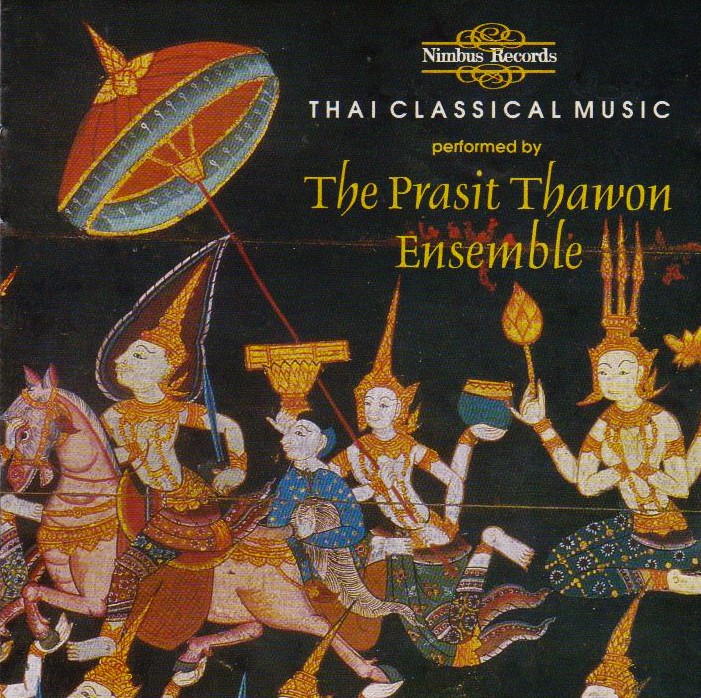
Prasit Thawon Ensemble: Thai Classical Music

This 1994 release on England's Nimbus Records is a beautiful example of the classical music of Thailand, as rendered by The Prasit Thawon Ensemble.

Utilizing horns; percussion including bells, gongs, finger cymbals, and woodblocks; alto and soprano xylophones and vocals, the long tradition of music, whether the pieces are older or new, from the Asian nation is given excellent expression by the ensemble, anchored by the two long centerpieces of the album, the exquisite 23 1/2-minute long "Sumran Dontri Klong" and the nearly 27-minute long "Cherd Chin."


Interestingly, the latter dates from the mid-19th century while the former was newly composed by Prasit Thawon, the leader of the performing ensemble, when this recording was made.

The group was founded in the late 1950s as "The Ensemble of the Dramatic School" at Bangkok and it performed in concerts and for radio and television broadcasts.  After Prasit Thawon retired in the mid-1980s, the ensemble was renamed "Sitti Thawon" and then to The Prasit Thawon Ensemble as a further honor to the founder.

The recording was made as part of an international conference devoted to Thailand at a London studio and is a fine representation of the fascingting music of that country.

Friday, July 22, 2016

Wire: Send

After another lengthy hiatus, beginning in 1992, Wire reemerged a decade later determined to push themselves in an expected direction.  With 2003's Send, which followed from and incorporated some songs from the two Read & Burn EPs, the band blazed, blasted and blew (largely) through a blistering barrage of tunes that showed that they were as delightfully idiosyncratic and creative as ever.

Anyone who saw Wire live during that period, as this blogger did for the first time at a Los Angeles show, it was more than a surprising to be confronted with a level of volume that was as loud as any concert experienced before.

But, the songs worked well in that maelstrom.  "In the Art of Stopping," "Comet," "The Agfers of Kodack," "Spent," and more are just built for speed and noise.  The live album, The Scottish Play: 2004 (a neat little play on The Bard) gives some idea of what Wire's music of that period sounded like in person, though it's obviously not possible to replicate the sonic assault.


But, that's not all that Send and related recordings from those first few years of the 2000s was about.  For one thing, although there are electronic treatments added for color and adornment, especially on "Read and Burn" it was great to be able to hear Robert Grey (Gotobed) playing a real drumkit again and performing with his old metronomic reliability.  Not that the late 80s version of Wire wasn't great--there was much to enjoy there--but the driving intensity of Send would not obviously have been anywhere near possible without Grey's drumming.

And, of course, there's Colin Newman's ironic, Cockney-inflected vocals--often supremely sarcastic, witty and insightful, and sometimes bellowing, as on the staggering "Spent."  Occasionally, Graham Lewis's voice, though definitely cigarette-burnished (or burned), comes out particularly effectively, even if processed, in the raging, biting "The Agfers of Kodack."  Though to hear him sing the tune on The Scottish Play reveals painfully what the years of smoking had done.

Finally, there is the production, which somehow manages to sound raw and polished all at the same time, due to the care and consideration taken by Newman, who has mixed all of Wire's music since at his home studio, Swim.

Some bands maintain remarkable longevity by falling back on past glories; others build upon their history while adding new dimensions by looking forward.  Wire is definitely the latter, even after Bruce Gilbert departed in 2004.  Their subsequent albums have all been great and their latest release, the mini-LP Nocturnal Koreans, shows that they are still very much forward thinking.

Saturday, July 16, 2016

Charles Mingus Sextet with Eric Dolphy: Cornell 1964

This 2007 release on Blue Note Records is another one of those happy musical discoveries--coming about when Sue Graham Mingus, the widow of the great bassist and composer Charles Mingus found a tape of a concert held at Cornell University in upstate New York on 18 March 1964.

The two sets make up the double disc offering here and the programming is, characteristically for Mingus diverse and different.  The first tune is a solo romp by pianist Jaki Byard, who creates a piece brimming with upbeat feeling based on stunning virtuosity.  Byard then comps quietly behind Mingus, who solos to great effectiveness on a piece by one of his heroes, Ellington's "Sophisticated Lady."

Then comes one of the centerpieces of this record and one of the most politically charged pieces in the leader's impressive catalog of original compositions: "Fables of Faubus."  This jibe at the governor of Arkansas, Orval Faubus, who fought the federally ordered desegregation of schools in 1957.  While the vocals decrying Faubus are important to hear, and certainly had a place in 1964, the piece is also a gem because of the way the remarkable sextet moved through the tune with its shifting tempos, excellent soloing, and remarkable harmonic interplay.  Byars, as just one example, takes a bit of "Yankee Doodle Dandy" and builds upon it in his great solo and Mingus quotes "When Johnny Comes Marching Home Again" in his solo.  But, this is a triumph of a band making the most of its ample and impressive resources and led by a composer at the peak of his powers.

"Orange was the Color of Her Dress, Then Blue Silk" is a beautiful ballad, in which we hear the phenomenal Eric Dolphy on bass clarinet, employing all of the explosive, technically imposing, and utterly unique elements of his playing, with Mingus clearly encouraging Dolphy on.


The great composer Billy Strayhorn's "Take the 'A' Train," another piece associated with Ellington, also gets a great workout and Byard's soloing takes in stride playing and other "older" styles in weaving a fascinating history-based performance.  Mingus's phenomenal bass solo, in conjunction with Danny Richmond's remarkable drumming, features the bassist talking, grunting, and otherwise having a hell of a time while the crowd laughs and roars in appreciation.  Dolphy offers another great solo while the band rumbles and roars behind him and the pieces closes to end a spectacular set.

The second set is anchored by another marathon piece, the mind-blowing "Meditations," which runs over 31 minutes.  While it does have its meditative moments, it also has its uptempo sections, where the band, firing on all cylinders, displays all of its stregnths and shows no discernible weaknesses, letdowns, or misfirings.  Hearing Clifford Jordan solo on tenor, while Dolphy backs him on bass clarinet, and the rhythm section churns and burns along with them, is really interesting and exciting, especially as the finish pits the horns against Byard's hard block chords and Richmond's stirring drumming and as Mingus can be heard directing the band where to go next.

"So Long Eric" has been taken by many to be a posthumously-titled homage to Dolphy, who died just three months later in Berlin, but it was actually given that title by Mingus as Dolphy left the band to take the tour to Europe that included his untimely passing.

It being the day after St. Patrick's Day, Mingus tossed in a version of "When Irish Eyes Are Smiling" and introduced trumpeter "Johnny O'Coles" as the "only Irishman in the band."  The album closes with the Fats Waller gem "Jitterbug Waltz", a fantastic rendering that highlights Dolphy's flute playing and provides more of the leader's great bass work.

It wasn't long after this recording that Mingus' career took a downturn, along with his mental and physical health.   There were later highlights like Let My Children Hear Music from the early 70s and the Changes albums from the same period, but the unit he had the year that the Cornell concert was made was exceptional and perhaps the high point of his long and remarkable career.

Thursday, June 30, 2016

Wolfgang Amadeus Mozart: Flute Concertos Nos. 1 & 2

Sometimes it's the lesser-known pieces in a master composer's catalog of works that are the most interesting.  This is certainly the case with these little gems, comprising the two concertos for flute and a short andante in C major by Wolfgang Amadeus Mozart released by the excellent Naxos label in the late 1980s.

The Capella Istropolitana, a chamber orchestra in Bratislava, Slovakia, conducted by Austrian Martin Sieghart, provides a fine accompaniment to flautist Herbert Weissberg, a native of Vienna, who remained in his music-rich hometown to study at the city's music academy and university and then became principal flautist for the symphony orchestra there.


The helpful liner notes state that Mozart wrote these pieces as part of a concerted (ha!) effort to break free of the limitations imposed upon him by his years under the patronage of the Archbishop in his native Salzburg.

In his very early 20s, about 1777, Mozart composed these concertos for a Dutchman named "De Jean," who was an amateur flautist and someone who had the kind of money Mozart craved, being perpetually in financial distress.

Evidently Mozart did not think highly of the flute and may not have put in the kind of passionate intensity in composition that he did many of his other works.  Still, these pieces are melodically solid and harmonically interesting, even if they don't rank among his greatest pieces.  The light, fragile sound of the flute dancing above the excellent orchestral background is pleasant and maintains interest.

Friday, June 24, 2016

Praxis: Transmutation (Mutatis Mutandis)

A week ago, while driving through the parched landscape of the high desert from Bishop to San Bernardino, the two-disc Axiom Funk compilation, Funkcronomicon, provided an unusual soundtrack to the bare hills, Joshua Trees, and the endless ribbon of asphalt that rolled on through the hours.

The great keyboardist Bernie Worrell, the "Wizard of Woo," died today at age 72 from lung cancer.  A classical piano prodigy who studied at the prestigious Julliard School of Music and the New England Conservatory of Music, Worrell was propelled to fame with this central role in funkmeister George Clinton's masterful ensemble, Parliament/Funkadelic, for many years.

In the early 1990s, Worrell joined forces with fellow P-Funk bassist Bootsy Collins; D.J. Af Next Man Flip, formerly Afrika Baby Bam of the great hip-hop group Jungle Brothers; drummer Brain (Bryan Mantia, later with Primus, Guns 'N Roses and others) and the phenomenal guitarist Buckethead in the Bill-Laswell produced collective, Praxis.


1992's debut record by the group, Transmutation (Mutatis Mutandis), was mind-blowing and innovative a quarter century ago and is still striking today.  The recording is full of interesting and strangely complementary mixes of metal, hip-hop, funk, electronics and other elements and takes great advantage of the talents of its five disparate, but well-synchronized members.

Worrell's organ, clavinet and synthesizer works particularly well as a foil for Buckethead's amazing pyrotechnics and the steady backing of Collins and Brain.  Laswell's production work is excellent, providing the right level of mixing for each performer and leaving space in the final product to hear the ensemble in all of its remarkable glory.

"Animal Behavior", with Collins' typically humorous vocal, is the closest thing to a standard tune on the album and its relaxed funk groove included some tasty Worrell organ playing.  The end of the tune features some beautiful melodic guitar work from Buckethead.  "Crash Victim/Black Science Navigator" is a crazed conglomeration of shredding guitar, sharp organ, and a strong, steady beat from the rhythm section, before Af Next Man Flip does his thing on the second half.

Worrell gets the spotlight in "Seven Laws of Woo," a play on his nickname, and the tune then heads into a metal-inflected jam that rocks hard and has another great Buckethead solo.  "Dead Man Walking" highlights Buckethead's astounding guitar abilities before the tune hits a solid funk groove punctuated by all kinds of electronic sounds and turntable work.  The "Interworld and the New Innocence" features some more delicate and memorable playing by Buckethead before the band breaks out into a harder-rocking section, where Worrell gets a clavinet workout with his organ accompaniment.  The record's 16-minute epic, "After Shock (Chaos Never Died)" includes some more fine Worrell workouts, including some haunting organ playing.

The whole album is fantastic, showcasing the strengths of the quintet with Laswell's crystalline production serving the proceedings very well.  This is one of many apt testimonials to the amazing talent of Bernie Worrell.

Saturday, June 4, 2016

Le Mystére des Voix Bulgares

When this blogger started listening to "world music" in 1990, this was one of the first recordings that was purchased, mainly because the 1986-87 (first on the British label 4AD and then on the American Nonesuch Explorer label) re-release of the 1975 Disques Cellier release by Marcel Cellier became something of a surprise world-wide phenomenon.

Obviously, the quality of an experience can't be repeated and, the more distant in time, the less can be recalled.  But, listening to the opening polyphonic harmonic vocal gymnastics employed by the two dozen singers of the Bulgarian State Radio and Television Female Vocal Choir, still provokes something of that spine-tingling feeling of just over a quarter century ago.

These are traditional folk songs, from weddings, harvests, dancing, and work, as well as from legend and myth in a part of the world little known to most of us in America, but which has ancient roots and connectivity between east and west that clearly have formed the unique qualities of this remarkable vocal music.

But, there is a distinctively modern "artistic" sheen put on the old folk origins, both in arrangment by Phillip Koutev and Krasimir Kyurkchiyski, and on the recording quality.  Purity is often a word used to describe this work and it is true from multiple standpoints:  the quality of each singer's voice, in the roots of the material, and in the fine sound recording quality.


To this listener, everything about this album is fantastic and it seems almost unfair to pick out highlights.  There are the ensemble passages, solos, and small group harmonizing--all of which have their particular aspects to recommend them.  One of the more notable elements, though, is the use of dissonant harmonies in diaphonic singing, described in the notes as "two voices (solo or choral) [which] track each other in parallel intervals.

Koutev and Kuykchiyski took the traditional pieces and reworked them in a modern way utilizing changes in mode and harmonic intervals, but always with an eye to preservation of the magic and power of the source materials, while recalibrating the works for modern presentation.

There are also occasional uses of instruments, such as the gayda, similar to a bagpipe, the kaval, a flute, and the gadulka, or violin, as well as some percussion.  These are often introduced as breaks in the vocal pieces or as stand-alones, in addition to accompaniment to the choir.

The writer of the liners, composer Ingram Marshall, points out that the use of a-harmonic materials by Eastern European classical composers like Bartók, Ligeti, Stravinsky, and Penderecki is often derived by folk music found in their native countries, like Hungary or Poland.  Marshall concluded his essay by asking "why more Western composers do not work with indigenous singers and instrumentalists as a springboard to creativity."  Of course, there are some who have used Eastern music for this purpose, including Lou Harrison and the inspiration he took from Balinese gamelan music.

In any case, Le Mystére des Voix Bulgares is still a stunning listening experience and there are several follow-ups from the ensemble, renamed after the fall of Communism, a few of which will be highlighted here in the future.  Finally, one of the most memorable concert-going experiences for this listener was seeing the ensemble perform at UCLA's Royce Hall sometime in the early to mid Nineties--where the recordings could only hint at the power and expressiveness to be found in a high-quality concert hall.

Thursday, June 2, 2016

The Complete Blind Willie Johnson

Blind Willie Johnson's voice is something else--a "false bass" growl that bursts forth from his tenor range and pulls the listener in with powerful lyrics generally of a strong religious nature and makes for an unusual deep dark blues and gospel stew.  On top of this, the remarkable slide and straight picking acoustic guitar playing might get short shrift with all the attention to Johnson's voice, but it is uniformly excellent playing.

With digital remastering, these 1920s recordings sound more immediate and, perhaps to some more listeners, more claustrophobic, but it is also true that just having the man's voice and guitar is all that is needed for a spectacular performance.

There are some tracks here that are well-known to even casual blues listeners (this blogger doesn't pretend to be a connoisseur), such as "Dark Was The Night, Cold Was The Ground"; "It's Nobody's Fault But Mine"; "Mother's Children Have a Hard Time"; "Let Your Light Shine on Me," which partly dispenses with that guttural growl; "John the Revelator," which has a female backing vocal from Willie B. Harris present on other tracks, as well, and others.  The first-named piece is a revelation, with the wordless emotional singing and beautiful guitar playing tingling the spine in ways that few others have.


But, there are many pieces, less familiar to amateurs like this blogger, that amply show the immense talent of a man who never received his due.  One standout is "If I Had My Way I'd Tear the Building Down," which has a great rhythmic sense to drive the piece vocally and instrumentally.  Another is "I'm Gonna Run to the City of Refuge," another vocal jewel with the female backing vocal on the chorus.  "God Won't Never Change" is sung completely in Johnson's straightforward tenor and is a gem.  "You'll Need Somebody on Your Bond" is another example of stellar slide guitar and Johnson's "false bass" vocals harmonize nicely (this isn't always true, however--as on "Praise God I'm Satisfied"and others) with his female counterpart.  "God Moves on the Water" has some very tasty slide work and a nice, growl-less vocal.

This is a collection of consistently rewarding early recorded blues and gospel from a master of acoustic guitar and deeply personal and stylized vocalizing.  Kudos also go to Samuel Charters for his detailed essay on Johnson and his music.

Particularly affecting is the fact that, as Charters tells so well, Johnson was a preacher in Beaumont, Texas, when, in 1945, his house burned down and he was left to live among the charred ruins, catching a fever that developed into pneumonia.  According to the woman who was married to him, a hospital refused to treat him because he was blind and Johnson died needlessly at 48.  Too many great black musicians of all genres died too young and in shocking circumstances at a time when they were creating some of America's greatest music and not given their due.  The story of Blind Willie Johnson may be one of the most heartbreaking of all.