No criticism, no reviews, no file sharing, just appreciation, on the basic premise that music is organized sound and from there comes a journey through one listener's library. Thanks for stopping in and hope you enjoy!
Friday, August 29, 2014
The Quintet Live at Massey Hall
This is an unbelievable concert by a lineup of great musicians putting on a clinic of stellar ensemble playing and proficient and inventive soloing of the highest order, put on at a performance at the Toronto venue on 15 May 1953.
Unfortunately, a heavyweight title fight between Rocky Marciano and Jersey Joe Wolcott and poor promotion and publicity led to a disappointing turnout to hear Charlie Parker, Dizzy Gillespie, Bud Powell, Max Roach and Charles Mingus display their individual and collective talents on famed "bebop" tunes like "Salt Peanuts." "Hot House," "A Night in Tunisia," and "Perdido."
The program also consisted of a beautifully-played standard, "All the Things You Are," and a lightning-fast workout in "Wee." These round out an album that doesn't appear to have any real downsides, although Mingus, who released the album on his own Debut, overdubbed bass passages because of under-recording at the concert. Notably, Mingus and Roach were responsible for the recording, a significant achievement given that live albums were still relatively new.
Parker, characteristically, showed up to the gig without a saxophone, so borrowed a plastic Grafton alto. Contractual issues also prevented the use of his name, so he went by the alias of Charlie Chan, a combination of his and his girlfriend's first names and a riff on a Chinese detective character from 1930s films. Parker, whose top-notch playing days were rapidly dwindling (within two years he would be dead at 34 from alcohol and drug abuse and other factors), is a mighty player here, setting the pace for everyone else, as his force-of-nature effect often did.
Gillespie, performing with his old partner, for the last time, is also in great form, displaying great speed, clarity in the highest notes, and showing that he was one of the few front-line players who could hold his own with the legendary Bird. It was said, interestingly, that, when not playing, Gillespie constantly disappeared backstage to check on the status of the Marciano-Wolcott fight--the problem with the account is the fight was very short, with Marciano knocking Wolcott out with 2 1/2 minutes left in the first round, unless Gillespie was tuning into pre and post fight commentary or something!
Powell, who was evidently stone drunk from the get-go and would soon slip into mental illness that rapidly diminished his formidable skills, plays with great aplomb and authority, showing why he was considered one of the greatest pianists of his era.
Mingus, the least-known of the combo at the time and who was a year or so from being a bandleader and crafting some of the greatest compositions in jazz, is a steady presence and performs especially well with Roach. As for the sublime drummer, what can be said?
Roach is totally in command of all of his ample resources behind the kit, accompanying each soloist as befitted the situation and then playing fantastic solos. In some ways, his performance is the best as he had to be the bedrock, along with Mingus, but in a more visceral way, for the trip of legendary frontline soloists.
It is hard to imagine a recording that boasts such a stellar lineup--and one that fully delivered the goods. The only alleged mark of real tension came when Parker, introducing "Salt Peanuts," referred to Gillespie as his "worthy constituent [rather than 'colleague'?]," which comment supposedly so irritated the trumpeter that Gillespie took to yelling the song title repeatedly during Bird's solo. Yet, there was considerable laughter as the tune ended, though Gillespie was later quoted as saying he was angered by Parker's antics.
Then, there was the matter of payment. With low turnout came minimal receipts which meant that there wasn't much money for the musicians. Only Parker received money with Gillespie observing that he only was paid "years and years" after the gig. Toronto was hardly a jazz center and the combination of the boxing match and the sad state of marketing the show all combined to lead to a hall that was about a quarter full.
Fortunately, this album has had a long life and several reissues and as long as this music is available it will, hopefully, have listeners. It is one of the great jazz records this amateur has come across of the hundreds in the growing collection.
Thursday, August 28, 2014
The Style Council: Internationalists
The years from 1983 to 1989 when The Jam's Paul Weller changed musical directions with The Style Council after referred to by some as his "lost years." Obviously, the sounds were dramatically different, although the last year or two of the former showed signs of Weller's move towards a poppier, soul and R&B direction. And, there are those who think that Weller's famous decision to disband The Jam at the height of its popularity was less about a noble effort to not milk the successful formula of the group so much as a canny recognition that the British music scene was changing--away from guitar-based rock to synthesizer-based pop.
Whatever the case, Weller's formation of The Style Council definitely downplayed the guitar for keyboards, funk bass, a more finely honed sense of melody, and other elements that were closer to the pop world. It also featured a determinedly fashion-conscious imagery that led some to call it highly self-conscious and pretentious. But, what differentiated the band from legions of other groups of that often-maligned era of the Eighties, is that Weller's politicized lyrics actually became sharper and more direct than they were in the musically harder-edged The Jam.
Moreover, his forays into other musical styles provided, at least for the first half of the six-year tenure of TSC, a diversity that was not to be found elsewhere. This changed by 1987 when the group's light dimmed dramatically and, when Weller decided to indulge his interests in the newly-emerging house music scene by the end of the decade, his longtime label, Polydor, rejected his house album, Modernism: A New Decade.
Fortunately, Weller had the talent and perseverance to take a break, refocus, retool, and recognize that there was another shift in musical direction back to guitar music in the early 90s, leading to a solo career that, pushing 25 years now, has been remarkably successful.
This listener, as is often the case, got into The Jam just after their breakup. Actually, seeing the video for "A Town Called Malice" was the first time encountering that remarkable group, but it was just after the September 1983 release of the stellar compilation Snap! when a strong passion for the band's music took root.
Meantime, Weller had moved on, joining forces with keyboardist Mick Talbot and guest musicians. In March 1983 he released The Style Council's first single, "Speak Like a Child," followed by a couple of other singles and a pair of EPs, including the Introducing The Style Council record that was loaned by a friend.
That same friend wanted to see TSC when they came to Los Angeles for two shows of four (the others in New York) for a very short (and the only in the band's history) American tour at the end of the year. Work commitments, though, prevented attending, but the thought was they would return soon enough. It was another nine years before Weller returned to Los Angeles and seeing three of his solo concerts proved to be great experiences watching a stellar musician at his best.
The Style Council's debut record was called My Ever Changing Moods in the U.S. (Café Bleu--obviously too "European" a title for American tastes?) after the title track, their lone Top 40 hit and one of Weller's best songs. The record had jazz-drenched tunes, a rap, keyboard romps, and other assorted sounds, with Weller not even singing on several tracks--an indication of this view that the group was actually more of a collective.
That soon changed, though, with the release of the second album, Our Favourite Shop in the U.K. and Internationalists in the States. By then, there was a set band with drummer Steve White and a phenom still in his teens, backup singer D.C. White (soon to be married to Weller), with bassist Camelle Hinds joining the group slightly later.
Internationalists is certainly a more cohesive and unified album than the debut and the quality of the songs is more consistent, while the diversity of sounds is still present, if not quite as pronounced. The album began with a somber, but highly effective meditation on joblessness, the uprooting of families, and anger towards the Thatcher government in "Homebreakers." An uptempo soul-funk workout, the title track declared that the band considered itself citizens of the world, rather than of a provincial nation--Weller was actively supporting Socialist causes at the time.
Another anthemic piece that was the first single and charted at #6 in England is "Walls Come Tumbling Down," which opens with the growled "You don't have to take this crap / You don't have to sit back and relax," the last part of the couplet apparently referencing the long-forgotten, but then-wildly popular Frankie Goes to Hollywood and their "Relax" hit. "The Lodgers" features another lyric about social malaise with a great bassline and solid White timekeeping, while D.C. Lee gets some prominent vocalizing on a top-notch track.
Another highlight is "With Everything to Lose" with a Latin rhythm, a nice flute intro and a lyric written by the drummer for a song that Weller had already completed called "Have You Ever Had It Blue?" Weller rightly noted that White had written a fine lyric and quickly recorded the album version. "A Stone's Throw Away" appeared with a string quartet and Weller's vocals and feature another excellent lyric about the widening gap between rich and poor in Thatcherite Britain. The strings provide a nice understated backing to the singing--and it should be said that the change in Weller's singing from his days in The Jam was striking.
"All Gone Away" has acoustic guitar over a beguiling samba rhythm and Weller's near falsetto talking about the decline of small towns and, if anything, may be too brief at 2:17, but it's a fine song and perhaps an interesting comparison to The Jam's "Man in a Corner Shop." There were complaints about "Come to Milton Keynes," a slap at faceless modern planned communities, but White's drumming is given a beautiful sound to accompany his always-fine playing, while Weller's melody moves along nicely. "Boy Who Cried Wolf" is all-electronic and features more of Weller's newly-developed and emotive croon.
Church bells introduce "A Man of Great Promise," with another fine melody and lyrics about Dave Waller, a musical associate of Weller from the early days of The Jam and who died of a drug overdose. A lilting rhythm of acoustic guitars, keyboards and cymbals underlie the interesting "Down in the Seine," which includes an accordion and Weller's singing of alternate verses in French, reinforcing his continental and, specifically, Parisian obsession.
The oddball tune is "The Stand-Up Comic's Instructions," with a popping bass, bluesy guitar licks and a Weller-sung chorus following the deep intonations of black British comedian Lenny Henry about racism. It's been considered half-baked by some, but is part of the diversity of sound that makes the album intriguing in its catholic ambitions.
Internationalists marked the peak of The Style Council's tenure, hitting #1 on the British charts, though, predictably, doing poorly in America, which has just never made much of Weller's Anglo-centric approach (though this blogger has never seen his to be an issue.)
The follow-up was two years later and, by then, Weller's decision to narrow the sound to the "northern soul" genre that was popular in England led to the "Cost of Loving" album to be considered too one-dimensional and lacking in passion and quality songwriting. This blogger, an eager follower of the band to that point, passed on buying it after a listen of my brother's copy.
"Lost years" is hardly a term to describe the sea change that was The Style Council. For a few years there, Paul Weller eagerly mixed a variety of sounds and wrote some of his best songs. After 1985, though, the situation changed significantly, though there were enough moments in 1988's Confessions of a Pop Group that, for this listener, made the album's return to diversity rewarding for the most part.
The purchase a few years back of the 5-disc retrospective The Complete Adventures of The Style Council reflects the dichotomy of those halves of the band's existence. The first two-and-a-quarters discs are generally brilliant, much of disc four with the Confessions material is quite good, and then there is the infamous Modernism and related pieces on the little-played fifth disc. Yet, Weller deserves a lot of credit for being willing to try new musical approaches, distance himself from The Jam's iconic sound, and come up with a good deal of very fine music during what was often a dreary decade in the rock scene. His revival in the early 90s led to the "lost years" tag being hung on The Style Council period, but it unfairly negates the often-superlative work he produced.
Saturday, August 16, 2014
Enrique Granados and Isaac Albéniz: Spanish Piano Music, Vol. 1
The English Nimbus label has released many excellent world music (especially Indian) and classical recordings over the decades. This 4-disc set of the piano music of the eminent Spanish composers Enrique Granados and Issac Albeniz is a top-notch recording that not only presents the works for which both are principally knows, Granados' Goyescas and Albéniz' Iberia, but other pieces representative of the two men.
The composers were contemporaries, who were born and died seven years apart, and they studies from the same musicologist, Felipe Pedrell, who inspired the men to embrace the idea of a particularly Spanish music.
Albeniz was from a small town in the northeastern part of Spain, not far from the French border, among Basque country. He was a child prodigy, taught by a sister, who made his concert debut in Barcelona at five years of age. Though he passed the entrance exam to the conservatory at Paris, he was denied admission because he was considered too young. Like Mozart, to whom he was compared, he was then shepherded by his father around Spain for performances with his sister. After studying in Madrid, he went to Leipzig and Brussels and contemplated studying with Franz Liszt, but his plan never materialized. Later, he lived and worked in London, though his interest in promoting a Spanish national music led him to his masterwork.
Albéniz composed, between 1905 and 1909, his Iberia suite of four books reflecting his impressions of the Spanish peninsula, with most of the focus on the Andalucía region. A fishing village, a town overlooking a famed gorge and a suburb of Seville are impressionistic subjects in the first book. The second reflects concepts derived from observing gypsies in Granada, an Andalucian dance, people in a tavern near Seville, architectural splendor in the Andalucía region and, in the only instance of a non-Andalucian subject matter, a neighborhood in Madrid. Just after finishing the work, Albeniz, who had Bright's disease, succumbed to liver disease a few days prior to this 49th birthday.
In addition to Iberia, this set contains his Suite Española, the España "souvenirs", a tango, and other works, including two unfinished pieces, Navarra (intended for Iberia) and Azulejos, which were completed by pianist Martin Jones for this recording.
Granados, a Catalonian who was raised in Barcelona, was best known initially as a pianist with highly-regarded improvisational skills, though his first published work, the Danzas Españolas brought him attention as did an opera, María del Carmen.
The composer based his Goyescas on the work of the famed painter Francisco de Goya and was completed in the early 1910s. Notably, the composer was asked to adapt the music for an opera, which was completed in 1914, just as World War I erupted. Finally, two years later a performance was held in New York and it was well received to the extent that President Woodrow Wilson invited Granados to a White House reception. Delaying his return to Europe for the honor, Granados and his wife were on the ferry, the S.S. Sussex in the English Channel when the ship was hit by a German torpedo and partially destroyed. Granados, who was 48, made it on to a lifeboat, but his wife Amparo struggled in the ocean and the composer dove in the water to save his wife, but both drowned.
Other works by Granados included in the set are a reverie, transcribed by Jones from a piano roll recording of the composer that was made the year he died; a set of Escenas Románticas (romantic scenes), and an Allegro de concierto.
There is a great deal of romantic feeling and emotion in these beautiful pieces, along with a high degree of technical precision, and Jones, who recorded the works over several sessions between late 1995 and Spring 1998, is excellent throughout. He has recorded many, many albums for Nimbus, including the complete works of such composers as Mendelssohn, Debussy (part of which was featured here), Brahms, and Stravinsky. The recording quality is clear, crisp and rich and the set is a real treat, especially for an amateur who knew little of Granados and Albéniz and their work.
Thursday, August 7, 2014
Masters of Turkish Music
Since we're on a bit of a roll with music recorded in the 78 rpm era, coming off the great Art Tatum, here's an offering from 1990 on Rounder Records of Turkish music that was produced between 1906 and 1949, in tandem with the University of Maryland-Baltimore County Center for Turkish Music.
Gorgeous male and female singing abounds on this album, full of keening, elongated melodies characteristic of the music of so much of the Middle East, but also with wonderful instrumental work, coming from the court of the failing Ottoman Empire, which collapsed after World War I in 1918, folk music, and urban music often performed by gypsies and other sources. Improvisation, moreover, plays an essential part of this fantastic music.
As observed in the brief, but informative, liners, record labels from Germany, England and a local label in Istanbul owned by Jews, produced recordings from as early 1903 and records from Turkey began to be available in the U.S. from about 1912 thanks to migrants from the Middle East and Near East. An overview of several styles of music, one of which, taqsim, has been covered here through the great album called Taqasim featuring Ali Jihad Racy and Simon Shaheen.
The first half of the disc features classical vocal music, including the gazel of the Ottoman court tradition which emphasizes the often staggering improvisations of a highly-skilled vocalist, while the second half highlights instrumentals, including, at the end, several excellent taqsim.
If one listens to flamenco singing or that of Bulgarian choral music, the clear connection to this vocal music is obvious. Moreover, the use of stringed instruments on this album also had ramifications throughout the Arab world and parts of Europe that were either controlled by Islamic regimes, as in Spain for seven centuries, or in the Balkans.
A special note of praise should go to the sound restoration work of Jack Towers in transferring these old recordings from discs supplied by two collectors and creating as clean and clear a sound as possible (and the pops, clicks and hisses were wisely left in). Truly, great music still comes through regardless of the technology.
Tuesday, August 5, 2014
Art Tatum: Piano Starts Here
It's one thing to hear a pianist with absolute control, staggering technique, superlative soulfulness and unparalleled swing. It's quite another when that player was completely blind in the left eye and had almost no vision in the right. Somehow, the masterful Art Tatum not only overcame that handicap, but actually transcended it in being one of the greatest practitioners of his instrument, not just in jazz, but in any form of music. Notably, the great Vladimir Horowitz, one of the piano's legendary players in the classical world, and George Gershwin, the famed composer, were enthusiastic admirers--in a time when classical musicians looked down upon jazz players and, of course, white audiences did not, as a rule, accept black entertainers like Tatum in the way they would a white musician.
Piano Starts Here, first issued by Columbia in the 1968, when jazz was losing audiences and you'd think the last thing that would be accepted was music from thirty-five years prior, presents Tatum's earliest recordings, a quartet of sides from March 1933, including the mind-blowing "Tiger Rag" as well as a spellbinding version of "St. Louis Blues," a tune identified with another great jazz pianist of the time, Earl "Fatha" Hines, as well as the standards "Tea for Two" and "Sophisticated Lady."
The other nine pieces came from a Spring 1949 concert called "Just Jazz", held at the Shrine Auditorium in Los Angeles and are filled with Tatum's trademark rapid runs in sixteenth notes, crystalline touch, boogie-woogie or stride playing and others. He also had the remarkable ability to rapidly and radically shift the time by halving the tempo or, alternatively, doubling it, while adding little flourishes that brought a playful humor to his playing.
In some ways, Tatum is an interesting comparison to Cecil Taylor, whose jaw-dropping technique is exhibited in entirely different ways, apropos of very distinct eras. Both seemed to be incapable of fluffing notes and were just unparalleled in their abilities to master the piano. Whereas Taylor, afer 1961 especially, moved further away from song structures with strong melodies and mined the percussive and harmonic potential of the keyboard, Tatum always worked within established structures and, it's important to note, the limitations of the 78 rpm record and its length limits.
Tatum died in 1956 and was only in his mid-Forties. He was never accorded the recognition he deserved, but he is still listened to and admired today and for very good reason. Maybe he was more of a dazzling technician than an artist like a Duke Ellington or Bill Evans or any number of other great pianists, but with his superlative abilities and crowd-pleasing technique, it would have been hard to envision him being any other way.
In any case, Piano Starts Here and a 1940 Decca album of solos, to be featured here someday, are among the greatest examples of the piano solo you'll hear anywhere, in jazz and beyond. Let's hope the great Art Tatum always has an audience and that it'll grow.
Monday, August 4, 2014
Buddy Guy: Buddy's Blues
This is another exceptional entry in the Chess Records 50th anniversary series from the late Nineties and features fifteen tracks from Guy's tenure at the legendary Chicago blues label from 1960-1967. Guy was truly a triple threat--a fine songwriter, an excellent soulful singer, and a staggering guitarist-and these selections are a great cross-section to his years with the label. Notably, he was not as well regarded in those years as some of the other Chess greats like Muddy Waters, B.B. King and so forth, but his time would come years later with his 1991 album Damn Right, I Got The Blues, which sold loads of copies and got tons of acclaim.
Still, there's no denying the stunning quality of Buddy's Blues from his singing and playing to the beautiful remastering that opens up the sound of these Sixties recordings to the stellar bands he performed with, including pianist Otis Spann, bassist Jack Meyers, drummer Fred Below and horn players Jarrett Gibson, Bob Neely, Donald Hankins, Gene Berge and more.
Guy originals like "Worried Mind;" "I Found a True Love;" "Stone Crazy;" "Ten Years Ago;" and "My Love is Real" are complemented by a raft of tunes by the great Willie Dixon, including his "I Cry and Sing the Blues;" "Let Me Love You Baby;" "Pretty Baby;" and "When My Left Eye Jumps." There is also a standout cover of Sonny Boy Williamson's "Keep It To Yourself," retitled here as "Keep It to Myself." Throughout, Guy sings with great power and intensity, while his guitar burns with a fantastically clean clear tone.
Guy just celebrated his 78th birthday on 30 July and it was intended to get this post together for that day, but here's a belated birthday wish to one of the great musical figures in American history, not just in the blues. Long may Buddy Guy live and play live and otherwise!
Labels:
blues,
Buddy Guy,
Chess Records,
Sonny Boy Williamson,
Willie Dixon
Thursday, July 24, 2014
Edvard Grieg: Holberg Suite/ Norwegian Wedding Dances/Lyric Suite
Edvard Grieg (1843-1907) was a Romantic pianist and composer whose use of folk music elements in his native Norway somewhat mirrors similarly explorations by contemporaries like Bedrich Smetana, Jean Sibelius, Anton Dvorak and others in other parts of Europe.
This 2-CD set on the budget German label, Pilz, presents a nice variety of the instantly-likable work of Grieg, including some of his better-known and more obscure works. The Slowakische Philarmnonie, conducted by Libor Pesek, and pianist Stefan Jeschko perform wonderfully, showing that lesser-known ensembles and players sometimes get short shrift as their status allows for these budget labels to offer well-performed music at a low price with no noticeable reduction in quality.
The Holberg Suite was published in 1884 to celebrate the bicentennial of the birth of Norwegian playwright Ludvig Holberg and is based on musical forms (the air, sarabande and gavotte, for example) from the 18th-century. Grieg is most renowned for his Peer Gynt suite, which will be highlighted here sometime, but the Holberg has as much going for it, including one after another of memorable and beautiful melodies, as well as striking harmonizing of instrumentation. Notably, the Holberg was originally composed for solo piano and only later adapted for orchestra, where the richness of its melodies and general structure are more fully realized.
What follows are a quartet of "Norwegian Wedding Dances," and a smattering of lyric pieces for piano that are beautifully rendered and redolent of the Romantic style which was the rage at the time. Particularly notable are the Halling Dances, which include some of Grieg's more recognizable melodic themes.
Then, there is the Ballade in G Minor, also known as "Ballade in the Form of Variations on a Norwegian Folk Song", the source being "The Mountain Song," is another gorgeous piano work of themes and variations which starts quietly and impressionistically and builds from there, with a clear (at least for this amateur listener) from Chopin and Schubert, as it develops impressively and more forcefully with crystalline arpeggios and strong left-hand block chords. Jeschko, as throughout the recording, plays with virtuosity, authority and a balance of power and a light touch as called for.
The second disc is principally noted for its rendering of the Lyric Suite, derived from a larger body of Lyric Pieces Grieg composed with three of the pieces developed from original orchestrations of lyric pieces by Hungarian conductor Anton Seidl, though Grieg later revamped the trio and added a fourth entirely his own. Grieg appreciated Seidl's work but felt that his lighter touch did not accord well with Seidl's more bombastic style developed partly from his training under Franz Liszt and more prominently from his long association with Richard Wagner. In any case, these are very fine pieces performed with great skill by Marian Pivca.
A Concerto for Violin in D-Minor by the Philharmonia Slavonica, conducted by Carlo Pantelli, with Bruno Zwicker as soloist; a Symphonic Dance by the Nuremberg Symphony and a Valse Triste by the London Festival Orchestra, the latter two conducted by Alfred Scholz round out the second disc and are beautifully performed and also a nice selection of the variety of the composer's oeuvre.
Saturday, July 12, 2014
Ornette Coleman: Change of the Century
There is a generation of jazz musicians that we are rapidly losing and yesterday another giant passed on. Bassist Charlie Haden, whose work with Ornette Coleman, Keith Jarrett and his own Liberation Music Orchestra and Quartet West projects among many others put him at the forefront of so-called "avant garde" or "new jazz" playing, died at age 76 in Los Angeles after a long illness.
Haden, who came to Los Angeles to study music and met Coleman in the mid-1950s, first came to attention in the legendary Coleman quartet that made a splash at the Five Spot Café in New York in 1959 and in subsequent classic recordings for Atlantic Records. The first, The Shape of Jazz to Come, has been featured here and is one of the great jazz records of all time.
The second album, recorded in Los Angeles in October 1959, is Change of the Century and its assertive, provocative title, as with its predecessor, is more than apt and delivers fully on its promise. Coleman was hitting on all cylinders with his unusual composition and arranging method, as well as his emotive and innovative playing and his telepathic harmonizing with Don Cherry, on pocket trumpet, continues to astound. Billy Higgins, an always-versatile drummer who could play as easily with the freest of players as well as the most traditional, is relentlessly swinging even as he adapts his playing to match the unusual structures established by the leader.
Then there's Haden, whose supple, flexible, creative and spot-on tone works in tandem with Higgins to keep those free rhythms with enough organization to allow the soloists to work without hindrance and provide the listener endless enjoyment—provided that the listener appreciates the yeoman work that a bassist provides.
This album is filled with great pieces, from the opening "Ramblin'" to the self-evidently titled "Free," the Higgins-showcase "Forerunner," which also has an excellent blistering Coleman solo and the sublime "Una Muy Bonita," which starts with Haden's low, simple but powerful underpinning riff and Coleman and Cherry's great melodic harmonizing to start a great piece of music. "Bird Food" has a melody that is, of course, highly evocative of Charlie Parker, showing the importance of tradition expressed in new ways. Cherry also gets an extended solo here. Finally, "Change of the Century" features a head arrangement of great complexity and speed with that Coleman/Cherry interplay that may well have peaked on this album and its title track. Coleman's solo work is also something to behold here.
Again, Haden's consistency, inventiveness and dependability in holding down the bottom is nothing short of remarkable on each of these tunes. He does get to put his playing more in the forefront on "The Face of the Bass" but it is not one he uses to show off, but instead displays his technique in more subtle ways which make his understated playing all the more remarkable. Sadly, as was too often the case in the jazz world, a heroin addiction led to Haden's departure from the Coleman quartet in August 1960.
But, as noted above, Haden went on to other impressive work, but his years with Coleman are likely the most memorable and it's hard to top the fabulous Change of the Century, which had the unusual distinction of being a sophomore release (well, in this case, a major-label followup--two albums on the Los Angeles-based Contemporary label predate the Atlantic albums) that was every bit as good as its forerunner.
30 years later, as part of the Los Angeles Festival, a reunion of the Coleman Quartet was scheduled at the beautiful old Orpheum Theatre in downtown. The September 1990 performance, however, became a late-hour trio when Don Cherry came down sick after a dental appointment. This listener, just starting to become exposed to jazz in a big way, happened to have great orchestra-level seats near the center of the former movie palace and listened with enthusiastic amateur wonder as Coleman, Higgins and Haden performed two hours of magical music.
It was an unforgettable experience and, pondering the death of Charlie Haden, it is one that came immediately to mind when the news was read. Long may his music be heard and appreciated!
Tuesday, July 8, 2014
Salamat Ali Khan: Ragas Gunkali, Saraswati, Durga
The British Nimbus label has released many recordings of classical music from the Indian subcontinent over the years and this very fine album of Hindustani vocal music, recorded in November 1990 at the label's studio at Monmouth, England, by the master Salamat Ali Khan and his sons, Sharafat and Shafqat, features three long ragas.
As pointed out in the notes, very helpful to an amateur (however enthusiastic) such as YHB, Hindustani music from northern India is also found in Pakistan, Bangladesh (formerly East Pakistan), Nepal and parts of Afghanistan. It is also observed that Muslims and Hindus are practitioners of the ghazal form of the music and often perform together despite the political differences that have driven the two groups apart.
Salamat and his brother Nazakat became known for their vocal duet performances from childhood in the early 1940s and were partners until 1974. Sharafat then began working with his father and Shafqat joined the two for this first recording session with this album. The partition of India in the late 1940s meant that the Khans moved to Pakistan and performed there for many years, although their return to India much later was widely hailed, as audiences recognized the brilliance of these amazing vocalists.
The first, the Gunkali, running over 20 minutes, highlights the singing of Shafqat and, while this was his debut on record, his vocal technique is outstanding with power, deft handling of complex lines, and beautifully-controlled tremolo as he navigates the tricky crescendos and diminuendos germane to the form.
On the half-hour Saraswati, Salamat and Sharafat sing with the elder Khan leading and the younger supporting beautifully. The song is filled with great technique and expressiveness, despite Salamat's recovery from a recent stroke, and his sons obviously learned well from their father's tutelage. The piece begins quietly and solemnly with the two vocalists accompanied by the harmonium before the tabla breaks in with a flourish at 3:45. From then on, the Khans work their magic with the fine underpinning by the instrumentalists.
The closing Durga, at a hair over 20 minutes, is a tour-de-force with Salamat and both his sons. The intertwining and harmonizing of their vocals is a wonder to behold and makes this wonderful song the highlight of the album, even through the other two ragas are remarkable on their own. The improvisations and vocal gymnastics are spectacular and the three frequently return together to the composed main vocal line. The tabla player also has the chance to demonstrate more of his skill here than on the other pieces.
The supporting musicians do an excellent job of providing the right balance of playing to buttress the singing of these masters and include Sharafat on harmonium, tabla player Ghulam Abbas Khan, who had accompanied Salamat and Nazakat from the age of 13, and tambura player Christian Ledoux.
The notes also have a useful history of the "khyal" or vocal music embodied by the disc and detailed explanations of the form of each raga.
For a novice, quickly absorbing what he can of the amazing variety, tradition and beauty of the music of India and Pakistan, this is another phenomenal recording among many that will be highlighted here. While Salamat Ali Khan died in 2004, his sons continue to work as ustads, or masters, in their field.
Sunday, June 29, 2014
Archie Shepp: Four for Trane
Tenor saxophonist Archie Shepp's Fire Music was highlighted here before, as the first Shepp recording this blogger heard back in the early Nineties. The predecessor and the leader's first recording for the Impulse label paid homage to John Coltrane, Shepp's supporter who lobbied hard to have the label sign the young firebrand. To date, Shepp had played for a period with Cecil Taylor and recorded with Don Cherry, formerly with Ornette Coleman, and others in the New York Contemporary Five.
Four for Trane was not only a tribute to the jazz giant who got him signed to a major jazz label, but a way for Shepp to combine his deep blues feel with a very fine band and the arranging abilities of trombonist Roswell Rudd, who worked frequently with Shepp in the 60s. The title directly refers to four of Coltrane's pieces covered by the band and this was a smart move by the leader, because it was said to producer Bob Thiele had to really be convinced by Trane to sign and work with Shepp. This album rewarded Coltrane's persistence.
The opening track "Syeeda's Song Flute" is something else--Rudd's complex and rich arrangement shone through beautifully, as it does on the gorgeous "Naima," one of Trane's greatest compositions. The way the various horns engage in interplay on both pieces, but especially on the intro to "Naima" is something to behold and it's a shame Rudd didn't get more credit for his arranging work. Moreover, the other two tunes, "Mr. Syms" and "Cousin Mary" are also solid blues pieces and they provide apt forums for Shepp's earthy and raw playing to their best advantage.
Also a standout throughout this recording is the underappreciated altoist John Tchicai, a half-African, half-Danish player, who performed with Shepp in the New York Contemporary Five and went on to work on Coltrane's free ensemble album, Ascension. Rudd also plays well and his instrument proved to be an interesting counterpoint to the saxes in the septet. Trumpeter Alan Shorter, brother of the famed tenor player Wayne Shorter, then just getting his name recognition going with the Miles Davis Quintet, doesn't get that much opportunity to solo.
It's the rhythm section that also gets tremendous credit for holding down the bottom and keeping things truly swinging on this album. Bassist Reggie Workman had played with Coltrane a number of times and was a very reliable, supple and flexible player behind the band. Drummer Charles Moffett would go on to achieve his best-known work with Ornette Coleman with the great recordings in Copenhagen in 1966 in the two-disc Golden Circle albums already featured here and others. His timekeeping is relentlessly sure and confident and he and Workman team up beautifully.
The one Shepp original is the provocatively-titled "Rufus (Swung, his face at last to the wind, then his neck snapped)," a tune that appeared later on a Coltrane/Shepp album recorded at the Newport Jazz Festival in 1965. Tchicai plays fantastically on the opening solo and Shepp comes in with his distinctive earthiness for some excellent interplay and then his own solo, while Workman and Moffett keep things moving with great efficiency and verve. In a way, "Rufus" was an announcement that, after the fine covers that started the album, Shepp was a fresh, new and exciting voice in the so-called "New Thing" or "Avant-Garde" that was sweeping through jazz in the Sixties.
Shepp followed this record with Fire Music and another excellent album, Mama Too Tight, which will also be featured here in the future. He spent some time in France recording there at the end of the sixties before returning to America and more Impulse albums. As jazz continued to decline in popularity, so Shepp's profile dimmed, but he has continued to make excellent music over the years, including a duet album with Dollar Brand that will make an appearance here someday. He is still with us, as are Workman and Rudd, and Four For Trane is definitely a highlight of his long, interesting and under-recognized career.
Saturday, June 28, 2014
Wire: The Ideal Copy
The Ideal Copy was the first Wire album purchased by YHB and was a memorable acquisition in 1987. The band had recently reunited after several years of inactivity and the change in their sound caused no small amount of comment (and consternation, in some cases) from fans of their first period from 1977-80 when they issued classic records like Pink Flag, Chairs Missing, and 154.
The truth is that any band that is going to last is going to have to change so that members feel like they're growing and fulfilled and Wire's decision to move into more electronics, while retaining their experimental bent, should, in retrospect, have come as no surprise.
For this listener, there was no predilection to compare this record to those of the earlier era, because there was no previous experience with those great records (that came not long after buying The Ideal Copy led to an exploration of those first discs.)
In any case, this is a memorable album, led off by a trio of tremendous songs: "The Point of Collapse," "Ahead," and "Madman's Honey." It's no surprise that when the band wisely allowed fans and friends to vote for their favorite tracks for The A-List, a compilation of their late 1980s output, these songs were all included. "The Point of Collapse" and "Madman's Honey" are more melodic and atmospheric, with minimal guitar lines and enhanced use of keyboards than earlier recordings and Colin Newman's singing was, well, more "honeyed" and far removed from the Cockney sneer of days of yore. "Ahead," which came out #1 in the aforementioned poll, is more aggressive, but still melodic and more ordered than anything found in the earlier work.
The more experimental and off-kilter work comes with the remainder of the work, including decidedly different vocal turns by Graham Lewis on the intriguing "Feed Me," with its washes of guitar bursts and its repetitive five-note "bass" accompanied by a low, rumbling drone. The catchy "Ambitious" has a bouncy drum beat, processed guitar riff and another "bas" riff which might have been done on keyboards and a string-like riff that runs throughout the piece. Lewis talks, roars and sometimes sings through the track in his inimitable way and there is a typical obtuse chanting of various acronyms at the end. The song is definitely about "The Ideal Copy," though, not atypically for a Wire song, the meaning of the lyrics is unclear (Graham Lewis stated in an interview that the concept referred to DNA, but then guitarist and sound manipulator Bruce Gilbert decided to remove references to DNA from the song!)
The short, cheeky "Cheeking Tongues" has a spiky processed guitar riff, sampled voices and a spry bass line, kept together by Robert Gotobed's metronome-like drumming. Newman either sings in a higher register or the vocals or processed and they are double-tracked. Again, there are the impressionistic lyrics, but the "soundtrack to your silence insincere" is a cool-sounding phrase. The atmospheric "Still Shows" has a sweetly-sung vocal, also by Newman and there is something about "cutting a rabbit/dressing the skin/selecting gear/tearing about" as a kind of chorus. But, the atmospherics are quite interesting, including a repetitive drumming pattern and a reggae-like rhythm guitar pattern and an echoed bass figure. "Over Theirs" has a very trebly guitar line, propulsive drum pattern, and a sinewy bass line while Newman sings about things that happen "over and over" in a , surprise, repetitive way. But, the track is instrumentally rich and compelling and holds the listener's interest.
At a little over 34 minutes, the proper album is a bit slight for a compact disc, so the band included the Snakedrill EP from 1986 with the standout opener "A Serious of Snakes," with its notable line, "I'd rather make furniture/than go to Midnight Mass," an oblique (naturally) reference to Christ and religion complemented by "They abandoned the baby/The baby trained/The baby returns/Baby kills Mary and Joseph." And, there's some reference to ancient Persia. But another interesting lyrical element comes with the stanza that runs:
Please send your God
My very best wishes
Does he still sing
Does he still fish
Does he still help you
On your days off
Again, who knows what it all means overall, but there's something impressive about the word play and the impressionistic imagery.
The comes "Drill," a piece the band has frequently referred to and revived as a template of sorts for the general sound that was developed over the course of their late 80s and very early 90s work. Here, repetition is taken to its (perhaps) logical conclusion and an entire album was devoted in 1991 to the "Drill" concept in several reimaginings.
"Advantage in Height" has an electronic riff, more slashing and trebly guitar, that steady drumming and an impressively deep throbbing bass line behind Newman's vocalizing. The closer on the EP is the strange "Up to the Sun" intoned largely a capella by Lewis and Newman, with a background of atmospheric electronic textures. Despite an obvious flub by Lewis early on, the tape kept rolling and then the two harmonize in a strangely effecting way before Newman concludes with Lewis humming a backing line.
A further bonus are three tracks recorded in London. "Ambulance Chasers" has an off-kilter guitar line and the lyric seems to be about money-grabbing lawyers who are "fucking and sliming/[with] no sense of timing" and someone is warned to "watch the front/[and] watch your behind." Notably, Robert Gotobed actually breaks away from strict timekeeping to hit a few short fills on his drum kit.
After a live rendition of "Feed Me" with a stronger guitar wash freed from the processing of the studio version and featuring Newman's vocals, which are not as striking though as Lewis's studio version. "Vivid Riot of Red" is a live version of "Up to the Sun," and is completely a capella. The track is made more interesting with audience participation, including shouts, whistles, yells, laughter and the strong burst of applause at the end.
The first album heard from most groups and performers tends to be the one that lives longer in the memory. The Ideal Copy is, of course, a hodge-podge of a short studio album joined to an earlier EP and the bonus live tracks. But, what holds it all together is Wire's determined effort to move forward in their unusual and impressionistic musical world. Many fans of early Wire were disappointed by the late 80s direction, but for YHB who started listening to the band with that material, it seemed entirely fresh and exploratory and, so, was also revelatory.
This listener appreciates the brilliance of the 1977-80 version of the band, but also enjoys most of the 1985-1990 output, too, even the much-maligned Manscape. Then, to see the band reemerge in the 2000s with a new bent that somehow channeled some of the elements of its past while pushing relentlessly forward was fantastic. Again, no band or performer can maintain a creative, viable long-term career without changing and adapting and Wire has proved more than adept at that. Despite Bruce Gilbert's retirement, Wire remains a strong, viable and intensely interesting band. The Ideal Copy has proven to be an ideal way to start listening to the band.
Tuesday, June 24, 2014
Steve Reich: Music for 18 Musicians
This is generally considered a landmark "minimalist" recording and perhaps the most renowned of the works of Steve Reich. The composer and colleagues first recorded the work for this release on ECM (notable as the label of jazz pianist Keith Jarrett among many others) in 1978 and there are detailed explanatory notes by Reich.
He stated in the notes that the earliest work on the piece took place in Spring 1974 and completion took place a little under two years later. The organization of the instrumentation was new with a violin, a cello, two clarinets doubling the bass clarinet, four female singers, four pianos, three marimbas, two xylophones and a metallophone.
Notably, Reich observed that "there is more harmonic movement in the first 5 minuts of 'Music for 18 Musicians' than in any other complete work of mine to date," though he added that most of this consists of "a re-voicing, inversion or relative minor or major of a previous chord" within a narrowed key signature limit. Certainly, anyone who has heard his "Early Music" recording (featured here previously) or other works prior to 1976 can identify with his statement on harmony.
Concerning rhythm, always a significant component of Reich's work, he pointed out that there were two simultaneous types in the piece, with the first being "a regular rhythmic pulse in the pianos and mallet instruments," while the other consists of "the rhythm of the human breath in the voices and wind instruments." These pairings involve playing or singing notes "for as long as their breath will comfortably sustain them." Reich's discovery that these dual rhythms are akin to "waves against the constant rhythm of the pianos and mallet instruments" and constitute a new sound source that he wished to develop in future work is something the listener can easily pick up on, even amateurs such as YHB. Even though the strings don't "breathe," Reich wrote that the players can "follow the rise and fall of the breath by following the breath patterns of the bass clarinet.
There are also, he went on, a cycle of eleven chords played at the beginning and end of the nearly hour-long piece, that determine the structure, as "all the instruments and voices play or sing pulsing notes within each chord." In addition, each "pulsing chord" is held for several minutes, during which a construction is added that changes the following chord and stretches them out. Moreover, repeated elements will vary by harmony and instrumentation, so that a pulse played by the pianos and marimbas in one section will be followed by marimbas and xylophones in a following one.
Reich also employs interesting relationships between harmony and melody, pointing out that "a melodic pattern may be repeated over and over again, but by introducing a two or four chord cadence underneath it, first beginning on one beat of the pattern and then beginning on a different beat, a sense of changing accent in the melody will be heard." Again, this is also very discernible and is one of several techniques that reveal how repetition can be given variety to develop a freshness that holds the listener's interest in a long, uninterrupted piece.
Finally, the composer explained that the use of the metallophone is as a cue to guide the musicians from one section to the following one "much as in a Balinese Gamelan a drummer will audibly call for changes of pattern, or as a master drummer will call for changes of pattern in West African music." Because there isn't a conductor who isn't playing, Reich concluded by stating that "audible cues become part of the music and allow the musicians to keep listening." This also seems to provide a state of constant interplay that aids in the sense that the music flows smoothly in an organic way, though obviously it is a structural facet of the piece.
It is worth pointing out that Reich's studies in drumming in Ghana in 1970 and then study with gamelan in 1973 and 1974 in Bali gave him the underpinning to introduce concepts of these musics in this composition. Gamelan has influenced a number of composers, including Satie, Cage, Harrison, Bartok and others.
What stands out to this listener on "Music for 18 Musicians" is that there is obvious repetition and order, but the way that the sustained "pulsing chords" evolve harmonically in tune with melody and with varying combinations of instrumentation following from section to section provides a much-needed variation to keep the listener's attention in focus. Moreover, there is a true warmth to the playing of these acoustic instruments within the evolving framework of the piece. The result is a richness and beauty that makes for an important benchmark in the development of so-called "minimalism." Repeated hearing of this fascinating work continues to yield a great deal of enjoyment and it is a testament to Reich's careful and thoughtful approach that this is the case.
Tuesday, June 10, 2014
Anthology of World Music: China
This is another entry in a stellar series of traditional world music reissued by Rounder Records from originals produced by the International Music Council and the International Institute for Comparative Music Studies and Documentation, edited by the institute's founder Alain Danielou and Ivan Vandor and done as a tribute to Danielou's long work in documenting indigenous music. Vandor, who succeeded Danielou as director of the institute, continued the work of issuing the recordings, which comprised fifty albums released between 1968 and 1987.
The album consists of seven selections for the pipa (four-string lute--already focused on in this blog with the work of the great Wu Man); the zheng (a 16-string zither); the qin (a 7-string zither) and the xiao (a bamboo flute.) The recording is bookended by the two lengthier tracks (which this blogger most enjoyed), the Haiqing na tian'e (Haiqing Seizing the Swan) and Guangling San (The Song of Guangling.) But, all the pieces are excellent and highly enjoyable, reflecting the long tradition of Chinese classical music.
The 29-page booklet includes a general essay on Chinese music, including vocal music, as well as the three stringed instruments heard on the recording, commentary on each piece and biographies of the performers. These latter include Chen Zeming on pipa; Li Tingsong, also on pipa; Ding Boling on zheng; Guan Pinghu on qin; Zha Yiping on xiao; Fu Xuezhai, also on qin; and Wu Wenguang on qin. Some of them were born in the 1890s and 1900s and others are from a generation or so later. The performances are striking and, while the sound quality is not likely to please audiophiles, it is hard to argue with the sheer beauty of the playing.
In addition to this great recording, others in the series will follow on Tibetan Buddhist music, Iranian classical music, and a 4-CD compendium of the music of North India. Rounder, a label founded by three university students in 1970 and which was bought by the Concord Music Group in 2010, deserves a great deal of credit for reissuing this valuable and amazing music.
Sunday, June 8, 2014
The Miles Davis Quintet: The Legendary Prestige Quintet Sessions
After his early development in the bands of the great altoist Charlie Parker followed by his leadership in the so-called "Birth of the Cool" sessions, all in the last half of the 1940s, trumpeter Miles Davis returned from triumph in Europe in 1949 to an indifference in the U.S. that he said fostered his addiction to heroin (after being clean even during his time with the omnivorous Parker). That descent to hell lasted several years and marked a clear decline in Davis' powers as a player and band leader.
Still, in 1951, as recording technology with the LP was allowing for longer pieces of music and the resulting expanded expression for musicians, Davis signed with the new Prestige label, founded by Bob Weinstock and made a series of recordings that were, generally, hit and miss.
Yet, by 1955, Davis kicked his habit and began making recordings that reflected his healthier status, including works with the great tenor player Sonny Rollins, vibraphonist Milt Jackson, altoist Jackie McLean and others. He had, however, not had a working band during the first several years of his Prestige era, but that all changed after the trumpeter put on a masterful performance of Thelonious Monk's "Round Midnight" at the 1955 Newport Jazz Festival, which is thought of as marking his true return to prominence in the jazz world.
In fact, his performance at Newport prompted him to pursue a contract at Columbia Records, which would give him better facilities and promotion for his work, but he still had to deliver product to Weinstock for Prestige. So, Davis worked out a deal in which he could record for Columbia in 1956, but not be able to release anything until he satisfied the terms of his Prestige contract first. Weinstock was also compensated for his willingness to abide by the terms of the unusual arrangement.
Davis made his initial Columbia recording debut in October 1955 and followed with sessions in June and September 1956. The resulting album, the classic Round About Midnight (a strange corruption of the Monk composition mentioned above), could not be released until March 1957 in accordance with the Columbia-Prestige deal.
With his future with Columbia (which turned out, probably, to be brighter and longer-lasting than anyone could have imagined) assured, Davis took his new band into the studios of Rudy Van Gelder in New Jersey and quickly recorded enough material in three long sessions in May, October and November 1956 to be the basis of four major albums: Cookin' with the Miles Davis Quintet, Relaxin' with the Miles Davis Quintet, Steamin' with the Miles Davis Quintet, and Workin' with the Miles Davis Quintet. Released between 1957 and 1961, these fine records benefitted from being issues during the years when Davis' Columbia albums, including Kind of Blue, Sketches of Spain, Porgy and Bess and others were establishing the trumpeter as a household jazz name.
This 4-disc set of the Prestige recordings from 1955 and 1956 was issued by Prestige's owner, The Concord Music Group, in 2006 and features an excellent 40-page book with background on the quintet and sessions and some great photos of the band members in the studio and at live gigs.
Unlike the Columbia recordings, in which Davis was given more opportunity to rehearse and record, as well as having access to better studio and recording facilities and equipment, the Prestige sessions were marked by the quick, one-take approach that was favored by Weinstock as closer to a live performance, but also done for economic reasons, given that the label was much smaller. This doesn't mean the Prestige sessions suffer greatly, but there is a discernible difference in hearing the albums from the respective labels.
As for the band, no one in 1955 knew much about the quartet that Davis recruited. Pianist Edward "Red" Garland had a light, lyrical touch the leader liked from his years with and admiration for Horace Silver. Young bassist Paul Chambers had a strong, supple sound and remarkable technique, but was still in his teens and not known when he joined the group, though that soon changed. Drummer "Philly Joe" Jones was better known and, in fact, had served as a sort of talent scout for his boss and was generally thought to be responsible for pointing Davis towards another Philadelphia musician, tenorist John Coltrane. Davis and Coltrane had met some years before, though the trumpeter did not apparently remember this when he saw Trane again in 1955.
Once the band began working together, including a long stint at the Café Bohemia, it was apparent that something special was happening, though not without problems. One was the fact that the other members of the band were heroin addicts and, in Coltrane's case, alcoholics and Davis often had a difficult time keeping his sidemen together to make concerts and sessions. Coltrane appears to have been the most affected by his addiction and was known to show up at concerts in rumpled, dirty clothing, nodding off on the stage, and otherwise being distracted. Davis fired members of the band on occasion and even punched Trane in the stomach in a rage after finding his tenor player high.
Coltrane, in fact, was a rough talent even at 30 years of age during these early years with Miles because of his addictions. Davis frequently kept Trane off the mike at recording sessions when ballads were performed, feeling that his sax player was not well enough developed to play on these sensitive tunes and used him for up-tempo pieces.
It was not until 1957, after Davis punched him and Thelonious Monk, who witnessed the incident, encouraged Trane to join his band, that the tenorist's playing improved markedly. This was not unlike what Davis had done a few years earlier in kicking his habit and when Trane played in the legendary Monk band at a lengthy engagement at the Five Spot during the latter part of that year, he was clearly a changed man. In fact, Trane was so superior a player once cleaned up that Davis hired him back and the two went on to make the great Kind of Blue not long afterwards.
The Prestige recordings of 1955 and 1956 are full of remarkable performances, including standards, pieces by Davis, Monk, Dizzy Gillespie, Dave Brubeck, Ahmad Jamal, Sonny Rollings and Trane's first recorded piece, "Trane's Blues." In addition to the studio sessions over three discs, there is a fourth that comprises two songs performed on The Tonight Show in November 1955 (including awkward introductions by sincere jazz fan and host Steve Allen), two songs at Philadelphia's Blue Note club in December 1956 and four tracks recorded at the Café Bohemia in New York in May 1958, well after the group left Prestige. An enhanced section provides transcriptions of five Miles solos from two sessions and three live performances, as well.
The rhythm section of Jones and Chambers, with Garland's consistent comping, are excellent and, on those occasions where Coltrane was really on, glimpses of his future greatness are in evidence. Meanwhile, Davis had mastered the art of finding the right note for the right time, of using the trumpet's middle range to execute beautiful lyrical emotion, and of adapting and arranging pieces to fit the band's strengths.
If anything, his skills as a band leader were as important, if not more so, than that of a player from the time this band came together to make these great recordings. And, it was only going to get better with the Columbia sessions, as will be covered here soon.
Thursday, May 29, 2014
Black Uhuru: Chill Out
For a few years after the death of Bob Marley and before dancehall turned the music into an electronic shell of its former self, reggae had Black Uhuru as its biggest offering to the wider world. A trio of great albums on Island Records from Sinsemilla in 1980, to 1981's Red (already featured here) and then 1982's Chill Out, today's selection, put the band, which was first formed in 1972, on the map.
With lead vocalist and chief songwriter Michael Rose providing memorable socially conscious lyrics and melodic ideas, and supported by backing vocalists Sandra "Puma" Jones and founder Duckie Simpson, the band was further strengthened by the amazing "Riddim Twins" of drummer Sly Dunbar and bassist Robbie Shakespeare, whose telekinetic synchronicity was mirrored by the production and arrangement skills, and the session band, The Revolutionaries, are also highly impressive.
"Darkness" by Rose is another standout, taking a different tack tempo-wise from the opener and highlighting Rose's strong sense of wordplay and unique vocalizing with Shakespeare's peerless bass playing shining through. "Eye Market," has a cool backing vocal refrain by Jones and Simpson and some notable synth touches. "Right Stuff" is another great tune, even if the vocoder element dates the song a bit." "Mondays" is a bit simplistic lyrically, but Rose's vocals are so unique that it really doesn't matter and the band plays great. "Fleety Foot" and "Wicked Act," complete a run of six consecutive Rose tracks, all quite strong.
"Moya (Queen of I Jungle)" by Simpson is probably the one track that might be of lesser interest, though Shakespeare hits single bass notes perfectly to make things move along. But, Simpson followed that with a masterpiece, "Emotional Slaughter," a deep, emotive and moving song that features Rose's singing at its searching best and another great Shakespeare bass performance, while Dunbar keeps the acoustic and electronic drum patterning steady as she goes.
The Revolutionaries' three lead guitarists, rhythm guitar and two percussionists provide a wall of dense, but very enjoyable and diverse sounds along with the supremely confident playing of the rhythm section, who are slyly (get it?) referred to in the credits as "Sly Drumbar" and "Robbie Basspeare.
Black Uhuru rode fairly high in those days, but it all fell apart after their 1984 album Anthem was released, this record, ironically, winning the first Grammy award for top reggae album. Rose left the group and Simpson and Jones and then Simpson alone kept the band going for quite a while, but it just never was the same. After a long hiatus, Rose resumed a solo career, largely steeped in dancehall, but also never reached the heights of prime early 80s Black Uhuru.
Tuesday, May 27, 2014
Franz Josef Haydn: Symphonies 94. 99 and 101 & Concerto For King Ferdinand, No. 5
This double-disc budget release on the German Pilz label from 1990 features fine performances of three of the great Haydn's later symphonies by the Philharmonia Slavonica, the Süddeutsch Philharmonie and the Camerata Romana--none known in the upper echelons of orchestras or smaller ensembles, but still excellent nonetheless.
Haydn was one of the modern developers of the symphony, though the form was still relatively brief at roughly 25 minutes for each four-movement work, even in the composer's later years--nothing like the gargantuan works by Mahler, Bruckner and others who followed a century and more later. These were also not monumental sonic blockbusters as with those later composers and were, instead, lighter, more melodic and, yet, still quite rich and complex.
Each of the three symphonies featured in this set was composed during Haydn's first stay in London. The Symphony #94 was written in 1791 and is usually denoted as the "Surprise Symphony" because of a famed little joke the composer inserted in its second movement. There is a quiet passage with piano when suddenly a quick loud fortissimo burst erupts from the orchestra before the movement resumes its ambient quietude. A biographer asked the aged composer whether this was done to awaken a sleeping audience member, to which Haydn replied, "No, but I was interested in surprising the public with something new."
The Symphony #99 was written in late 1793 and premiered early the next year on Haydn's second visit to England and is notable for being the first of the composer's symphonic works to feature clarinets. Coming at around the same time and premiered within a couple of months as the other, the Symphony #101 is usually known as the "Clock Symphony" because of a notable "ticking" rhythm in its second movement. As with most of the dozen London (or Salomon, after Johann Peter Salomon, a musician, composer, and impresario who brought Haydn to Britain) symphonies, it was very warmly received and, like the others, is frequently performed.
The fifth concerto for King Ferdinand of Naples (later of "The Two Sicilies" in Italy originally featured a pair of that monarch's favorite instrument, an Italian one similar to a hurdy-gurdy. Modern performances forego that unusual sound and soloists usually feature flutes and oboes. The second and third movements of the concerto, which was completed in 1786, were recycled the following year in Haydn's Symphony #89.
Haydn is often overshadowed by Mozart, who was a generation younger, but his later works in particular are amazing and the composer became a favorite of this listener from the time his music was first heard a quarter century ago, in 1990. These symphonies are timeless classics that never get old or timeworn.
Wednesday, May 21, 2014
Mbuti Pygmies of the Ituri Rainforest
Recorded in the late 1950s, this Smithsonian Folkways album became a favorite for this listener when bought on its CD reissue in 1992. This was because the way in which the album was recorded and edited was immersive. The ambient sounds of the Ituri rainforest in what is now The Democratic Republic of Congo is an essential part of the simple, but profoundly affecting, music-making of the Mbuti. Their story is even more poignant given the turmoil and tragedy experienced by these people in the decades since these recordings were made. The Congo and the situation of the Mbuti can be read about in many places, including this 2005 National Geographic piece here.
Consequently, this album takes on a greater significance because of what it documented before Congo degenerated into its current state. The vivid sounds of the rainforest are brought forth throughout and a variety of songs relating to hunting elephants, gathering honey, engaging in ritual dance, holding tribal initiations, and so forth open a window into a little-known and threatened society.
Flutes, a hunting bow played like a jawharp with the mouth, and a variety of choral performances and chants are the centerpieces of this album, with the last fifteen minutes devoted to the sacred ritual of molimo, in which the centrality of the rainforest to the worldview of the Mbuti is honored. A long, hollowed out piece of wood, like a trumpet and also called a molimo, is used as an instrument in which to sing during such festivities as a fire dance.
Western music tends to emphasize an abstract formality, in which the performance of music is presented in contrived settings. This is not to be seen as a criticism, but merely as an observance of how far "advanced civilizations" have moved from the genesis of music as part and parcel of everyday activities among pre-literate societies.
Yet, there are still parts of the world, like the remote Ituri rainforest of northeastern Congo, where, with all the threats and destruction, there are some people, like the Mbuti, who are still connected to music in an aboriginal form, as a part of everyday activities celebrating the forest, animals, hunting, food gathering and religious/spiritual ritual.
Obviously, listening to an album like this gives only a glimpse into that world, but it is a fascinating one. Over twenty years after the first hearing, this blogger still is awestruck by the plain beauty of the rainforest setting and in the way the Mbuti utilize music as part of the view of their unique world.
Monday, May 19, 2014
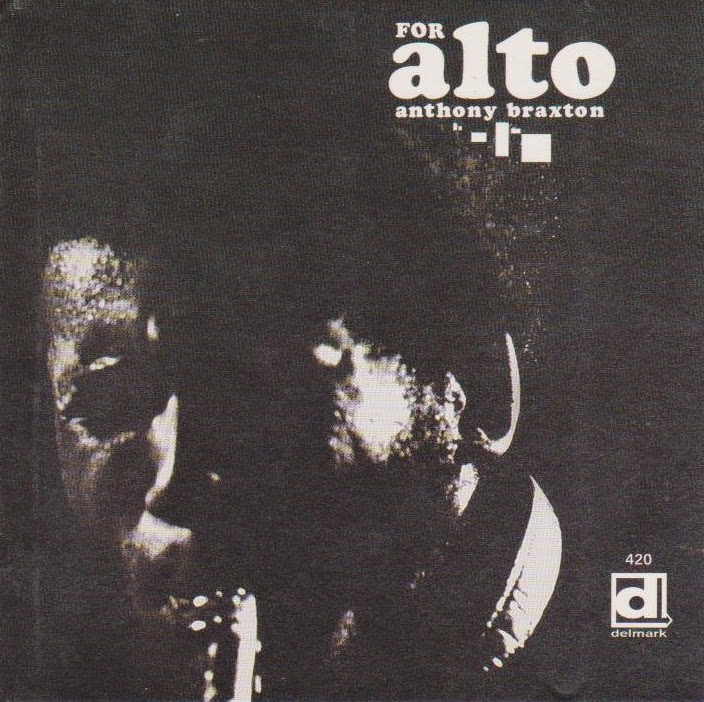
Anthony Braxton: For Alto
Anthony Braxton, recently honored as a NEA Jazz Master, has had his music stereotyped as cerebral, dense, impenetrable and more. The difficulty probably stems largely from the fact that he follows his vision for sound in ways that don't easily dovetail into neat categorizations about what separates improvised jazz from notated composition and that he puts such a great deal of thought into what he creates that his music doesn't provide easy benchmarks from which to listen. Braxton's music does take effort, more than most people would want to (which is obviously just fine), but the rewards, at least for this listener, are palpable and long-lasting.
There are times, however, when his music has more approachability than others and, while it might be thought that a double album of solo saxophone would be the last place to approach approachability, For Alto actually has a lot that can appeal more broadly than Braxton's debut record, 3 Compositions of New Jazz, which was highly complex, ambient and "difficult."
Still, this is Anthony Braxton, so there are plenty of moments of knotty abstraction, but there are also many instances in which he plays quite melodically, soulfully and with a passion that is, to these ears, accessible, if a listener takes that great advice from saxophonist Albert Ayler and his trumpeter brother, Donald, to "follow the sound" rather than the notes.
After a brief and relatively placid forty-five second opener, the altoist tears into the next track, dedicated to composer John Cage. Though it is nine minutes long, a concentrated listening to the way that Braxton develops his solo, from the very fast and aggressive first third to a quieter, if still quite intricate, following section that then goes into a remarkable section of overblowing at the upper register after about 4:30 and then carrying the piece through to the end, it is easy to get caught up in Braxton's sheer inspired passion for what he was doing.
By contrast, the third piece, dedicated to artist Murray De Pillars, is, at first, more melodic and drenched with soulfulness, demonstrating that Braxton could play with a simplified emotion, while still tackling complex structures, such as a notable array of trills, in very effective ways. Then, he turns to some harsher sounds, alternating between mid and upper range blowing and then punctuated with harsh honks that are very interesting.
A smooth segue into a track dedicated to the great pianist Cecil Taylor moves the tempo up, but not as frenetically as the Cage piece. Again, Braxton is a marvel in terms of his mixture of formidable technique and the sheer joy of expression. While it would be tempting to try to equate the saxophonist's approach on this piece of Taylor's ways of playing the piano, it is almost certainly more plausible to think of the spirit of exploration to be the linkage. In fact, towards the end the playing gets quite bluesy. In any case, it is great to have one intrepid explorer saluting another.
The longest track, at nearly thirteen minutes, is dedicated to Ann and Peter Allen and the piece is very ambient, understated and the silences or near-silences are notable given much of the busy playing that came before. The beauty of this piece and in much of the ten-minute one that follows, dedicated to Susan Axelrod, is that Braxton provides the opportunity for ample space in terms of varieties of sound that he works with. The altoist does open up more with the Axelrod work, turning up the volume, increasing the tempo and playing with more blues feeling, while keeping a strong melodic current going.
It makes the album much more interesting and compelling when he sequenced the tracks to give the listener a chance to enjoy a full range of emotion and sound, from hard-charging, complex runs and blasts of intensity to the more introspective and moodier elements, as found in the Allen and Axelrod pieces.
In fact, the ten-minute piece dedicated to friend Kenny McKenny moves into very experimental territory with multiphonics, unusual breathing and fingering technique and other technical displays that are very much contrasting with the two works before. Again, though, for those willing to go on that journey into new territory, it is fascinating being in "the bubble" with Braxton as he explores ways to play the saxophone that are probably the most innovative after the death of John Coltrane two years before. Still, it could easily be understood why the McKenny piece could prove difficult to many listeners and play right into the stereotype mentioned at the outset.
Fittingly, the album concludes with a nearly twenty minute work dedicated to Leroy Jenkins, who worked with Braxton on the 3 Compositions of New Jazz record and subsequent albums recorded for the Actuel label in France and others. The piece starts off quietly and slowly, with repetitive patterns dominating and then punctuated with more honks and odd blasts of sound to contrast.
Braxton was only 24 when this album was recorded, but it sounds the summation of years of careful accumulation of sounds developed in live and recorded situations by someone much further along in years. It also bears remembering that this was 1969 when jazz was largely dominated by psychedelic and spiritual music, much of it fantastic, by such major figures as Alice Coltrane and Pharoah Sanders and with Miles Davis's electric revolution just around the corner (yes, not quite "On the Corner".)
Whereas the work of Mrs. Coltrane or Sanders or Davis definitely sounds "of the time," For Alto has a timeless quality to it. Obviously, being a solo album makes it easier (without harps or electric keyboards or the blissed-out vocals common to the period). But, it's also that listening to this album makes the listener feel that it's just you and the alto player as he bares his soul through a dizzying palette of sounds that probably was not thought possible at the time.
For Alto was audacious then and now, over 70 minutes of solo alto saxophone playing by a young man already determined to rewrite the rules of not just playing his instrument, but of composing and of working with sound. Forty-five years later, the album still sounds ground-breaking, hugely ambitious, fully immersive and impressively realized.
If the NEA Jazz Master program had existed 45 years ago, it seems plausible that Braxton could have been given the award just on the basis of this fantastic and essential document. In any case, it was great to see him get the honor this late in his life and finally receive some belated recognition for his immense, if somewhat challenging, body of work.
Friday, May 16, 2014
Method of Defiance: Inamorata
Bassist and producer Bill Laswell's career has been a long and varied one, but few of his many recordings feature as many intersections of musicians as his Method of Defiance project's 2007 album, Inamorata.
This album has a slew of renowned jazz performers from the 1960s onward like tenor saxophonist Pharoah Sanders, keyboardist Herbie Hancock, tenor player and flautist Byard Lancaster, sax player Dave Liebman and guitarist Pete Cosey.
Younger jazz performers like trumpeters/cornetists Graham Haynes (son of the great drummer Roy Haynes), Toshinori Kondo, and Nils Petter Molvaer, and keyboardist Craig Taborn are also on board.
Frequent Laswell collaborators John Zorn, along with his Masada String Trio, guitar wizard Buckethead, former Parliament and Funkadelic keyboardist Bernie Worrell and table player and drummer Karsh Kale.
Finally, as Method of Defiance, in its early incarnations, was heavily driven by the electronic bass 'n drum sound, a plethora of performers from that genre were matched up with the aforementioned musicians, including Paradox, Black Sun Empire, D Star, SPL, Fanu, Outrage, Corrupt Souls, Amit, Evol [misspelled "Evil" on the sleeve] Intent, Fanu and Submerged, the latter being Laswell's partner on the first M.O.D. album and who released this album on his Ohm Resistance label.
These recordings are uniformly interesting and entertaining and some of the performances are just outstanding, including the impassioned playing of Sanders, Liebman and Zorn (and the Masada String Trio's jittery strings with a mournful and brief interlude in the middle of the piece) on their tracks, "Ta' Wil", "Aibi Virus" and "Pattern Engine." The cooler sounds of the several trumpeters provide a nice counterbalance, while Hancock, Worrell and Taborn use their keyboards to nice effect in providing another palette of sounds to contrast with the horns. Notably, Cosey and Buckethead, both incredibly inventive and fast players, are somewhat muted here, using their guitars for color and ambience more than for blazing solos or heavy riffs.
The many electronic performers here work well with the other instruments, providing a diverse array of drum machine patterns, electronic percussion and processed sounds that make this more than a typical drum 'n bass record, introducing diversity in its mixings of "live" instruments in the horns, keyboards and guitars categories. Karsh Kale's excellent table playing on "Aether" is also a highlight, especially as it dovetails with Molvaer's cool keyboards and Laswell's loping bass. "Remains," featuring Corrupt Souls has several cool and varied electronic "riffs", a sampled voice intoning something about science and technology, and another solid Laswell groove on bass. "Black Water" has a solid flow to it and Haynes' ultra-smooth cornet work is countered by Lancaster's hard blowing, while Laswell holds it all together with more great playing.
Holding much of this together is Laswell's bass playing--consistently in touch and integrated with the other sounds and highlighting his talent for holding down the bottom of a piece with little wasted effort and flashes of dub and jazz elements. His work in bringing in a staggering array of jazz-based talent, mixed with Submerged's recruiting of electronic artists makes Inamorata an entirely successful foray into expanding drum 'n bass out of electronics and into a fruitful collaborative partnership with other instruments.
Method of Defiance: Inamorata (Ohm Recordings, 2007)
1, Ta' Wil
2. Humanoid
3. Hidden Killer
4. Amenta
5. Panepha
6. Babylon Decoder
7. Aibi Virus
8. Anti-Jazz Glitch
9. Black Water
10. Pattern Engine
11. Aether
12. Remains
Subscribe to:
Posts (Atom)