Showing posts with label Nimbus Records. Show all posts

Sunday, March 22, 2026

Frederic Chopin: Piano Works

During these even more than usual turbulent times, immersion in the amazing sound world of Frederic Chopin is a badly needed balm and tonic and this six-disc set by the British label Nimbus Records provided six hours of enjoyment and escape.  There are some less-than-flattering reviews out there concerning the quality of the recordings compared to others made with Vlado Perlemuter (1904-2002).

Amazingly, these performances were set down between 1974 and 1992, when the Lithuania-born pianist was between 70 and 88 years old, but, to these untrained ears, they don't sound like the work of someone whose technique or abilities diminished much if at all.  Incredibly, his concert career stretched through three-quarters of a century and, while his earliest recordings were in 1939, he didn't work much in the studio until the mid-Fifties, but did so consistently, including sets for Nimbus of works by Beethoven, Fauré, Liszt, Ravel and others.

An obituary in The Guardian observed that Perlemuter's renderings of Chopin were "more unique and inimitable" than those he did of Ravel, which others prefer, and that his efforts were "simple and conceived of structurally," while "he put line before detail, large patterns before small."  The point seemed to be that the pianist was less concerned with the virtuosity in performing Chopin's works rather than evoking the structural brilliance of the composer and that he prized the left-hand work to reveal the underpinnings of the music.

Another reviewer remarked on the directness of Perlemuter's approach, with clarity and the tonal color employed also of note, while excessive ornamentation was largely eschewed, though some might view this as a colder, more clinical approach to Chopin's work, which many view as requiring an emotive approach.  For this listener, there are qualitative differences between the types of works in terms of what differentiates the Nocturnes from the Mazurkas or the sonatas from the Preludes, these last being some of the earliest Chopin works heard, so they have more memorable resonance.  

In terms of discerning the finer points of performance (touch, tone, tempo, dynamics, etc.) or studio recording quality, none of this substantially determined the enjoyment of the set.  Listening through these six discs several times in the last couple of weeks, Chopin's compositional wonders and Perlemuter's beautiful playing, even if more understated and conservative than other masters shine through, especially with all of negativity in the world right now.


Tuesday, July 13, 2021

Felix Mendelssohn: Complete Piano Music

Why the great Felix Mendelssohn has not been featured here before is an unfortunate oversight because, despite his tragically brief life, he amassed an incredible body of work, so we'll make up for lost time by highlighting this amazing six-disc box set issued by the remarkable Nimbus Records comprising all of the music written for piano by this sublime composer.

Performed by the brilliant Martin Jones, who has recorded an enormous amount for the label, the recordings entail over six hours and it has never been a problem to sit down for a work day at the computer and listen to this uniformly excellent music all the way through or over a couple of days.  Especially during these troubled times, when a respite is often needed to refresh the mind, listening to Mendelssohn's diverse array of piano works is a necessary and appreciated balm.

More impressive is that much of this work was done while the composer was a teen, including his sonatas, which as the liners note, hardly sound like they were juvenile works.  The beautiful preludes and fugues were produced during his late teens through late twenties.  At twenty, Mendelssohn visited Wales and three fantasies came out of that, including a remarkble one in F-sharp minor.

His best known piano pieces include the Rondo Capriccioso, the Variations Sérieuses, and the Songs Without Words, the latter intended for those to play at home in their parlor and often thought of as "piano fodder for the multitude," but highly popular when performing music was common in many households long before, of course, the phonograph, radio and television.  "Sweet Remembrance," the first of those songs without words, has great personal meaning as it was the march used for my own wedding nearly a quarter century ago.

Sunday, December 6, 2020

Shahmirza Moradi: The Music of Lorestan, Iran

This very impressive recording by sorna (a double-reed wind instrument) master Shahmirza Moradi and his son Reza, accompanying on the dohol (drum) includes the performance of a half-dozen dance pieces, recorded live in early 1993 in Paris, from the long tradition of this fascinating music from the Lorestan province in western (or south-western, as stated in the liners) Iran.  Moradi (1924-1997) was from Dorud, a county seat and was a member of the Lur peoples, who number about five million in that area of country.  

Renowned for his amazing skills in maintaining circular breathing, a powerful projection of sound, and his considerable improvisational skills, Moradi displays all of his immense talent and ability on these lengthy tracks and, with concentrated listening and the following of his assured, flowing and technically brilliant lines, the pieces don't seem to go as long as they are.  This is all the more remarkable given that the sorna has a limited range of one octave and one note above, but that's a testament to Moradi's awesome playing.  His son's accompaniment also keeps an excellent rhythm over which the master weaves his stunning lines.  Moradi was a wonder and this album is a distinct pleasure to hear and to appreciate the incredible performance, which must have been quite an experience to hear live.

Wednesday, November 18, 2020

Antonio Vivaldi: Violin Concertos, Volume 2

During these trying times, it has often been important to listen to music that is melodic, harmonically rich, and, frankly, uplifting and relaxing (though, at other times, turbulent and roiling music is what is wanted!)  Often, baroque music, whether it be Bach, Handel, Monteverdi, or any number of other great composers of that era, is a tonic and balm to help maintain a positive mood in the face of so many trials and tribulations.  Today's featured recordings fit the bill to a T, these being the five-disc set comprising the second volume of violin concertos recorded by the Israel Chamber Orchestra conducted by Shlomo Mintz and reissued by Nimbus Records in 2009 from an early 90s release by MusicMasters.

The so-called Red Priest, Vivaldi (1678-1741) was a violin maestro as well as a master composer and these pieces are really a pleasure to hear.  They are often laden with emotion, including with contemplative as well as uplifting elements, filled with gorgeous melodies, and with tight and unified harmonies.  The playing of the chamber orchestra, formed in 1965 and led for a few years by Mintz, is excellent.  I've run through the entire set of five hours a few times lately because this music really is a great way to help navigate the troubled waters in our uncertain world.

Tuesday, April 30, 2019

Camarão Plays Forró: Dance Music From Northeastern Brazil

This is fabulous music from northeastern Brazil with emphasis on virtuoso accordion playing by Reginaldo Alves Ferreira, known as Camarão (shrimp in Poruguese because of a sunburn he once sported in the studio), who gets billing and a few pieces by Arlindo Dos Oito Baixos, whose work with the eight-bass button accordion is featured on four pieces.

Released in 1998 on the great British label Nimbus, which has issued so many remarkable recordings of world music, this album's music employs several styles including forró, baião, xote, arrastapé and chachado, which are basically unknown to most foreign listeners who identify Brazilian music with the samba and bossa nova.


This is also more country music, though migrants seeking work and better opportunities have brought the music of the northeast to the large cities of the south.  Accompanying the accordions on these pieces are light percussion on the triangle, cow bells and bass drum, while some guitar and vocals are interspersed, giving the tunes additional variety.

Camarão was quoted in the liner notes about the importance of not "modernizing too much" and keeping tradition in a way that was "essentially simple and direct," while he strives to "play music that smells of the land" in his native Pernambuco town of Caruarú.

In America, we think of dance music as often very beat heavy, whereas this music is light and airy, with the mastery of the accordion sensitively complemented by the other instruments and the vocals also treading softly but with much melodic emphasis.  This is a gorgeous recording not often heard here and a welcome addition to the fine collection of world music offered by Nimbus.

Tuesday, March 20, 2018

Mustafa al Sunni: Songs of the Sudan

This fantastic Nimbus Records release features the music of Sudanese oud master and singer Mustafa al Sunni.  Accompanied by percussionist Abd al Haziz Karar, whose work is sensitive and subtle, but highly effective, al Sunni plays his instrument with great skill and variety, while his keening vocals are beautifully done.

The liner notes do a great job of providing historical context for the music of this nation that has been rent apart by factional fighting for so many years, an irony given the many references in the essay to the wide-ranging influences in the music from many parts of northern and central Africa and beyond.  The narrowed focus of political factions has so little to do with the long tradition of musical elements that are imported and absorbed into existing local ones.


Also noteworthy are the lyrics and the emphasis on poetry, whether the songs are traditional turath, or those passed down through generations, praise songs called savra that talk about the bravery of warriors, or hagiba, classical pieces with the most intent poetic lyrics.  The intensity of these can be read in the translations provided in the notes.

Hearing the nimble playing of the oud, the excellent percussive accompaniment and the yearning singing and then thinking of the horrors that have emerged from the Sudan over recent decades, this recording is a reminder of how the music of Mustafa al Sunni represents a part of his nation's heritage and traditions that hopefully will survive the terror and turmoil.

Thursday, July 28, 2016

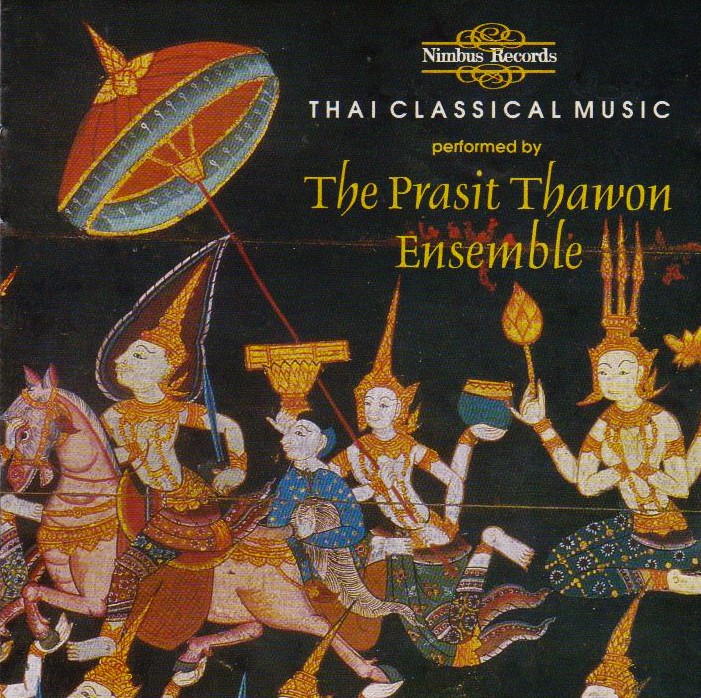
Prasit Thawon Ensemble: Thai Classical Music

This 1994 release on England's Nimbus Records is a beautiful example of the classical music of Thailand, as rendered by The Prasit Thawon Ensemble.

Utilizing horns; percussion including bells, gongs, finger cymbals, and woodblocks; alto and soprano xylophones and vocals, the long tradition of music, whether the pieces are older or new, from the Asian nation is given excellent expression by the ensemble, anchored by the two long centerpieces of the album, the exquisite 23 1/2-minute long "Sumran Dontri Klong" and the nearly 27-minute long "Cherd Chin."


Interestingly, the latter dates from the mid-19th century while the former was newly composed by Prasit Thawon, the leader of the performing ensemble, when this recording was made.

The group was founded in the late 1950s as "The Ensemble of the Dramatic School" at Bangkok and it performed in concerts and for radio and television broadcasts.  After Prasit Thawon retired in the mid-1980s, the ensemble was renamed "Sitti Thawon" and then to The Prasit Thawon Ensemble as a further honor to the founder.

The recording was made as part of an international conference devoted to Thailand at a London studio and is a fine representation of the fascingting music of that country.

Sunday, May 8, 2016

Dr. L. Subramaniam: Three Ragas for Solo Violin

This is another stellar release in the "Indian Classical Masters" series from Nimbus Records, issued in 1991, of the beautiful and technically superior work of violinist Dr. L. Subramaniam coming out of the Carnatic music tradition of southern India.

Subramaniam was a child prodigy, giving his first solo violin performance at the age of six, and mastered not only the indigenous music of his homeland, but also received a master's degree in Western classical music.  He has composed music that fuses the Indian and western forms with his hybrid works performed throughout Europe, the United States and in India.

Obviously, the violin, as a western instrument, came late to India, being introduced, according to the informative liner notes in the early 1800s, though its use as a solo instrument has come in the post-World War II era.

The three ragas performed here are ranging from 20 to 25 minutes in length, giving Subramaniam the fullest opportunity to develop the melodic elements of the pieces and then to employ a great variety of improvised variations, accompanied by the tambura (drone) of Narendra Kotiyan.  Throughout, Subramaniam's playing is gorgeous, complex and rich with often thrilling technical displays of virtuosity performed with great precision and control, but also emotionalism.


As explained by Dr. John Marr, Carnatic music (which has been featured here before), has seven degrees in an octave with a variety of talas, or time measures, employed.  There are six dozen scales, or melakartas, in the tradition that are formed from the basis of six patterns that refer to hours and minutes and then  the augmentation of these.  Half come from the "hour and minute" examples and the other half from the augmented melakartas.

Carnatic music revolves around religious pieces called kirtana and kriti and the soloist is known for how they improvise from the basic melodic themes of these songs and it was the vocal work that was the basis for traditional Carnatic music.  This was highlighted in the previous posting on this blog of a great album by Ramnad Krishnan.

For many western listeners, these lengthy pieces can be a challenge, but this listener has found, in twenty-five years of enjoying Indian classical music, that having the drone almost as a meditative "bottom" and then treating the soloist as someone developing the western classical notion of "variations on a theme" while waiting eagerly for those virtuosic displays of rapid runs and technical gymnastics is a good way to approach the music.

Ultimately, there is something very meditative in listening to Indian classical music, whether from the Hindustani or Carnatic traditions--that approaching it as a continuous experience that is less dependent on time as it is on development of the melodic themes by improvisational variation makes the music more emjoyable.  Dr. L. Subramanian is a masterful performer and this recording is another excellent recording from Nimbus, which has a large catalog of Indian classical music.

Thursday, June 18, 2015

Flamenco Live!

This 4-disc box set, issued by the British Nimbus label in 2000, is a collection of four previously-released live albums from the label.  Three of the four feature singers and guitarists performing cante with the traditional-style vocals of María la Burra, María Soleá, José de la Tomasa, Chano Lobato, Manuel de Paula, Gaspar de Utrera, Miguel Funi, El Cabrero, Tina Pavón, Emilia Jandra, Rafael Calderón, Manuel Márquez, and Monica Dominguez--all of whom deserve mention because they are all excellent in conveying the passion and intensity of the form.

On two of the cante discs, the guitarists, who play with great dexterity, emotion and the use of variations are Paco del Gastor and his brother Juan.  They provide a perfect accompaniment to the vocalists in the environments of flamenco clubs, with a few in larger concert settings.  The fourth disc, another cante, features guitarist Manolo Dominguez, whose daughter Monica is one of the five vocalists, with the material also recorded in clubs.

The third disc is a spotlight for Paco del Gastor, whose talents took him from his native Morón de la Frontera, where much of this music was recorded and where the del Gastor dynasty of excellent guitarists were from, to the Spanish capital Madrid.  After hearing three recordings of cante, in which the singers are justly at the fore, demonstrating their various talents and abilities to the fullest, it is a bit jarring to hear a solo guitar performance--at least at the beginning.  But, Paco del Gastor is such an amazing performer that any sense of disconnect melts away quickly as the listener is absorbed in the work of this master.


That said, the highlight of this box, at least for this listener, are the two performances at the end of the second disc, Cante Flamenco, in which the del Gastor brothers take a back seat to the remarkable talents of El Cabrero (José Dominguez Muñoz), who had a twelve-year partnership with Paco del Gastor.

That synergy definitely shows on these pieces, recorded at a larger festival, but El Cabrero is the main attraction, with his vocals featuring a distinctive ululating at the end of certain phrases, a very strong elongating of the syllables that characterize the cante, but in a way that appears more like a plaintive and anguished cry, and politicized lyrical content.

There is a lot of material in this set, four-and-half hours worth, but most of it consists of rare instances of traditional pieces recorded in small flamenco clubs in Andalucia, the cradle of the form, and this is a paramount reason to shell out for the whole set, though the individual discs are available from Nimbus.  Those who favor the guitar work over the vocals would be advised to search out the Flamenco de la Frontera disc from Paco del Gastor, or the several albums on Nimbus from Paco Peña, another giant of the flamenco guitar.

For this listener, relatively new to the music, though, the vocals seem essential in conveying the passion and intensity as reflected in the cante that is ultimately the heart and soul of flamenco.

Tuesday, April 14, 2015

Hindustani Classical Vocal

This triple-disc box set issued by the UK-based label, Nimbus Records, features three-and-a-half hours of spellbinding, evocative and expertly sung and played vocal music from the Hindustani classical tradition of northern India.  Highlighted are three legendary female singers:  Sulochana Brahaspati, Girija Devi, and Shruti Sadolikar, who are each given a disc of at least sixty-five minutes to show their amazing talents and vocal gymnastics.

As typical for this breathtaking style of music, the ragas tend to start slow and, anchored by the drone of the tambura and occasional striking of the tabla, atmospheric. For the longer pieces, lasting in one case nearly an hour, the gradual buildup of tension and tempo is a wonder to behold, at least for those with the patience to listen that long.  Something of a concentrated effort on listening to the unfolding, however, is well worth the time invested.


Brahaspati, now approaching her eighties, is given that one-hour Raga Bilakshani Todi to demonstrate the full range of her impressive vocal prowess, and her miniature (well, at sixteen minutes in comparison to the first piece) Raga Mishra Bhairavi is also a tour-de-force.  Recorded at the Nimbus Records studio in England in late September 1991, the then 57-year old vocalist has a deeper voice than her compatriots, and is accompanied by sarangi player Sultan Khan and tabla performer Anindo Chatterjee.

Shruti Sadolikar is much younger, though now in her mid-sixties, and is from a subsequent generation than the other women on this set.  She has two longer ragas, the Miyan-ki Todi and the Bibhas, the former being over thirty-five and the latter twenty-seven minutes in length.  She concludes with a shorter fourteen-minute Raga Bhairavi.  Anand Krishna Kunte plays the sarangi, Chatterjee is again on tablas, and there are two tambura players, Uma Mehta and Kamaljit Kaur.  This disc was recorded at the end of February 1992 in France.

Finally, there is Girija Devi, who was recorded at the Nimbus studio, a couple of weeks after Brahaspati in October 1991.  Her first raga, the Maru Bihag, is just over a half-hour.  She has by far the shortest piece in the set, the Raga Desh at just under seven minutes, followed by the sixteen-minut Raga Pilu and the eleven-minute Dadra.  Devi is accompanied by tambura player Sudha Datta, tabla performer Subhen Chatterjee, and Ramesh Misra on sarangi.

While not as well-known as the instrumental music embodied by such internationally-acclaimed performers as Ravi Shankar, Alla Rakha, Ali Akbar Khan, and Zakir Hussain, the female vocalists featured on this box set are as technically breathtaking and emotionally evocative as their male instrumental counterparts.

Monday, November 3, 2014

Wolfgang Amadeus Mozart: Complete Piano Sonatas

Any appreciable amount of time spent listening to Mozart is an awe-inspiring experience considering how short a time he lived, the amount of varied music he wrote, and the fact that, as the notes to this great box-set indicate, "Mozart had little or not need to write down sonatas: he improvised them, making an impression on his audience on the spur of the moment . . . [he] only wrote down what he had to."  Obviously, he was a total prodigy--a performer and composer whose gifts come only on the rarest of occasions--and much of what made him such a legend in 18th-century music circles was done for the moment and then lost.

There were, in all, twenty-two sonatas by the master for solo performance on the keyboard, the four earliest, starting from when Mozart was ten years old, having been lost, leaving eighteen.  The last of the sonatas came in July 1789, a little over two years before the composer died.  This set, released in 1996 by the British Nimbus label and totaling a little over six hours on as many discs, is performed by the excellent Bulgarian-born Marta Deyanova.  The recordings were largely made in 1989 and 1990, with one track laid down in 1995 and the sound is superb.

The notes by David Threasher compactly and succinctly discuss the eighteen sonatas and a nice touch are quotes from letters written by Mozart to his father Leopold.  One of these is from 1777, in which the 21-year old informed his father that "I played all my six sonatas today" and then quoted from a Count Savioli who told Mozart that "I hear that you play the clavier [a precursor to the modern piano] quite passably."  The composer then merely stated that, "I bowed."  These six works came from two years prior to the letter.

Threasher pointed out that Mozart's earliest piano sonatas were influenced by a set of six sonatas published in 1774 by the great Franz Josef Haydn, although he also noted that Mozart's improvisatory powers were dominant in at least the first of the sextet.

In a letter to his father written four days later than the one quoted above, Mozart wrote that he had just composed a rondo for a sonata, this being a Sonata in C Major and for which he had totally improvised a rondo "full of din and sound" a few weeks prior.  This work was dedicated to a young pupil, Rose Cannabich, with a pretty andante which may have reflected strong feelings the composer had to his charge.  His next set of sonatas came, then, in 1777-78, during which time Mozart experienced difficulties working in Paris, where he was underappreciated and in which his mother died during a visit to him.


A few sonatas were written in 1783, just after his marriage to Constanze Weber and while the pair were living in Salzburg with his father.  Threasher wrote that "Mozart was aware that he would need a fund of new music for the purposes of performance, pedagogy and perhaps publication, and composed these three sonatas to fill such a need."  One of these, in A major, is among the composer's most-beloved pieces, featuring the stunning Rondo alla Turca finale.

Further works came later in 1783 and during the following year, including the famed C minor sonata and a stand-alone fantasia in that key that usually proceeds the other in performance.  This fantasia, even amongst the greatness of the other solo piano works, astounds with its jaw-dropping technicality and its beauty.

Finally, a quartet of sonatas came in 1788 and 1789 and characteristically at least one of these, the F major was written to pay off one of his chronic debts--in this case to his publisher.   Another, a C major, was intended for teaching and bore the title "Little Sonata for Beginners."  The final two, coming in 1789, remained unpublished until after Mozart's death and one, a B flat, appeared as a work for piano and violin, with the latter assumed not to have been the master's work.

As to Deyanova, who has recorded many albums of piano music for Nimbus, including works by Schubert, Scriabin, Chopin and Rachmaninoff, she was a prize-winning performer as a child in her homeland and then won international competitions in Italy, Paris and in Sofia.  After a 1969 prize-winning performance, Yehudi Mehunin wrote that "I wish Marta Deyanova the international career she so richly deserves."  Fortunately, that did happen, as she has toured the world over and, from 1978, recorded her extensive solo piano work for Nimbus.

Saturday, August 16, 2014

Enrique Granados and Isaac Albéniz: Spanish Piano Music, Vol. 1


The English Nimbus label has released many excellent world music (especially Indian) and classical recordings over the decades.  This 4-disc set of the piano music of the eminent Spanish composers Enrique Granados and Issac Albeniz is a top-notch recording that not only presents the works for which both are principally knows, Granados' Goyescas and Albéniz' Iberia, but other pieces representative of the two men.

The composers were contemporaries, who were born and died seven years apart, and they studies from the same musicologist, Felipe Pedrell, who inspired the men to embrace the idea of a particularly Spanish music. 

Albeniz was from a small town in the northeastern part of Spain, not far from the French border, among Basque country.  He was a child prodigy, taught by a sister, who made his concert debut in Barcelona at five years of age.  Though he passed the entrance exam to the conservatory at Paris, he was denied admission because he was considered too young.  Like Mozart, to whom he was compared, he was then shepherded by his father around Spain for performances with his sister.  After studying in Madrid, he went to Leipzig and Brussels and contemplated studying with Franz Liszt, but his plan never materialized.  Later, he lived and worked in London, though his interest in promoting a Spanish national music led him to his masterwork.

Albéniz composed, between 1905 and 1909, his Iberia suite of four books reflecting his impressions of the Spanish peninsula, with most of the focus on the Andalucía region.  A fishing village, a town overlooking a famed gorge and a suburb of Seville are impressionistic subjects in the first book.  The second reflects concepts derived from observing gypsies in Granada, an Andalucian dance, people in a tavern near Seville, architectural splendor in the Andalucía region and, in the only instance of a non-Andalucian subject matter, a neighborhood in Madrid.  Just after finishing the work, Albeniz, who had Bright's disease, succumbed to liver disease a few days prior to this 49th birthday.

In addition to Iberia, this set contains his Suite Española, the España "souvenirs", a tango, and other works, including two unfinished pieces, Navarra (intended for Iberia) and Azulejos, which were completed by pianist Martin Jones for this recording.

Granados, a Catalonian who was raised in Barcelona, was best known initially as a pianist with highly-regarded improvisational skills, though his first published work, the Danzas Españolas brought him attention as did an opera, María del Carmen.

The composer based his Goyescas on the work of the famed painter Francisco de Goya and was completed in the early 1910s.  Notably, the composer was asked to adapt the music for an opera, which was completed in 1914, just as World War I erupted.  Finally, two years later a performance was held in New York and it was well received to the extent that President Woodrow Wilson invited Granados to a White House reception.  Delaying his return to Europe for the honor, Granados and his wife were on the ferry, the S.S. Sussex in the English Channel when the ship was hit by a German torpedo and partially destroyed.  Granados, who was 48, made it on to a lifeboat, but his wife Amparo struggled in the ocean and the composer dove in the water to save his wife, but both drowned.

Other works by Granados included in the set are a reverie, transcribed by Jones from a piano roll recording of the composer that was made the year he died; a set of Escenas Románticas (romantic scenes), and an Allegro de concierto.

There is a great deal of romantic feeling and emotion in these beautiful pieces, along with a high degree of technical precision, and Jones, who recorded the works over several sessions between late 1995 and Spring 1998, is excellent throughout.  He has recorded many, many albums for Nimbus, including the complete works of such composers as Mendelssohn, Debussy (part of which was featured here), Brahms, and Stravinsky.  The recording quality is clear, crisp and rich and the set is a real treat, especially for an amateur who knew little of Granados and Albéniz and their work.

Tuesday, July 8, 2014

Salamat Ali Khan: Ragas Gunkali, Saraswati, Durga


The British Nimbus label has released many recordings of classical music from the Indian subcontinent over the years and this very fine album of Hindustani vocal music, recorded in November 1990 at the label's studio at Monmouth, England, by the master Salamat Ali Khan and his sons, Sharafat and Shafqat, features three long ragas. 

As pointed out in the notes, very helpful to an amateur (however enthusiastic) such as YHB, Hindustani music from northern India is also found in Pakistan, Bangladesh (formerly East Pakistan), Nepal and parts of Afghanistan.  It is also observed that Muslims and Hindus are practitioners of the ghazal form of the music and often perform together despite the political differences that have driven the two groups apart.

Salamat and his brother Nazakat became known for their vocal duet performances from childhood in the early 1940s and were partners until 1974.  Sharafat then began working with his father and Shafqat joined the two for this first recording session with this album.  The partition of India in the late 1940s meant that the Khans moved to Pakistan and performed there for many years, although their return to India much later was widely hailed, as audiences recognized the brilliance of these amazing vocalists.

The first, the Gunkali, running over 20 minutes, highlights the singing of Shafqat and, while this was his debut on record, his vocal technique is outstanding with power, deft handling of complex lines, and beautifully-controlled tremolo as he navigates the tricky crescendos and diminuendos germane to the form.

On the half-hour Saraswati, Salamat and Sharafat sing with the elder Khan leading and the younger supporting beautifully.  The song is filled with great technique and expressiveness, despite Salamat's recovery from a recent stroke, and his sons obviously learned well from their father's tutelage.  The piece begins quietly and solemnly with the two vocalists accompanied by the harmonium before the tabla breaks in with a flourish at 3:45.  From then on, the Khans work their magic with the fine underpinning by the instrumentalists.

The closing Durga, at a hair over 20 minutes, is a tour-de-force with Salamat and both his sons.  The intertwining and harmonizing of their vocals is a wonder to behold and makes this wonderful song the highlight of the album, even through the other two ragas are remarkable on their own.  The improvisations and vocal gymnastics are spectacular and the three frequently return together to the composed main vocal line.  The tabla player also has the chance to demonstrate more of his skill here than on the other pieces.

The supporting musicians do an excellent job of providing the right balance of playing to buttress the singing of these masters and include Sharafat on harmonium, tabla player Ghulam Abbas Khan, who had accompanied Salamat and Nazakat from the age of 13, and tambura player Christian Ledoux.

The notes also have a useful history of the "khyal" or vocal music embodied by the disc and detailed explanations of the form of each raga.

For a novice, quickly absorbing what he can of the amazing variety, tradition and beauty of the music of India and Pakistan, this is another phenomenal recording among many that will be highlighted here.  While Salamat Ali Khan died in 2004, his sons continue to work as ustads, or masters, in their field. 

Wednesday, May 14, 2014

Claude Debussy: Complete Piano Works, Vol. 3: Preludes, Books 1 and 2

This recording, the third of a series of five discs issued by the British Nimbus label in 1998, features the two books of preludes, totaling two dozen pieces, created by the great French composer in 1909-10 and 1912-13.

Although inspired generally, it is said, by the exceptional series of 24 preludes by Frederic Chopin, these works don't bear much resemblance structurally to those classic piano works, which were progressions in key signatures.  Rather, Debussy was motivated by a variety of source material, from a statue in the Louvre museum to a line from poet Charles Baudelaire to a label from a bottle of Italian wine to a reminiscence of days spent by Debussy in Eastbourne, England.

The composer did not take kindly to being labeled "impressionistic" in his style of writing, with the liners by Roy Howat noting that Debussy was interesting in "'something different'—in a sense, realities" though these could be seen as part of a mystery, a natural splendor, a spiritual grandeur that reflects in the emotive, dynamic and shifting elements of his music, in which it is easy to see why "imbeciles" (as he called them) would apply the label "impressionistic" rather than "realistic."


Notably, the composer wrote in 1911, between the production of the two prelude books, that "the noise of the dea, the curve of the horizon, the wind in the leaves, the cry of a bird; all leave impressions [bold added for emphasis] on us."  Howat suggests that Debussy's fascination with musically reflecting environmental aspects was a reality for him, because of an alienation from "an everyday world with which he never quite came to terms."  This, in fact, is not a surprising judgment, given the position of artists of all types, who often develop a "reality" that seems fantastic to others.

In any case, these two dozen pieces do show a range of atmospheres and stylistic variation that show that Debussy was both reflecting tradition while working with a modern palette of sounds and concepts, with unusual scales and the use of chromatic, rather than tonal, elements employing new chordal approaches in his music.  The preludes bring out contemplation, excitement, mystery, playfulness, experimentation, and many other feelings and ideas in a way that is simply unique to the composer.

During the time he was working on the first book of preludes, Debussy learned he had rectal cancer and, as his condition worsened, he underwent an early form of colostomy surgery.  The disease progressed, though, and the composer died of it in Spring 1918.  He was buried in Paris amidst a furious round of bombing by the Germans as the First World War ground to a close.  This aspect lends, perhaps, a further interesting meaning to the debate about musical "reality" as opposed to "impressionism."  Whatever labels are applied to Debussy's music, his unerring instinct for new ways of creative expression and experimentalism are noteworthy throughout his career and the preludes exemplify this.

Martin Jones, a celebrated British pianist whose work for Nimbus includes recordings of all the Felix Mendelssohn piano pieces and those of Spanish composers like Enrique Granados and Isaac Albeniz, as well as Johannes Brahms, Percy Grainger and Carl Czerny, among others, plays beautifully and sensitively.

Wednesday, June 19, 2013

The Art of Paco Peña


Flamenco music is a newfound interest and this 1993 compilation from the British label Nimbus gathers material from several recordings for that label by the Spanish maestro, Paco Peña. 

A generous 65-minute album culls 15 tracks, including a collaboration with Eduardo Falú. a noted guitarist, composer and singer from Argentina with whom Peña extensively toured Europe in the mid-1980s. 

Several tracks are pieces from pioneers in the flamenco style, namely Ramón Montoya and Niño Ricardo. 

The remainder of the pieces are Peña's own work and he is joined on some of these by Tito Losada.  Finally, there is an excerpt from the unusual religious work, the Misa Flamenco, or Flamenco Mass, composed by Peña and premiered at Wroclaw, Poland in 1988, though the version on this record came from a London presentation a few years later.  In this sampling, there are four flamenco singers, four guitarists, two percussionists, and the chorus of The Academy of St. Martin in the Fields.

Peña is heralded for not only his superlative technique, but for his firm grasp of traditional methods with modern conceptual attributes.  This is an enjoyable record, probably, for even the most seasoned fan of flamenco music, but it is a great introduction for greenhorns like yours truly.

The Art of Paco Peña (Nimbus Records, 1993)

1.  Solquena  5:04
2.  La Rosa  4:31
3.  Milonga Uruguaya  1:58
4.  Seguiriyas  6:03
5.  Gloria  4:13
6.  Salobre  5:06
7.  La Cuartelera  2:59
8.  Alegrías  3:54
9.  Riomar  4:05
10.  Santo  2:55
11.  Soleá  4:28
12.  Claroscuro  5:25
13.  Valse Criollo  3:11
14.  Tarantas  5:17
15.  Canto Eucaristico y Despedida (excerpt)  6:17

Monday, July 9, 2012

Wu Man: Chinese Music for the Pipa

Wu Man, born in 1963 in Hangzhou in southern China, is a master of the pipa, a pear-shaped lute, with four strings, twenty-six frets and six ledges serving as stops, that is plucked, in what is known as the Pudong school of performing on this classical Chinese instrument.  The Pudong tradition dates to the 1700s and from an area within Shanghai and Wu Man received her instruction from such masters at Lin Shicheng (1922-2006).  She studied with Lin at the Central Conservatory of Music in Beijing and was the first person to receive a master's degree in pipa studies and performance.  In 1989 she was awarded the first prize at the National Academic Competition for Chinese Instruments. 

The following year she went to the United States to study English and remained a resident.  She has had many honors, won a great number of awards and prizes and has played with an impressive and eclectic list of performers and ensembles, including the Kronos Quartet, Henry Threadgill (both featured here), Philip Glass, and Yo-Yo Ma's acclaimed Silk Road Project.


Wu Man's first recording was issued by the Nimbus label, which has issued many excellent world music and classical albums, in 1993 and is called Chinese Music for the Pipa.  The seven tracks include five traditional pieces and two modern ones (one composed in 1929 and the other just two years before the recording. 

Pieces reflect certain modes of performance, such as martial and civil or combinations of the two.  This latter is endemic to the final and most modern piece, Dian (The Points) which displays Wu Man's astonishing technique and skill, while also evoking the great emotion, especially the kuyin (or weeping tones) style.  There are also significant variations in tempo, from the faster folk-infused Denghue jiaohui that opens the album to the reflective Chen Sui, the fourth piece.

The liner notes by the artist and Stephen Jones give excellent information on the instrument and how it is played, the use of scores for the pipa, and summaries of the seven works on the album.  Three years after this debut, Wu Man worked with an ensemble on a second Nimbus release, Chinese Traditional and Contemporary Music, which further explored her interest in exploring and presenting the classical music of her country with modern expressions based on earlier styles and forms and this album will be featured here someday.

Wu Man: Chinese Music for the Pipa (Nimbus Records, 1993)

1.  Dengyue jiaohui (Lanterns and moon competing in brilliance)  5:21
2.  Wulin yiyun (Ancient melodies of Wulin)  14:17
3.  Bawang xie jia (The tyrant removes his armor)  10:27
4.  Chen Sui (Chen and Sui dynasties)  12:12
5.  Xu lai (Sounds of nature)  6:28
6.  Yue'er gao (The moon on high)  13:31
7.  Dian (The Points)  8:56