Thursday, May 17, 2012

Minutemen: Double Nickels on the Dime

In the earlier post on Hüsker Dü's mind-blowing Zen Arcade, it was noted that that record was bought along with another phenomenal double album, Double Nickels on the Dime from Minutemen.  Both of these albums signaled a high point for the "do it yourself" atmosphere of American punk (post-punk?  whatever?) rock, epitomized by the underfunded, but overexuberant SST Records label, of the early to mid-1980s.

Whereas Zen Arcade showed a more obvious "hardcore" element, particularly in its paint-peeling speed-fueled side two, Double Nickels on the Dime (a reference to driving 55 mph on Interstate 10, as shown on the album cover below, where band member Mike Watt tools down the freeway at the indicated speed on said highway, while he has a twinkle in his eyes through the rear view mirror and out the windshield is the sign for State Route 11 (now State Route 110) to the band's beloved home base of San Pedro--the title is also evidently a rejoinder to Sammy Hagar's popular tune, "Can't Drive 55," which the Minutemen dudes felt was not much of a protest song.  Jesus, what a long diversion that was!) is a stylistically diverse tour-de-force of political pieces, strange abstractions, covers of Steely Dan, Van Halen, and Creedence Clearwater Revival songs, and tons else.

In fact, the album was intended to be a single disc release with recording commencing in November 1983, until D. Boon (guitar, vocals), Watt (bass, vocals), and George Hurley (drums) found out that their bandmates were releasing a double album.  Joking "take that, Hüskers!" on the liners, Minutemen went back into the studio in April 1984 with quickly-written pieces and hammered out the material for their own double album.  The record was made for only $1,100!  SST responded by delaying the Zen Arcade release, so that the two albums could come out together in July 1984.  This was perfect for some buyers, who took the opportunity to buy both and enjoy a singular experience of enjoying two landmark albums of the day.

The vinyl release included 45 (yup, 45) songs over the four sides, three sequenced by individual band members picking songs by straws and the fourth deemed "chaff," literally leftovers.  Boon's trebly guitar featuring some arresting soloing, Watt's fluid bass, and Hurley's muscular drumming are excellent throughout with the guitarist singing all but two of the pieces, which were performed by Watt.  Political anthems like "Viet Nam," "Political Song for Michael Jackson to Sing [what a great title!]," "The Big Foist," "West Germany," and "Untitled Song for Latin America," are paced with the covers, like Creedence's "Don't Look Now," which was recorded live, Van Halen's "Ain't Talking 'Bout Love," and Steely Dan's "Dr. Wu," and a variety of off-the-wall pieces like "#1 Hit Song," ""Maybe Partying Will Help," "Toadies," "Take 5, D," which deals with leaking showers and perhaps other topics, "The Road of the Masses Could Be Farts," and "Jesus and Tequila." 


"Viet Nam" is a highlight with its funk-like guitar, buoyant bass, and rock solid drumming providing a solid basis for Boon's political diatribe about the war.  That song is followed by Boon's beautiful and contemplative acoustic piece, "Cohesion."  The powerful "Shit from an Old Notebook," featuring a Boon rant against commercialism has a great Hurley backbeat and Watt's signature bass anchoring the sound perfectly.  The trio's tight interplay also shines on "Nature Without Man," "One Reporter's Opinion," which has a cool lyric about Watt as a mechanistic human being, "The Big Foist," "Nothing Indeed," "This Ain't No Picnic," "Storm in My House," and a host of other pieces.  There is also the great "Corona," written by Boon and which has an extremely catchy twangy guitar riff and a thumping polka beat.  Hurley gets to showcase his drumming best, perhaps, on the under a minute "Martin's Story."  After an intense "The World According to Nouns," the album closes nicely with a relaxed, funky jam called "Love Dance."  There are also little interludes playing up the car theme found in the title and art work by having audio of the band members' cars starting up.

"The Glory of Man," with an awesome bass line from its writer, Watt, and the bassist's sublime (and perhaps the band's overall signature song), "History Lesson—Part II" are probably the two most memorable tracks to YHB, although it's hard to take these pieces out of the context of a uniformly excellent album that moves quickly from song to song in its 80+ minute vinyl and 78-minute CD versions.

With excellent reviews, a heavy touring schedule to support the album, and decent sales, considering its lack of "commerciality," the band was at a creative peak.  After the follow-up, 3-Way Tie (For Last), came out in 1985, D. Boon was tragically killed in a traffic accident in Arizona just before Christmas.  Devastated, Watt and Hurley ended the band, but later formed the excellent fIREHOSE, a very different, but impressive trio with guitarist/vocalist Ed Crawford, that lasted from 1986 to 1994.  Watt has continued with a solo career that has included three "operas," including 2011's brilliant Hyphenated-Man, based on figures found in Hieronymus Bosch's allegorical paintings from the late 15th and early 16th centuries.

It's hard to believe that it is almost thirty years since the landmark Double Nickels on the Dime emerged in tandem with Zen Arcade, marking a high-water point for independent music in the U.S.  and Minutemen remain one of the great bands of its day.

Monday, May 14, 2012

WOMAD Volume 4: An Introduction to Asia

In 1982, British musician Peter Gabriel co-founded WOMAD (World of Music, Arts and Dance) to take traditional and new music from around the world to a broad audience.  With a popular annual festival and recordings, among other projects, WOMAD has been a success in its aims.  For this blogger, one of the first "world music" recordings encountered back in 1990 was the cassette edition of the company's fourth volume of introductory music, this on Asia.

One could quibble about assigning a unifying identity of "Asia" on places as differed as Israel, Pakistan, Iran, and Sri Lanka (presumably, the "Far East" being China, Japan, and what is commonly referred to as "Southeast Asia"), but it is hard to argue against the very high quality of traditional and modern sounds on this excellent album.


The first track featured traditional music from the desert region of Rajasthan in India, followed by a "roots" turn coupled with club dance rhythms by Israeli-Yemeni pop star Ofra Haza.  Iranian classical music with the lute-like tar is just ahead of a political work by a Kurdish singer, Sivan Perwer.  The rhythms of men beating their chests with their hands while women engage in a trance-like chant on a piece from Pakistan called "Mersiyet," commemorating the massacre of Shi'ite Muslims at Kerbalain 680 A.D. comes right before a pop track from the Indo-British collective Alaap.  Four pretty traditional works from Sri Lanka (an awesome ad hoc field recording at a temple), Uzbekistan (a plaintive male vocal accompanied by a lute called the doutar, the gijak or fiddle, and a large drum called a dora), Iraq (a stunning track with a 79-tone zither called the kanun), and India (an impressive tabla solo) lead up to the finale, a stunning rendering of the song Yun Na Thi by the legendary Indian singer Asha Bhosle.

This is a wide-ranging record of a variety of musical sounds from the Middle East to the Indian subcontinent and gives about equal time to women as to men and to modern as to traditional works.  Peter Gabriel, along with other musicians like Bill Laswell and Mickey Hart, is to be given credit for presenting a balanced and compelling approach to bringing music of other cultures to the Western world.  WOMAD's An Introduction to Asia had a major impact on this blogger's budding appreciation for "world music" and is well worth the effort if the rare recording can be located.

WOMAD, Volume 4: An Introduction to Asia (1987)

1.  Desert Musicians of Rajasthan:  Raga Sindhi Bhairavi
2.  Ofra Haza:  Im Nin 'Alu
3.  Daryoush Tala'i & Djamchid Chemirani:  Tar and Zarb
4.  Sivan Perwer:  Daye Ez Xelim
5.  Pakistani Womwn Singers:  Mersiyet
6.  Alaap:  Chunni Ud Ud 'Jae
7.  Temple Musicians of Sri Lanka:  Ritual of Siva-Linga
8.  G.Iakobov:  Assalom
9.  Ali Kamel:  Kanun Solo
10.  Pandit Sharda Sahai:  Tabla Solo
11.  Asha Bhosle:  Yun Na Thi

Friday, May 11, 2012

Wolfgang Amadeus Mozart: Symphonies 35 and 38 and the Salzburg Symphonies

In 1990, when classical music was first being discovered by this blogger, one of the first recordings obtained was Wolfgang Amadeus Mozart's Linz (or 36th) symphony and, within moments of listening to the theme of the first movement, it was extremely easy, as it has for many millions of people, to appreciate and enjoy the true genius of the composer.

Mozart (1756-1791), a child prodigy as a performer and composer, composed voluminously and with amazing creativity and was immensely popular.  Over 600 works were produced in about a quarter century and he was only 35 when he died--who knows how many more compositions, including masterpieces, he would have produced if he had lived as long as one of his mentors, Franz Josef Haydn?

He also composed extremely rapidly and completed his final trio of symphonies in only a month and a half.  His greatest work came in the final decade of his life, during which time, not coincidentally, he worked closely with the great Haydn, who, in turn, learned much from his much younger compatriot.


There is so much to discover and appreciate in the mountains of music, most of it of extremely high quality and so memorable, produced by the remarkable Mozart.  A nice collection of two of his most famous symphonies, the 35th (Haffner, from 1782) and the 38th (Prague, from 1786), as well as the so-called Salzburg symphonies, which are divertimenti or lighter music that run about half the length of the "mature" symphonies, can be found on a release by the German budget label, Pilz.

As a rank amateur, this blogger lacks the discernment to distinguish between good, excellent or superior playing in the way that a professional musician or a well-schooled aficionado can, so the Pilz disc may or may not meet the criteria called for by the latter, but for moi it works just fine.

The two symphonies on the first disc are performed by the Mozart Festival Orchestra, while, on disc 2, the Salzburg pieces are by a German orchestra called the Süddeutsche Philharmonie along with a thirteen minute Serenata Notturna by the Münchner Symphoniker that functioned more like a suite than a symphony and was "light music" that was performed in the evenings in outdoor settings, hence the name. 

Yet, even though the Salzburg "symphonies" and the serenades were usually thought of as ephemeral and not as important as "major" works like symphonies, concertos, sonatas and other more formally performed works, Mozart's skills with memorable melodies and unusual orchestration have made these pieces as timeless as the others.

Saturday, May 5, 2012

Charles Mingus: The Black Saint and the Sinner Lady

In January 1963, bassist and composer Charles Mingus took an eleven-piece ensemble into a studio and recorded music intended for a ballet and the resulting Impulse! Records album, The Black Saint and the Sinner Lady, is a staggering recording rich with textures, colors, rhythms and solos that make it a unique and involving experience.

It is also an album that can't be appreciated as background music, played while you're doing something else.  It calls for a concentrated listen, following Mingus' solid bass playing, the interplay of the horns (trumpet, trombone, saxes, flute, tuba), Jaki Byard's sympathetic piano and Dannie Richmond's excellent drumming, as well as Jay Berliner's occasional, but spectacular, flamenco guitar playing.

This blogger first heard the album in the early 1990s on the first CD release by MCA, but a new release on an Impulse! two-fer with Mingus, Mingus, Mingus, Mingus, Mingus (another trememdous record) has greatly improved sound--a bonus with music as compelling as this.

Mingus, a native of Nogales, Arizona, who grew up in Los Angeles, was clearly affected the by the big band music of his youth, especially that of Duke Ellington.  Like so many young jazz musicians, however, his world was turned upside down by the titanic developments of be-bop, especially the legendary combo of alto sax player Charlie Parker and trumpeter Dizzy Gillespie.  Bop was a small group form, but Mingus found a way throughout his career to skillfully take the big band sound and arrangement and meld it with the small combo component. 


Mingus also had a masterful composition and arranging style that was heavily influenced by Ellington and Parker, but was his own, weaving the variety of instruments at hand in fascinating and varied ways.  He could play it slow and sweet, sounding very "traditional", but also turn it up and move it quickly, bringing a power and intensity unrivaled at the time.

The peak was almost certainly Black Saint where uptempo, intense passages are leavened by slower, more melodic interludes, the latter often featuring Byard's beautiful touch, while the former highlighted the telepathic interplay between Mingus and Richmond.  Coloring from the baritone sax and tuba especially are noteworthy.  In the passages featuring Berliner, the flamenco touches are thrilling, as is the consistently excellent playing of alto sax player Charlie Mariano, an underappreciated player who also shone on the Mingus, Mingus, Mingus, Mingus, Mingus album.

In many ways, Black Saint is the ultimate ensemble record, in which for all the great soloing, the cumulative effect of the diverse array of instrumentation, working with a richly layered score by a master, make this record a highlight for anyone interested in the best jazz has to offer.

Charles Mingus may have been volatile, argumentative, difficult, unpredictable, mentally unstable at times, but he was also highly respected by his peers for his excellent bass playing and his unsurpassed compositional and arranging skills.  When he was at his best, as with The Black Saint and the Sinner Lady, he was as good as anyone in the jazz world. 

Sadly, within a few years of this momentous achievement, Mingus was hardly working, evicted from his New York apartment and struggled to keep his career going, though he had moments of excellence in the face of difficulty before his death of ALS (Lou Gehrig's disease) in 1979. 

And, years after his death, the work that he considered his masterpiece, but which had a failed attempt at mounting in a live recording not long before Black Saint, was lovingly resurrected and completed by a team of musicians and composers.  This was the great Epitaph, which will be covered here in the future.

Charles Mingus:  The Black Saint and the Sinner Lady (Impulse! 1963)

1.  Track A—Solo Dancer  6:37
2.  Track B—Duet Solo Dancers 6:43
3.  Track C—Group Dancers  7:20
4.  Mode D—Trio and Group Dancers
     Mode E—Single Solos and Group Dance
     Mode F—Group and Solo Dance  18:39 

Wednesday, May 2, 2012

Cocteau Twins: Treasure

In late 1985, the same day the Cabaret Voltaire record, Drinking Gasoline, was purchased at a Music Plus store in Brea, the compilation album (and first U.S. domestic release) The Pink Opaque by Cocteau Twins was added to the acquisition, making it one of those great record buying days, comparable to getting Hüsker Dü's Zen Arcade and Minutemen's Double Nickels on the Dime at one visit or King Sunny Ade's Aura along with Black Uhuru's Anthem or Coltrane's My Favorite Things with Ornette Coleman's The Art of the Improvisers.

What a difference between the industrial sounds of the Cabs and the ethereal, shimmering textures of Cocteau Twins, focusing on the otherwordly vocalizing by Elizabeth Fraser!  Although in one important sense, there may be a major common thread--both created bodies of work that resonated with fans because it was far less about technical mastery of instruments than in setting a mood or an atmosphere that was, in its own way, a form of virtuosity.

Cocteau Twins fans tend to be pretty intense about the band's music and, probably, detractors are equally so about their dislike of it.  Fraser's trilling, swooping chirps, vibrato, and other mannerisms, coupled with evidently nonsensical lyrics, at least until later albums, probably rub many people the wrong way as pretentious and self-conscious.  Robin Guthrie's arrangements could be dismissed as simplistic and overtly romantic.

Yet, admirers could argue that Fraser's vocals are a thrilling combination of otherworldly intonations and soaring beauty, while Guthrie orchestrated a backing sound that perfectly matched her singing, provided you were willing to be drawn in to a sound that really was unusual and unique.


Perhaps none of their records captures the blend of exquisitely mannered vocalizing and an empathetic and complementary instrumental backing as the 1984 album Treasure (though others might argue, persuasively, that 1991's Heaven or Las Vegas is just as skillfully executed.)  After a Gothic debut album, Garlands (1982) that hinted at what was to come and a sophomore effort, Head Over Heels (1983) that was a significant improvement, Treasure was a huge leap forward in the band's development.  The album was recorded in August and September and released very quickly on 1 November 1984.

From the first track, "Ivo", named for the owner of the band's groundbreaking label, 4AD, the lushness of Guthrie's arrangement and the sweeping vocals of Fraser are totally in sync.  What distinguishes the instrumentation from the earlier records was its greater diversity.  While critics and even Guthrie himself often downplayed his guitar skills, "Ivo" reveals him to be quite capable of executing a solid solo.  Excellent as this song is, the followup, "Lorelei", provides a grand scale of power through both Guthrie's playing and Fraser's singing that is a highlight of the record.  There are jazz-like, choral, medieval (something reminiscent of Dead Can Dance--perhaps), ambient and other sounds that make each track stand out from the others and breathe more life into the pieces.  The closer, "Donimo," does what a final track should--it leaves a memorable impression ending on powerful instrumental flourishes while Fraser's vocals soar to the heights after being understated for much of the song.

But, the biggest difference between Treasure and its predecessors is the presence of bassist Simon Raymonde.  He keeps the unearthly flights of fancy grounded and establishes rhythm without showiness, playing just the notes that are needed.  In any band, the guitarist and vocalist get the lion's share of the attention and, while the band was aided here by drum machines, drummers are often right behind.  The odd man or woman out, inevitably, is the bassist, but an excellent one is a steady anchor and Raymonde fits the bill perfectly.

Treasure is generally acclaimed as the Cocteau Twins' best record and it is hard to argue against that sentiment.  The band did go on to make many fine records up until their disbanding in the late 1990s.  Though there was a reunion planned for the Coachella music festival a few years back, Fraser opted out not long after the announcement is made and there is no reason to assume a reunion is possible.  More recordings by this amazing band will be featured here in the future.

Cocteau Twins:  Treasure (4AD, 1984)

1.  Ivo
2.  Lorelei
3.  Beatrix
4.  Persephone
5.  Pandora (for Cindy)
6.  Amelia
7.  Aloysius
8.  Cicely
9.  Otterley
10.  Donimo

Thursday, April 26, 2012

Hamza El Din: Escalay (The Water Wheel)

The great Hamza El Din (1929-2006) was born in a small village along the Upper Nile River in Sudan that was buried underwater during the construction of a dam.  Hamza went to Cairo to study engineering, but wound up also taking an interest in the Arabic classical stringed instrument, the oud, which he studied at several musical institutes.  He also was an adept performer on the tar, a hand-held drum from his homeland.

Notably, the Muslim society of his home country did not allow for professional musicianship, but Hamza became a master of his instrument and also developed a style of composition and performance that made him renowned for the mixture of Nubian music from his home with the rich and broad history of Arabic classical traditions.

After performing at the Newport Folk Festival in 1964, Hamza was signed to the folk and blues label, Vanguard Records, and issued two albums, including Music of Nubia and The Oud.  But, after he signed with Nonesuch Records, he released his best-known album, Escalay (The Water Wheel), which came out in 1971 on that label's staggering Explorer series.

The title track is an epic 21 1/2 minute piece that depicts aurally a boy who works a water wheel, one of the vital functions of life in the Nubian desert that revolved around the Nile River.  Hamza's hypnotic playing of the oud mimics the functioning of the turning of the wheel and he utilized a drone and harmonic strumming while occasionally singing wordless calls that might be Hamza recreating the boy's vocalizing as he works at the wheel throughout a blistering day in the desert.


The second track, "I Remember," is from the famed Egyptian composer Mohammed Abdul Wahab, whose music will be the focus of a later post on an album by Simon Shaheen on the groundbreaking Axiom label run by Bill Laswell.  Wahab, like Hamza, was focused on creating new music using the tools of tradition with modern ideas and wrote this piece with the electric guitar in mind.  Hamza utilizes the tradition oud and the piece is a fantastic showpiece for his playing.

The album ends with the aptly-named "Song with Tar," in which Hamza shows his facility on the drum, as hand claps embellish his vocals.  It's a great way to end an excellent album in which Hamza reveals his many talents perfectly.

This blogger's first experience hearing Hamza was about 1990 when the album Eclipse, produced by Grateful Dead drummer Mickey Hart, who issued many excellent world music albums for Rykodisc's 360 series, was purchased.  Not long after that, sometime in the mid-1990s, Hamza played the intimate back room at McCabe's Guitar Shop (Bill Frisell was another phenomenal performer that I saw there--click here for more about McCabe's and its upcoming concert schedule) and it was one of the highlights of my concert-going experiences.  His mastery of the oud, evocative reedy singing, and his gentle humor as he talked about his music made it a special experience. 

Hamza El Din has been dead for five years now, but his music lives on for those who want an unforgettable journey into new variations on ancient Arabic, Egyptian and Nubian musical traditions.

Monday, April 23, 2012

Harry Partch: Revelation in the Courthouse Park

Harry Partch (1901-1974) was from Oakland and of parents who had served as Presbyterian missionaries in China.  His mother was an organist and singer and his father collected instruments so, growing up primarily in Arizona and New Mexico, Partch was exposed to much music. 

As a composer, however, he was self-taught and, going far beyond just that aspect, he developed his own 43-tone music system as well as building a series of instruments of his own design for that system.  In the Great Depression years, after some time studying in England, he wandered the United States essentially living as a "hobo" riding the rails and taking inspiration from so-called "hobo graffiti" for some of his earliest pieces. 

From the late 1920s, he began building instruments adapted from traditional ones.  After years of wandering and experimentation with his system of performing music, he received, in his early 40s, a Guggenheim Fellowship to pursue his ideas with decent funding.  By the late 1940s, he had a position as a research assistant at the University of Wisconsin, during which time he built new instruments and wrote a book based on his musical notation system.  During the 1950s, he continued to receive assistance from the Guggenheim Fellowship program, universities, and other foundations while living and working in California. 

In 1960-61, he wrote the remarkable Revelation in the Courthouse Park.  His later years were spent at La Jolla and San Diego and received somewhat more attention with such landmarks as an exhibit and concert at New York's Whitney Museum and recordings with the major label, Columbia.  He died in San Diego at age 75 and, as an outsider in the "classical music" world, is generally considered a "cult" figure.


To ears conditioned to listening to "Western" music in just intonation and established scales, Partch's music seems foreign and strange.  Much of this is because of his microtonal system and unusual instrumentation, of which there was essentially an entire orchestra, but a great deal of it also comes from his interest and application of ideas from Asia, Africa and ancient Greece.  If a listener has had any appreciable exposure to music from these parts of the world, Partch's pieces will sound familiar, but also has their own individuality of sound.

Instruments include the "kithara," a large stringed instrument with 72 strings in a dozen groups of six that was modeled after ancient Greek instruments.  Rods are moved to create changing sounds while a pick or a finger are used to pluck the strings.  A zither-like "harmonic canon" is also used with picks or the finger while glass rods are used to change the tuning for either 44 or 88 strings.  The "crychord" has a single string over a box that resonated the string's sound and a handle, rod or arm controlled the string's tension to change pitch; meantime, a beloows was conected to an car's horn and three small organ pipes.  A "chromolodeon" is an adapted pump organ, an instrument Partch's mother played, with the reeds tuned to microtones.  Partch also had adpated violas and guitars.  He also had a variety of marimba instrments made of bamboo or spruce blocks and one, the "bamboo marimba" or "boo" was struck with dowels covered in felt, rather than with mallets.  The "cloud-chamber bowl" consists of Pyrex bowls with the centers removed and which were recovered from a radiation lab at UC Berkeley.  These were played from a rack.  "Cone gongs" were made from airplane gas tanks and put on stems.  Then, there were the "spoils of war," consisting of seven shell casings placed on a stand along with the cloud-chamber bowl and other percussion components, including bamboo peces, a Chinese wood block, and others.  On his instruments, Partch wrote out tunings based on his use of 43 microtones per octave, which he considered more natural that the just intonation or equal tempered scale of twelve notes per octave.

Revelation in the Courthouse Park is a fascinating adaptation of the ancient Greek play The Bacchae by Euripides, in which Dionysus, born in Thebes of the god Zeus with his mother Semele, is denied recognition of his divine status by his father Cadmus and members of that household.  After wandering in Asia and using his charisma and divine power to attract a passionate following of primarily women (the bacchantes) in a cult.  Returning to his hometown for revenge, he is able to gain more followers, including some of his aunts and eventually Cadmus, but the Theban king, Pentheus, Dionysus's cousin, is determined to destroy the cult.  Dionysus, appearing in disguise as an Asian priest, convinced Pentheus to don his own disguise to spy on a bacchanalia, or ritual of his cult with frenzied music, dancing and sex, from a tree.  Dionysus then alerts his entranced followers to the presence of the intruder and the women, including Pentheus' own mother, Agave, attack and kill him.  When it is realized what was done, the house of Cadmus is ruined by the tragedy.

Meantime, Partch introduces a modern corollary built around Dion, a modern rock and film star (likely drawn from the Dion of pop fame in the late 1950s and early 1960s) who is modeled after Dionysus and who has established a nonsensical cult of Ishbu Kubu.  Sonny (Pentheus), a young man based in the "courthouse park" is challenged by the presence of Dion and seeks to expose him as a fraud.  Sonny's mother, Mom (Agave) joins the cult as does the town's mayor (Cadmus.)  The piece is a not-too-subtle damnation of moralistic authority figures trying to tamp down the natural inclination of younger people to enjoy earthy entertainments of all sorts, including music, and its creation in 1960 came right in the middle of the highly conservative, Cold War environment in America.  This is a universal story that could resonate in many places in many eras.

The galaxy of Partch-built instruments provides a wonderful and provocative accompaniment to the chanting and singing of the performance's text and there is also a marching band of traditional elements such as piccolo, trombone, trumpet, bass, tuba and drum during some of the modern scenes.  The main issue was that the recording was made in 1987 for The American Music Theater Festival, but the piece had only been performed once in the composer's lifetime, in 1960 at the University of Illinois.  While a Partch disciple, Danlee Mitchell, would transport the instruments from San Diego to Philadelphia for the performance, musicians were needed and the problem of training some to play the unorthodox instruments seemed insurmountable.  The head of Drexel University's music department, who happened to be a Partch devotee, offered to take on the task and also prepared the singers, none of whom had worked with microtones before.  In addition, the piece was performed at the city's Great Hall and its Greek Revival architecture also provided an apt setting as well as excellent acoustics.

Dionysus/Dion is performed by Obba Babatunde, a highly regarded actor, nominated for a Tony for his work in the original production of Dreamgirls and an Emmy nominee, who was a student of Sammy Davis, Jr. with great talent in singing, music performance, dancing and other areas.  Other cast members are excellent, including Christopher Durham as Pentheus/Sonny, Suzanne Costallos as Agave/Mom and Casper Roos, who has a highly distinctive dramatic voice as Cadmus/The Mayor.

It may take time for a new listener to get used to the unusual musical sounds, but Revelation in the Courthouse Park is a revelation into the musical and theatrical talents of the great Harry Partch.  The cover above comes from a 2003 release from the Tomato label, which is a 2-CD set running about 84 minutes.

Thursday, April 19, 2012

Eric Dolphy: The Illinois Concert

Sadly underappreciated, Eric Dolphy was a multi-talented flautist, bass clarinetist and alto saxophone player whose career as a leader was only about four years, from 1960 to 1964.  But, what a remarkable body of work he left, whether heading his own combos or working with such legendary performers as Charles Mingus, Ornette Coleman and John Coltrane.

Born in Los Angeles in 1928, Dolphy was performing music from an early age and supported by his father who built him a studio at their home.  He graduated from Los Angeles City College and made his mark locally by performing in the bands of stalwarts Chico Hamilton and Gerald Wilson, the latter still living at age 93.  Getting wider exposure with Hamilton, Dolphy left his employ and went to New York in 1959, the year that John Coltrane recorded Giant Steps, Miles Davis issued Kind of Blue, and Ornette Coleman made his controversial debut in New York after also having come out from Los Angeles.

Another Los Angeles connection was made in the Big Apple when Dolphy got reacquainted with LA native Charles Mingus and joined his band, working with him for about a year.  Although Dolphy left the Mingus group, he continued to work with the great bassist and composer on and off for the remainder of his life.

It was in Los Angeles that Dolphy met Coltrane who was on tour there with Davis and, in late 1961, the tenor sax giant asked Dolphy to join his band.  Coltrane had just signed with the new Impulse! label and Dolphy was involved in the first two albums cut with the company.  The first was Africa/Brass in whic Dolphy's arranging skills were put to use with the remarkable track Africa, down to the simulation of animal sounds and other interesting uses of a variety of big band elements.  On the next album, Live at the Village Vanguard, Dolphy was given extended opportunities to solo on the track "Spiritual," where his clarinet offered an interesting contrast to the leader's tenor and soprano sax work.

Dolphy was rewarded by stridently harsh criticism offered of him and Coltrane during this period and the two were labeled, infamously, as "anti-jazz."  Strangely, there doesn't seem to have been that much of a concern when Dolphy was part of the ensemble that performed Ornette Coleman's groundbreaking record Free Jazz late in 1960 and which was released just a couple of months before the Village Vanguard recording was made.

Meantime, Dolphy was signed to Prestige Records and, not that atypical for that label, made a wealth of recordings in less than two years during 1960 and 1961, including such classic albums as Out There and Outward Bound, which titles none-too-subtly implied that Dolphy was playing far "out of the mainstream."  Actually, his work always featured ballads and down-tempo pieces that highlighted his ability to play with gorgeous lyricism, though the up-tempo tracks definitely showcased his angular and rapid runs that gave him a distinctive sound.

By 1964, Dolphy had signed with Blue Note Records and made the masterpiece Out to Lunch, a record that blended his ability to play "new" music with clear references to the past, utilized top musical talent like trumpeter Freddie Hubbard, drummer Tony Williams, bassist Richard Davis and vibraphonist Bobby Hutcherson.  He also was a featured sideman in the excellent Point of Departure album by another underappreciated jazz musician, pianist Andrew Hill.

Dolphy then embarked on a tour of Europe with Mingus and decided to remain there, partially because his fiancee was working in Paris.  His plans included working with such free jazz stalwarts as Albert Ayler and Cecil Taylor, but in late June he collapsed at a concert (some sources say at his hotel room) and was taken to a hospital.  Evidently, staff there thought that, as a jazz musician, he must have been on overdosed on drugs and he was left in a room unattended.  A diabetic, Dolphy then lapsed into a coma and died.  He had just turned 36 years old and was to be married soon.  The jazz world lost an immense talent and, by all accounts, a kind and gentle man.


Dolphy made superb classic live recordings in 1961 at the Five Spot Cafe in New York with the fanstastic trumpet player Booker Little, who died of uremia at age 23 very shortly after and these will be highlighted here in the future.  But, there is also the remarkable album The Illinois Concert, recorded in March 1963 and basically lost until over a quarter century later when it was issued by Blue Note.  Dolphy was the only jazz figure invited to a festival at the University of Illinois and the event featured a tense panel discussion that basically led classically-trained faculty to look down upon Dolphy for being a jazz player, though he did sometimes play in classical works.

Still, at his performance, Dolphy wowed many of the audience members and music students with several pieces performed with a quartet featuring drummer J. C. Moses, bassist Eddie Khan, and a young Herbie Hancock, soon to join Miles Davis.  The concert opened with a 20-minute rendering of the classic "Softly As In a Morning Sunrise" and the notable aspect to this piece is that the quartet didn't play the melody until the very end of the song, though it was referred to throughout, especially via Dolphy's bass clarinet.

A showcase for the leader on that instrument was his solo work on the great Billie Holiday classic, "God Bless the Child."  How any of the faculty, or suspicious critics, could speak against Dolphy given the inventive, probing and technically stunning playing of this piece is anyone's guess.  Dolphy also played flute on his "South Street Exit" and then switched to alto for another original, "Iron Man," which would be recorded subsequently in the studio for an album of that name.

Then comes the most interesting part of the show:  Dolphy and quartet were joined by students from the university's music program for big-band renderings of two songs.  One is a tune that John Coltrane fans will recognize as "Miles' Mode" from the eponymous album released that same year, but which appears to be a Dolphy original, though credited to Trane on that record.  The melody, based on the twelve-tone row from modern classical music, provides an ideal launching pad for solos and the brass from the larger ensemble, including future jazz notable Cecil Bridgewater, adds greatly to the song.  Then, the enhanced group performed "G.W.," a tribute to Dolphy's Los Angeles mentor, Gerald Wilson, and also his first piece written with a big band in mind, though this was the first recording of it in that format.  On both big band works, Dolphy plays alto sax.

Restored and mastered from the original tapes, this record is a rare opportunity to hear Dolphy in a setting with a big band, highlights his multi-faceted talents on three instruments, and utilizes a solid backing band, including Hancock, who went on to great fame with Davis and on his own.  There's no doubting the greatness of the Five Spot recordings with Little, but this is a top-notch record and a great overview of the amazing Eric Dolphy.

Eric Dolphy:  The Illinois Concert (10 March 1963)

1.  Softly As In a Morning Sunrise  20:17
2.  Something Sweet, Something Tender  1:28
3.  God Bless the Child  8:45
4.  South Street Exit  7:30
5.  Iron Man  10:57
6.  Red Planet  12:26
7.  G.W.  7:40

Monday, April 16, 2012

The Velvet Underground and Nico

The album cover art by Andy Warhol for The Velvet Underground and Nico (1966).
Sometimes it is hard to appreciate the impact or significance of a musician, a band, a song, an album or a concert long after the landmark takes place, especially when there is no context to which to refer.  This is even more true when the importance of said musical aspect is not realized more broadly until much later.

Few bands in rock history have had as much impact on other musicians and on later audiences, while being almost wholly and roundly ignored in its own time as The Velvet Underground.  With a situation like that of VU, it is sometimes hard to sort out the myths from the realities and fiction from fact and sometimes it is more interesting and fun to not entirely be sure which is which.

In any case, this amazing band which emerged from New York as proteges of artist Andy Warhol and began making some waves in the rock underground in 1965 and afterward.  Though their association with Warhol and his coterie of interesting personages was relatively short, the Velvets are still often inextricably linked with that scene.  The band consisted of guitarist and vocalist Lou Reed, electric violist, pianist and bassist John Cale, guitarist Sterling Morrison and drummer Maureen Tucker. 

The personnel was an interesting mix.  Reed had a troubled upbringing including a forced stay at a mental home because, allegedly, of homosexual "tendencies" that led to shock treatment, but was also a poet and budding songwriter who later worked in a songwriting house in New York churning out pop tunes for small record labels.  Cale was a classically trained musician, although early on he became a devotee of the avant garde, associated with important composers and musicians in that world.  He took on the bass guitar on joining the Velvets, which had a previous bassist.  Morrison was a quiet and studious man whose solid rhythm and laser-sharp soloing was a true anchor for the band and he also did backing vocals and played bass.  This was also true of Maureen Tucker, a rare woman in a major rock band, and even though she may not have been technically proficient (having to play the bass drum with a stick rather than a foot pedal), she kept a solid and reliable beat and was a steady and universally loved presence in the band.

Among the many distinguishing characteristics of this groundbreaking group was Reed's songwriting, which featured a direct and obvious reference of subjects generally considered taboo even in rock music unless they were reduced to puns, obscure references and other "covers", such as drug use, unconventional sexual situations, stories of drag queens and more.  However, Reed also used his pop songwriting skills to create memorable melodies and could craft beautiful pieces as well as experimental and experiential songs.  In a way, Reed was an interesting comparison to Bob Dylan and his famed lyrics and the fact that the two had singing styles that were wholly their own, but which also generated much derision.  And, as with Dylan, there truly was no one like Reed at the time, though many would be influenced by him afterward.  Cale's use of viola also added a very modern European and classical color to the group and his association with the classical avant garde suited the Velvets music and image quite well, even as his relationship with Reed became volatile.

This is the front cover image for disc 2 of the Peel Slowly and See box set with a facsimile of the tape box from the sessions for the album.  The set is an outstanding overview of The Velvet Underground's short, but spectacular, career.
Signed to Verve Records and its A & R man Tom Wilson, who made his mark in the 1950s as a jazz producer, the VU were produced on their first recording by Warhol who insisted that a German-born artist, Christa Paffgen, otherwise known as Nico, be included in the project.  This didn't sit too well with the band and a compromise of sorts was effected when the album was titled The Velvet Underground and Nico and which featured an iconic Warhol image of a banana on the front cover.  While Nico sang in a tuneless monotone, there is something about her icy vocals that blends in well with the songs she was given on this remarkable album.

Reed's ability to mix the tender and tough is amply demonstrated right away on the record, where the gorgeous and plaintive "Sunday Morning" is followed by the famed "I'm Waiting for the Man," in which protagonist relates the humiliation of going to score drugs.  Another ballad-like classic comes with "Femme Fatale," featuring Nico on vocals, followed by the S & M homage, "Venus in Furs."  A plaintive "All Tomorrow's Parties,"also with Nico, is followed by the mindblowing "Heroin," which seeks to mimic the drug's effects in a powerfully sonic way.  Then comes another awesome ballad, "I'll Be Your Mirror," also sung by Nico, before the album closes with more experimental, mind-bending pieces, "The Black Angel's Death Song," highlighting Cale's striking viola playing, and "European Son," a tribute to Reed's poetic mentor, Delmore Schwartz, and a good old freak out sonically.

Sadly, The Velvet Underground and Nico was recorded in Spring 1966 and then sat for a year while the execs at Verve decided what to do with the album, especially as the label had another "outside" band, the Frank Zappa-led Mothers of Invention.  While some believe the record would have had a better commercial showing had it been released in the Summer or Fall of 1966 as it should have, rather than March 1967, the subject matter of many of these songs were almost certainly not going to fly on mainstream rock radio or make much of a dent on the Billboard charts.

More important for posterity, if not for contemporary concerns for the band like recognition and financial rewards, was that the album and those that followed inspired a generation of musicians who would come of age in the 1970s and afterward.  Brian Eno is said to have remarked that the VU only sold a handful of albums, but everyone who bought a record went out and formed a rock band.  While not strictly the case, there is enough truth in the statement borne out by the many descendants of the Velvets whose music demonstrates the importance of this truly essential band.

The Velvet Underground and Nico (1966/67)

1.  Sunday Morning  2:54
2.  I'm Waiting for the Man  4:38
3.  Femme Fatale  2:37
4.  Venus in Furs  5:10
5.  Run Run Run  4:19
6.  All Tomorrow's Parties  5:58
7.  Heroin  7:10
8.  There She Goes Again  2:39
9.  I'll Be Your Mirror  2:12
10.  The Black Angel's Death Song  3:12
11.  European Son  7:47

Thursday, April 12, 2012

Geza Music from the Kabuki

This is another recording from the fantastic Nonesuch Explorer series encompassing music from the kabuki, a popular and earthy form of Japanese theater that brings in drama and music for what were plainly sexual themes in its earliest incarnations, though political pressure led to later changes in thematic content.  These performances, which usually go on for several hours in contrast to shorter Western theatrical offerings, utilize music that is purely instrumental, that which has vocals, miming, dancing and drama with colorful costumes and makeup.   The term geza refers to music performed off-stage in a room that was blocked from view by a black bamboo curtain and which usually consisted of percussion to accompany the performers and provide sound affects, while other musicians playing stringed instruments and flutes were on stage and visible.  The album's selections are from the Kabuki theater, but include some pieces that were adapted from Noh or No, which was a puppet theater favored by the aristocratic classes of Japan.


Geza music is determined by the scene or situation found in the kabuki performance and pieces are identified with street scenes, festivals, spoken narratives, fight scenes, religious shrines and particular sound effects, sujch as falling water, a ghost, the wind and others.  Instruments include the shamisen, a three-stringed instrument similar to a guitar, lute or banjo, the shakuhachi or bamboo flute, percussion instruments like drums, bells, gongs, and cymbals and vocals.  The music can range from soft, pastoral and contemplative to fast, martial and comical.

These 1966 performances are outstanding for variety of instrumentation, composition and their relation to what is acted out on the kabuki stage.  The 2002 CD version features beautifully remastered sound by the famed sound engineer Robert C. Ludwig and the liner notes, written at the time of the recording, are very helpful in understanding the history, structure, and method of kabuki performance.  Someday, perhaps, attendance at a kabuki presentation will add to the experience that can only be hinted at by listening to this extraordinary album.

Geza Music from the Kabuki

1.  Music of Downtown  7:46
2.  Festival Music  6:09
3.  Aikata  7:36
4.  Dance Music  4:23
5.  Sound Effects 3:59
6.  Shrine Music  3:00
7.  Interludes  4:41
8.  Voice  5:54
9.  Aikata 7:40

Monday, April 9, 2012

Franz Josef Haydn: Symphonies 94 and 100


Born in 1732 to a wheelwright and a cook in a small hamlet in Austria near the Hungary border, Franz Josef Haydn grew to be a towering figure in 18th-century music, known as a key developer of both the modern symphony and string quartet.  He also was highly influential in the popularity of piano trees and the sonata form of composition.

Haydn struggled to establish himself as an independent musician and then found work as a music director (or Kapellmeister) for a nobleman before taking the same type of position for the Esterhazy family.  For three decades, until about 1790, he worked for the family, who were avid music lovers who gave Haydn access to the material and personnel he needed to being a prolific and varied composing career.

Trips to London in the first half of the 1790s brought Haydn fame and money.  Two of the most famous of his 104 symphonies (though, at about 20-25 minutes each, they were far shorter than the gargantuan efforts of later symphonic composers like Bruckner or Mahler, which could go on for 80 minutes or so) were written in England and are featured in an excellently-recorded and packaged CD from The Royal Philharmonic Orchestra, recorded in 1994 and released six years later.

Haydn's remaining fifteen years were spent in Vienna and, though he retained his music director position with the Esterhazy's, though on a part-time basis, he continued to work independently, composing some well-regarded oratorios, a trumpet concerto, and his final string quartets.  By 1802, however, his health was failing and he had to give up composition.  He died in May 1809, just as Napoleon was invading Vienna, at age 77, and he stands with his good friend Mozart as a giant of his era and a major influence on his student, Beethoven.

The Royal Philharmonic Orchestra performances of the two symphonies, commonly referred to as the "Surprise" (94) and "Military" (100) are very nicely done and melodies known the world over abound in these two works.  In the "Surprise," composed and presented in 1792 during his first London sojourn, there is not only the famed melodic statement in the first movement, but the name comes from a point in the second movement in which a quietly-played series of variations on a melodic theme with piano is suddenly interrupted by a powerful blast by the orchestra before returning to its placid variations.  While it is said that Haydn did this to stir sleeping noble audiences during a quiet passage, he claimed otherwise, saying he was looking for something unusual to mark his British debut.  In any event, the novelty became renowned, even though the melodic beauty and rhythmic variations of the piece are exceptional.

The Military, so named because of the second movement's use of trumpet fanfares and percussive power, was an even greater success when it premiered in England two years after the "Surprise."  A gorgeous melody marks the first movement, even though the war-like bombast of the second garnered much attention. A folk-like theme in the finale has also been a major mainstay of the classical recordings and concert performances before more military-style percussion brings the piece to a powerful, unforgettable end.  This symphony also marked an early use of timpani (or kettle drums) as a solo device, in both the second movement and the finale.

Haydn may not be as famous or highly-regarded as his compatriot, Mozart, but he had a long, brilliant, and highly productive career, including many concertos, masses, operas, piano trios, string quartets and solo piano pieces.  Funnily enough, this CD was purchased at a Pic 'n Save along with others in the same series that will be highlighted here, but the performances are excellent and the sound quality is high.

Friday, April 6, 2012

Archie Shepp: Fire Music

Archie Shepp is a tenor sax player, a playwright, actor, poet, and a teacher.  His name first became known in the jazz world when he joined the band of trailblazing pianist Cecil Taylor (whose Conquistador! album has been covered here) at the beginning of the 1960s and participated in some of Taylor's recordings for Nat Hentoff's Candid label.

Shepp became a friend of John Coltrane (also to have a prominent place here) and, through Trane's influence, was signed to Impulse! Records.  His debut for the label, Four for Trane, will get a posting here some day, but it was Shepp's sophomore record, Fire Music, that gets first dibs.  For the album, as he did with the first, the leader assembled a sextet that provided a big band sounds because of the use of four brass instruments (Shepp's tenor, Ted Curson on trumpet, Joseph Orange on trombone, and Marion Brown on alto sax) and Reggie Johnson's bass and Joe Chambers on drums.


The dominant piece is the opening "Hambone," with a driving supporting riff by the other brass instruments behind Shepp's keening soloing.  Dramatic changes of pace come with covers of Duke Ellington's classic, "Prelude to a Kiss," which showcases Shepp's flair for the romantic ballad, and the smash bossa nova hit, "The Girl from Ipanema," which takes on a more experimental flavor with Shepp's arrangement.

More than perhaps any other "avant-garde" jazz artist of the 1960s, Shepp was intensely committed to African-American issues and was outspoken in his support of civil rights and other questions.  Most of the songs on the album were recorded in 16 February 1965, including "Los Olvidados," (The Forgotten), referring to a Luis Buñuel film but also coming from Shepp's experiences with youth mobilization in New York.

Five days later, though, Malcolm X, just entering into a new phase of his spiritual and political life, was assassinated and a shaken Shepp took drummer J. C. Moses and bassist David Izenzon into the studio to perform a piece written in response.  "Malcolm, Malcolm—Semper Malcolm" is a powerful combination of Shepp's anguished poetry and excellent support from the rhythm section, especially Izenzon's bowing, which lends a particular emotional component to the song.

A bonus track on the CD version is a live performance of "Hambone", with only Johnson and Brown remaining from the studio band, from the Village Gate club in New York in March 1965, from which engagement the live album, "On This Night" derived.  The studio version of the song is exciting and varied, but the live rendering is even better, which, in jazz, is almost to be expected.  In fact, Shepp's next release on Impulse! was a shared album with Coltrane at the 1965 Newport Jazz Festival--which will also someday comprise a post here.

Shepp continued to fuse political activism with experimental jazz arrangements through the later Sixties and into the early Seventies.  Though his music became more accesible and less political later, he has continued to work and is now nearing 75 years old.  Fire Music is one of the best of his early works and is an essential document from the ferment of 1960s "avant-garde" jazz.

Archie Shepp:  Fire Music (Impulse! 1965)

1.  Hambone  12:28
2.  Los Olvidados  8:53
3.  Malcolm, Malcolm—Semper Malcom  4:48
4.  Prelude to a Kiss  4:49
5.  The Girl from Ipanema  8:33
6.  Hambone (Live bonus track)  11:50

Tuesday, March 27, 2012

The Durutti Column: The Return of the Durutti Column

It was 1986 and YHB was going to see New Order play at what was then called the Irvine Meadows (now the Verizon Wireless) Amphitheater, an outdoor venue in southern Orange County.  New Order was at its synth-driven pop peak, but the two opening acts were virtually unknown in these parts.  These were The Fall and The Durutti Column and, curious to know what they might sound like on stage, YHB purchased recent releases from the groups, including an album from the former and an EP from the latter.  The second had an immediate impact, including the gorgeous song, "Tomorrow," which became a mainstay of The Durutti Column's discography.

When the concert started, an exceptionally thin and frail looking guitarist, Vini Reilly, ambled on stage and sat down on the floor, which was a strange sight in a place that seated thousands, and there he remained for the entirety of the set.  A viola player, a trumpeter and a drummer, the exceptional Bruce Mitchell playing on a small kit, followed.  In the large open-air environment, the band played songs characterized by exquisite guitar playing with viola and trumpet accompaniment and occasional solos and Mitchell's polyrhythmic touch, often using brushes.  The performance was excellent, though entirely out of place, and this blogger was hooked.  Then, The Fall appeared with its steady backbeat, driving guitar, and sarcastic poetic and political utterances from the irascible and irrepressible Mark E. Smith.  During these unusual opening acts, the mainly young audience generally ignored the proceedings, but roared when New Order took the stage to perform their staggeringly popular danceable anthems like "Blue Monday" and "Bizarre Love Triangle."

There are many great albums by The Durutti Column, the sole mainstay of which is Reilly, though Mitchell has been a part of most recordings.  Classically trained on piano, Reilly turned to guitar in his teens (he was briefly in a punk band with Stephen Morrissey, later known simply and famously as Morrissey from The Smiths and his long solo career) and is an phenomenal player, though hardly given to pyrotechnics, with a few exceptions.  Instead, he plays with extraordinary facility, grace and precision, using gorgeous melodies and phrases rather than power chords or extremely rapid runs to make his mark.


It all started in Manchester, England, when impresario Anthony Wilson created the legendary Factory Records label and made The Durutti Column his first signing, just ahead of famed groups like Joy Division and Cabaret Voltaire.  There was actually a band involved, but, before too much studio work could be attempted, two songs appeared on the label's initial release, A Factory Sampler from 1978, the unit disintegrated.  Wilson reconfigured things so that the debut record, recorded in late 1979 and cheekily titled The Return of the Durutti Column (which, internally within Factory, it was, though publicly it was not) was Reilly accompanied on some pieces by a drummer and bass player, but on others by drum machines and synths manipulated by producer Martin Hannett.  Both were notoriously idiosyncratic and uncompromising in their vision, but the combination worked.

The Return of the Durutti Column, which came out in January 1980, is entirely instrumental, with Reilly's lyrical and understated guitar playing taking center stage, but Hannett's production and atmospherics a perfect complement.  The entire album is great and songs move pretty seamlessly from one to the next.  The opening "Sketch for Summer" and its kindred "Sketch for Winter" are excellent embodiments of the Durutti sound, the latter featuring Reilly's gorgeous work alone.  The shorter "Jazz," probably named for the drum machine cymbals utilized in it, and one of the longer pieces, "Conduct," are also very noteworthy.

Wilson and Factory were notable for unusual promotional and marketing ideas and one of them was the printing of the 2,000 copy run of the album on sandpaper, these being assembled by the members of Joy Division, soon to become legendary "post-punk" figures.  These initial vinyl copies included a flexidisk with two electronic pieces by Hannett.  In the 1990s, after Wilson resurrected Factory with a distribution deal through major label London Records, he reissued the back catalog of The Durutti Column in his "Factory once" series.  The Return of the Durutti Column like other band albums features those Hannett pieces and four other songs recorded in 1980, two produced by Hannett.  The cover shown here is from that 1996 reissue.  YHB's initial copy of the album was actually a cassette housed in a burgundy clamshell box with a piece of sandpaper as a liner, one of several such clamshell editions of TDC albums obtained from a Tower Records store in Brea.

The 2002 film 24 Hour Party People a loosely-based biopic about Wilson, Factory and the Manchester music scene has a scene of Reilly playing to an empty house at the famed Hacienda Club owned by Wilson and Factory.  While Wilson worked hard to champion the group and Reilly, The Durutti Column did have a small following in Manchester and a larger one overseas, being particularly popular in Portugal and Japan.  Despite the failure of Factory, versions one and two, Reilly has continued a regular recording schedule of uniformly excellent records, which will be covered here subsequently.  It is amazing that, nearly 35 years along, this criminally underrecognized musician is still steadily working to a small, but loyal, following.

The Durutti Column: The Return of the Durutti Column (Factory Records, 1980)

1.  Sketch for Summer
2.  Requiem for a Father
3.  Katharine
4.  Conduct
5.  Beginning
6.  Jazz
7.  Sketch for Winter
8.  Collette
9.  In D

1996 CD bonus tracks on Factory once:

10.  Lips That Would Kiss
11.  Madeleine
12.  First Aspect of the Same Thing
13.  Second Aspect of the Same Thing
14.  Sleep Will Come
15.  Experiment in Fifth

Sunday, March 25, 2012

John Cage/David Tudor: Indeterminacy

In the world of modern, so-called "avant garde" or "minimalist", classical music, there is no composer as well-known and, perhaps, infamous as John Cage.  The Los Angeles-born Cage was a student, for a time, of Arnold Schoenberg, famed for his twelve-tone row method of composition, but developed increasingly idiosyncratic and challenging ways to make music. 

Much of Cage's work was done for ballet works choreographed by his long-time partner, Merce Cunningham, but he also composed many other pieces that ran the gamut from the haunting "Four Walls" for piano and voice, his toy piano works, and the notorious "4'33"," a performance that required a pianist to walk out to the instrument and then sit at it without playing a note for the prescribed length in the title. 

For Cage, this was an opportunity to have the audience "play" the piece by its reactions (uncomfortableness, awkwardness?) to the jarring silence.  While the work may have seemed a publicity-seeking novelty not worthy of being called a "composition," it highlighted Cage's increasing concern with environment, in which the audience, the concert hall (or wherever the piece was being performed) and the performer were cohorts.

Increasingly, Cage became fascinated with chance and randomness as crucial elements to his work and he often used the numerology implicit in the classic Chinese philosophical work, the Tao Te Ching (pronounced Dow Duh Jing), as part of his compositional process.  Like many post-World War II composers, he also embraced electronics as a means to further develop his work and found an important partner in David Tudor, whose methods of using electronic sound dovetailed nicely with Cage's concepts.


Perhaps the highlight of the two's collaborative spirit is the remarkable 2-CD set, Indeterminacy, recorded in 1959 and released by the Smithsonian Institution's Folkways imprint.  Here, Cage recites 99 short narratives that seem, by turns, to be random/chance utterances, tales of encounters with fellow composers like Karlheinz Stockhausen, aphorisms related to Zen Buddhism (a field of study avidly pursued by the composer), and others, often spiced with humor and ironical observations.  Cage adjusted the speed of his readings, as well as the pitch and cadence of his voice, to lend variety to his contributions.  Meantime, Tudor, sitting in a separate room or space in the studio, manipulated a menagerie of electronic devices using snippets of material used in earlier Cage works, which themselves added a randomness and sense of chance proceedings to Cage's recorded narrations.

Is this music?  This is a question that will often be raised in this blog (though, perhaps, what has been posted so far has been more about the quality of what a given reader or listener might discern rather than a philosophical question about the definition of music.)  In the case of Indeterminacy, the music might be thought of as melodic and rhythmic through Cage's style of reading, while Tudor's contributions are, perhaps, more about coloration. 

This blog defines music at its root as "organized sound."  Certainly, this album was organized and it does contain sound.  The fact that it does not have standard melodies, harmonies, rhythms, and coloration migth mean, to many, that it is not music.  As with the related question, "is it art?" it could be posited that the answer is in (rather than with "the eye of the beholder") the "ear of the beholder."  For this beholder, Indeterminacy is, indeed, music, just an expression and a form that is highly experimental and, yet, entertaining and intriguing. 

Monday, March 19, 2012

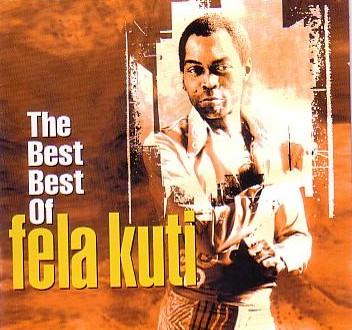
Fela Anikulapo Kuti: The Best Best of Fela Kuti


Born in 1938 in Nigeria to a minister father and a teacher/political activist mother, Fela Kuti turned to music whereas his three siblings studies medicine.  He lived for periods in London and Los Angeles before returning to his home country and creating a blend of funk,soul, jazz, and traditional Nigerian music, which he called "Afro-Beat."  By the early 1970s, Fela hit on a formula in which albums generally consisted of two side-long tracks that had long instrumental introductions with a tight rhythm over which Fela, on saxophone or keyboards, and other musicians in his "Nigeria 70", later "Africa 70" and "Egypt 80" ensemble played extended solos and vamps.  Vocalising usually involved Fela's chanting and singing of highly politicized lyrics while backup singers followed in a call-and-response mode.

The content of Fela's songs were direct satires on the follies of decades of African colonialism and, while they frequently targeted the colonizers, especially religions like Christianity and Islam, they also attacked Nigeria's military and civilan despots and Westernized Africans, including women who asserted rights that were not traditional in Nigeria or Africa generally.  The relentless funky grooves of the music and the incendiary lyrics became Fela's famed calling card. 

Unfortunately, political and military authorities were enraged by songs like "Zombie," "Sorrow, Tears and Blood," "Coffin for Head of State," and "Army Arrangement," and threw Fela in jail several times and destroyed his self-proclaimed "Kalakuta Republic" commune.  In one instance, his aged mother was tossed through a window and later died from her injuries.  Unbowed, Fela continued to issue his pointed musical jeremiads well into the 1990s.  Developing complications from AIDS, however, the musician died in 1997.  As is so often the case, Fela remained relatively unknown in this country until a musical celebrating his life and music, simple called "Fela" was produced in 2008 and just recently ended a run at the Ahmanson Theater in Los Angeles.

This blogger first heard Fela's music in 1990 with the recently-released recording "ODOO" on Shanachie Records.  Like most of his recordings, there were the two side-long tracks.  The title track, spelled out as "Overtake Don Overtake Overtake" and the other piece "CBB (Confusion Break Bones)" follow the time-honored formula referred to above and the album quickly became a favorite, though Fela's last few years featured very little recording or live performance.  While the running times are 31 and 29 minutes, respectively, the hypnotic rhythms and beats, as well as the exciting extensive soloing are highly effective in mitigating the length.  If a listener has spent time with Indian ragas, classical symphonies, or longer jazz performances, then there should be little problem with Fela's awesome extended Afro-beat pieces.

While devotees would champion the individual albums with their unedited tracks, the two-disc "Best Best of Fela Kuti," issues by Universal in 2000 provides a valuable overview of his career from 1972 to 1989, albeit with edited versions in most cases.  The set is crammed full at 158 minutes and has the virtue of a tracklisting picked by Fela's son Femi, who has had his own notable career.  From "Lady" to "ODOO", the album covers some of the greatest songs in Fela's career. 

Highlights for this listener are "Roforofo Fight," "Zombie," "ITT," "No Agreement," and "Shuffering and Shmiling," though, truthfully, all of the thirteen selections are great and, with two essays and annotations to the pieces in the booklet, "Best Best" provides a solid overview of the career of one of the world's greatest performers. 

Fela Kuti:  The Best Best of Fela Kuti

CD1

1.  Lady
2.  Shakara
3.  Gentleman (Edit)
4.  Water No Get Zombie (Edit)
5.  Zombie
6.  Sorrow, Tears and Blood
7.  No Agreement (Part 2)

CD2

1.  Roforofo Fight
2.  Shuffering and Shmiling (Part 2)
3.  Coffin for Head of State (Part 2)
4.  ITT (Part 2)
5.  Army Arrangement (Part 2)
6.  ODOO (Edit)

Thursday, March 15, 2012

Hüsker Dü: Zen Arcade


That was a great record-buying day way back when, going to the record store (remember those?) and picking up two double-LPs from the standouts of the local independent "punk" (well, mostly) label SST.  One, to be covered here soon, was Minutemen's awesome Double Nickels on the Dime and the other was Hüsker Dü's staggering Zen Arcade. 

The record is a concept album about a young man from a troubled home life trying to make sense of a confusing world as he ventures out on his own and some of its most intense songs directly reference the struggles at home, with titles like "Broken Home, Broken Heart," "Indecision Time," "Beyond the Threshold," "Pride," "I'll Never Forget You,"The Biggest Lie," and "What's Going On."  Side Two of the LP is the most powerful with some of the above songs blasting through in roughly two-minute bursts of rage punctuated by guitarist Bob Mould's anguished, tortured vocals and blistering solos.  Drummer Grant Hart provided a milder touch with such songs as "Never Talking to You Again," which has acoustic guitar from Mould rather than his trademark electric work, "Standing by the Sea" which juxtaposes ocean sounds with lyrics of alienation and isolation, and "The Tooth Fairy and the Princess," which has to be the most unlikeliest title of a song from a "punk" band.

That's part of the great success of Hüsker Dü, though, in that the songwriting differences between Mould and Hart provided a balance and widened the band's appeal.  While eventually those differences led to acrimony and a bitter breakup, the yin and yang aspect of their relationship proved to be really effective on Zen Arcade and the few albums that followed.

But, to this listener, the key to the band was just as often the very solid, effective and grounding bass of Greg Norton.  He didn't write many songs, do many vocals, or solo, but Norton's steady anchoring was essential to Hüsker Dü's impressive run through some of the best music of the Eighties.  Now, a restaurant owner and part-time musician, Norton's presence only grew as subsequent albums were produced, engineered, and mixed in a way that presented his work better.  Mould and Hart were justifiably lionized for their songwriting, but Norton was just as essential in making it all come together.

Zen Arcade garnered so much attention and interest that SST struggled to produce enough records to keep up with the demand, an issue that eventually led the band to sign with major Warner Brothers.  Complaints were uttered about the production quality and sound, but it is worth noting that the band proudly proclaimed on the liners that "everything on the record is first take," excepting two songs.  Moreover, "the whole thing took 85 hours, the last 40 hours straight for mixing."

The "punk" ethos is there in the lightning fast production of this low-budget album on a small label operating on a shoestring, but that explains a lot of what makes this record so great.  The Hüskers were coming into their own, churning out powerful songs (with a little piano and acoustic guitar along with the heavier, faster pieces) that showed the growth of Mould and Hart's songwriting, as well as Norton's important contributions, and they were on a roll that lasted a few more great years. 

They had been an underground hardcore band from Minneapolis, but this album made by the shore at Redondo Beach turned them into nationally and internationally-known figures in short order.  More than a quarter century later, it doesn't sound dated and its power and passion remain undimmed.  Zen Arcade is an essential document from the mid-1980s.

Tuesday, March 13, 2012

Albert Ayler: Spiritual Unity

In the so-called world of "avant-garde" or "free" jazz, there was probably no one freer than tenor saxophonist Albert Ayler.  Born in Cleveland in 1936, Ayler first developed professionally in Europe, where he had served, as so many jazz musicians did, in the military.  His earliest recordings came out of Denmark and, in 1964, he returned to New York and formed a trio with bassist Gary Peacock (best known for his work in the Keith Jarrett trio, specializing in standards, with the renowned pianist and the remarkable drummer Jack DeJohnette) and drummer Sunny Murray, who may have been the freest drummer in jazz, coming first to attention with Cecil Taylor.  Ayler was hailed for his innovations by John Coltrane, who was clearly influenced by the former in his work, especially from the 1965 album Meditations onward, and by the sadly underappreciated Eric Dolphy, who said Ayler was the best sax player he knew.

Their 1964 album, Spiritual Unity, the first release of the iconoclastic ESP-Disk label, is a fantastic document of Ayler's self-described "energy music."  Freed of dependence on chord changes and standard timekeeping, the trio was an example of how absolute freedom (well, outside of the basic head or melody statement offered in a given piece) can work when the players are sympathetic to each other as well as independently playing whatever moves them on their instrument.

Peacock manages to provide a foundation without a steady rhythm or pulse, but his playing does keep the sound anchored, even as explores a wide tonal range on the bass.  Murray, eerily humming or moaning throughout, which adds an air of mystery, foreboding, or a strange feeling of joy (depending on the listener's take) also employs a great variety of percussive elements, none of it involving rolls, hard cracks of the snare, or aggressive ride cymbal playing.  Instead, he plays impressionistically and uses seemingly all parts of his kit, especially a spreading cymbal sound, to create with Peacock lots of space for the leader's playing.  For something this "free" the rhythm section is amazingly grounded without being restricted to a defined sense of time.

Ayler, as he nearly always did, dominates the proceedings, largely because of his massive, powerful sound on the saxophone, assisted by the hardest plastic reed he could get.  This not only allowed him tremendous volume, but an expansive vibrato that made his playing instantly recognizable (not that this was considered a good thing by many.)  Known as an intensely charismatic, spiritual and eccentric person, Ayler was convinced that he was on a God-given mission to change the world through music.  This might not have seemed that "far out" in the "far out" Sixties, but the sheer conviction he possessed is palpably heard in his music, especially on Spiritual Unity, where he finds the right compatriots to craft his message.


Ayler's most  well-known composition, "Ghosts," is given two variations here, the second twice as long as the first (and Ayler soloing for much longer than on the first version), and it is the best example of his approach of using simple melodies, seemingly drawing from spirituals, pre-1930 New Orleans-style jazz, marches, and rural folk, to open a piece before launching into the totally free soloing that ran the gamut of expressive honking, screaming, wailing, squealing and, occasionally, a beautiful clear-toned phrase that could remind listeners that Ayler was perfectly capable of playing "in the tradition" if he chose to.

Actually, Albert Ayler was more "in the tradition" than people gave him credit for, if we allow for the fact that "in the tradition" can mean taking earlier aspects of the music, applying new ideas, and then creating a hybrid that celebrates the best of what jazz can be.  Far more than merely high-volume screaming, Ayler crafted a totally unique sound that took "free" jazz to the limits.

At under 30 minutes and because of the empathy among the musicians that was fully realized in the title, Spiritual Unity is probably the best place for the uninitiated to start with Ayler.  While his music is invariably described as "difficult," the best piece of advice on how to listen to it was offered by him and his trumpeter brother, Donald:  try to listen to the sound and not the notes.  In other words, don't get caught up in intellectualizing the music from a structural point of view.  Instead, focus on the emotion embodied in the playing and let it carry you as far as you are willing to go.

For those willing to go along for the ride, the music of Albert Ayler, especially up through 1967 and the album Love Cry, can be a powerful and affecting experience.  Disappointed that his message of music as the harbinger of a new, peaceful age was not reaching larger audiences, Ayler redirected his efforts towards a more commercial sound driven by funk, electric guitar, and "hippie" lyrics and vocals by his girlfriend Mary Parks (known as Mary Maria.)  That proved to be unsuccessful also and, just as Ayler was starting to move back toward the free jazz sound that made his name (if not his fame), he disappeared in November 1970 and was found floating in the East River, a death usually attributed to suicide, though some believe he was murdered or perhaps fell in the river accidentally.

An early death often drives a mystique that can overshadow the work the person did, but in Ayler's case, the work speaks for itself.  A better introduction to that work cannot be found than Spiritual Unity.

Albert Ayler Trio:  Spiritual Unity (ESP-Disk)

1.  Ghosts: First Variation  5:14
2.  The Wizard  7:23
3.  Spirits  6:48
4.  Ghosts: Second Variation  10:02

Thursday, March 8, 2012

Franz Schubert: Die Grossen Symphonien


In 1990, when explorations into various types and forms of music were made by YHB, the world of "classical" was one of those investigated.  Immediately, one of the favored composers emerged:  Franz Schubert (1797-1828), a native of Vienna, who, in a remarkably short period, put forth an enormous amount of great music that was underappreciated in his lifetime, though now he is recognized as truly one of the great composers in history.

Schubert worked in a dizzying array of musical forms in short order:  in about a decade between roughly 1820 and 1830 he wrote nine symphonies, over 600 lieder or songs with vocals, operas, religious works, solo piano, and chamber music.  In fact, Schubert's work with lieder and the fact that his melodic gifts were so pronounced led many critics and others to conclude that he lacked the weight and gravity of such masters as Beethoven or Bach.  Notably, though, Schubert's work might actually be favorably viewed as heir to the work of Mozart, who also had a preternatural gift for melodic invention.

While he is probably best known for his chamber music, including such renowned works as the "Trout Quintet" and "Death and the Maiden," as well as for the lieder, Schubert also created masterpieces in the realm of symphonies, including his "The Great" Symphony in C-Major, or his Ninth, and the Unfinished Symphony, or the Eighth (these and the Seventh were not numbered until decades after the composer's death.)

Today's entry focuses on a somewhat obscure recording of Schubert's Fifth, Eighth and Ninth symphonies along with a few shorter pieces, including the famous devotional chamber work, "Ave Maria."  The 2-CD package was recorded by the Slovak Philharmonic Orchestra and the Slovak Chamber Orchestra, produced by a company in the Slovakian capital of Bratislava, and reissued by a German firm. 

As is with the case with so much of classical recordings, the fact that the orchestras are not considered "top tier" does not at all mean that the playing or recording quality are inferior (at least not to amateur ears such as those belonging to YHB.)  This is great music by a master composer rendered in a beautiful way by high quality orchestras. 

Notably, this package was purchased, along with several others in the series, at, of all places, the Tuesday Morning store several years ago and many hours have been spent thoroughly enjoyed listening to the CDs.  There are certainly dozens, maybe hundreds, of recordings of these major works of Schubert available on a variety of major and so-called "discount" labels.   Most of us, though, would hardly know the difference relative to the performance quality.

In any case, Franz Schubert is among the greatest of composers and certainly at the highest level of what is often referred to as the "early Romantic" period, on par with such luminaries as Mendelssohn, Rossini and Paganini, among others.  While to some, Schubert might not seem as powerful, deep or profound as Beethoven, but for remarkable quality in a sheer variety of a prolific nature, he is one of the most remarkable composers the "classical" world has ever known.